
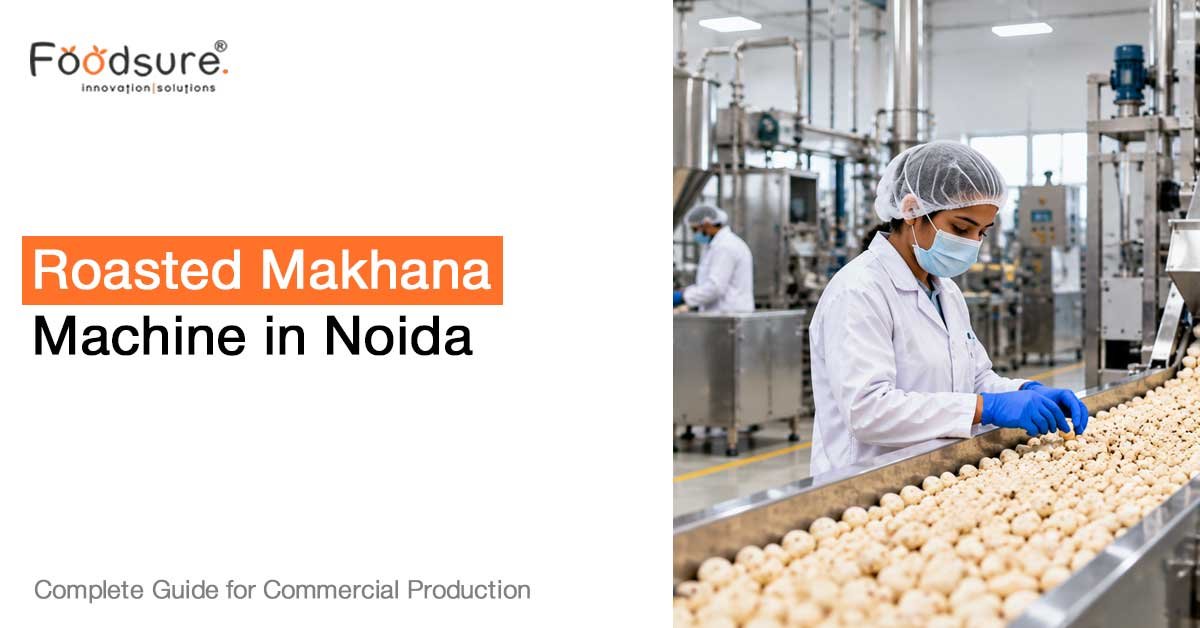
Noida has emerged as a major manufacturing center for food processing firms and snack manufacturers. In light of the increasing demand for healthy snacks, roasted and flavored makhana has emerged as a lucrative product line for manufacturers.
The decision about the right roasted makhana machine in noida for commercial production can assist in ensuring a more uniform roasting process and less manual labor for increased production. The correct machine should be chosen based on requirements for capacity, space, heating system, and automation, among other aspects.
What Is a Roasted Makhana Machine?
The roasted makhana machine is equipment used to roast makhana using controlled process conditions. Compared with manual roasting, industrial machines are able to ensure better heat control and product movement.
A typical roasted makhana production flow can include:
Raw Makhana → Cleaning → Grading → Roasting → Cooling → Flavouring → Packaging
The exact setup varies according to the type of product and how much automation is needed. For a small-scale business, it is enough to have one roasting machine. However, large-scale operations might link roasting operations with others such as cleaning, sorting, seasoning, cooling, and packaging operations.
Why Invest in a Makhana Roasting Machine in Noida?
The increasing demand for packaged snacks is encouraging businesses to move from manual processing towards more controlled production systems. A suitable makhana roasting machine in Noida can offer several advantages for commercial manufacturers.
1. Consistent Roasting
Conditions for roasting have direct bearing on the texture, crispiness, coloration, and quality of the final product of makhana. The control of heat can contribute greatly to achieving uniformity between batches.
2. Higher Production Output
The manual process of roasting coffee may become complicated as the volume increases. With commercial machines, the volume can be managed more easily, enabling companies to increase production without solely relying on the manual process.
3. Reduced Manual Intervention
Automatic or semi-automatic roasting decreases the need for constant monitoring during manufacturing. The operator will be able to engage in other tasks like inspection, seasoning, packaging, and materials handling.
4. Better Process Control
The temperature, roasting time, and motion of the item can affect the product itself. Using commercial equipment helps to control these factors, thus providing for the uniformity of the roasting process.
5. Easier Production Scaling
Companies have the option of choosing machines based on their present requirements, keeping in mind future growth. This is especially relevant for snack foods since these products will have an increasing volume in the future.
How Does a Commercial Makhana Roasting Machine Work?
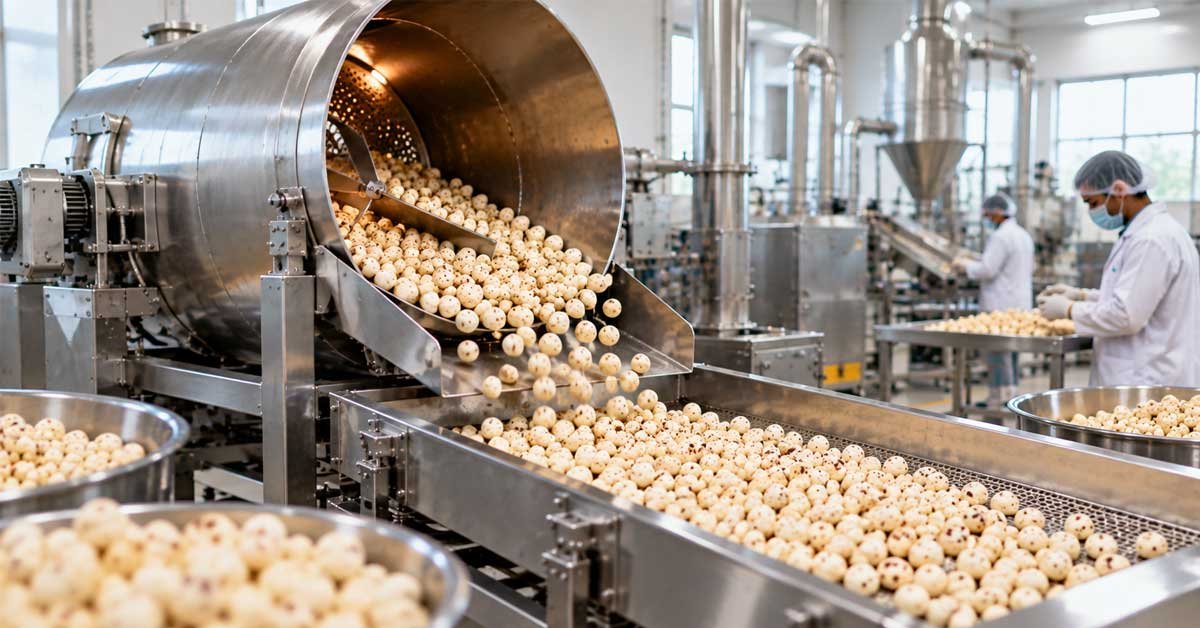
The working process may vary depending on the machine design, heating system, and automation level. However, the basic operation generally follows a controlled roasting sequence.
Step 1: Makhana Preparation
Before roasting, makhana is cleaned and graded to remove unwanted material and separate the product according to the required specifications.
Proper preparation helps ensure that the roasting stage receives a more consistent raw material.
Step 2: Loading
The prepared makhana is added to the roasting process based on the capacity of the machine.
If the machine is overloaded, it may have an impact on the movement and heating of the product; therefore, manufacturers should run the machine within its suitable capacity.
Step 3: Controlled Roasting
The process involves heating the makhana as the product is being moved or agitated in the roasting system. Through controlled operations, the right texture can be obtained.
Step 4: Cooling
After roasting, the product may be cooled before seasoning or packaging. Cooling helps reduce the product temperature and prepares it for subsequent handling.
Step 5: Seasoning and Packaging
However, if the makhana is to be prepared with a variety of flavours, the roasted makhana can be transported to the seasoning/coating system. Thereafter, the makhana can be sent to packaging machines.
Key Features to Look for in a Roasted Makhana Machine
Selecting machines based merely on cost or maximum capacity will result in the wrong choice. The business must examine the machine based on its need for production.
Temperature Control
Temperature regulation is vital for the development of constant conditions during roasting. The equipment must provide the opportunity to control the roasting procedure depending on the desirable properties of the end product.
Uniform Heat Distribution
The equipment is expected to create good heat transfer throughout the product. Unequal transfer will create under-roasting of certain makhana while over-roasting others.
Suitable Capacity
The choice of capacity should be made based on the amount of production. Capacity that is too small may limit production, whereas excess capacity may lead to unnecessary costs.
Food-Grade Construction
Food contact materials must be constructed from proper food-grade materials and must be designed for hygienic processing. They should also be easy to clean and maintain.
Easy Operation
Simple controls and accessible components can make daily operation easier for production staff. Automated controls can also help improve process repeatability.
Easy Cleaning and Maintenance
The design of roasting machines should take into account easy cleaning and inspection. Easy access components may lower maintenance costs and help maintain hygiene during production.
How to Choose a Makhana Roaster Supplier in Noida?
Selecting a reliable makhana roaster supplier in Noida is as important as selecting the machine itself. Businesses should evaluate the supplier’s technical capabilities, machine configuration, installation support, and after-sales service.
Before finalising a supplier, consider:
- Production Capacity Requirement
- Heating System
- Degree of Automation
- Materials for Food Contact
- Power Requirements
- Available Installation Space
- Cleaning and Maintenance
- Installation/Commissioning Support
- Operator Training
- Availability of Spare Parts
- Technical Assistance after Sale
The supplier must have an understanding of the production need before he recommends a machine rather than offering the same configuration to all his customers.
Commercial Makhana Machine in Noida: Which Businesses Need It?
A commercial makhana machine in Noida can be useful for businesses producing roasted or flavoured makhana at different scales.
Small Snack Businesses
Smaller brands looking to enter the packaged makhana industry can go for machinery that suits their current level of production.
Growing Food Brands
Businesses experiencing increasing demand may require higher-capacity roasting equipment to reduce production bottlenecks and improve consistency.
Contract Manufacturers
Food companies making makhana under various brand names could find the equipment useful in handling commercial production and changing products frequently.
Large Food-Processing Companies
Established manufacturers may integrate roasting machinery with cleaning, grading, seasoning, cooling, and packaging systems for a more automated production line.
Manual Roasting vs Commercial Roasting Machine
| Factor | Manual Roasting | Commercial Roasting Machine |
| Production capacity | Generally limited | Suitable for higher production volumes |
| Process consistency | Depends heavily on operator | More controlled |
| Labour requirement | Higher | Lower manual intervention |
| Temperature control | More difficult to standardise | Better process control |
| Scalability | Limited | Easier to scale |
| Production monitoring | Continuous manual attention | Can be automated or semi-automated |
This is subject to the production level required and other considerations in the organization. For low volumes, manual methods might be used, while commercial equipment would be more feasible as production levels rise.
Factors to Consider Before Buying
Businesses should evaluate the complete production requirement before purchasing a roasting machine.
Production Capacity
Estimate the required output per hour or per day. This provides a better basis for selecting machine capacity.
Heating System
Consider whether the machinery requires electricity, gas or other suitable means of heating. Availability of utilities and needs must be assessed before the machinery is installed.
Available Space
Measure the production area and account for operator movement, material handling, cleaning, and maintenance access.
Energy Requirements
Manufacturers should evaluate the machine’s power or fuel requirements and consider operating costs along with the initial investment.
Automation Level
The use of semi-automation and full automation can minimize manual intervention, but automation must be based on the need for production.
Maintenance Support
The availability of spare parts and technical assistance can have a significant impact on long-term machine performance.
Integrating Roasting into a Complete Makhana Processing Line
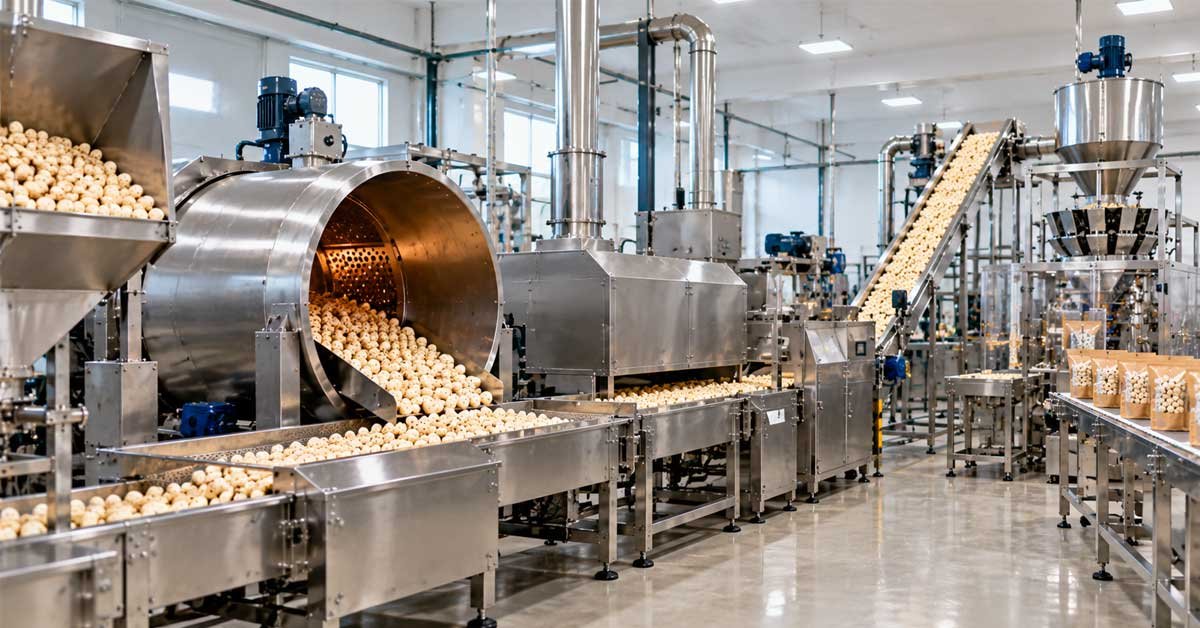
Roasting is only one stage of commercial makhana production. Businesses planning larger operations may integrate the roasting machine with other processing equipment.
A typical line may include:
Raw Makhana Receiving
↓
Cleaning
↓
Grading
↓
Roasting
↓
Cooling
↓
Seasoning / Flavouring
↓
Packaging
↓
Finished Product Storage
Integrating different stages can reduce unnecessary manual handling and create a more organised production workflow.
Other business organizations that are comparing machines from other areas may consider the use of a Makhana Roaster Machine in Jharkhand.
Maintenance and Hygiene of Makhana Roasting Equipment
Proper maintenance is a vital aspect of dependable commercial production. Operators must adhere to the recommended maintenance procedure as outlined by the manufacturer of the machinery.
Maintenance ought to be done in an appropriate manner, especially for the parts that come into contact with food. Accumulation of product residue in the machine must be avoided.
Routine checks may include:
- Heating system inspection
- Cleaning of product contact surfaces
- Inspection of moving parts
- Electrical connections inspection
- Inspection of control panel
- Inspection of fasteners and components
- Lubrication as required
- Machine Cleaning
Proper maintenance can reduce unexpected downtime and help maintain consistent roasting performance.
Why Choose the Right Roasting Equipment?
The right equipment can influence production efficiency, product consistency, labour requirements, and long-term operating costs.
A machine that can satisfy the production requirements is useful to ensure consistency in roasting as well as increasing capacity. However, buying the machine based on its low cost may lead to some limitations on the capacity, high maintenance needs, or problems in the process of expansion.
For this reason, it is important for manufacturers to take into account the production requirements in total.
Conclusion
Making an investment in a suitable roasted makhana machine in noida will help food manufacturers roast consistently, be efficient in their production processes, minimize manual handling, and create a scalable makhana processing business.
Prior to buying a machine, firms should consider its capacity, heating system, temperature control, automation, food-grade construction, energy needs, available space, maintenance, and technical assistance.
The makhana roaster supplier in Noida should also be able to advise on equipment based on the manufacturing needs of the equipment rather than just machine capacity.
Businesses that plan on engaging in larger-scale operations will benefit from incorporating the roasting process with other pieces of equipment used for cleaning, grading, seasoning, cooling, and packaging. With the right machinery and processing procedures in place, the production of roasted makhana will be viable.
Frequently Asked Questions
What is a roasted makhana machine used for?
The Makhana Roasted Machine is meant to be utilized in roasting makhana in a controlled heat process. The roasted makhana machine is an invention meant for more efficient processing than manual roasting.
How do I choose the right makhana roasting machine in Noida?
Think about your production capacity requirements, heating system, level of automation, space available, energy consumption, cleaning requirements, and after-sales technical support before you choose the machine.
Is a commercial makhana machine suitable for small businesses?
Yes. Small firms have the freedom to opt for smaller capacity machines depending on their needs of production. It is usually better to opt for capacity depending on production needs than purchasing bigger capacity machines.
Can a roasting machine be integrated with other makhana-processing equipment?
Yes. Depending on the process setup, there are cases where the roasting machine is combined with cleaning, grading, cooling, seasoning, and packaging machines to make the process smoother.
What should I check before selecting a makhana roaster supplier?
Check the supplier’s machine settings, production capacity, quality of construction, installation help, operator training, availability of spare parts, maintenance support, and technical assistance.




