
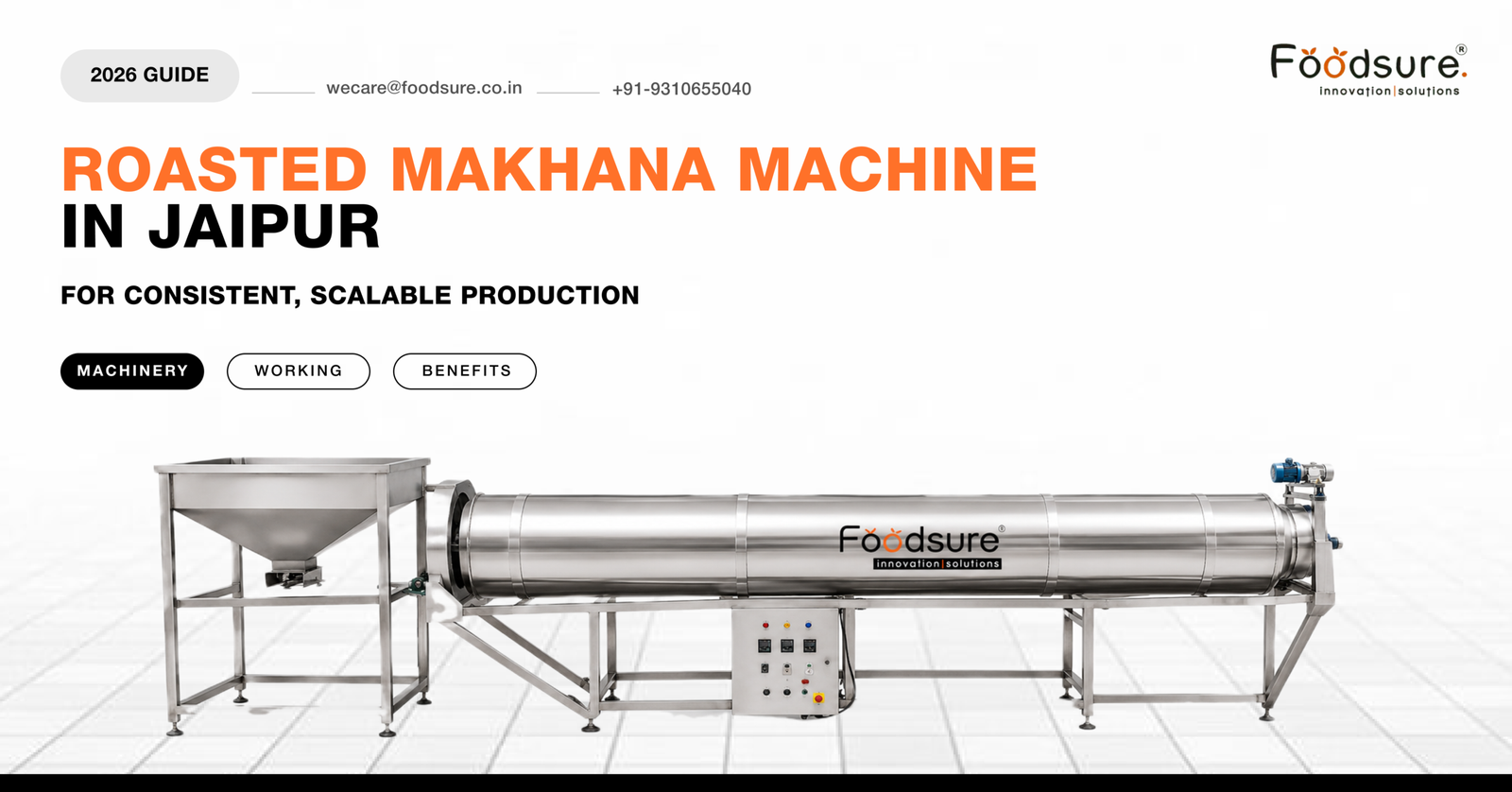
Roasted makhana is gaining attention in India’s packaged snack market, creating opportunities for businesses that want to manufacture flavoured fox nuts for retail stores, distributors and online customers. For entrepreneurs in Jaipur, investing in a roasted makhana machine can help improve production consistency, manage repetitive processing tasks and prepare the business for larger orders.
The opportunity is supported by developments in India’s makhana sector. According to the Department of Agriculture and Farmers Welfare, Government of India, as reported by the Press Information Bureau, India’s makhana production reached 63,910 metric tonnes in 2024–25. The department’s second advance estimate for 2025–26 puts production at 80,590 metric tonnes. The latest figure is an estimate rather than a final production result. Read the Press Information Bureau’s update on makhana production.
For businesses in Jaipur, the challenge is converting raw makhana into a consistent, market-ready snack. Manual roasting can produce variations in colour, texture and crispness, particularly when batch sizes increase. A properly configured roasting machine helps operators control heating and repeat the process more consistently.
A commercial roasted makhana machine in Jaipur may form part of a processing line that includes grading, roasting, flavour coating, cooling and packaging. Buyers can choose semi-automatic equipment for more hands-on control or an automatic system for greater integration, depending on their production requirements and expansion plans.
Why Are Businesses in Jaipur Investing in Roasted Makhana Machines?
Businesses entering the makhana market need equipment that can support product consistency without making the production process unnecessarily complicated. Moving from manual roasting to machine-based processing can offer several operational advantages.
Uniform product quality
Manual roasting depends heavily on the operator’s experience and ability to maintain suitable heating conditions. A roasting machine helps standardize the process through controlled heating and consistent product movement. The final quality still depends on raw material condition, batch size and operating settings.
Higher production capacity
Manual processing can become difficult to manage when orders increase. Commercial roasting equipment is available in different capacity configurations, allowing businesses to select a machine according to their expected production volume.
Buyers should distinguish between rated machine capacity and actual finished output. Loading, unloading, cleaning and downstream processing can affect the quantity produced during a working shift.
Better process control
Semi-automatic machines can provide temperature controls that help operators maintain consistent roasting conditions. More advanced configurations may use programmable logic controllers (PLCs) and touchscreen interfaces to monitor and adjust selected operations.
The appropriate control system depends on the machine configuration. A PLC should not be assumed to be part of every automatic model.
Reduced manual intervention
A roasted makhana processing machine can reduce repetitive work involved in roasting, product movement and flavour coating. The number of operators required depends on the automation level and whether grading, coating and packaging are integrated into the same production line.
Easier production scaling
Businesses can start with a machine that suits current demand and expand their setup as orders grow. However, increasing roasting capacity alone will not increase finished output if the coating or packaging stage becomes a bottleneck.
For this reason, buyers should evaluate the complete processing workflow rather than selecting equipment based only on its maximum rated capacity.
Key Features to Look for in a Roasted Makhana Machine
Selecting the right machine involves more than comparing prices. Businesses should examine the heating system, construction materials, operating controls, capacity and support available from the manufacturer.
1. Temperature control
Temperature control helps operators maintain repeatable roasting conditions and reduce variations in product colour and texture.
Foodsure Machines’ published roasting machine specifications describe digital temperature controls, a PID controller, safety cut-offs and customizable hexagonal or circular drums for its roasting equipment. The suitable temperature range and configuration should be confirmed for the specific machine being purchased.
2. Suitable production capacity
Capacity should match the expected quantity of raw makhana processed per hour. Foodsure’s published makhana machinery information includes configurations around 50 kg/hr and other capacity options, depending on the equipment selected.
Before ordering, ask whether the quoted capacity refers to raw material input or finished product output. Also confirm whether the machine is designed for batch processing or continuous operation.
3. Food-contact materials
Food-contact surfaces should be suitable for food processing and accessible for cleaning. Stainless steel SS 304 is commonly used in food processing equipment because of its corrosion resistance and suitability for many food-contact applications.
Check which machine components are made from SS 304. The entire machine body may use different materials depending on the design, so do not assume every component is stainless steel unless the manufacturer confirms it.
4. Semi-automatic or automatic operation
A semi-automatic setup may suit businesses that want more direct control over selected stages. An automatic line can integrate more operations and reduce manual handling, depending on its configuration.
Compare the actual features offered rather than relying on the automation label alone. Ask which stages require manual intervention and which are controlled automatically.
5. Flavour coating and packaging compatibility
Roasted makhana may be sold plain or in flavours such as peri-peri, cheese, pudina and other seasoning variants. A suitable coating system helps distribute seasoning across the product.
Packaging equipment should be selected according to pack sizes, production targets and the product’s shelf-life requirements. Nitrogen flushing may be considered where suitable, but packaging performance and shelf life depend on the product, packaging material and validated process.
6. After-sales support
Installation assistance, operator training, spare parts and maintenance support are important when machinery is used for commercial production.
Before placing an order, confirm the warranty, installation scope, expected delivery time and service arrangements with the supplier.
How Does a Roasted Makhana Machine Work?
The processing sequence depends on the level of automation and the equipment included in the production line. A typical roasted makhana manufacturing process involves the following stages.
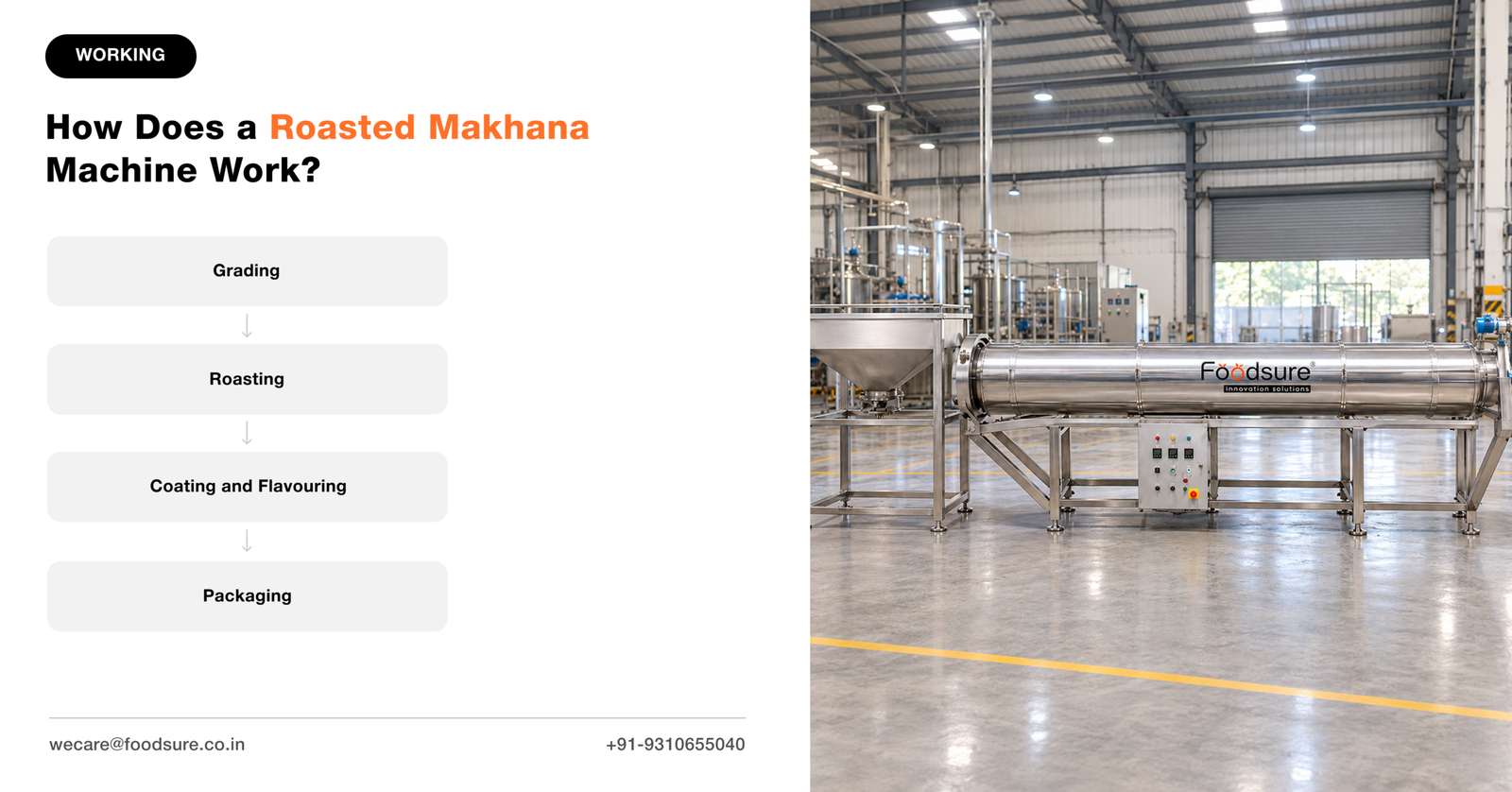
1. Grading and sorting
Raw or popped makhana is sorted according to size and quality requirements. Grading helps separate different sizes and remove unsuitable material before subsequent processing. Depending on the setup, this stage may use a grading machine, manual sorting or a combination of both.
2. Roasting
The makhana enters the roasting machine, where heat is applied under controlled operating conditions. A rotating drum helps move the product through the heated chamber.
Operators adjust the process according to the raw material, desired texture and machine specifications. Trial runs help establish suitable operating conditions for consistent results.
3. Flavour coating
After roasting, the makhana can be transferred to a coating drum or seasoning system. Oil and seasoning are applied according to the recipe and desired flavour profile.
The coating method, mixing time and ingredient quantities influence flavour distribution and product consistency.
4. Cooling
Coated makhana is cooled before packaging, where required by the process. Adequate cooling helps prevent excess condensation or product sticking during packing.
5. Packaging
The finished product is packed into the selected pouch or container. Packaging may be manual, semi-automatic or automatic depending on production requirements.
For businesses looking for an integrated setup, Foodsure’s makhana machine range includes equipment options for roasting, grading, flavour coating and packaging. The exact combination should be selected according to the required capacity and product specifications.
Capacity and Selection Guide for a Roasted Makhana Machine
The choice between semi-automatic and automatic equipment depends on production targets, budget, labour availability and plans for future growth.
| Production setup | Suitable for | Key consideration |
| Semi-automatic, around 50 kg/hr | New businesses, small manufacturers and entrepreneurs testing demand | More hands-on operation and a lower level of process integration |
| Semi-automatic, around 50–100 kg/hr | Growing businesses supplying local retailers and distributors | Balance between production volume, manual work and investment |
| Automatic, around 100 kg/hr or more | Established processors with higher-volume orders | Greater process integration, utilities and downstream capacity requirements |
These are planning categories, not a guarantee of output from every model. Actual capacity depends on the equipment configuration, raw material, product specifications and operating conditions.
How much does a roasted makhana machine cost in Jaipur?
The cost depends on capacity, automation, heating method and the number of processing stages included in the quotation.
For preliminary budgeting, businesses may compare indicative estimates of ₹15–20 lakh for a semi-automatic setup and ₹22–23 lakh for a more integrated automatic setup. These figures should be treated as budget estimates rather than verified current market prices.
Foodsure’s published makhana machinery listing displays a listed price of ₹14.5 lakh per unit for certain equipment configurations, with a price-on-request option. Specifications and prices vary across listings, so buyers should obtain a current quotation for the exact machine and scope of supply.
The final project cost may include:
- The roasting machine and any additional processing equipment.
- Grading, coating and packaging systems.
- Electrical installation and utility requirements.
- Freight, installation and operator training.
- Initial spare parts and maintenance provisions.
A complete quotation makes it easier to compare suppliers on the actual scope of supply rather than the headline machine price.
Biggest Challenges and Solutions for Roasted Makhana Production in Jaipur
Even when demand is promising, makhana processors need to manage several practical challenges to maintain product quality and production efficiency.
1. Inconsistent quality from manual roasting
Manual roasting can produce variations in colour, crispness and texture because heating conditions and product movement may differ between batches.
Solution: A properly configured roasted makhana machine helps standardize heating and product movement. Operators should establish suitable settings through trials and monitor the finished product for consistency.
2. High labour and time requirements at scale
Manual processing becomes harder to manage as batch sizes and order volumes increase. Additional workers may be required for roasting, flavouring, sorting and packing.
Solution: A semi-automatic or automatic processing line can reduce repetitive tasks. The actual staffing requirement depends on how many stages are automated and how material is transferred between machines.
3. Choosing the right investment level
First-time buyers may struggle to decide whether to invest in semi-automatic or automatic equipment. A lower initial price may be attractive, but manual handling can limit future throughput.
Solution: Calculate the expected daily output and cost per kilogram of finished product. Compare the initial investment, operating expenses, staffing needs and expected order volume before selecting a machine.
4. Managing electricity and utility requirements
The power requirement can vary considerably between roasting equipment and a complete processing line. Buyers who consider only the roaster may underestimate the electrical load of conveyors, coating systems and packaging equipment.
Solution: Ask the manufacturer for a complete utility schedule, including connected load, voltage, phase requirements and any compressed-air or heating requirements. Have the installation requirements checked before ordering.
5. Maintaining hygiene for retail production
Retail buyers expect consistent products manufactured under suitable hygiene and handling conditions. Poor cleaning practices or unsuitable material handling can create quality and contamination risks.
Solution: Select equipment with appropriate food-contact materials, accessible cleaning areas and a design suited to the product. Follow a documented cleaning schedule and applicable food safety requirements throughout production.
Benefits of Using an Automated Roasted Makhana Machine
A well-selected machine can improve several aspects of commercial production.
- Quality consistency: Controlled heating and repeatable settings help reduce batch-to-batch variations.
- Higher production potential: Equipment designed for commercial processing can handle larger quantities than many manual setups.
- Labour management: Automation can reduce repetitive handling and allow operators to supervise multiple production activities.
- Hygienic processing: Suitable food-contact materials and cleanable equipment support better sanitation practices.
- Better production planning: Standardized processes make it easier to schedule batches, estimate output and manage inventory.
- Room for expansion: A modular processing line can be expanded as demand grows, provided the connected equipment can support the increased output.
Actual improvements in labour, output, energy use and product yield should be measured during production trials. These figures help businesses determine whether the proposed equipment delivers a suitable return on investment.
How to Choose the Best Roasted Makhana Machine in Jaipur
The best machine is not necessarily the largest or most expensive one. It is the machine that fits your current production requirements and allows practical expansion as your business grows.
Before purchasing, evaluate the following factors:
- Expected production capacity in kilograms per hour.
- Semi-automatic or automatic operation.
- Total investment, including installation and training.
- Electrical load and other utility requirements.
- Food-contact materials and cleaning access.
- Temperature controls and available automation features.
- Compatibility with grading, flavour coating and packaging equipment.
- Ease of operation and technical manpower requirements.
- Supplier experience and documented product specifications.
- Warranty, spare parts availability and after-sales support.
- Maintenance requirements and operating costs.
- Product trial results and the quality of finished makhana.
Ask the supplier to demonstrate the machine using your intended raw material wherever possible. Compare throughput, finished product quality, energy consumption and rejected product under similar operating conditions.
Also confirm whether the supplier can support the full processing line or only individual machines. This is particularly important when you intend to expand from roasting into flavoured snack manufacturing and retail packaging.
Why Choose Foodsure Machines for a Roasted Makhana Machine?
Foodsure Machines offers makhana processing equipment for businesses looking to develop or expand their roasted snack production. Its published machinery range includes roasting equipment and options for grading, flavour coating and packaging, allowing buyers to discuss configurations suited to their production needs.
When evaluating Foodsure for a roasted makhana machine in Jaipur, consider the following:
Capacity options: Discuss the expected production volume and select a machine configuration that matches your requirements. Confirm the rated capacity and practical output for the specific model.
Process control: Review the available temperature controls, drum configuration and heating method to understand how the machine can support your roasting requirements.
Food-contact construction: Confirm the materials used for product-contact surfaces and the cleaning arrangements available on the selected equipment.
Processing line integration: If you plan to manufacture flavoured makhana, discuss whether grading, coating, cooling and packaging equipment should be included in the project.
Installation and support: Ask about installation, operator training, warranty coverage, spare parts and after-sales service before finalizing the order.
Rather than selecting equipment based only on price, compare the full scope of supply and the production requirements the machine is expected to meet.
Planning a makhana processing business in Jaipur? Contact Foodsure Machines to discuss your production targets, preferred automation level and machinery requirements. Request a model-specific quotation and technical specifications before making your investment decision.
Frequently Asked Questions
1. What is the suitable production capacity for a small-scale makhana business?
A machine rated around 50 kg/hr may be a starting point for some small-scale businesses. The appropriate capacity depends on daily demand, operating hours, batch size and the amount of manual work involved in other processing stages.
2. How much does a semi-automatic roasted makhana machine cost in Jaipur?
The cost depends on capacity, heating method and machine configuration. An indicative budget of ₹15–20 lakh may be used for preliminary planning, but buyers should obtain a current quotation that specifies the machine, installation, training and any additional equipment included.
3. Can an automatic roasted makhana machine handle seasonal changes in demand?
An automatic machine can help manage larger production volumes when demand increases, provided the equipment is correctly sized. Raw material availability, staffing, packaging capacity and order scheduling must also be considered.
4. What is the difference between a commercial makhana machine and a makhana making machine?
A commercial makhana machine may refer to equipment for a specific stage, such as roasting, grading or flavour coating. A complete processing line combines multiple stages to prepare finished products for packaging and sale.
5. What is the annual maintenance cost of a semi-automatic or automatic makhana machine?
There is no single annual maintenance cost applicable to every machine. Expenses depend on operating hours, equipment complexity, replacement parts, servicing requirements and the availability of manufacturer support. Ask the supplier for a recommended maintenance schedule and an estimate of routine service costs.
6. What is the difference between a roasted makhana machine in Jaipur and one in Kolkata?
The basic roasting process is the same. The differences buyers should evaluate are the machine specifications, supplier experience, delivery arrangements, installation support and after-sales service available for their location.
7. Which material is suitable for a commercial roasted makhana machine?
SS 304 stainless steel is commonly used for food-contact surfaces in food processing equipment. Buyers should verify the material specifications for the product-contact components and confirm that the design supports appropriate cleaning and sanitation.
8. Can I manufacture flavoured makhana using the same processing line?
Yes, a suitable production line can combine roasting with flavour coating, cooling and packaging. The required equipment depends on the seasoning recipe, production volume and packaging format.
9. What should I check before buying an automatic makhana machine?
Review the rated capacity, actual output, automation features, power requirements, food-contact materials, cleaning access, warranty and after-sales support. A product trial can help verify whether the machine meets your production requirements.
10. How can I get a quotation for a roasted makhana machine from Foodsure?
Share your expected production capacity, preferred automation level, product requirements and installation location with Foodsure Machines. Request the technical specifications, itemized quotation, delivery terms and details of installation and after-sales support.




