

Makhana is now becoming quite popular in India as a snack, especially roasted and flavored makhana. Since demand is growing, food manufacturers want to get dependable equipment for roasting the makhana in large quantities without compromising on the texture and color of the product.
For those who produce processed snacks in Madhya Pradesh, having a roasted makhana machine in Bhopal will go a long way in ensuring that the roasting process is efficient and not entirely reliant on manual processing. Whether you have a small business or a big one, the proper roasting machine can come in handy.
What Is a Roasted Makhana Machine?
A roasted makhana machine in Bhopal is food-processing equipment designed to roast makhana uniformly under controlled heating conditions.
The traditional process of roasting could require a lot of manual labor, and differences in the roasting process may be seen from one batch to another. The use of commercial roasters gives proper control over heating and movement of the products. The design of the machine depends on many factors.
Why Is Makhana Roasting Important?
Roasting is one of the vital processes involved in making ready-to-eat makhana. Good roasting has an effect on the texture, crispiness, appearance, and quality of the end product.
Consistent roasting is vital for commercial producers because inconsistency may affect the quality of the product.
A suitable roasting system can help with:
- More uniform roasting
- Better process control
- Reduced manual intervention
- Higher production capacity
- Consistent product texture
- Improved production flow
- Easier integration with downstream processing
How Does a Makhana Roasting Machine Work?
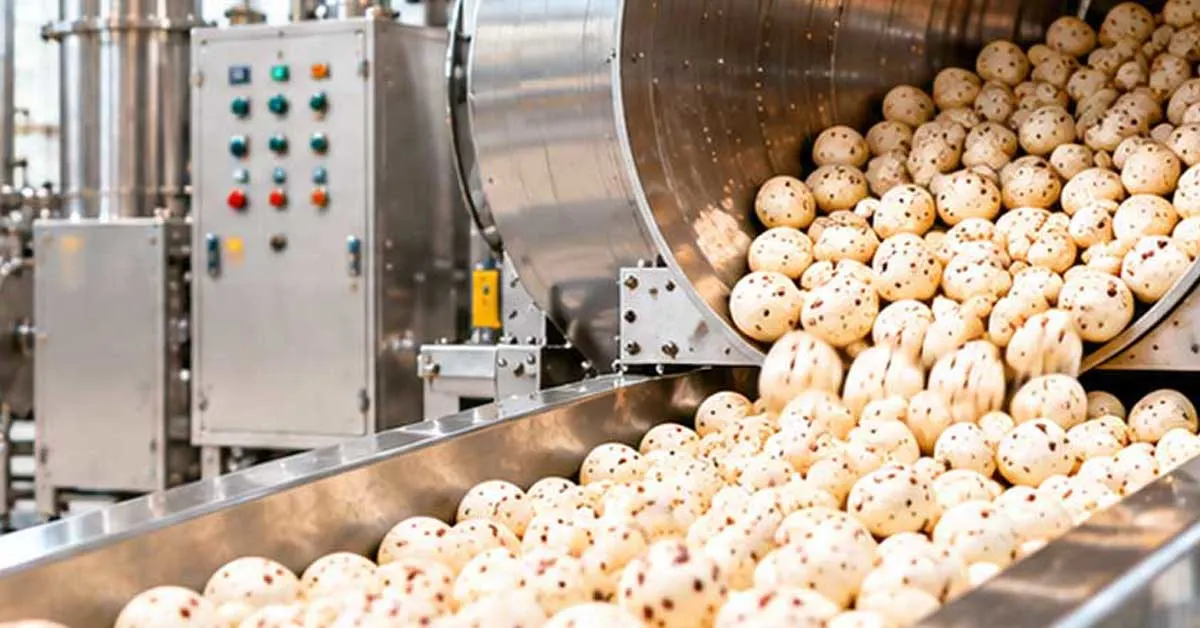
The main principle behind the operation of the machine is heating along with the right movement of the product. The raw or processed makhana is fed into the machine, where it undergoes heating.
The movement of the product ensures even distribution of heat, while the operator keeps an eye on the process as per the roasting specifications.
A simplified commercial roasting flow is:
The exact process may vary depending on the machine design and the product requirements.
Features of Makhana Roasting Equipment in Bhopal
Businesses looking for makhana roasting equipment in Bhopal should evaluate the machine according to their production requirements rather than focusing only on price.
1. Controlled Heating
A suitable machine should provide controlled and stable heating for more consistent roasting.
2. Uniform Product Movement
Proper product movement helps expose the makhana to heat more evenly and can reduce under-roasted or over-roasted pieces.
3. Commercial Production Capability
The selection of the equipment should be done according to the needed production capacity. The equipment meant for commercial purposes is able to handle larger quantities of production.
4. Hygienic Construction
Food-contact surfaces should be made from suitable materials and designed for routine cleaning and maintenance.
5. Easy Operation
Operators should be able to control and monitor the roasting process without unnecessary complexity.
6. Integration with Other Equipment
It would be best if the roaster was well integrated into other parts of the processing equipment such as cleaning, grading, flavoring, and packaging.
Commercial Makhana Roasting Machine in Bhopal
A commercial makhana roasting machine in Bhopal is particularly relevant for businesses producing roasted makhana at larger volumes.
Commercial equipment will assist in minimizing manual effort and creating a more controlled process for production. It depends on how the business operates whether the roasted goods will go into bulk packing or even continue with further processes like seasoning and packing.
It is essential that the amount of production of the business is known beforehand when choosing the equipment. This will ensure that there is no wastage in the production process.
Manual Roasting vs Machine Roasting
| Factor | Manual Roasting | Machine Roasting |
|---|---|---|
| Labour requirement | Higher | Lower |
| Heat control | More variable | More controlled |
| Batch consistency | Operator dependent | More consistent |
| Production volume | Limited | Higher |
| Process monitoring | Manual | Systematic |
| Scalability | Limited | Better suited to commercial production |
Manual roasting may remain practical for very small operations, but businesses handling larger quantities generally need more organised production methods.
Benefits of Using a Roasted Makhana Machine
Investing in suitable roasting equipment can provide several operational benefits.
1. Consistent Roasting
Controlled heating and product movement can help maintain more consistent roasting across batches.
2. Higher Productivity
The machine is able to roast more than is possible with the traditional hand-roasting method.
3. Reduced Manual Work
Automation reduces repetitive handling and allows operators to focus on monitoring the production process.
4. Better Product Uniformity
More consistent processing can help manufacturers maintain similar texture and appearance between batches.
5. Easier Production Scaling
Businesses can select equipment according to current production requirements and add capacity as demand increases.
6. Improved Production Flow
This dedicated step for roasting is one that could easily work with the rest of the equipment.
How to Choose the Right Roasting Machine in Bhopal
Selecting the right machine requires consideration of several technical and operational factors.
Production Capacity
Establish how many makhana need to be roasted in an hour. The capacity should depend on both present and future production needs.
Heating System
The heating system should provide suitable control and consistent heat distribution for the intended product.
Construction Material
Food processing equipment must use suitable hygienic materials for construction, particularly those parts coming in contact with the product.
Automation Level
It will be up to the firm to determine whether they need manual, semi-automatic, or automatic operation, depending on labour availability and output.
Available Space
The machine footprint, feeding area, discharge area, and maintenance access should all be considered before installation.
Maintenance Requirements
Equipment should be easy to inspect, clean, and maintain. Regular maintenance helps support reliable operation and minimise unexpected downtime.
Makhana Roasting in a Commercial Processing Line
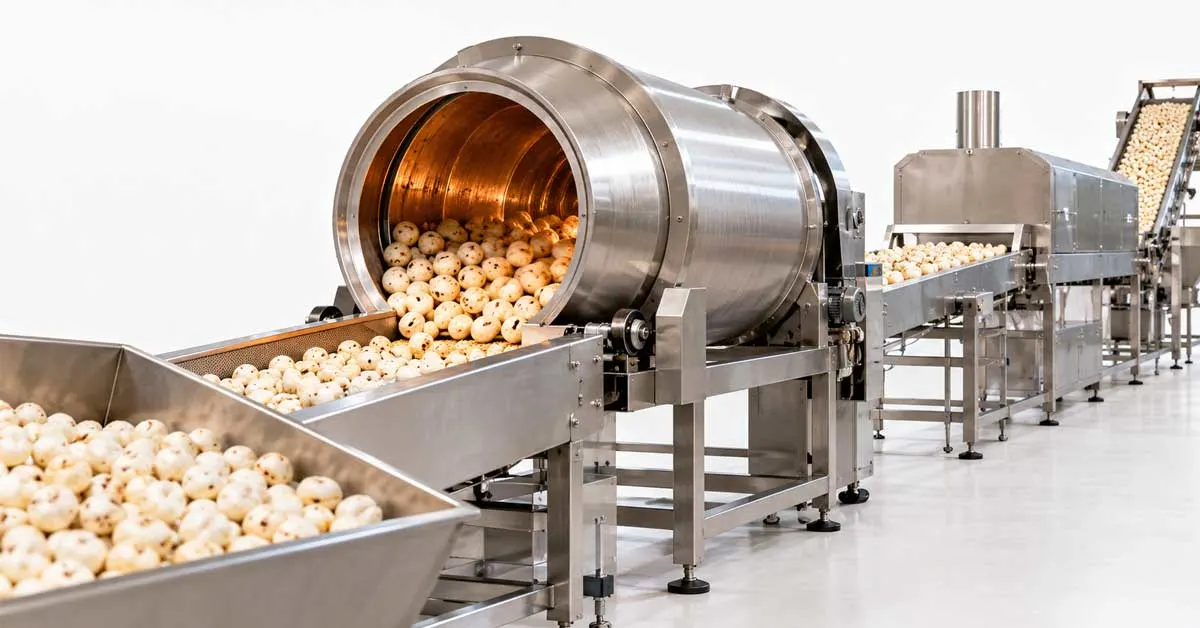
Roasting is generally one part of a larger makhana processing setup. A commercial line may include multiple stages depending on the final product.
A typical flow can be:
All businesses do not necessarily need all stages. For instance, a business manufacturing roasted makhana in bulk may require different machinery from another business packaging flavoured makhana for retail.
Businesses planning a complete setup can also evaluate the best makhana processing machine in Madhya Pradesh based on production capacity, machine configuration, technical support, and suitability for their specific processing requirements.
Hygiene and Maintenance
It is very important to keep the processing machines clean on a regular basis. Makhana pieces and other seasoning residues may stick to the machines if they are not maintained properly.
Basic maintenance practices include:
- Cleaning the machine after production
- Removing accumulated product residues
- Inspecting heating components
- Checking moving parts
- Monitoring unusual noise or vibration
- Inspecting electrical connections
- Following the manufacturer’s maintenance schedule
A preventive maintenance programme can help identify potential problems before they lead to production interruptions.
Who Should Invest in a Makhana Roasting Machine?
A roasting machine can be useful for businesses that are moving from small-scale production towards commercial processing.
Potential users include:
- Makhana processors
- Roasted snacks producers
- Flavored makhana producers
- Food processing companies
- Packed snacks brands
- Bulk makhana suppliers
- Businessmen developing an already existing food processing plant
The appropriate machine depends on the intended production volume, product range, available investment, and future expansion plans.
Role of the Machine Supplier
Choosing a proper supplier is one of the crucial steps in machinery investment. The company must consider the construction of machines, technical specifications, installation support, operator needs, maintenance support, and after-sales services.
The supplier must know about the particular needs of makhana processing and cannot supply roasting machines without taking into account the nature of the product.
Prior to finalizing any machine, the buyer must inform the supplier about his expectations in terms of capacity, space, heating, automation, and further processing.
Future Scope of Makhana Processing in Bhopal
The increasing need for nutritious and handy snacks can provide opportunities for makhana manufacturers in Bhopal and other regions of Madhya Pradesh.
Businesses can explore different product categories, including:
- Plain roasted makhana
- Flavoured makhana
- Premium packaged makhana
- Bulk roasted products
- Private-label snack products
- Institutional supply
As businesses move towards organised food processing, machinery can play an important role in improving production consistency and supporting larger volumes.
Conclusion
A roasted makhana machine in Bhopal can help food businesses improve the efficiency and consistency of commercial makhana roasting. The process of roasting using a roasting machine involves controlled heating, systematic product flow, and minimal manual effort, which makes it ideal for companies.
When selecting makhana roasting equipment in Bhopal, businesses should consider capacity, heating control, construction, automation, available space, maintenance, and integration with the rest of the processing line.
For growing manufacturers, choosing the right commercial makhana roasting machine in Bhopal can support consistent production while providing a foundation for future expansion into flavoured and packaged makhana products.
Have a Question? Let’s Connect
Need expert guidance on food processing machines, production setup, or process optimization? Our team is ready to help you choose the right solution for your business.
Frequently Asked Questions
What is a roasted makhana machine used for?
A roasted makhana machine is used for roasting the makhana through heating processes and enables manufacturers to achieve uniformity in the quality of roasting.
Is a commercial makhana roasting machine suitable for small businesses?
Yes, provided that the machinery capacity is adequate for the manufacturing needs of the business. Growing businesses need to consider the size and capacity of machinery based on their present capacity and growth plans.
What should I consider when buying makhana roasting equipment?
Key considerations include production capacity, heat source, building materials, degree of automation, size of machines, maintenance needs, and compatibility with other manufacturing equipment.
Can a makhana roasting machine be integrated into a complete processing line?
Yes. Depending on the setup, roasting equipment can be connected with cleaning, drying, grading, cooling, flavouring, and packaging stages.
How can businesses maintain a makhana roasting machine?
Regular cleaning, inspection of the heating and moving parts, electrical connection checks, removal of product accumulation, and adherence to the manufacturer’s maintenance schedule can ensure good machine operation.




