
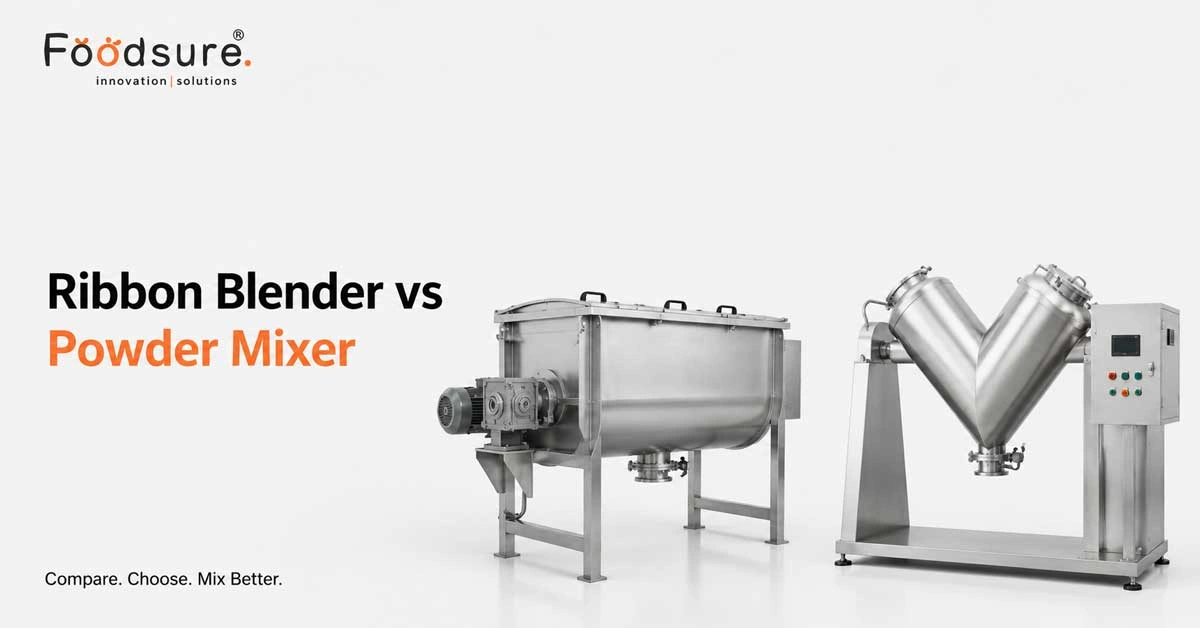
It is crucial to choose a Ribbon Blender or a powder mixer before moving towards a complete mixing system because this decision plays a significant role for all Food, Nutraceutical, Chemical, and Ingredient Manufacturers. Both machines have a similar purpose in blending dry ingredients, but the methods used, function, applications, effectiveness and product-friendliness vary in multiple cases. Manufacturers in almost every industry often feel confused when it comes to selecting a mixer between a ribbon blender and Powder Mixer, as both seem to have the same working mechanism.
However, this leads to Comparison anxiety among customers as they’re unable to decide the machinery class that best suits their demands and manufacturing capabilities.
If a mistake is made in selecting the right machinery, then they will suffer from irregular and improper mixing along with increasing running costs. Some criteria depend on the Ribbon Blender versus the Powder Mixer, for example, the attributes of your ingredient, composition of your powder, size of batch, production speed, and the degree of homogeneity your final product requires in order for your production system to be efficient. In this guideline, you’ll find a list of comparisons of these mixing technologies based on their unique and main functions as well as applications, so it might make it a bit simpler for you to pick the best one out for your requirement.
Difference between ribbon blender and powder mixer
Before purchasing the equipment, manufacturers are advised to understand the differences between the working mechanisms of a Ribbon Blender vs Powder Mixer. Although both pieces of equipment are utilized for dry material blending, they function uniquely and are designed with different operating and application principles in relation to the applications. Ribbon blenders are primarily used for blending different product types such as granules & powders used during the process for making several types of products.
Powder mixer machines, in contrast, are employed as specialized and finely adjusted mixing equipment for a wider product application range. Machine selection is based on physical attributes of ingredients such as chemical reactions, blend proportion ratios & specific application to meet customer-required final product specifications.
Working Principle Comparison
The operating principle leads to factors such as product mixing quality, product uniformity, working efficiency, production period, etc. Learning the operating principle of these two devices can enable the operators to choose the proper one in line with the situation.
| Parameter | Ribbon Blender | Powder Mixer |
|---|---|---|
| Mixing Mechanism | Helical ribbon agitator rotates inside chamber | Paddle, screw, or customized mixing system |
| Mixing Action | Moves material horizontally in opposite directions | Provides controlled and gentle powder blending |
| Suitable Materials | Powders, granules, spices, dry ingredients | Fine powders and sensitive formulations |
| Mixing Accuracy | Suitable for general blending applications | Suitable for precision mixing |
| Application Areas | Food, seasoning, bakery, supplements | Nutraceutical, pharmaceutical, specialty powders |
Buyers Remain Confused While Choosing The Mixing Equipment
Most of the buyers face the issue of getting confused between a Ribbon Blender and Powder Mixer due to both performing similar operations. Wrong selection of a mixer category may impact the product quality and efficiency as well as the return on investment. Knowing some common problems of choosing helps the manufacturer find a way out of it.
Mixers Are Used For Mixing Dry Ingredients
Both the Ribbon Blender and Powder Mixer are generally used for dry ingredients, powders, and blends, which results in common operation for both types of machines. Due to the fact that both types of machines have several similar uses, buyers face several difficulties while identifying them. A better understanding of ingredients along with the process helps a buyer.
Buyers Look Only For Production Capacity
Many manufacturers choose the required machine only after looking for the necessary output. When deciding on the mixer specification, the material property is totally ignored. Similar production capacity may require two different machines if the density, particle size, and the percentage moisture content are different. This may bring down the efficiency of the mixer along with the quality of the product.
A Variety of Mixer Designs Confuses Buyers
Manufacturers have a large range of mixer specifications, models, and designs that may make it difficult for a newcomer to choose the appropriate mixer. It can be complicated to have multiple options and customisations when all that a manufacturer needs is just the right mixer at the right price
Ribbon Blender Applications In Food Processing
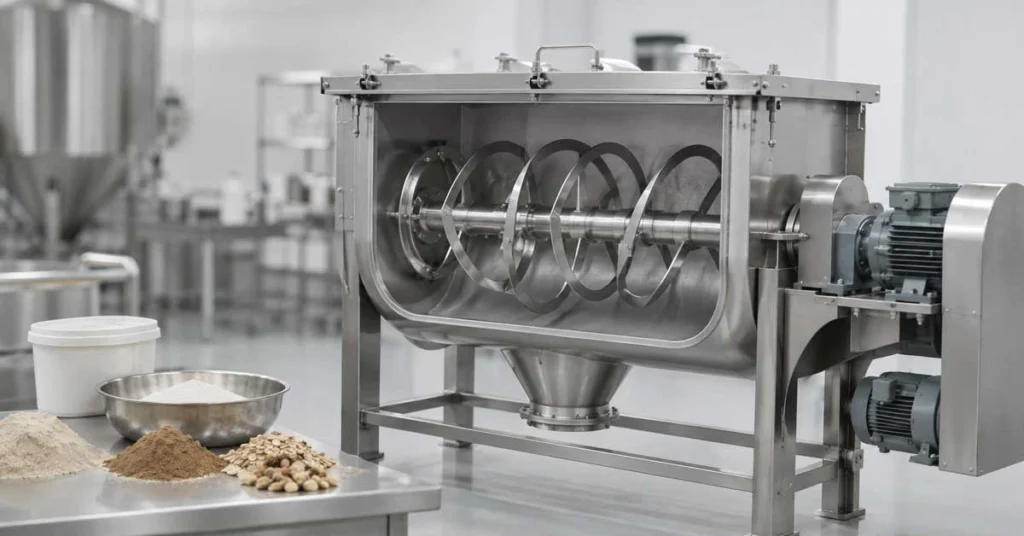
Ribbon blenders are highly useful in food industries where a thorough blend of dry ingredients is needed. Ribbon blenders offer a horizontal configuration, which helps in thorough mixing of materials in a horizontal chamber. These machines are highly effective for any manufacturer who seeks an economical and robust mixing system.
Spice Powder Mixing
Ribbon blender ensures that both ingredients and spices, etc. Blend evenly. The internal and external ribbons cause continuous movement of product to prevent irregular ingredient concentration. Hence, used at spice mixing unit and producing consistent quality.
Protein Powder Mixing
Ribbon blender blends protein with additives and flavor agents. Gentle mixing action of ribbon blender retains the quality of the product. Used by nutritional food manufacturers and functional food manufacturers.
Bakery Ingredients Mixing
Bakery manufacturers use ribbon blenders to blend flour, sugar, cocoa, etc. The product obtained is consistent throughout, and there is no uneven concentration; used in bakery and food ingredients manufacturers.
Powder Mixers For Manufacturing
Powder mixers are suited for applications where controlled and accurate mixing of powders is important. They are preferable where ingredients are sensitive, or where formulation control is important to maintain ingredient ratios and create accurate formulations; these applications are relevant to industries where precise control of the composition of a product is necessary.
Vitamin, Mineral and Nutrition Powder
Nutritional supplement manufacturers can achieve accurate distribution of vitamins, minerals, and nutrients through a precisely controlled mixing process to produce consistent product quality, ensuring ingredient segregation will not occur during production.
Active Ingredient Mixing (Pharmaceutical)
Highly precise mixing systems are essential for accurate mixing of formulations in the pharmaceutical sector, with controlled operation to ensure homogeneous distribution of active ingredients. These systems are desired for applications where an accurately controlled blend is required.
Specialized Fine Powder Processing
Fine powders can sometimes segregate; powder mixers offer the controlled, sensitive processing required so that characteristics of the powder are not lost or altered and the product is a highly consistent fine powder-based product suitable for use in many manufacturing operations.
Ribbon Blender vs Powder Mixer Selection Flow Chart
The proper selection process starts by knowing not only the properties of the manufactured products but also the objectives and production purposes. Considerations relating to raw materials, mix requirements, and capacity would then guide a producer in their decision on appropriate machinery
Understanding each ingredient in your recipe will significantly improve the mixing processes. By considering the ingredients’ factors before buying equipment, you are in a better position to enhance your mixing processes and avoid many of the operational issues that can hinder the long-term success of production. The following flow diagram illustrates what this step-by-step approach would entail.
Key Factors for Selecting A Mixer
When selecting mixing equipment, a range of technical and commercial factors need to be addressed to allow businesses to select the best Ribbon Blender vs Powder Mixer depending on their own manufacturing specifications.
Ingredient Properties
The characteristics of the raw materials are essential in the selection of the mixer. Particle size, density of solids, moisture levels, and flowability are some examples that will influence the choice between a Ribbon Blender and Powder Mixer to achieve optimal results. Analysis of the ingredients is an important process in preventing ingredient segregation and ensuring consistency of the end product.
Production Capacity
The required amount of the product to be manufactured should take into account the actual size of the batch required and planned business expansion. Selecting an appropriate machine size will increase operational efficiency, lower operational costs, and ensure smoother operations. Equipment that is either too large or too small will negatively influence productivity and the investment needed.
Mixing Accuracy
Various food products need different degrees of blending precision. Standard food powders are suitable to be run through a Ribbon Blender, whereas highly controlled nutrient or pharmaceutical powders will require a Powder Mixer to achieve suitable production levels. Correct mixing accuracy will ensure better quality of the end product.
Cleaning and Maintenance Requirements
Food processing equipment should be designed for ease of cleaning and routine maintenance. They should be constructed to minimize contamination risks and meet food safety criteria. Easy accessibility to parts of the machine will reduce downtime when performing routine maintenance and cleaning.
Future Production Growth
Manufacturers should look beyond the current needs to estimate future production volumes before buying any equipment. Investing in a mixer that can satisfy the increasing production needs at a later stage will help avoid costly machine replacement. This also ensures greater operational flexibility.
Ribbon Blender vs Powder Mixer Table Comparison
By looking at the technical features between the two machines, manufacturers will learn that there is more to understand before choosing the best equipment for their production process. Below, a few of the biggest differences between a Ribbon Blender vs Powder Mixer are provided.
| Feature | Ribbon Blender | Powder Mixer |
|---|---|---|
| Best Application | General dry powder and granule mixing | Precision powder blending |
| Mixing Method | Horizontal ribbon agitation | Paddle, screw, or customized mixing |
| Mixing Accuracy | High for general applications | Very high for sensitive formulations |
| Batch Capacity | Small to large industrial batches | Small to medium precision batches |
| Cleaning | Easy cleaning and maintenance | Depends on machine configuration |
| Investment | Economical | Higher for specialized applications |
This comparison table shows both machines meet the different requirements of food manufacturing. Selecting the right equipment for each of your specific production purposes depends not just on how much each machine will fit into your production space but also on the quality and type of your products and your company’s growth strategy.
Foodsure Machines Industrial Mixing Solutions
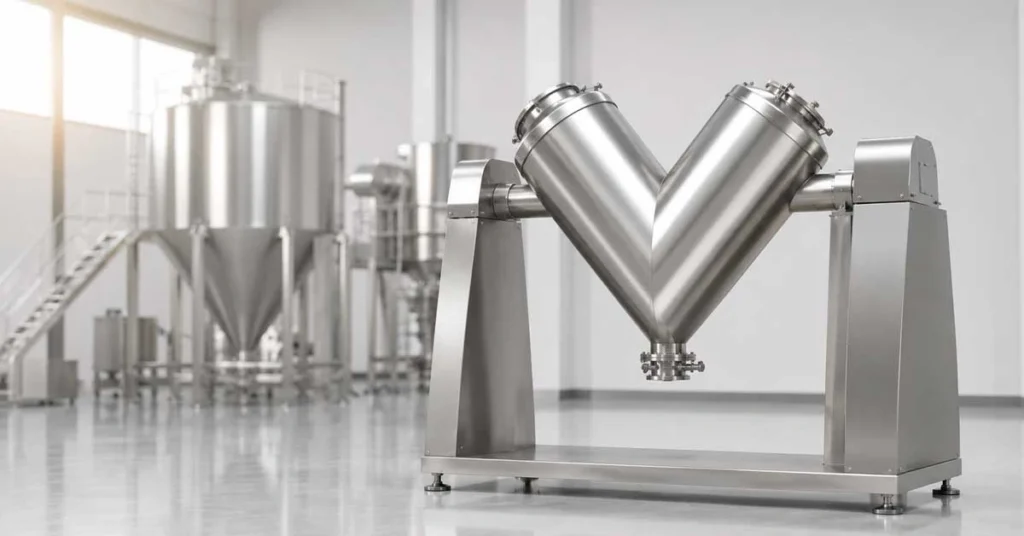
Foodsure Machines provides total industrial mixing solutions to food processing, nutraceutical, and ingredients manufacturing businesses. Foodsure Machines designs specific mixing systems that help companies maximize operational efficiency, product quality consistency, and long-term system reliability.
Foodsure Machines services include:
Customized Mixer Design
Foodsure Machines designs ribbon blender and powder mixers to specifications based on the product attributes and process parameters of manufacturing operations. The custom-engineered mixing solutions are tailored to maximize mixing efficiency, product consistency, and operational performance.
Machine Selection Assistance
With expertise in designing tailor-made machines, Foodsure Machines helps manufacturers select Ribbon Blender vs Powder Mixer the most appropriate machine to meet the manufacturer’s production capacity, ingredients, and application needs. Effective selection helps the manufacturer get effective performance from the investment in mixing machines.
Full Installation & Commissioning
Foodsure Machines can also provide full installation and commissioning services for new production line equipment to ensure that every machine performs at its best and meets the production requirements before the commercial manufacturing process starts.
Factory Layout Design
For optimum material flow, machine integration, and overall manufacturing workflow, Foodsure Machines also offers assistance with creating an effective production factory layout to support precise and hygienic food manufacturing.
Operator Training & Technical Support
To develop technical expertise and capability on operator skills, Foodsure Machines provides operator training on how to use the machine and clean and maintain the machine properly. It helps manufacturers promote their operational performance and minimize operational errors.
After Sales Service & Machine Maintenance
A committed after-sales service by the technical team of Foodsure Machines offers maintenance support and troubleshooting assistance, ensuring the optimal performance of machines with minimal downtime for ongoing production. Spare parts and technical guidelines are also available for troubleshooting operations and to minimize downtime during maintenance. Using high-tech engineering and expertise, Foodsure Machines helps manufacturers maximize mixing efficiency and production consistency, and minimize potential hazards.
Conclusion
The choice between a Ribbon Blender and Powder Mixer hinges on several key factors: properties of your ingredients, desired level of mixing uniformity, overall production capacity requirements, and product application. Choosing an appropriate type of industrial mixer-whether a ribbon blender for overall blend or a powder mixer for precisely controlled operations-can enhance productivity, ensure quality consistency, and optimize long-term operating costs. With the right investment, driven by an understanding of each mixer’s unique capabilities, businesses in Foodsure Machines’ key client sectors can implement truly efficient and productive industrial mixing systems.
Frequently Asked Questions (FAQs)
What is the main difference between Ribbon Blender vs Powder Mixer?
Ribbon blenders are typically designed for the general blending of dry ingredients, whereas powder mixers are manufactured to give controlled, precisely defined, and thorough mixing, especially with fine powder materials and sensitive products for specialized uses.
What industries utilize ribbon blenders and powder mixers?
Industrial mixing machines are used in: Food Industry, Nutraceutical Industry, Pharmaceutical Industry, Chemical Industry, Bakery Industry, Spice Industry, Nutritional Supplement Industry
Ribbon Blender vs Powder Mixer: How do I select one?
To select the best model for your operations, consider: ingredient composition, desired uniformity (mixing precision), production capacity, total batch volume, and end product application (finished product requirements)
Does Foodsure Machines customize industrial mixers?
Absolutely! Foodsure Machines custom-builds both Ribbon blenders and Powder Mixers based on client production capacity, product types, and overall factory needs.
Which mixer is preferable for making food powder?
The choice of mixer for a specific food powder depends on its characteristics. Ribbon blenders work well for food powders that require only general mixing, but powder mixers deliver more precision for sensitive formulations and unique finished products.




