
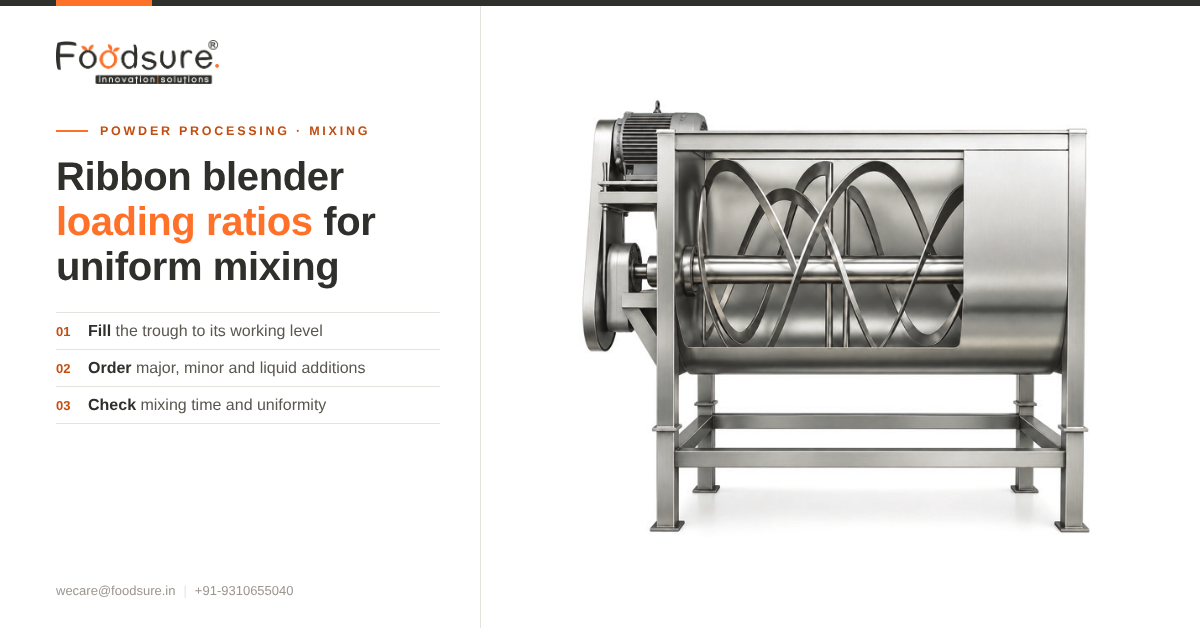
The powder mixing efficiency depends on some variables like the material used, the mixing time, the blender, and the quantity of materials to be loaded in the blender. In this instance, the ribbon blender loading ratio is just one such variable.
A ribbon blender is commonly employed in industries like food processing, spices, nutraceuticals, chemical processing, and others that deal with dry powders and granules. The horizontal U-shaped blending tank and rotating ribbon blender are constructed in such a way that the materials are moved in multiple directions.
But still, even an efficient machine will not be able to give efficient results if the loading process is not done properly. Underloading will decrease the efficiency of ribbon movement, while overloading will limit the circulation of the materials.
In case of manufacturers intending to create a new production line, knowing the proper loading ratio will help in achieving consistent mixing processes. This will help in making proper decisions in the selection of the ribbon blender machine, comparison of equipment specs, and the estimation of investment needed for a commercial powder processing plant.
What Is a Ribbon Blender Loading Ratio?
The ribbon blender charging ratio indicates the amount of material charged in the blender in relation to the total volume of the blender. The ribbon blender charging ratio is mostly analyzed in terms of a percentage of the volume of the blender.
The basic formula is:
Loading Ratio (%) = (Material Volume ÷ Total Blender Volume) × 100
For example, if a blender has a total chamber volume of 1,000 litres and the material occupies 600 litres, the volumetric loading ratio is 60%.
The calculation is used to show the degree of occupation of the chamber while mixing. However, the volume of the chamber is not necessarily equal to the volume of work that is recommended by the manufacturer.
The loading range for a particular blender will depend on the design, ribbon shape, material properties, and mixing needs. Thus, any loading ratio must be taken in relation to the manufacturer’s guidelines.
Loading Ratio vs Batch Capacity
Loading ratio and batch capacity are related, but they are not interchangeable.
- Loading ratio indicates the proportion of the chamber occupied by the material.
- Batch capacity by volume refers to the volume of material processed in one batch.
- Batch capacity by weight refers to the mass of material processed in one batch, commonly expressed in kilograms.
- Working volume is the usable volume recommended for the intended mixing operation.
It is significant because two powders taking up the same space can weigh very differently from each other.
For instance, a light premix and a heavy mineral powder can both fill 500 litres of space yet weigh vastly differently. The blender has to be appropriate for both the amount of space and the weight of the material.
Why Is the Correct Ribbon Blender Loading Ratio Important?
Choosing the correct loading ratio is vital to ensuring that the materials are able to be processed in the mixing chamber. This factor is essential in determining efficiency, consistency, and repeatability.
1. Improved Mixing Uniformity
The ribbons transport the material inside the chamber via axial and radial movements. This process facilitates the distribution of ingredients in the batch.
If the loading ratio is appropriate, it becomes easier for the material to pass through the active mixing zone. This facilitates even distribution of both major and minor ingredients.
An inappropriate loading ratio may prevent movement or limit the efficiency of the mixing process, leading to concentration differences in the batch.
2. Better Distribution of Minor Ingredients
Many powder formulations used in industries are mixed with a few colorants, flavors, vitamins, minerals, enzymes, and various functional ingredients.
There is a need for even mixing of these elements with the rest of the base powder. Poor loading will complicate this process significantly when there is a difference in the size, density, or characteristics of the particles.
The proper loading ratio together with the right ingredient-addition sequence will help in making good conditions for the mixing of minor ingredients.
3. Efficient Use of Equipment
Using the blender at an optimal loading level allows the manufacturer to utilize the chamber space efficiently without limiting the movement of the material.
Processing very small loads in a big machine repeatedly could lead to inefficient processing. On the other hand, loading too much material could lead to increased mechanical strain and poor mixing.
Optimizing the batch size will help balance production and utilization of the equipment.
4. Reduced Batch-to-Batch Variation
The same loading ratio allows for more consistent operating conditions to be set up. When there is a large variation in batch size between two separate production cycles, there will also be variations in mixing performance.
By standardizing the batch volume/weight, companies can create consistent operating practices and quality outcomes.
5. More Predictable Production Planning
Loading ratio affects the amount of material that can be treated in one loading cycle. After knowing the available working volume and the bulk density of the material to be treated, the company can determine an approximate batch weight for manufacturing.
This is especially true when dealing with companies that manufacture spice mixes, bakery premixes, nutritional powders, and the like.
What Is the Ideal Ribbon Blender Loading Ratio?
No loading ratio will serve all ribbon blenders and powder formulations. This depends on the manufacturer’s design parameters, the ribbon configuration, the materials used, and the mixing quality needed.
The supplier of the machine may give the minimum and maximum volumes that the machine will operate in. They should be more important than industry-wide assumptions.
Below is a table showing the influence of various loading ratios on mixing. This is generally how the machine will work under normal operating conditions.
| Loading Condition | Potential Mixing Behaviour | Practical Consideration |
| Very low loading | The ribbons may not engage the material effectively throughout the intended mixing zone | Confirm the minimum recommended working volume |
| Moderate loading | Material circulation may be more effective when the formulation and equipment are compatible | Validate uniformity through sampling |
| High loading | Available space for material circulation may become restricted | Check ribbon clearance, motor load, and mixing results |
| Overloading | Material movement may be restricted, and mechanical load may increase | Stay within the manufacturer’s specified capacity |
A moderate loading level can be a useful starting point for trials, but the correct setting must be validated for the specific machine and product.
Why Maximum Capacity Is Not Always the Best Choice
In some instances, the choice of a blender is solely based on the maximum capacity indicated by the manufacturer. Nevertheless, the maximum chamber capacity does not automatically mean the optimal operating capacity of the powder in question.
If a powder has poor flow characteristics, it will act in a different way compared to a free-flowing granular powder. In the same way, a formulation with low amounts of valuable components might need better process validation.
The aim is to establish a loading capacity that will give satisfactory results in terms of mixing and equipment performance.
Factors That Affect Ribbon Blender Loading Ratio
The loading ratio should be selected according to the material being mixed rather than using the same setting for every product.
Powder Bulk Density
Bulk density is the mass of the material per unit of its bulk volume, which includes the space between particles.
Light powders take up more space in the chamber for a certain mass, whereas heavy powders take up less space. This means that the effective batch weight can be very different depending on the material used.
The bulk density of the material mixture should be used by manufacturers wherever possible.
Particle Size and Distribution
Variations in particle sizes may cause a difference in the movement of the powder, as well as segregation. Fine powders may stick to the walls or agglomerate, while bigger particles might act differently when circulated.
The loading ratio that works perfectly with a certain particle-size distribution does not guarantee the same results for another.
Ingredient Density Differences
If there is a considerable variation in density of the ingredients, the mixture may segregate easily when it comes to mixing, discharging, or further handling.
In order to know if the final mixture is homogeneous, one has to consider such factors as the loading ratio, order of adding ingredients, mixing time, and discharge procedure.
Flowability and Cohesion
Flowing powders usually behave in a different way compared to sticky, cohesive or hygroscopic materials. In the case of cohesive powders, one may expect them to get agglomerated or adhere to the chamber wall, thus influencing the material flow.
It is more reasonable for the producers to analyze the equipment itself or the mixing technique than trying to overcome all difficulties through the loading ratio increment.
Ribbon Design and Blender Geometry
These parameters include the diameter of the ribbon, its pitch, clearance, and configuration. The geometry of the chamber and discharge also plays an important role in the movement and evacuation of material.
What is a good loading level for one machine may not necessarily be a good level for another machine, even though the machines may have the same nominal volume.
Mixing Time and Speed
The effect of mixing time and agitator speed will be reflected in the motion and distribution of the components. Nonetheless, extended mixing does not necessarily ensure uniformity.
Overmixing can lead to higher energy usage and can be harmful to some products because of segregation and/or degradation. Appropriate mixing time and speed have to be determined through experimentation.
Common Loading Mistakes and How to Avoid Them
Incorrect loading practices can cause poor mixing, longer processing cycles, unnecessary equipment stress, and inconsistent finished products.
| Common Mistake | Possible Consequence | Recommended Action |
| Filling beyond the recommended working volume | Restricted circulation and increased mechanical load | Follow the supplier’s loading limits |
| Using very small batches in a large blender | Inadequate engagement of material by the ribbons | Confirm the minimum usable working volume |
| Estimating batch weight without checking bulk density | Incorrect capacity calculations | Measure or verify bulk density |
| Changing batch size without revalidating the process | Differences in mixing behaviour | Recheck mixing time and uniformity |
| Ignoring ingredient-addition sequence | Uneven distribution of minor ingredients | Standardise the loading sequence |
| Using mixing time as the only quality measure | Inconsistent batches may go undetected | Use representative sampling and suitable tests |
| Discharging without checking segregation | Product quality may vary during packaging | Validate discharge and downstream handling |
These issues should be assessed as part of the complete mixing process. A loading adjustment alone may not resolve problems caused by unsuitable ingredients, poor ribbon design, or inconsistent feeding practices.
How to Validate a Ribbon Blender Loading Ratio
The most reliable loading ratio is one that produces the required mixing quality consistently under normal operating conditions.
Manufacturers can establish this through controlled trials.
1. Define the Uniformity Requirement
Identify those components that should be well-distributed within the mix and the allowable variation thereof for the final product. It will depend on the formulation and use of the mixture.
2. Establish a Baseline Batch
Start with a batch size within the manufacturer’s recommended operating range. Record the loading volume, batch weight, ingredient sequence, mixing time, and agitator speed.
3. Collect Representative Samples
Collect samples from appropriate sites, and when required, take them at various stages of discharge. One sample may not be adequate for the whole batch.
The sites and method of sampling must be the same to ensure comparability of results.
4. Test Mixing Uniformity
Appropriate analytical technique or validated indicator compound should be used to evaluate the distribution of the constituents. In case of food, nutraceutical, or other regulated applications, the technique should be suitable for the formulation.
5. Compare Different Loading Levels
Where necessary, conduct trials at different loading levels within the permitted equipment range. Keep other variables as consistent as practical so that the influence of loading can be assessed.
6. Document the Results
Record the chosen load ratio, batch weight, mixing time, test results, and operational observations. After validation of the process, incorporate the findings in the SOP. This method ensures creation of a repeatable process, as opposed to visual assessment only.
Ribbon Blender Loading for Different Powder Applications
Different industries use ribbon blenders for formulations with distinct ingredient properties and quality requirements. Loading conditions should be established for the specific application.
Spice and Masala Blending
The masala mixing machine is employed for the mixing of spice powder and seasoning mixes. These formulations can be prepared using ingredients of varying particle size, density, and flow characteristics.
It is essential to keep in mind the minor ingredients’ distribution, aroma retention, powder handling, and segregation upon discharge.
Food Premixes
A premix machine may be applied for blending the ingredients needed in bakeries, beverage powders, seasonings, as well as other dry food formulations.
Sampling and mixing in cases when premixes contain small amounts of functional ingredients is rather important. Working capacity should be sufficient for proper circulation without exceeding the mechanical capabilities of the blender.
Nutritional and Supplement Powders
A supplement premix machine may handle vitamin and mineral blends, protein ingredients, or other nutritional formulations.
The required uniformity can be demanding when active ingredients are present in low concentrations. Manufacturers should validate the batch size, ingredient-addition method, mixing time, and sampling procedure according to the formulation’s quality requirements.
General Industrial Powders
A powder mixer machine may be used for mineral blends, chemical powders, and other dry materials, subject to compatibility with the equipment’s construction and design.
Bulk density, flowability, particle properties, and material handling requirements should all be considered before selecting the loading ratio.
Choosing a Ribbon Blender Machine for Commercial Production
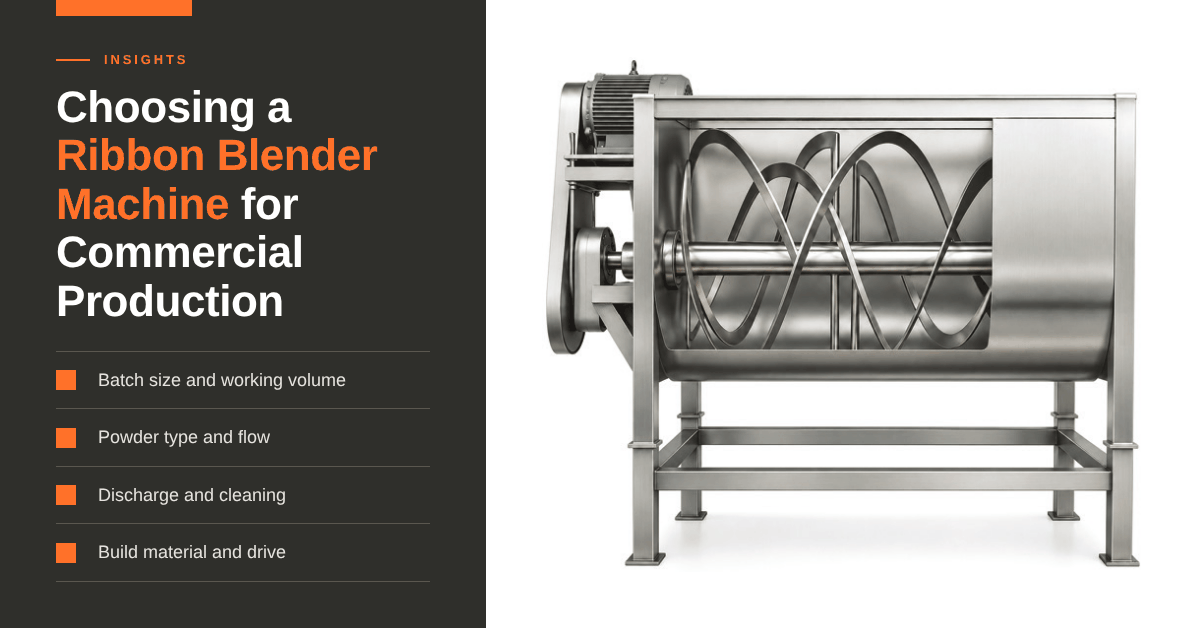
Selecting the right equipment is essential for achieving reliable mixing performance. A ribbon blender machine should be evaluated according to its working volume, batch weight, material characteristics, and intended production output.
Working Volume and Batch Capacity
Consider both the nominal chamber volume and the suggested operating range of the equipment. Check the expected weight of the batch by considering the bulk density of the formula.
Ribbon Configuration
Discuss the ribbon configuration, chamber design, and compatibility with the components you will be blending. The manufacturer should be able to explain what the mixer was designed to do and its capabilities.
Motor and Drive System
The drive system must be suitable for the material load and mixing resistance. Dense or cohesive materials may impose different demands on the machine than lightweight, free-flowing powders.
Discharge Arrangement
The discharge system will affect how the product is removed and may also affect the separation or residue left in the chamber. Think about whether the design will support the necessary batch processing and cleaning.
Food-Contact Materials and Hygiene
For food and nutritional applications, evaluate the materials used on product-contact surfaces, cleanability, and suitability for the intended formulation.
Integration with Packaging
If the blender forms part of a complete production line, consider how the mixed powder will move to downstream equipment. A powder packing machine may be integrated after mixing, depending on the process layout and packaging requirements.
Suitable conveying, storage, and transfer arrangements can help minimise segregation and contamination risks between blending and packing.
Ribbon Blender Price and Premix Plant Cost
The investment required for powder mixing equipment depends on capacity, construction, automation, and the overall production setup.
The ribbon blender price may vary according to chamber volume, material of construction, motor and drive configuration, discharge system, control panel, and additional features.
A complete plant requires a broader assessment. The premix plant cost may include raw material handling, weighing systems, feeding equipment, blending, transfer conveyors, storage bins, sieving, packing, installation, and commissioning.
When comparing equipment quotations, manufacturers should clarify:
- Nominal capacity and suggested capacity to use
- Expected weight per batch of the intended material
- Details of motor and power needs
- Material for construction and contact with product
- Mixing and discharge arrangements
- Maintenance requirements
- Compatibility with preceding and succeeding units
- Training and support
- Availability of spare parts
When evaluating a powder mixer machine manufacturer, consider the supplier’s ability to understand the application and recommend a suitable configuration. The lowest initial quotation may not represent the best fit if the machine’s working volume or construction is unsuitable for the product.
Businesses planning to buy powder mixing machine India should share the expected batch weight, bulk density, ingredients, required uniformity, and production schedule with the supplier.
The phrases ribbon blender loading ratio price, ribbon blender loading ratio manufacturer, and buy ribbon blender loading ratio may also appear in search queries, but the loading ratio is an operating parameter rather than a separate machine or product. Buyers should clarify whether they need a ribbon blender, a replacement component, process guidance, or a complete powder mixing setup.
Conclusion
The ribbon blender loading ratio is an important factor in the industrial mixing of powders as it affects material circulation, mixing efficiency, batch size, and equipment utilization. Underloading and overloading are potential problems, so the right load ratio should be chosen by the manufacturer.
Batch calculations, good handling practices, mixing, and proper sampling techniques lead to the establishment of accurate and reliable operating procedures. The ratio of loading must be assessed taking into account bulk density, ribbon pattern, mixing time, and material properties.
For businesses planning a new powder processing setup, selecting the right ribbon blender machine and working with a capable powder mixer machine manufacturer can help align equipment performance with production requirements. A properly specified blender, supported by process validation and routine quality checks, provides a stronger foundation for uniform and repeatable powder mixing.
Frequently Asked Questions
1. What is the ideal ribbon blender loading ratio?
There is no universal ratio. This is affected by the design of the blender itself, the ribbon arrangement used, material bulk density, and ease of flow. Consult the recommended operating volume as indicated by the blender manufacturer.
2. Can a ribbon blender be filled to 100% of its chamber volume?
It is not appropriate to take the chamber volume in its stated value as the optimum volume for use. The filling up of the chamber will affect the freedom of movement of the materials.
3. How do I calculate ribbon blender batch weight?
Multiply the usable working volume in litres by the material’s bulk density in kilograms per litre. Confirm that the calculated batch weight is within the machine’s rated limits.
4. Does a higher loading ratio improve mixing efficiency?
It does not have to be so. Increasing the loading ratio will enhance equipment efficiency to an optimal operating point, but too much loading will hinder circulation and homogeneity. It all depends on the material and the blender design.
5. Does mixing time depend on the loading ratio?
Yes. Changing the loading ratio can change material circulation and mixing behaviour. Mixing time should be validated for the selected batch size and formulation instead of being assumed constant for every load.




