
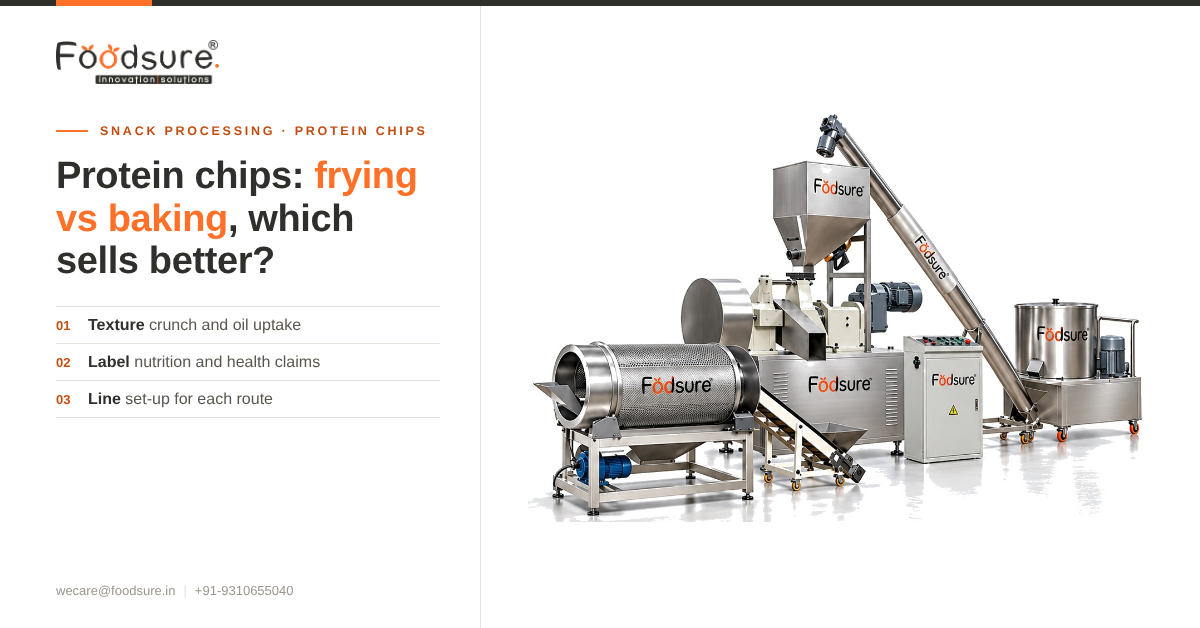
The use of protein chips has emerged in the savoury snack segment where consumers desire to have tasty snacks which incorporate not only flavours but also proteins in them. As far as food producers are concerned, there is a chance for them to create a balance of taste, texture, nutrition, shelf-life, and cost.
In creating protein chips, one of the first decisions to be made is that of whether to bake or fry. Both are suitable for making tasty snacks, although they vary in factors such as texture and oil content.
It is critical to know about protein chips frying vs baking when businesses want to bring out a new product or add to their existing line of snacks. Fried protein chips can provide a familiar crunchy texture and taste, while baked protein chips can attract those who prefer something different from the regular fried snacks. But just because they are either fried or baked does not mean that there will be increased sales.
The choice also affects machinery requirements. Manufacturers must consider whether they need a dedicated protein chips machine, a frying or baking system, seasoning equipment, and suitable packaging machinery.
This blog compares frying and baking, explains the factors that influence sales, and outlines the equipment considerations for commercial protein chips production.
What Are Protein Chips?
Protein chips are savory snacks created in a way that makes them offer higher protein content than normal snacks. These may be made by using proteins such as pea protein, soy protein, lentil flour, chickpea flour, or any other source of protein.
In some cases, the chips can be made from dough rich in proteins, which is shaped into chips and then cooked. In other cases, extrusion can be used to make the chip acquire its desired shape and structure.
The final product can be either fried, baked, or cooked using another cooking method.
Common product characteristics include:
- A crisp and crunchy texture
- A distinctive savory taste
- A known protein content per serving
- A consistent shape and appearance
- Acceptable shelf-life in protective packaging
- An acceptable texture during storage
It is not true that protein chips are manufactured using the same process. The formulation meant to be fried will act differently from one formulated for baking or extrusion. It is thus advisable for the manufacturer to choose the process to use when developing the product.
Protein Chips Frying vs Baking: Key Differences
Frying and baking use different heat-transfer mechanisms, which affect the final product’s texture, colour, oil content, and processing requirements.
Frying generally involves direct contact with hot oil, while baking relies primarily on hot air and heat transfer through the product. The final nutritional profile depends on the formulation, cooking conditions, oil uptake, and portion size.
| Comparison Factor | Fried Protein Chips | Baked Protein Chips |
| Texture | Can deliver a crisp, rich, fried-style bite | Can produce a crisp texture, depending on formulation and baking conditions |
| Oil content | Usually higher when oil is absorbed during frying | Often lower when little or no added oil is used |
| Flavour | Develops familiar fried notes and rich mouthfeel | Can offer roasted or toasted flavour notes |
| Processing | Requires a suitable fryer, oil management, and temperature control | Requires an oven or suitable baking system with controlled heat and airflow |
| Formulation | Must tolerate frying without excessive breakage or oil uptake | Must retain structure and crispness during moisture removal |
| Production considerations | Oil quality, filtration, temperature, and replacement are important | Heat distribution, airflow, residence time, and moisture removal are important |
| Product positioning | May suit indulgent or conventional savoury snack categories | May suit products positioned around an alternative to fried snacks |
| Cost considerations | Includes oil consumption, filtration, and oil-handling requirements | Includes oven energy, airflow systems, and baking time |
| Quality control | Oil uptake, colour, crispness, and residual moisture require monitoring | Colour, crispness, residual moisture, and uniform baking require monitoring |
However, these are only general trends and not certainties. One can have a different oil content in a properly formulated fried food product from another fried food product, just as one can have a different fat content in baked food products.
Which Protein Chips Sell Better: Fried or Baked?
There is no definite winner for either fried or baked protein chips. Sales would depend on the market, pricing, quality of the product, distribution methods, and the perceived expectations for the snack category.
Rather than assume one process would be the winner all the time, the manufacturer must determine which product proposition works best for its target market.
When Fried Protein Chips May Perform Well
Fried protein chips may be suitable for consumers who prefer a familiar savoury snack with a rich taste and crisp bite.
Potential advantages include:
- Familiar eating experience: Many consumers already associate fried snacks with crunch and strong savoury flavours.
- Rich mouthfeel: Oil contributes to flavour release and mouthfeel, which can be important in certain snack formulations.
- Established snack positioning: Fried chips may fit naturally into conventional snack categories where consumers prioritise taste and texture.
- Flavour compatibility: Certain spice blends and seasoning profiles may work particularly well with a fried-style product.
However, the commercial success of fried protein chips still depends on how well the product delivers on taste, texture, nutrition, and price.
When Baked Protein Chips May Perform Well
Baked protein chips may appeal to consumers seeking alternatives to conventional fried snacks, especially when the product delivers a satisfying crunch without excessive oil.
Potential advantages include:
- Product positioning: Baking can help to develop a product idea involving an alternative to deep-fried products.
- Potentially reduced oil: The amount of fat used in baking may be relatively low if it is not required to add oil in high amounts, although this needs to be confirmed.
- Unique taste profiles: Baking may allow obtaining a toasted flavor that would complement some protein components.
- Different oil handling: The baking process does not involve deep frying and, hence, may not require an oil filtration system.
Baked products also have challenges. They may become too hard, dry, dense, or brittle if the formulation and baking conditions are not properly controlled.
What Manufacturers Should Compare Before Choosing
For commercial decision-making, manufacturers should test both processes against the same product goals.
Key factors include:
- Customer preferences for taste and texture
- Amount of protein per serving
- Fat and calorie content
- Costs of ingredients and processing
- Yield and energy consumption in production
- Breakage of product during handling
- Shelf life and package requirements
- Project price and target customer
A small market trial can provide more useful sales evidence than selecting a process based only on general assumptions about healthy snacks.
How Frying Changes Protein Chips Texture and Quality
The frying process entails immersing the shaped product in hot oil such that moisture is driven out of the product at the same time that an outer crust is created. This can result in the creation of a crispy exterior.
On the other hand, protein-rich formulas tend to have different behaviors from the usual formulas based on potatoes. The amount of protein, starch, fiber, and moisture content will affect the expansion process.
Oil Absorption
Oil absorption is determined by some factors, such as ingredient composition, product shape, frying temperature, frying time, water loss, and draining conditions.
Excessive oil absorption can influence the nutritional value, taste, mouthfeel, and cost of production. The manufacturer must determine the fat content of the final product because not all fried chips absorb the same amount of oil.
Texture Development
It is important that the frying process be controlled so that the desired crunchiness can be obtained without burning or overhardening.
In case the product is overfried, there could be a risk of developing an excessively dark color or even bitterness. In case the cooking process is inadequate, the chips may end up retaining too much moisture.
Oil Quality
Oil quality can deteriorate during repeated heating. Oxidation, contamination, and excessive thermal exposure can affect product flavour and overall quality.
A commercial frying setup should therefore include appropriate oil monitoring, filtration, cleaning, and replacement practices according to the process and applicable food-safety requirements.
How Baking Changes Protein Chips Texture and Quality
Baking uses controlled hot air and heat transfer to cook the product and remove moisture. The result depends on oven temperature, airflow, residence time, product thickness, and the formulation’s ability to form a crisp structure.
Moisture Removal
It is necessary that baking reduces moisture enough to ensure the desired texture and shelf-life of the product. Nonetheless, it needs to be noted that reduction of moisture cannot be exaggerated, because it may cause some negative consequences.
Too much drying may make chips hard or brittle, and lack of proper drying may make the product soft.
Surface Colour and Flavour
Factors that affect the final color and flavor include the ingredients used and the baking process. Ingredients rich in protein may brown differently than typical starch-based ingredients.
Color, flavor, and aroma must be assessed throughout the baking process to prevent irregular coloring and darkening of the product.
Crispness and Structure
There may be some challenges associated with formulating and developing a crispy structure for baked protein chips. The ratios of protein sources, starch, fiber, binders, and moisture play a critical role in the process.
The same method that works in one formulation may not work in another. This is why the trials must focus on the final product when it cools down in its packaged form.
Can Extrusion Be Used to Manufacture Protein Chips?
Yes. Extrusion is the process for producing various types of expanded and formed snack foods, which include some protein-based products as well. This process involves heat, pressure, moisture, and mechanical work applied to form products from ingredients.
An extruded protein chip can be subjected to baking or frying, among others.
A proper protein chips machine will depend on what type of machine the manufacturer uses. This can include an extruder, a shaping and cutting machine, a frying machine or oven, a seasoning machine, and a packaging machine.
Manufacturers must know what kind of product they want to manufacture before buying machines. A high-protein expanded puff, a thin chip, and a protein crisp will need different processing methods.
Important Extrusion Variables
- Moisture content: Influences material flow, expansion, and the structure formed during extrusion.
- Temperature: Affects cooking, protein transformation, and the behaviour of the material.
- Screw configuration and speed: Influence mixing, shear, residence time, and energy transfer.
- Die design: Determines the shape and dimensions of the extrudate.
- Cutting system: Helps maintain consistent product size.
These parameters need to be optimized through product trials. The equipment setup must be selected based on the texture, formulation, and output required.
Equipment Required for Commercial Protein Chips Production
The machinery required depends on whether the product is made through direct dough processing, extrusion, frying, baking, or a combination of methods.
A commercial production line may include the following equipment.
1. Ingredient Handling and Mixing
Ingredients are weighed and blended according to the formulation. Proper mixing helps distribute protein ingredients, starches, seasonings, and other components before shaping.
The mixer should be suitable for the ingredient characteristics and batch size.
2. Extrusion or Shaping
In case the product is extruded, the formulation is processed using an extruder to form the desired shape through a die. This can be achieved through other methods such as sheeting, forming, and cutting.
This will depend on the product design and texture.
3. Frying or Baking
The shaped product is cooked using the selected process. Frying equipment requires suitable oil circulation, temperature control, draining, and oil-management arrangements.
Baking equipment requires suitable heat distribution, airflow, and residence-time control.
4. Cooling and Inspection
The product is allowed to cool after the cooking process before adding flavoring and packaging. Cooling aids in preparing the product for further processes and prevents any condensation in the packaging.
Inspection helps to detect damaged, overcooked, undercooked, or misshapen products.
5. Seasoning and Flavouring
A snack flavouring machine can be used to distribute seasoning across the chips. The type of seasoning equipment depends on the product shape, coating method, batch size, and whether oil or other liquid ingredients are used to support adhesion.
Uniform flavour distribution is important because uneven seasoning can affect the consumer experience.
6. Packaging
A proper packaging system can provide protection against moisture, oxygen, and mechanical damage to the chips. The chosen packaging material must be suitable for the product in terms of fat content and shelf-life.
The effectiveness of the packaging system can be tested through shelf-life tests and not just the packaging system itself.
How Other Snack Machines Fit into the Production Line
All snack machines are not appropriate for protein chips just because they are used somewhere else in the snack industry. There must be compatibility between the machinery and the product’s composition and process of making.
Protein Puffs Machine
Protein puffs machine can be considered as the type of machines that are designed to make puffed snacks. Protein puffs and thin protein chips may utilize similar technologies, but they are not the same product.
Puffed snacks require a different shape and puffed character than other snacks. The manufacturer must determine if the machine can create the chip shape that is desired.
Popcorn Machine
A popcorn machine is designed primarily for popping corn kernels. It is not a direct replacement for a protein chips production line because the raw materials and processing requirements are different.
The popcorn machines might also be applicable in a larger snack business firm that produces different products; however, protein chips need some other process.
Snack Roasting Machine
A snack roasting machine may be appropriate for products that require roasting or dry heating. Whether it can process protein chips depends on the product shape, moisture level, heat sensitivity, and required texture.
Manufacturers should request a product trial before using general-purpose roasting equipment for a new protein snack.
Namkeen Machine
A namkeen machine is a broad term that can refer to equipment used for various Indian savoury snacks. Some equipment, such as seasoning systems or packaging machinery, may be relevant to protein chips production.
However, a complete protein chips line must be specified according to the product rather than relying on the general category of the machine.
Cost Factors: Protein Chips Frying vs Baking
The investment for fried and baked protein chips depends on the product formulation, output capacity, level of automation, and the equipment included in the production line.
The snack making machine price can vary considerably because a basic cooking unit and a fully integrated production line have different equipment requirements.
The protein chips machine cost may include extrusion or forming equipment, a fryer or oven, seasoning equipment, conveyors, cooling systems, and packaging machinery.
Costs Associated with Frying
A fried protein chips line may require investment in:
- Equipment for frying and temperature control
- Oil circulation and filtration systems
- Oil storage, handling, and disposal
- Drainage and cooling equipment
- Ventilation and appropriate safety measures
- Maintenance and cleaning arrangements
Oil consumption is also an ongoing operating cost. Actual use depends on the product, process, oil management, and production volume.
Costs Associated with Baking
A baked protein chips line may require:
- An appropriate industrial oven
- Heating and ventilation systems
- Conveyors or trays, depending on the design
- Cooling systems
- Temperature control and monitoring
- Cleaning and maintenance systems
Energy use depends on the oven design, throughput, operating conditions, and the amount of moisture removed.
Comparing Total Operating Costs
A fair comparison should include both initial investment and recurring costs. Manufacturers should evaluate the cost per kilogram of saleable product rather than comparing only the purchase price of the fryer and oven.
Important considerations include ingredient costs, energy use, oil consumption where applicable, labour, product losses, cleaning, maintenance, packaging, and output per hour.
The best financial option depends on the actual production conditions and the product’s expected selling price.
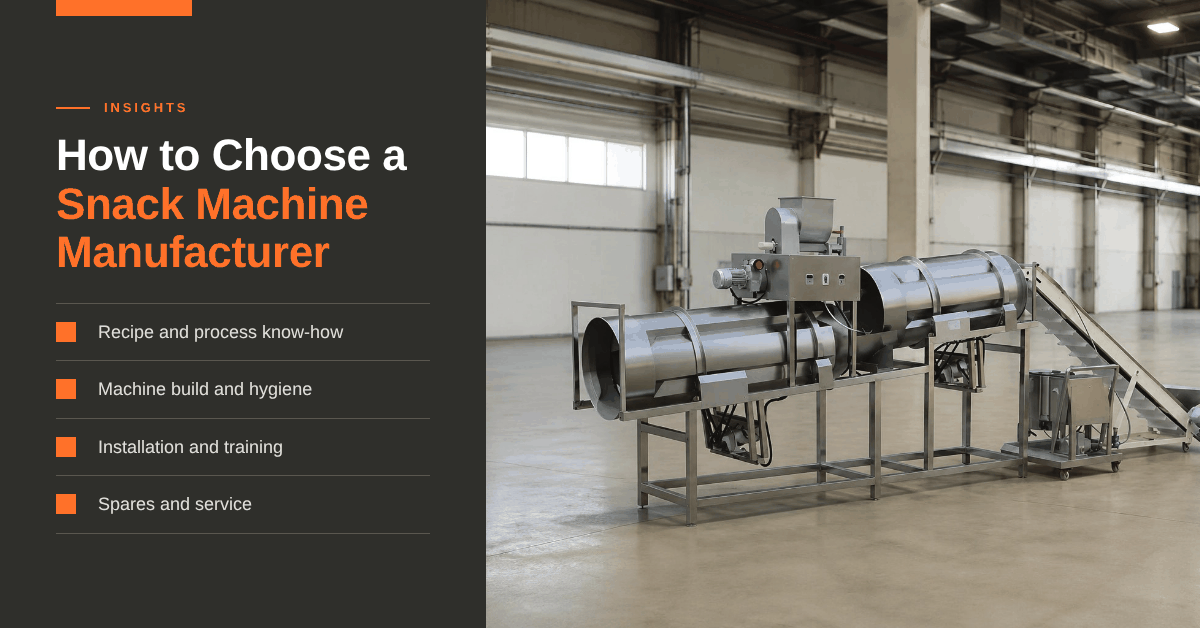
How to Choose a Snack Machine Manufacturer
Selecting a reliable snack machine manufacturer is important when establishing a commercial protein chips line. The supplier should understand the intended product and recommend equipment that can achieve the required texture, capacity, and process consistency.
Before finalising a purchase, manufacturers should evaluate:
- Exposure to the planned variety of snacks
- Compatibility with protein-based formulation systems
- Capacity to produce and anticipated production
- Oil frying, baking or extrusion line configuration
- Process and temperature controls
- Seasoning and packaging capability
- Cleaning and maintenance considerations
- Installation and post-sales considerations
- Spare parts availability
- Future expansion capacity
Product trials are especially valuable where the formula includes novel protein ingredients. The product trial can provide valuable information on whether the suggested equipment is capable of producing the desired texture, taste, and appearance.
Companies that wish to buy snack machine India must provide details about their target output, product, ingredients, method of cooking, and degree of automation required. This would help in evaluating the equipment configuration.
The phrases protein chips frying vs baking price, protein chips frying vs baking manufacturer, and buy protein chips frying vs baking describe comparisons or search intent rather than standard machinery categories. Buyers should clarify whether they need a frying system, a baking line, an extrusion setup, or a complete protein snack manufacturing solution.
Conclusion
Frying and baking are decisions that are determined by what kind of product the company would like to manufacture and whom they would like to target as consumers. Fried protein chips will give a savory taste, whereas baked products will give a different flavor and may be low in fat content.
Neither process ensures improved sales. Manufacturers need to determine whether the taste, texture, nutritional content, shelf life, cost of manufacture, and acceptability to consumers favor one product over another.
Choosing the right protein chips machine and supporting equipment is equally important. The production line should match the formulation, cooking method, required capacity, and desired level of automation.
For companies wishing to enter the protein snack market, a proven formula, proper equipment, strict quality control, and practical costs will build a better basis for success.
Frequently Asked Questions
1. Are fried protein chips better than baked protein chips?
Both techniques are not necessarily better than one another. Fried chips may be preferred by consumers who enjoy the traditional taste and texture of fried chips, whereas baked chips might be preferred by those looking for a different kind of snack from their regular fried chips.
2. Are baked protein chips always healthier?
No. Baking can decrease the amount of oil used in deep frying, but nutrition values depend on the ingredients used, fats added, serving sizes, and composition of the end product.
3. Which process gives protein chips a crispier texture?
Both frying and baking can produce crisp chips. The outcome depends on the formulation, moisture content, product thickness, temperature, processing time, and cooling conditions.
4. Can the same protein chips formulation be used for frying and baking?
Not necessarily. The same ingredients and moisture content that is suitable for frying can be different for baking. Different processes have to be tested through formulation and finished product testing.
5. What machinery is needed to manufacture protein chips?
Depending on the process, a production line may require ingredient mixing, extrusion or forming, frying or baking, cooling, seasoning, inspection, and packaging equipment.




