
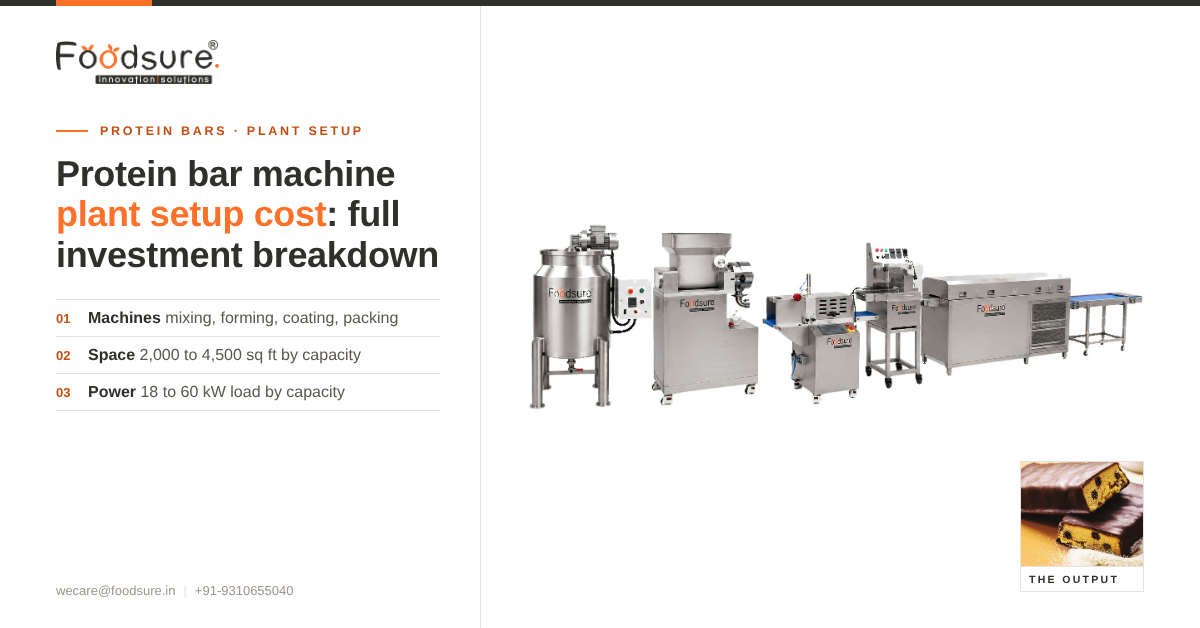
A start-up for a protein bar manufacturing company is not limited to buying equipment. The entrepreneurs will have to think about the plant layout, machinery, power supply, raw materials, packaging materials, manpower, regulatory requirements, and working capital.
Understanding the protein bar plant setup cost helps manufacturers evaluate the complete investment instead of focusing only on the price of individual machines. The total cost will depend on production volume, level of automation, types of products, plant facilities, and the scale of manufacture.
Be it a small plant or a commercial-scale one, this blog describes all the main cost heads, machinery, and other factors that will affect the cost of your project.
What Does Protein Bar Plant Setup Cost Include?
The protein bar plant setup cost refers to the overall investment required to establish and prepare a protein bar manufacturing facility for commercial production.
This can involve various aspects apart from the purchasing of machines. This includes such aspects as setting up the factory, installing the electrical and utility systems, sourcing for raw materials, packaging, and putting in place quality control measures.
A typical investment plan may include:
- Machinery and allied equipment for production
- Factory premises and infrastructure
- Plant electrification and utilities
- Storage facility and logistics
- Packaging machines and consumable supplies
- Licenses and compliances
- Installation and training of operators
- Initial raw materials and working capital
The investment will depend on the choice of production process and the degree of automation used. Thus, manufacturers have to develop a site-specific estimate and not a standard one that applies to all facilities.
Major Components of Protein Bar Manufacturing Plant Investment
A protein bar manufacturing plant investment should be divided into clear categories. This makes it easier to understand where the budget will be allocated and identify requirements that may otherwise be overlooked.
1. Machinery and Equipment
Machinery is one of the major components of a manufacturing project. The equipment configuration depends on the product type, production capacity, and processing method.
A typical protein bar production line may include:
| Machinery | Purpose |
| Ingredient weighing system | Measures ingredients according to the product recipe |
| Mixer | Combines protein ingredients, binders, cereals, nuts, and other components |
| Protein bar extruder | Forms suitable dense and cohesive mixtures into continuous profiles |
| Slab-forming machine | Spreads or compresses particulate mixtures into sheets |
| Cutting machine | Divides formed products into individual bars |
| Cooling conveyor or tunnel | Helps stabilise bars before subsequent processing |
| Enrobing machine | Applies chocolate or compound coating where required |
| Conveyors | Transfer products between processing stages |
| Packaging machine | Wraps finished bars for storage and distribution |
| Inspection and coding equipment | Supports product checks and batch identification |
Each product does not necessarily need each of these machines. For instance, a production company making uncoated bars made of dates will need a set-up different from a production company that manufactures chocolate-coated bars. Machines should be chosen based on what the product is rather than buying machines that cannot be used.
2. Factory Space and Infrastructure
The factory premises form another important part of the protein bar plant setup cost.
The required space depends on production capacity, equipment dimensions, storage requirements, and the number of processing stages.
Manufacturers should plan separate or appropriately organised areas for:
- Material receipt and storage
- Weighting and preparation of ingredients
- Mixing and processing
- Forming and cutting
- Cooling and coating, if necessary
- Packaging and storage of final products
- Quality control operations
- Cleaning and maintenance
- Movement and utility
The layout should support a logical movement of ingredients and finished products. Adequate space for cleaning, inspection, and maintenance should also be considered before finalising the factory arrangement.
3. Electrical and Utility Installation
The manufacturing plant will need proper electricity and utilities for the operation of its machinery.
The need will depend on the total load of motors, heaters, cooling system, compressors, and packaging machines.
Other utility requirements may include:
- Compressed air for pneumatic systems and packing machines
- Cooling facilities for processing products
- Water for cleaning purposes and other general uses
- Ventilation and temperature control
- Drainage and waste disposal facilities
Manufacturers should obtain a consolidated utility schedule from their machinery supplier before completing electrical and infrastructure planning.
4. Installation and Commissioning
Machinery procurement is not the final stage of a plant project. Equipment must be installed, connected, tested, and commissioned before regular production begins.
This investment component may include:
- Machine placement and installation
- Electrical and utility connections
- Equipment installation
- Trial production
- Adjustment of operating parameters
- Training of operators
- Technical assistance and commissioning
The scope of these activities should be clearly mentioned in the supplier’s proposal so that businesses can understand what is included in the project.
5. Licences and Regulatory Compliance
Food production companies must take into consideration registrations, licences, and food safety criteria, if applicable.
For example, in India, food business operators need to get the respective FSSAI registration or licence according to their type of operation and qualifications. Information regarding FSSAI licensing and registration is provided on the FSSAI website.
Additionally, companies will need to consider other permissions for their premises, business setup, staff, and production operation.
For applying for licences, it may be necessary to submit the following documents: processing plant drawing with machinery installed capacity and power.
6. Raw Materials and Packaging Supplies
Initial raw-material procurement should be included in the protein bar manufacturing plant investment.
Depending on the product range, ingredients may include:
- Whey, soy, pea, or other protein ingredients.
- Oats, cereals, and rice crisps.
- Nuts and seeds.
- Dates and other dried fruits.
- Nut butters and suitable binders.
- Sweeteners and other recipe ingredients.
Package materials will be another necessity for the organization as manufacturers can require the proper packages for their products. It would be better to plan for the initial inventory based on production and demand rather than having more stock.
7. Manpower and Working Capital
A manufacturing unit requires trained personnel to operate equipment, manage production, inspect products, maintain hygiene, and handle packaging.
Depending on the scale of the plant, the workforce may include:
- Production operators.
- Packaging staff.
- Production supervisors.
- Quality-control personnel.
- Maintenance support.
- Helpers and material-handling staff.
Working capital should also account for recurring expenses such as raw materials, packaging, utilities, salaries, transportation, maintenance, and other operating requirements.
These expenses are important because a business needs sufficient operating support even after the machinery has been installed.
Protein Bar Plant Setup Cost in India: Small, Medium and Large Units
The protein bar plant setup cost India varies according to production capacity, machinery configuration, factory infrastructure, and automation requirements.
Businesses can broadly plan their manufacturing facilities according to three production scales.
| Plant Scale | Typical Setup Approach | Main Investment Considerations |
| Small-scale unit | Essential machinery and a practical production workflow | Core processing equipment, basic infrastructure, and manageable inventory |
| Medium-scale unit | Integrated processing with additional automation | Higher production capacity, supporting machinery, utilities, and packaging |
| Large-scale plant | More automated and coordinated production line | Advanced machinery, larger facility, integrated handling, and higher operating requirements |
A small factory could start off with the basic mixing, molding, cutting, and packaging machines. A medium-sized factory would have automated conveying, cooling, and coating machines. A large factory would need an even more sophisticated production line. The size of the factory that is suitable will depend on many factors.
Factors That Influence Protein Bar Plant Setup Cost
Several factors can change the overall investment required for a manufacturing facility.
Production Capacity
More stringent demands on production may call for more machines, more storage facilities, and increased utility capacity.
Manufacturers should first ascertain the anticipated production output per hour or shift before choosing the equipment.
Automation Level
Manual, semi-automation, and complete automation require different types of machines.
An increase in automation level could mean decreased repetitive manual operations; however, the cost is justified by the anticipated production volume.
Type of Product and Recipe
Each kind of protein bar will require different processing procedures.
If the mixture is dense and sticky, it would require an extrusion process for the molding, whereas the product that contains whole nuts, oats, or cereals could require slab molding.
Chocolate bars may require enrobing and refrigeration equipment.
Factors for Plant Layout and Availability
The state of readiness of the identified premises can affect the level of work done on the infrastructure prior to installation.
Considerations like the flooring, electricity, ventilation, drainage systems, and other requirements should be considered in advance during planning of the project.
Packaging Requirements
Single wrapping materials, multipacks, size of products, coding considerations, etc. could affect the packaging layout.
The packaging module needs to be selected according to the throughput capacity of the processing machine.
Scope of Work by Supplier and Technical Support
The total scope of work will depend on whether the supplier is delivering individual machines or a complete integrated system.
Protein Bar Machine Price vs Complete Plant Investment
The protein bar machine price and the complete plant investment are not the same.
A quotation for an individual mixer or extruder may cover only that specific machine. A complete manufacturing project can include several additional requirements.
| Investment Head | Individual Machine Purchase | Complete Plant Setup |
| Main machinery | Selected machine | Multiple machines according to the process |
| Supporting equipment | May be separate | Planned as part of the production workflow |
| Factory layout | Usually handled separately | Can be included in project planning |
| Utilities | Site arrangements may be separate | Coordinated according to machinery requirements |
| Installation | Depends on supplier scope | May include integrated installation |
| Commissioning | May cover one machine | Can cover the complete production line |
| Operator training | Depends on agreement | Can be included in the project scope |
| Future integration | Requires separate planning | Can be considered during initial design |
Therefore, businesses should avoid comparing a single-machine quotation with a complete plant proposal without checking what each includes.
How to Prepare a Protein Bar Plant Setup Cost Guide
A practical protein bar plant setup cost guide should begin with a clear understanding of the manufacturing process.
The following steps can help businesses prepare a more realistic investment plan.
Define Your Product Range
Determine which types of protein bars you want to manufacture. Specify the ingredients that will be used, their texture, size and coating needs.
Set Your Manufacturing Targets
Determine the desired hourly and daily manufacturing target figures. Consider present demands and potential future increases.
Create Your Machinery List
Specify the type of machinery that you will use for mixing, forming, cutting, cooling, coating and packaging.
Prepare Your Factory Layout Plan
Prepare a plan for the layout of your factory machinery, storage facilities, utility services and operators.
Determine Infrastructure Needs
Consider the electrical load, need for compressed air, cooling, water supply, ventilation, and drainage.
Consider Operating Costs
Consider the cost of raw materials, packaging material, labor, maintenance, and others.
Compare Supplier Proposals
Request a detailed protein bar machine quotation that specifies the equipment, capacity, technical details, installation scope, utilities, and support included.
This approach helps manufacturers compare complete project requirements rather than relying on an isolated machine price.
How to Choose the Right Protein Bar Machine Manufacturer
Selecting a reliable protein bar machine manufacturer is important when planning a new production facility.
Before finalising a supplier, evaluate:
- Experience in the use of commercial food processing machinery
- Knowledge of various types of protein bar texture and formation
- Capacity and technical specifications of machinery
- Compatibility of mixing, formation, cooling, and cutting machines
- Material handling and packaging integration
- Food contact materials and hygienic design
- Installation and start-up assistance
- Training and maintenance assistance
- Availability of spares and after-sales service
- Opportunities for future expansion
A suitable manufacturer should understand the intended product and recommend machinery according to the actual process requirements.
Why Choose Foodsure for Protein Bar Plant Setup?
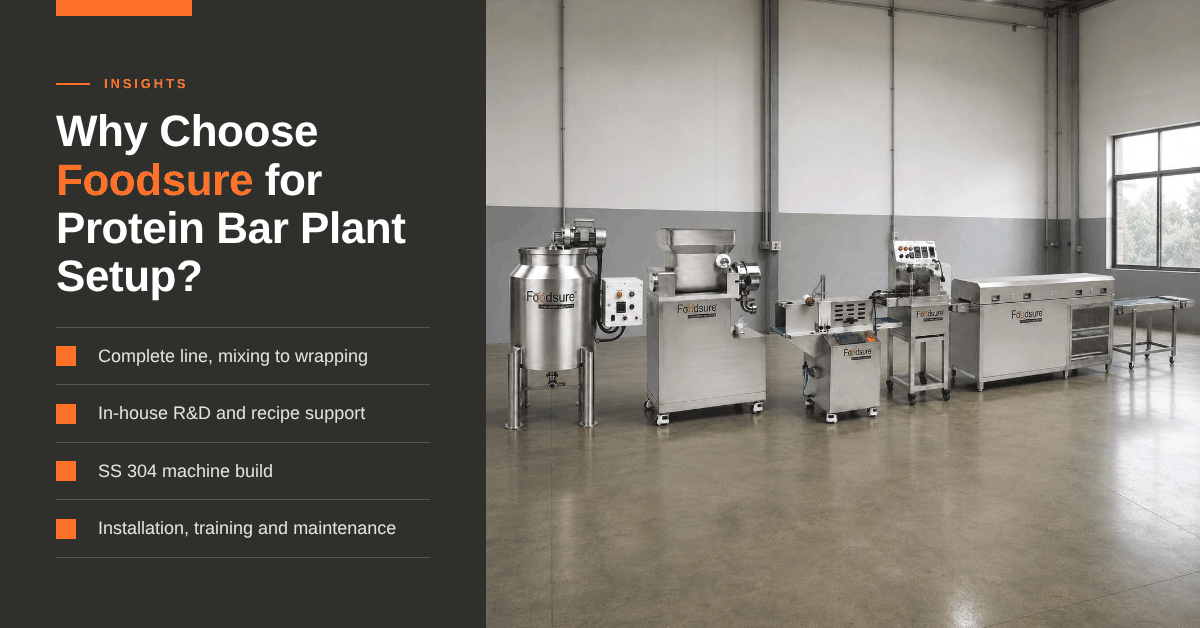
Foodsure offers food processing machines for companies who want to set up or expand their protein bars production plants.
Companies looking into the costs of setting up the protein bar production plant can use Foodsure for assessing their production needs, machine setup, plant layout, automation, machine integration, and utilities.
Based on the scale of the project, the protein bar production line may contain suitable machines for ingredients preparation, mixing, molding, cutting, cooling, coating, and packing.
It is also possible for the company to consult about installation, commissioning, operator training, and technical support at the same time when discussing the machinery needs.
The goal is to assist companies in selecting the right setup according to their production needs.
Conclusion
Cost estimation of the protein bar plant setup should be done by considering the whole manufacturing process and not just the machinery purchase. All other aspects like equipment, factory building, utility services, installation, licenses, raw materials, packaging, labor force, and working capital form part of the total investment.
In case of companies looking forward to investing in a protein bar manufacturing plant, the proper way would be to identify the product line, set up production goals, make a proper machinery list, and compare the entire supplier proposals.
With proper equipment and a good protein bar manufacturing process, it becomes easy for the manufacturers to have an efficient plant.
Frequently Asked Questions
1. How much does it cost to set up a protein bar manufacturing facility?
It will depend on the production capacity of the facility, the design of the machinery, level of automation, infrastructure of the factory, utilities, raw materials, packaging and working capital.
2. What will be part of the protein bar plant setup cost?
The protein bar plant setup cost will consist of the machinery, factory preparation, utilities, installation and commissioning costs, licenses, raw materials, packaging materials, manpower and working capital.
3. What machinery do you require for a protein bar production line?
Machinery that will be needed for a protein bar production line will include weighing, mixing, forming and extruding machinery, cutting, cooling, conveyors and packaging machines. The list can further be expanded depending on the nature of the products.
4. What influences the cost of a protein bar machine?
The protein bar machine cost will depend on the type of machine, capacity, level of automation, construction, forming technique, auxiliary machines, and installation needs.
5. How can I get a protein bar machine quote?
To get an appropriate protein bar machine quote, provide information about the type of product to be produced, ingredients, production capacity, bar size, forming process, packaging needs, and existing factory facilities.




