
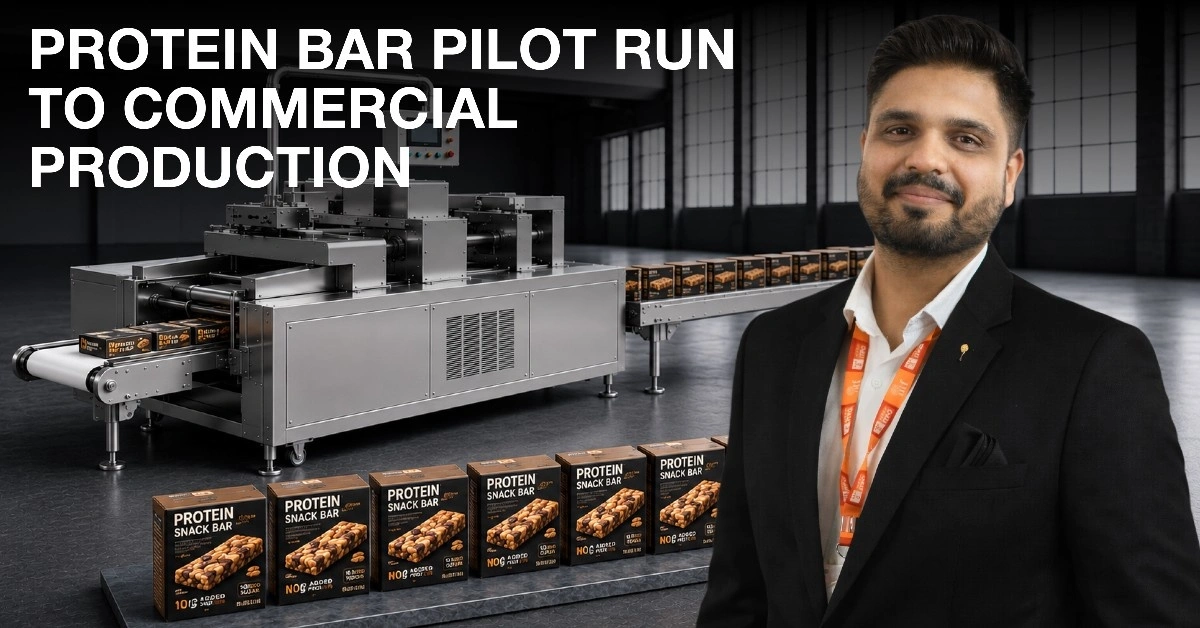
If you are planning on successfully bringing your product to market there is a crucial component beyond a stellar recipe – a solid protein bar pilot run to commercial production roadmap. While an effective product recipe the success of a protein bar lies in reliable commercial manufacturing as well as consistent quality and continued profitability. This detailed step-by-step plan for bringing your product from a concept to the store shelf and is key to avoiding pitfalls in the scale up process.
A successful launch relies upon developing, implementing, and refining each aspect of the protein bar development cycle.
This plan outlines each part of the process, whether you’re a start-up or are simply expanding your already established product portfolio.
Protein bar pilot run to commercial production is the process of scaling a protein bar formulation from laboratory or pilot-scale batches to consistent, high-volume commercial manufacturing while maintaining quality, texture, nutrition, and shelf life.
What makes a Protein Bar Pilot Run Essential?
When a formulator is developing their recipe, they must first demonstrate that their formulation can work within a real-world manufacturing process. Prior to committing to commercial equipment and process inputs, the protein bar formulation must be validated. During a protein bar pilot manufacturing run, companies investigate all the key attributes: including texture, ingredient performance, operational efficiency, and product uniformity.
What might not seem apparent during laboratory-based formulation may become a problem as volumes scale up.
This is why running the recipe through a pilot plant production run helps them solve these issues before heading toward commercial protein bar manufacturing. What also becomes incredibly valuable with a pilot run is cost management. Companies can calculate the resources needed – such as the raw materials, labor hours, and output yield – in a controlled environment for the protein bar scale-up guide to have accurate cost data.
Protein Bar Pilot Run To Commercial Production Flow
This flow chart highlights the entire process for the protein bar from the pilot production stage all the way to the commercial stage. Through this process, each step ensures that the product is reliable as well as able to be scaled up effectively and reduce overall risks.
Major Steps on the Protein Bar Scale-Up roadmap.
Product Development –
Every effective protein bar manufacturer kicks off the process with product development . In this phase, a company determines the desired nutritional specifications of a bar, the chosen raw materials and the formulation that fits best the identified market needs.
Often many prototypes are created , reviewed and approved before being approved for the trial runs.
Effective Product development makes the rest of your protein bar scaling-up process a lot easier. The better formulated the bars are during this stage, the smoother will go in commercial scaling.
Protein Bar Pilot Production Process –
In the protein bar pilot run stage, the initial product development gets tested under real commercial production environment and environment. The process involves using a set of smaller commercial scale production equipment that mimic the commercial production set up to produce a batch of bars and evaluate the outcome of the product as it goes through various processes such as mixing, extrusion, cooling, cutting and packaging. The gathered information on the protein bars will decide whether it will proceed to the protein bars trial run or to the commercial production process.
Process Optimization –
After pilot studies are completed, manufacturers assess the gathered data to determine areas for improvement. They could consider changing ingredient formulation ratios, production temperatures, manufacturing rates or packaging processes. Because optimization will result in reduced costs, decreased waste and a streamlined workflow, this is an essential part of a protein bar scale up guide.
Manufacturers look for ways to achieve a stable, repeatable process that can be amplified without negative consequences on product quality.
Commercial Scale-Up –
Following positive pilot tests and an approved optimization plan, the company is ready for the next step – manufacturing of protein bars commercially.
Businesses now need to acquire scaled-up equipment and procedures, begin producing at industrial volumes, and establish consistent standard operating procedures. At this stage, a protein bar scale up guide effectively shows the shift from testing a bar’s feasibility to mass manufacturing.
Pilot Run vs Commercial Production
| Factor | Pilot Run | Commercial |
|---|---|---|
| Production Volume | Small batches | High-volume production |
| Main Objective | Testing and validation | Market supply |
| Equipment Type | Pilot equipment | Industrial equipment |
| Risk Level | Controlled | Higher operational exposure |
| Cost Focus | Process learning | Profitability and efficiency |
As shown, the main variations between a protein bar pilot run and commercial production are based on whether your team is optimizing, verifying and learning from (pilot) or simply producing with optimum output and profitability (commercial). It’s critical that these differ and we understand where they overlap when building a Protein Bar Pilot Run to Commercial Production roadmap.
The Role of a Protein Bar Machine in Scale-Up
Choosing the right protein bar machine is key as you prepare to scale up. When choosing the best equipment for your protein bars you need to factor in both consistent output and demand for higher production volumes. You may need a way to automatically mix, form and shape your product at scale and a fully automated machine can do this.
Automation decreases variations in your production process and also helps increase overall efficiency of production which makes transitioning from your protein bar pilot process to mass production more manageable.
Many protein bar manufacturing facilities that grow will implement one machine per product or an entire automated line so keeping equipment scalable is helpful as you continue your expansion to save on future expenditures.
Equipment Scale – Up Flow Chart
This process makes sure production capability is consistent to your business goals for growth. Whether you’re trying to decide on the best machine, or working to maximize uptime and decrease production interruption, this process of scaling equipment allows for consistent growth and efficient production. Equipment validation successful equipment validation can be a challenging part of going from a protein bar pilot to full commercial production.
Common Challenges During Scale-Up
Even with meticulous deliberation, producers mostly face the predicaments during scale-up. Comprehending these obstacles aids firms to prepare efficient solutions.
Ingredient Performance
Ingredients can act differently at commercial quantities than they do during laboratory development. Moisture navigation, texture variation, and ingredient chemistry could affect final product standards. The protein bar pilot production process assists in identifying these issues before full-scale manufacturing enunciates.
Production Consistency
Keeping uniform standards across large scale manufacturing batches can be hard. Inconsistencies in processing conditions could impact the texture, look, and nutritional profile. A structured protein bar production scale up guide helps institute controls that minimize these inconsistencies.
Equipment Compatibility
Not every protein bar machine is prevalent for every formulation. Indifferences in viscosity, ingredient composition, and product dimensions can affect machinery output. Pilot evaluation provides valuable insights that assist better machinery decisions.
Foodsure Machines and Their Services
At Foodsure Machines, we empower brands every step of the way from the protein bar pilot run to full-scale commercial production with our in-house expertise, equipment resources, and in-depth knowledge. Our support allows for manufacturers to scale-up seamlessly to commercial.
| Service | Benefit |
|---|---|
| Pilot Run Support | Validates production feasibility |
| Equipment Consultation | Helps select the right protein bar machine |
| Process Development | Improves manufacturing efficiency |
| Scale-Up Planning | Supports commercial expansion |
| Technical Support | Resolves production challenges |
Foodsure Machines can also provide support at all the levels required for your protein bar scale roadmap helping you to mitigate business operational risks, optimise your production, enable commercialisation and support you on scaling up your protein bars towards commercial success.
Best Practices for Successful Protein Bar Production
Conduct Thorough Pilot Evaluation
A comprehensive protein bar pilot run must test every aspect of production, from ingredient performance to packaging integrity. Long evaluation assists producers make informed decisions before scaling operations.
Invest in Scalable Machinery
Choosing a reliable protein bar machine early in the process helps long-term flourishing. A scalable machine decreases future capital expenses and boosts production flexibility.
Quality control
Quality control should be applied on every aspect of the production from protein bar pilot run to commercial production process; monitoring always provides assurance of consistency, product reliability and customer service. –
Develop the long term scale-up plan
A protein bar manufacturing scale up guide defines the route to the successive development in a clear structured guide way, giving manufacturers ability to plan and mitigate obstacles in the growth process.
Conclusion
From the above, it is understood that the successful completion of the protein bar pilot to commercial production journey makes it possible for businesses to implement a protein bar pilot production with full knowledge, efficiently, and with minimum risks. It contributes to streamlining commercial protein bar production. A proper protein bar scale up plan allows companies to optimize the process, address bottlenecks, enhance efficiency, and guarantee protein bar consistency.
Moreover, knowing the nuances of a protein bar pilot run versus commercial protein bar manufacturing and the right equipment and procedures ensure commercial viability.
Partnering with Foodsure Machines and following their expert advice and roadmap enables businesses to step into profitable large-scale protein bar manufacturing.
Frequently Asked Questions
1. What is a protein bar pilot run?
A protein bar pilot run is a manufacturing trial executed on a limited scale preceding commercial-level manufacturing. A pilot run allows companies to evaluate product formulations, evaluate the efficacy of manufacturing machinery, refine process efficiency, spot potential production issues and gather valuable operational data to support successful commercial production.
2. Why is the protein bar pilot production process so critical?
The protein bar pilot production process safeguards companies from expensive mistakes by simulating the manufacturing process under live conditions. A pilot run facilitates discovery of issues involving key ingredients, machinery, and quality before significant investments are committed to full-scale operations.
3. How long does the protein bar scale-up process take?
Timelines can fluctuate based on product complexity, test and validation needs, equipment availability, and necessary regulatory oversight. Most projects take weeks or months from initiation of pilot production to commercial product launch, including process development, validation and preparation.
4. What type of equipment is typically included in protein bar production?
Standard protein bar production uses machinery such as mixers, extruders, slab formers, cutters, coolers, and packaging machines. Precise equipment requirements vary according to product characteristics, volume targets and operational automation.
5. How do Foodsure Machines assist with commercial production?
Foodsure Machines offers pilot run support, process development, equipment analysis and recommendations, scale-up support, and technical advisory services. Companies leverage these services to optimize production efficiency and mitigate risk transitioning from pilot production to full scale.




