
Starting a protein bar manufacturing business can be an opportunity for food entrepreneurs, health-focused brands, contract manufacturers and existing snack businesses looking to expand their product range. But before investing in a protein bar machine, you need to understand three important things: the machine price, the production capacity you actually need, and how long it may take to recover your investment.
For manufacturers in India, Nepal, Sri Lanka and Bangladesh, these decisions also depend on local ingredient costs, electricity rates, packaging expenses, distribution margins and the price customers are willing to pay for protein bars.
A small business supplying local gyms and online customers may not need the same production line as a manufacturer supplying supermarkets or exporting to other countries. Choosing a machine that matches your business plan can help you control costs, maintain consistent product quality and increase production as demand grows.
In this guide, we explain protein bar machine prices, production capacities, manufacturing processes and ROI calculations in simple language. We also cover what to check before buying a protein bar manufacturing machine from Foodsure Machines.
Is Protein Bar Manufacturing a Good Business Opportunity in South Asia?
Demand for convenient, ready-to-eat nutrition products has encouraged food manufacturers to explore protein bars, energy bars and other high-protein snacks. However, market growth figures should be treated as an indicator of opportunity, not a guarantee that a new manufacturing business will be profitable.
According to Grand View Research, India’s protein bar market generated an estimated USD 863.9 million in revenue in 2024 and is projected to reach USD 1,266.9 million by 2030, with a forecast compound annual growth rate (CAGR) of 6.6% for 2025–2030. These are commercial market research estimates, not official government statistics.
Grand View Research
India also has a sizeable food processing industry. A February 2026 release from the Government of India’s Press Information Bureau reported that the sector’s gross value added increased from ₹1.34 lakh crore in 2014–15 to ₹2.24 lakh crore in 2023–24, based on revised estimates. This provides useful context for businesses considering new processed food products, although it does not measure protein bar demand specifically.
Press Information Bureau
For South Asian manufacturers, possible customer groups include:
- Gym members, fitness enthusiasts and sports nutrition customers.
- Office workers, students and travellers looking for convenient snacks.
- Online shoppers buying directly from emerging food brands.
- Supermarkets, health food stores, pharmacies and specialist nutrition retailers.
- Distributors and importers serving regional or international markets.
The opportunity will differ by country, city, product price and distribution channel. A manufacturer in India may have a different cost structure from a business in Nepal, Sri Lanka or Bangladesh, especially when machinery, protein ingredients or packaging materials need to be imported.
The practical approach is to validate demand in your target market first, then choose a machine based on realistic sales expectations.
What Is a Protein Bar Machine?
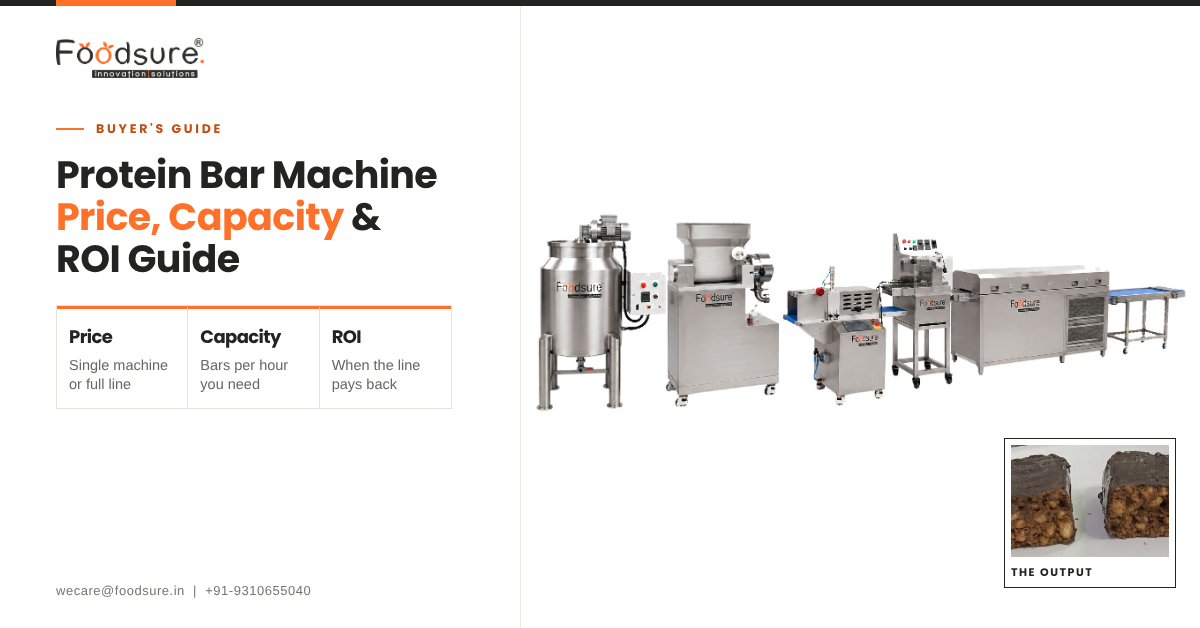
A protein bar machine is food processing equipment used to turn a prepared protein mixture into bars of a consistent size and shape. Depending on the machine configuration, the line may include mixing, forming or extrusion, cutting, cooling and packaging equipment.
A complete protein bar manufacturing line helps businesses produce bars in larger quantities while reducing dependence on manual shaping and cutting.
Manufacturers can use these machines for products made with ingredients such as:
- Whey, soy, pea or other protein powders.
- Oats, nuts, seeds and cereal ingredients.
- Dates, syrups and other binding ingredients.
- Chocolate, cocoa, dried fruit and flavouring ingredients.
The exact equipment required depends on the recipe. A soft date-based bar, a firm protein slab and a coated protein bar may need different forming, cooling or finishing arrangements.
If your product range includes more than protein bars, you can also explore a dedicated High Protein Snack Machine or other high-protein snack formats. For products designed primarily for quick energy, an Energy Bar Machine may be a better fit. These are related but distinct equipment requirements, so confirm recipe compatibility before purchasing a line.
Protein Bar Machine Price in India, Nepal, Sri Lanka and Bangladesh
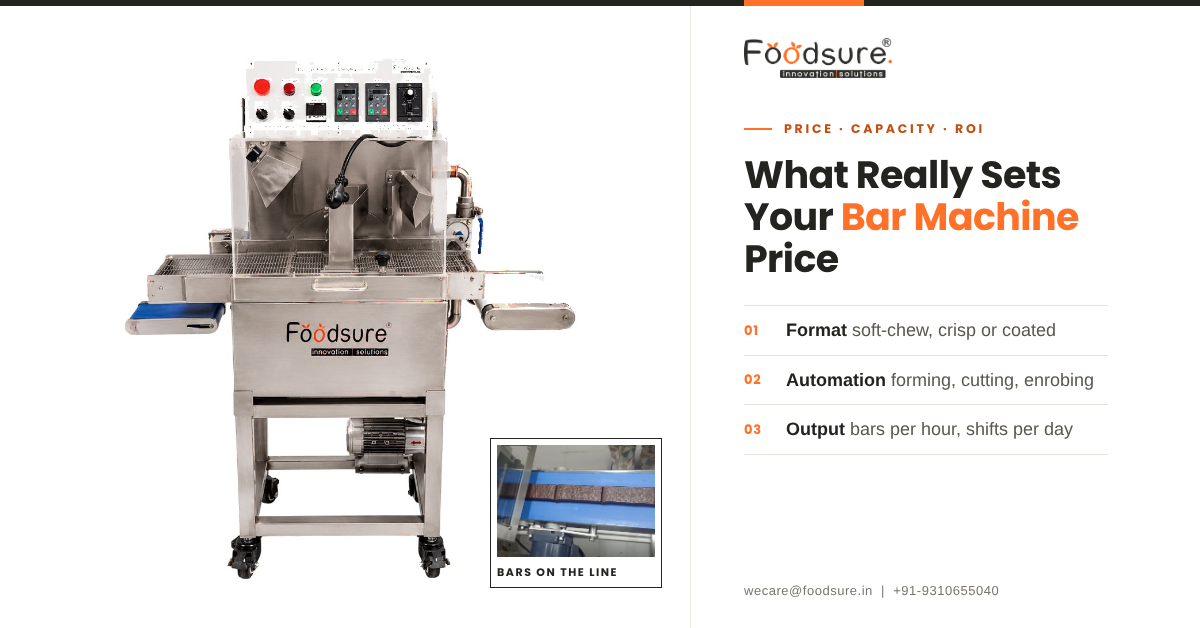
The price of a protein bar manufacturing machine depends on its capacity, automation level, construction, forming technology and the number of operations included in the line.
There is no single verified price that applies to every protein bar machine. A basic forming unit and a complete automatic production and packaging line are different investments, even when both are marketed as protein bar manufacturing equipment.
For an accurate protein bar machine price, ask the manufacturer for a quotation based on your product recipe and expected output.
What determines the price of a protein bar machine?
| Price factor | How it affects your investment |
| Production capacity | Higher hourly output may require larger or faster equipment. |
| Automation level | Automatic feeding, forming, cutting and packaging can increase the initial cost. |
| Product recipe | Sticky, soft, firm or coated bars may require different equipment arrangements. |
| Material and construction | Food-contact materials and the machine’s build affect cost and cleaning requirements. |
| Packaging system | Individual wrapping, sealing and date coding add to the total line cost. |
| Installation and training | Commissioning, operator training and after-sales support may be quoted separately. |
| Import and logistics costs | Freight, duties, local taxes, installation travel and spare parts can affect the delivered cost. |
How much does a protein bar manufacturing plant cost?
The cost of the complete plant can be higher than the machine price alone. Your project budget may also need to cover:
- Factory preparation, electrical connections and utilities.
- Ingredient handling, storage and weighing equipment.
- Packaging materials and finished-product storage.
- Product formulation, testing and shelf-life studies.
- Licences, registrations and compliance requirements.
- Staff training, initial ingredients and working capital.
For businesses in Nepal, Sri Lanka and Bangladesh purchasing equipment from India or another country, request the delivered price in writing. Confirm whether freight, customs duties, taxes, installation, commissioning and operator training are included.
Foodsure Machines can be approached for a quotation based on the required output, product type and level of automation. Ask for a breakdown of the machinery, included accessories, electrical requirements, installation and ongoing support instead of comparing suppliers on the headline price alone.
Protein Bar Machine Capacity: Which Production Size Should You Choose?
Capacity is one of the most important factors when buying a protein bar machine. If you buy a machine that is too small, it may struggle to meet future orders. If you buy a line that is too large, you may pay for production capacity you cannot use.
For initial planning, manufacturers can compare production requirements against the following illustrative capacity levels.
| Nominal production capacity | Possible business use | What to consider |
| 50 kg/hour | New brands, small factories and local distribution | Lower production volume and room to test demand |
| 100 kg/hour | Growing brands, contract manufacturing and wider retail distribution | A balance between production volume and investment |
| 200 kg/hour | Established manufacturers and large-volume supply contracts | Greater demand, working capital and downstream packaging capacity |
These are planning scenarios, not a claim that every machine offers these capacities. Confirm the actual rated output, supported recipes and tested production rate with the equipment supplier.
How many protein bars can a machine produce per hour?
The number of bars produced depends on the weight of each bar and the machine’s actual output in kilograms per hour.
The basic calculation is:
Barsperhour=Outputinkg/hour1,000Weightperbaringrams
For example, consider a machine rated at 100 kg/hour producing bars weighing 40 grams.
1001,00040=2,500
The theoretical output is 2,500 bars per hour.
This does not mean the factory will consistently produce 2,500 saleable bars every hour. Mixing, material feeding, changeovers, cleaning, cooling, packaging and rejected products can reduce the actual output.
How Does a Protein Bar Manufacturing Machine Work?
A protein bar production line typically follows these stages, although the exact process depends on the recipe and equipment configuration.
- Ingredient weighing and mixing
Protein powders, oats, sweeteners, binders and other ingredients are weighed and mixed until the required consistency is achieved. Correct mixing helps maintain a uniform texture and ingredient distribution.
- Forming or extrusion
The prepared mixture is shaped into a continuous slab, rope or another suitable form. The method depends on the recipe and machine design.
- Cutting and sizing
The formed mixture is cut into individual bars of the required length and weight. Consistent sizing helps with packaging and portion control.
- Cooling or finishing
Depending on the product, bars may need cooling, setting or chocolate coating before packaging. Not every recipe requires the same finishing process.
- Packaging and quality checks
Finished bars are wrapped, sealed and checked for weight, appearance and packaging quality. Date coding and batch identification should be included where required.
Before buying, check whether the quoted price covers all these stages or only the forming and cutting equipment. A supplier may quote for a single machine rather than a complete protein bar production line.
How to Choose the Right Protein Bar Machine for Your Business
The best protein bar machine is not necessarily the one with the highest capacity. It is the one that can handle your recipe, produce the required quality and fit your sales plan.
Consider the following before making a purchase.
- Finalise your product recipe. Decide whether you will manufacture whey protein bars, plant-based bars, cereal protein bars, date-based bars or chocolate-coated products. Different mixtures behave differently during forming and cutting.
- Estimate monthly sales. Calculate how many bars you realistically expect to sell through gyms, distributors, retail outlets and online channels. Use confirmed orders and market testing where possible.
- Check actual production capacity. Ask the supplier to demonstrate the machine with a recipe similar to yours. Confirm bar weight, dimensions, output per hour and the level of wastage.
- Review the packaging arrangement. Packaging speed should match production speed. Otherwise, finished bars may accumulate between the forming line and the packaging machine.
- Check cleaning and maintenance. Protein mixtures can contain sticky syrups, oils, nuts and powders. Ask how the equipment is cleaned, how frequently parts need maintenance and whether replacement parts are available locally.
- Compare complete quotations. Review the machine price, electrical load, installation, training, warranty, spare parts and after-sales support.
- Plan for future products. If you intend to launch energy bars or other high-protein snacks later, discuss the range of products the proposed line can handle. Do not assume that one machine will process every recipe without changes.
Which machine should you consider?
- Protein bar machine: For producing shaped protein bars in the sizes and formats supported by the equipment.
- High Protein Snack Machine: For businesses exploring a wider range of high-protein snack products.
- Energy Bar Machine: For energy bar recipes that may use different ingredient ratios, binders and forming methods.
These terms are useful when researching equipment, but the machine’s technical specifications and recipe compatibility matter more than its name.
Protein Bar Machine ROI: How to Calculate Your Return on Investment
Return on investment (ROI) helps you understand whether the money invested in machinery is generating enough profit to justify the cost.
For a protein bar manufacturing business, ROI depends on much more than production capacity. You need to consider the selling price, the cost of ingredients, packaging, labour, electricity, maintenance and how many bars you can actually sell.
A machine with a high output may still deliver a poor return if orders are low or production costs are too high.
What costs should you include in your ROI calculation?
| Cost or revenue factor | What to include |
| Initial investment | Machinery, installation, electrical work and other setup costs |
| Revenue | Saleable bars sold multiplied by the net selling price per bar |
| Ingredients | Protein powder, oats, binders, sweeteners, nuts and other ingredients |
| Packaging | Wrappers, cartons, labels, coding and secondary packaging |
| Production costs | Labour, electricity, cleaning and maintenance |
| Distribution costs | Freight, warehousing, distributor margins, commissions and returns |
| Other expenses | Rent, marketing, testing, administration, interest and taxes where applicable |
The most useful starting point is your contribution per bar. This is the money left after subtracting variable costs from the net selling price. It must still cover fixed costs and the investment in the factory.
Protein bar manufacturing ROI example
Consider a hypothetical small-to-medium protein bar business in India. The numbers below are assumptions for demonstrating the calculation, not actual Foodsure customer results or a market-wide profit benchmark.
| Business assumption | Illustrative figure |
| Total initial investment | ₹18,00,000 |
| Saleable bars sold per month | 44,000 |
| Net selling price per bar | ₹25 |
| Variable cost per bar | ₹22 |
| Contribution per bar | ₹3 |
| Monthly contribution | ₹1,32,000 |
| Monthly fixed operating costs | ₹80,000 |
| Estimated monthly operating profit | ₹52,000 |
In this example, the business sells 2,000 bars per working day over 22 days each month.
The monthly operating profit is calculated as:
44,000(₹25-₹22)-₹80,000=₹52,000
The simple payback period would be:
₹18,00,000₹52,00034.6months
That is approximately 35 months, assuming the business maintains the same sales volume, contribution and fixed costs.
This calculation excludes financing costs, taxes, depreciation and unexpected expenses. The initial investment is also assumed to cover the entire setup, not just the machine.
What happens if sales increase?
If the same business sells 60,000 bars per month at the same ₹3 contribution per bar and fixed costs remain ₹80,000, monthly operating profit becomes ₹1,00,000. The simple payback period on the same ₹18 lakh investment would fall to 18 months.
This is a sensitivity example, not a sales forecast. Actual results will depend on demand, discounts, ingredient prices, production efficiency and operating costs.
The lesson is straightforward: buying a higher-capacity protein bar machine does not automatically improve ROI. The extra production must translate into additional profitable sales.
Use this formula to calculate your own ROI
\[ \text{Monthly operating profit} = (\text{Bars sold}\times\text{Contribution per bar}) -\text{Fixed monthly costs} \]
Simplepaybackinmonths=TotalinitialinvestmentMonthlyoperatingprofit
If you want to express annual operating return as a percentage of the initial investment, you can use:
AnnualoperatingROI=AnnualoperatingprofitInitialinvestment100
Use consistent accounting assumptions when comparing options. For a more complete investment decision, also consider working capital, loan repayments, depreciation, taxes and cash flow.
Protein Bar Manufacturing in India, Nepal, Sri Lanka and Bangladesh
South Asian manufacturers should not use the same financial assumptions for every country. Ingredient sourcing, consumer spending, electricity, imports, distribution and food regulations can differ considerably.
India
India offers a large food processing ecosystem, along with access to ingredient suppliers, packaging companies, retail channels and contract manufacturing opportunities.
The Government of India’s Ministry of Food Processing Industries publishes annual reports on the sector, while the Press Information Bureau provides updates on government schemes and industry developments. These are useful starting points for checking official industry information and potential support programmes.
For a new Indian protein bar business, focus on:
- Choosing a target customer before finalising the product.
- Comparing the cost of whey-based and plant-based recipes.
- Checking applicable FSSAI requirements and food labelling rules.
- Evaluating direct-to-consumer sales alongside gyms, retailers and distributors.
- Confirming machinery installation, training and after-sales support.
Nepal
Businesses in Nepal should estimate the cost of bringing machinery into the country, including freight, customs duties, taxes and any installation travel.
A local brand might start with a limited range of bars for gyms, specialist shops, online customers or selected retail outlets before investing in a larger line.
Before placing an order, confirm whether spare parts and technical assistance can be provided within a practical timeframe. Build the expected landed cost into the ROI calculation rather than using the Indian ex-factory price alone.
Sri Lanka
Sri Lankan manufacturers should assess local demand, the availability and cost of ingredients, packaging expenses and the economics of distributing products through retail or online channels.
For businesses considering imported protein powders or machinery, currency movements and import-related costs can affect margins. A financial model should therefore include a contingency for changes in input costs.
Confirm the food safety, product registration and labelling requirements that apply to the intended product and sales channel before commercial production.
Bangladesh
Bangladeshi manufacturers may consider protein bars for specialist nutrition stores, gyms, online brands and selected retail channels.
Before investing in a high-capacity machine, test product acceptance and pricing with the intended customer group. Businesses importing equipment should also calculate freight, customs duties, taxes, local electrical requirements and spare-parts availability.
Food safety, labelling and any applicable import or product approval requirements should be checked with the relevant Bangladeshi authorities.
What all four markets have in common
Regardless of the country, a sensible investment plan should answer these questions:
- Who will buy the bars, and at what price?
- Can the required ingredients be sourced consistently?
- What is the real cost of producing and packing one saleable bar?
- Can the business secure enough repeat orders to use the machine efficiently?
- Will local compliance and packaging requirements affect the product design?
- Can the supplier support the machine after installation?
Country-specific regulatory advice should come from the relevant authorities or a qualified local compliance professional. Requirements can vary by formulation, claims, product category and intended market.
Why Consider Foodsure Machines for Protein Bar Manufacturing?
Choosing the right machinery supplier is as important as selecting the production capacity. A suitable machine should match your product recipe, production target, available factory space and long-term business plans.
Foodsure Machines provides food processing machinery and production solutions for businesses developing and scaling packaged food products. When evaluating a protein bar manufacturing machine, discuss your complete production requirements rather than requesting a quotation based only on hourly capacity.
Before finalising your investment, ask Foodsure Machines about:
- Production capacity: The available configurations and expected output for your required bar weight.
- Product compatibility: Whether the machine can handle your specific protein mixture, binder and texture.
- Food-contact construction: The materials used on surfaces that come into contact with ingredients and finished products.
- Automation and packaging: Whether forming, cutting, cooling and individual packaging are included or supplied separately.
- Installation and training: The support provided during commissioning and operator training.
- After-sales service: Warranty terms, spare parts, maintenance requirements and technical assistance.
Foodsure Machines can be included in your supplier comparison when you are planning a new production line or expanding an existing food manufacturing facility. Request machine specifications, a detailed quotation and a production trial using your intended recipe before making a final decision.
Common Mistakes to Avoid When Buying a Protein Bar Machine
Even a well-equipped factory can struggle if the machinery investment is not aligned with the business plan.
Buying more capacity than you need. A large machine can increase the initial investment and operating costs without improving profitability if demand is limited.
Ignoring the recipe during machine selection. A machine that handles one type of protein mixture may not produce the same results with another. Test the actual formulation before committing.
Comparing only the machine price. Installation, packaging, utilities, transport and working capital can significantly increase the total project cost.
Overestimating sales. A machine’s rated output is not the same as the quantity you can sell each month. Base your financial calculations on realistic demand.
Ignoring packaging and shelf life. A well-formed bar still needs suitable packaging and a validated shelf life. Product stability depends on its ingredients, moisture, processing, storage conditions and packaging.
Choosing a supplier without checking support. Ask about spare parts, maintenance, warranty coverage and technical assistance before placing the order.
Conclusion
Investing in a protein bar machine requires more than comparing prices and production capacities. You need to understand your recipe, estimate realistic sales, calculate the cost per bar and choose equipment that supports your production goals.
For manufacturers in India, Nepal, Sri Lanka and Bangladesh, a practical approach is to begin with a clear market plan, compare suitable machine configurations and calculate the complete cost of setting up the production line.
Foodsure Machines can be part of that evaluation process. Request machine specifications, a detailed price quotation and a production trial to determine which configuration suits your business.
Planning a protein bar manufacturing unit? Contact Foodsure Machines to discuss your required production capacity, product formulation and machinery requirements before making your investment.
Frequently Asked Questions
What is the price of a protein bar machine in India?
The price depends on production capacity, automation, recipe compatibility, packaging equipment and installation requirements. A single forming machine will have a different price from a complete automatic production line. Request an itemised quotation from Foodsure Machines based on your intended output and product type.
What is the production capacity of a protein bar manufacturing machine?
Capacity varies by model and configuration. For initial planning, manufacturers can compare 50 kg/hour, 100 kg/hour and 200 kg/hour production scenarios. Actual output depends on the recipe, bar weight, machine settings, operating time and packaging speed. Confirm the tested capacity with the supplier.
How many protein bars can a 100 kg/hour machine produce?
For 40-gram bars, a machine producing 100 kg/hour would theoretically make 2,500 bars per hour. Actual saleable production may be lower because of downtime, cleaning, material losses and packaging limitations.
Is protein bar manufacturing profitable in India?
It can be profitable if the selling price covers ingredients, packaging, labour, utilities, distribution and other operating expenses. Profitability depends on demand and contribution per bar, not just the number of bars a machine can produce. Prepare a financial model using your own supplier quotations and sales estimates.
Can a protein bar machine produce energy bars too?
Some equipment configurations may be suitable for both products, but compatibility depends on the formulation and forming method. Ask the supplier to test both recipes before assuming that one machine can produce every type of bar.
What is the difference between a protein bar machine and a high protein snack machine?
A protein bar machine is designed to form and cut protein bar mixtures into individual bars. A high protein snack machine may serve other snack formats, depending on its design. The correct choice depends on the product you intend to manufacture.
What is the difference between a protein bar machine and an energy bar machine?
Protein bars are generally formulated to provide protein, while energy bars are commonly designed to provide energy through carbohydrates and other ingredients. The recipes and processing requirements can overlap, but the machinery must be checked for compatibility with the specific product.
Is an automatic protein bar production line worth the investment?
An automatic line may be worthwhile when order volumes justify the additional cost and the business needs consistent output with less manual handling. For a new brand with uncertain demand, a smaller or semi-automatic setup may be more appropriate. Compare the total investment against realistic sales and labour savings.
What should manufacturers in Nepal, Sri Lanka and Bangladesh check before importing a protein bar machine?
They should calculate the landed cost, including freight, customs duties, taxes, installation and other applicable charges. They should also confirm electrical compatibility, local compliance requirements, spare-parts availability and the supplier’s after-sales support.
How long does it take to recover the investment in a protein bar machine?
There is no fixed payback period. It depends on the total investment and monthly operating profit. Calculate payback by dividing the initial investment by monthly operating profit, using realistic sales and cost assumptions.




