
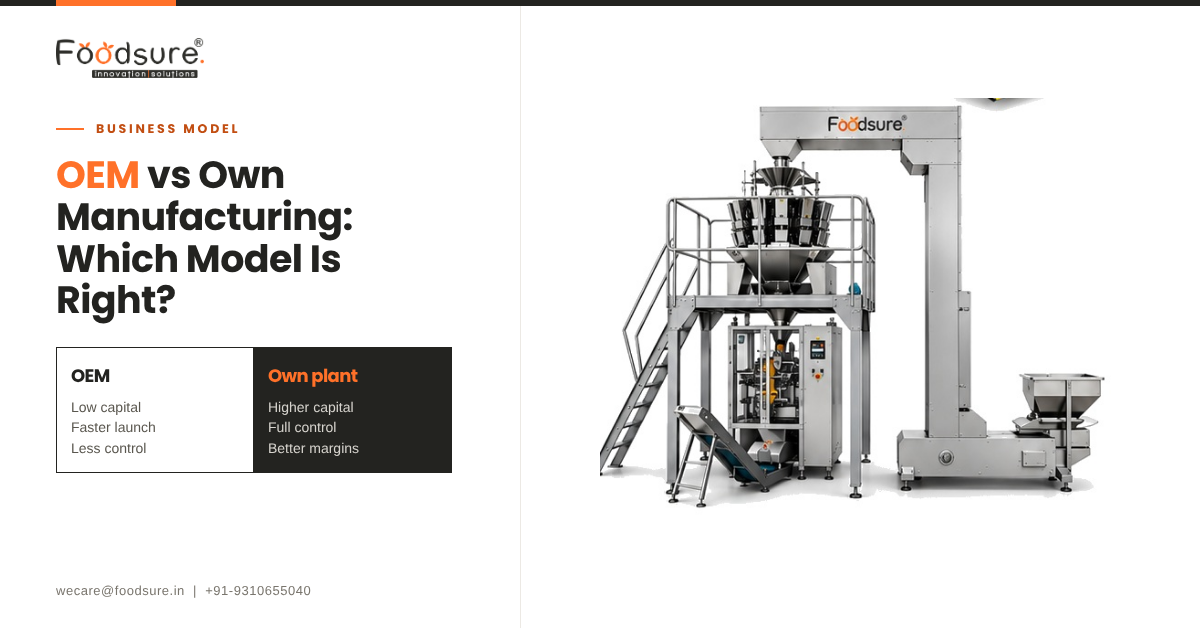
Launching a food product requires more than a good recipe. You need to decide how to manufacture it, maintain consistent quality, manage costs and meet customer demand.
For a food brand in India, Nepal, Bangladesh or Sri Lanka, there are two common options. You can work with an Original Equipment Manufacturer (OEM) or contract manufacturing partner, or you can invest in your own production facility.
Both options have advantages. OEM manufacturing can help you enter the market without purchasing an entire production line. Own manufacturing gives you greater direct control over production, equipment, quality checks and capacity.
The right choice depends on your budget, expected sales, product type, production volume and long-term business plans.
For example, a startup launching a protein snack may prefer contract manufacturing while testing its product. An established brand receiving regular orders may consider investing in a high protein snack manufacturing machine to bring production in-house.
However, buying machinery does not automatically make manufacturing cheaper. You must also account for installation, raw materials, labour, packaging, maintenance and the cost of running the factory.
This guide compares OEM vs own manufacturing, explains the costs and risks of both models, and helps food businesses across South Asia decide which approach suits their needs.
OEM vs Own Manufacturing at a Glance
| Factor | OEM Manufacturing | Own Manufacturing |
| Initial investment | Generally lower | Generally higher |
| Factory space | Usually not required | Required |
| Machinery purchase | Usually handled by the manufacturer | Your responsibility |
| Production control | Shared with the manufacturing partner | Direct |
| Speed to market | Often faster | Requires setup and commissioning |
| Daily operations | Mainly managed by the partner | Managed by your team |
| Quality control | Depends on the agreement and partner’s systems | Directly managed by your team |
| Production capacity | Depends on available partner capacity | Depends on your equipment and operations |
| Manufacturing expertise | Less in-house expertise needed initially | Technical expertise required |
| Long-term assets | Limited manufacturing assets | Potential ownership of machinery and infrastructure |
| Best suited for | Testing demand and entering the market | Businesses with suitable demand and resources |
OEM manufacturing generally reduces the burden of establishing a factory. Own manufacturing requires a larger operational commitment but gives you more direct control over how products are made.
Neither option is automatically more profitable. The decision should be based on the actual cost of producing and selling your product.
What Is OEM Manufacturing?
OEM manufacturing is an arrangement in which a third-party manufacturer produces products for a brand according to agreed specifications.
In the food industry, businesses also use the terms contract manufacturing and private-label manufacturing. These arrangements can overlap, but they are not always identical.
A brand may provide its own formulation, ingredients, packaging design and product specifications. Depending on the agreement, the manufacturing partner may also assist with product development, sourcing, processing, testing and packaging.
Consider a business in Bangladesh that wants to launch a high-protein snack.
The business may already have its brand name, product concept, packaging design and distribution plan. However, it may not have the industrial mixer, extrusion or forming equipment, cooling system and packaging machinery needed for commercial production.
Instead of setting up a factory immediately, the brand can approach a suitable contract manufacturer.
The manufacturer produces the agreed quantity using its existing facilities, while the brand concentrates on product positioning, marketing, sales and distribution.
How OEM Manufacturing Works
The exact process depends on the product and manufacturer, but a typical workflow includes the following stages.
- Product development: Finalise the recipe, ingredients, nutritional targets, texture and other product requirements.
- Sample production: Produce samples and check taste, appearance, weight, texture and packaging compatibility.
- Testing and approval: Review the product against agreed specifications and arrange suitable nutritional, microbiological or shelf-life testing.
- Commercial production: Manufacture the approved product in the agreed quantity.
- Packaging and dispatch: Pack the product, complete the required documentation and arrange delivery.
Not every OEM provides formulation or testing services. Confirm what is included before signing an agreement.
OEM manufacturing can be particularly useful when a business wants to test several product ideas without investing in separate production lines for each one.
What Is Own Manufacturing?
Own manufacturing means your business owns or directly operates the facility where its products are made.
You may purchase the machinery, rent or own the factory space, hire production workers and manage the complete manufacturing process.
For a food business, this can involve:
- Factory space and electrical infrastructure
- Processing and packaging machinery
- Raw material and finished product storage
- Production staff and technical supervision
- Cleaning, sanitation and quality checks
- Equipment maintenance and spare parts
- Packaging procurement and inventory management
- Regulatory compliance and production records
The exact requirements depend on the product.
A company producing protein snacks, for example, may need equipment for mixing, extrusion or forming, cutting, cooling and packaging. A makhana business may require grading, roasting, flavouring and packing equipment instead.
Owning the facility gives the business more direct control, but it also makes the business responsible for keeping the entire production system working efficiently.
A machine that remains idle for much of the month still represents invested capital, even when sales are low.
OEM vs Own Manufacturing: Which Costs More?
Initial investment is one of the biggest differences between the two models.
With OEM manufacturing, you generally pay for product development where applicable, manufacturing, packaging and other agreed services. You avoid the immediate expense of buying an entire production line.
With own manufacturing, you must budget for both the equipment and the infrastructure needed to operate it.
Costs Involved in OEM Manufacturing
Depending on the contract, your expenses may include:
- Product development and sampling
- Ingredients and packaging materials
- Manufacturing charges
- Minimum order quantities (MOQs)
- Product testing
- Transport, storage and distribution
- Artwork changes or special packaging requirements
The main financial advantage is that you can often begin production without making a large investment in factory infrastructure.
However, MOQs can create cash-flow pressure. You may have to pay for more stock than you can sell quickly, and your product’s manufacturing cost will depend on the supplier’s pricing and contract terms.
Costs Involved in Own Manufacturing
A factory budget needs to cover more than the price of machinery.
| Cost category | What to consider |
| Premises | Rent, deposit, construction or renovation |
| Machinery | Processing, handling and packaging equipment |
| Installation | Electrical connections, commissioning and other site work |
| Utilities | Electricity, water, ventilation and other operating requirements |
| Labour | Operators, supervisors, quality staff and maintenance workers |
| Raw materials | Ingredients, processing losses and inventory |
| Packaging | Pouches, wrappers, labels, cartons and other materials |
| Quality and compliance | Testing, hygiene systems, records and applicable approvals |
| Maintenance | Spare parts, servicing and unexpected repairs |
| Working capital | Money needed to operate before customer payments arrive |
The total investment varies according to product type, production capacity, automation level, factory location and equipment specifications. There is no single factory setup cost that applies to every food business.
Fixed Costs vs Variable Costs
Understanding fixed and variable costs helps you compare both models more accurately.
Fixed or semi-fixed costs may include factory rent, permanent salaries, insurance and equipment depreciation. These expenses can continue even when production slows.
Variable costs generally change with production volume. Examples include ingredients, packaging and some processing or manufacturing charges.
OEM manufacturing may shift a larger share of your costs towards each production order. Own manufacturing adds more direct responsibility for fixed costs, although raw materials, packaging and other variable expenses remain.
For a fair comparison, calculate the total cost of producing and delivering a saleable unit under both models. Do not compare an OEM quotation with the machinery purchase price alone.
When Should You Invest in a High Protein Snack Machine?
This is an important question for brands planning to manufacture protein snacks, nutrition bars or other high-protein food products.
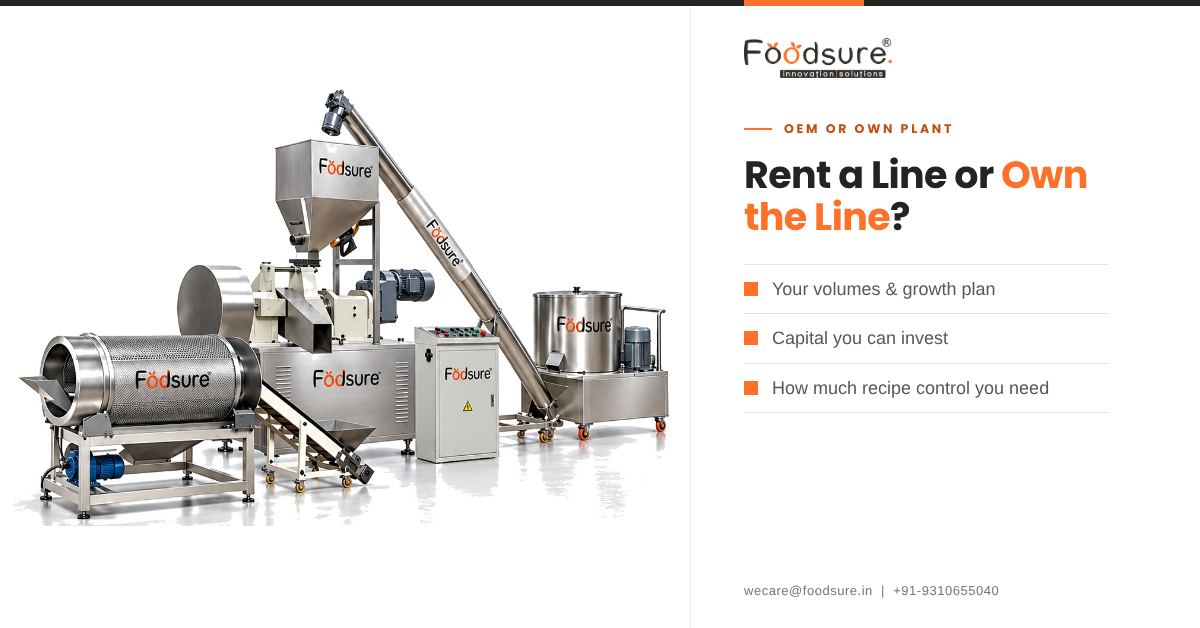
A high protein snack machine can help a business establish its own production process instead of depending entirely on a third-party manufacturer. However, the right investment depends on the product being made and the volume you expect to sell.
Before purchasing a high protein snack manufacturing machine, answer these questions:
- Do you already have regular orders or are you still testing demand?
- How many units do you expect to sell each month?
- What is the current cost per unit from your contract manufacturer?
- What would your own production cost be after including labour, ingredients, packaging, utilities and maintenance?
- Do you have the space, power supply and trained operators required?
- Can the machinery handle your formulation, texture and required output?
- Will the investment leave enough working capital for marketing, distribution and inventory?
If demand is still uncertain, OEM manufacturing may help you test the market before committing significant capital.
If orders are consistent and the cost comparison supports bringing production in-house, investing in suitable equipment may be worth evaluating.
Choosing Equipment for Different Food Products
Not all snack manufacturing machines perform the same function. Your product and process should determine which equipment you need.
- High Protein Snack Machine: Relevant for businesses developing suitable high-protein snack products. The equipment configuration depends on the recipe and whether the product is extruded, formed, baked or processed through another method.
- Protein Bar Machine: Relevant for brands producing protein bars that require operations such as mixing, forming or slab shaping, cutting, cooling and packaging, depending on the formulation.
- Makhana Machine: Relevant for businesses processing fox nuts, including operations such as roasting, flavouring and packaging. The required machinery depends on whether the business buys raw makhana or performs earlier processing steps as well.
- Soya Badi Machine: Suitable for businesses planning commercial soya chunks or soya badi production. The production line may include mixing, extrusion, drying and packaging equipment, depending on the process.
- Popcorn Machine: Relevant for brands producing flavoured or packaged popcorn. Commercial operations may involve popping, seasoning, conveying and packing equipment.
For a brand planning its first production facility, it is important to understand the complete process rather than selecting a machine based on output claims alone.
Foodsure Machines offers food-processing machinery options for businesses evaluating in-house production. When comparing equipment, ask for the specifications, intended product, rated capacity, utility requirements, installation details and support available for your proposed production line.
The aim is to select machinery that matches realistic demand, not simply the largest available capacity.
Which Model Is Better for Food Brands in South Asia?
India, Nepal, Bangladesh and Sri Lanka share regional trade connections, but food businesses in these markets do not all face the same operating conditions.
Factory costs, access to ingredients, packaging suppliers, electricity supply, transport expenses, local regulations and distribution networks vary by location. These factors should be included in the manufacturing decision rather than relying on broad regional assumptions.
OEM vs Own Manufacturing in India
For an Indian food brand, OEM manufacturing can be useful when launching a new product or testing demand in a particular region.
A startup may prefer to spend its available capital on product development, branding, distribution and customer acquisition instead of setting up a complete factory.
Own manufacturing becomes worth evaluating when production requirements are predictable and the business has enough capital and technical support to operate its own facility.
Indian businesses must also account for applicable food safety and licensing requirements. The Food Safety and Standards Authority of India (FSSAI) provides official guidance on food business licensing and registration through its business registration and licensing resources.
OEM vs Own Manufacturing in Nepal
For Nepalese food brands, the decision should account for the location of the factory, access to machinery and spare parts, ingredient sourcing, transportation and the market the business intends to serve.
A company launching a new packaged snack may find it practical to work with a suitable contract manufacturer while developing its sales network.
A business with stable demand may later evaluate a local production line if the total cost of manufacturing, servicing equipment and distributing products supports the investment.
Before setting up a facility or outsourcing production, check the applicable requirements with Nepal’s Department of Food Technology and Quality Control and other relevant authorities. Do not assume that a manufacturer’s existing approvals automatically cover your own business or product.
OEM vs Own Manufacturing in Bangladesh
Bangladeshi brands can compare both models by looking at product demand, supplier capability, manufacturing costs and distribution requirements.
For example, a business introducing a high-protein snack could begin with contract manufacturing to understand customer response and the size of repeat orders.
Once demand becomes more predictable, the company can compare the ongoing OEM cost with the complete cost of operating its own production line.
Food safety obligations also need to be checked. The Bangladesh Food Safety Authority publishes food-related laws and regulations, including requirements relevant to food businesses and product claims. Brands should consult the official BFSA laws and regulations for applicable requirements.
OEM vs Own Manufacturing in Sri Lanka
Sri Lankan food businesses should consider the product’s target market, access to raw materials, packaging availability, production requirements and the cost of distributing finished goods.
OEM manufacturing can be a useful option for a new brand that wants to establish demand without immediately managing its own production facility.
For established businesses, in-house manufacturing may be worth considering when regular orders justify the machinery, staffing and operating expenses.
Before making a decision, confirm the relevant food manufacturing, hygiene, labelling and licensing requirements with the appropriate Sri Lankan authorities. Requirements can vary according to the product and business activity.
What About Selling Across Borders?
A product manufactured in one South Asian country may be intended for sale in another country or for export beyond the region.
In such cases, manufacturing decisions should account for more than production cost. Import requirements, food labelling, product testing, shelf life, packaging and buyer-specific standards may also affect the final economics.
Do not assume that a product approved for sale in one country automatically meets every requirement in another. Confirm the rules for each destination before finalising the product and manufacturing arrangement.
Which Model Gives You Better Quality Control?
Own manufacturing gives you direct control over machinery, production schedules, operators and process settings. However, this does not automatically mean your products will be better.
Quality depends on the raw materials, recipe, production process, staff training, testing and food safety systems used throughout manufacturing.
A capable OEM partner can maintain consistent production standards if the facility has suitable equipment, trained employees and effective quality controls.
The difference is who manages these responsibilities and how much direct oversight your business needs.
Food Safety and Certifications
Before choosing an OEM partner or setting up your own facility, understand the food safety requirements for your product and target market.
The Food and Agriculture Organization (FAO) explains the role of Good Hygiene Practices and Hazard Analysis and Critical Control Point (HACCP) systems in preventing food safety problems. These practices help businesses identify risks and establish controls throughout food production. Read the FAO’s guidance on GHP and HACCP.
ISO 22000:2018 is an international standard for food safety management systems. It applies to organisations across the food chain and provides a framework for managing food safety risks. Certification is one way to demonstrate conformity, but ISO itself does not certify businesses.
Depending on your product, customers and export destinations, you may also need to evaluate other standards or buyer requirements.
Before finalising an OEM agreement, check:
- Whether the facility has the appropriate food safety systems for your product
- Whether the manufacturer can provide batch records and traceability
- How ingredients and finished products are tested
- How complaints, rejected batches and product recalls are handled
- Which certifications are valid and relevant to your target customers
- Who is responsible for regulatory compliance and product documentation
If you establish your own factory, you will need to build suitable food safety controls into your operations as well.
Common Mistakes to Avoid With OEM Manufacturing
OEM manufacturing reduces some operational responsibilities, but it does not remove every business risk.
1. Choosing a Manufacturer Only on Price
A low manufacturing quotation may look attractive, but compare the complete offer. Check product quality, MOQ, lead times, packaging, testing, payment terms and transport costs.
2. Ignoring Minimum Order Quantities
An order that is too large can tie up money in inventory. Estimate how quickly you can sell the finished products before committing to a large production run.
3. Leaving Product Specifications Unclear
Document the ingredients, product weight, nutritional targets, taste, texture, packaging and acceptable quality limits. Clear specifications reduce the risk of receiving a product that differs from the approved sample.
4. Failing to Protect Product Ownership
Your contract should clarify who owns the formulation, product design, packaging artwork and other intellectual property. It should also address confidentiality and restrictions on using your proprietary information.
5. Not Checking Production Capacity
Ask whether the manufacturer can handle your current order volume and expected growth. Confirm how production slots are allocated during busy periods.
6. Depending on One Supplier Without a Backup Plan
A production delay or supply problem can interrupt sales. Consider whether you need a second qualified manufacturer or another way to protect supply.
Common Mistakes to Avoid With Own Manufacturing
Setting up your own factory brings different risks. Most can be reduced through careful planning before purchasing machinery.
1. Buying More Capacity Than You Need
A larger machine is not necessarily a better investment. If sales do not justify its capacity, you may spend more on equipment, utilities, space and maintenance than necessary.
2. Ignoring Installation and Commissioning Costs
The quoted machine price may not include every cost required to start production. Ask about electrical connections, site preparation, installation, commissioning, operator training and other applicable charges.
3. Underestimating Working Capital
You need money for ingredients, packaging, salaries, utilities and distribution while waiting for customers to pay. Avoid spending your entire budget on machinery.
4. Hiring and Training Too Late
Operators should understand the equipment and production process before commercial manufacturing begins. Plan training and staffing alongside installation.
5. Treating Maintenance as an Afterthought
Ask about preventive maintenance, spare parts, service support and expected servicing requirements. Unplanned downtime can delay orders and increase costs.
6. Ignoring Food Safety From the Beginning
Plan suitable hygiene controls, cleaning procedures, testing, storage and documentation before starting production. Retrofitting these systems later can create additional costs and delays.
Can You Combine OEM and Own Manufacturing?
Yes. A hybrid manufacturing model can work well when a business has different products at different stages of growth.
For example, a snack brand could manufacture its established, high-volume products in-house while outsourcing new flavours or experimental products.
A business could also use OEM manufacturing during the early stages, then gradually bring selected products into its own facility when demand and production economics justify the investment.
This approach can help the company balance production control with flexibility.
However, the hybrid model still requires careful planning. Running two manufacturing arrangements can increase the complexity of inventory management, quality checks, product specifications and supply planning.
When Should You Move From OEM to Own Manufacturing?
There is no universal sales figure or production volume at which every food business should establish its own factory.
The decision depends on the difference between the total cost of outsourcing and the total cost of producing internally.
A practical way to evaluate this is to compare both options using your own sales and cost data.
| What to compare | Questions to answer |
| Demand | Are orders consistent enough to plan production reliably? |
| OEM cost | What is the complete cost per saleable unit, including transport and other charges? |
| In-house cost | What will ingredients, labour, packaging, utilities, maintenance and other operating expenses cost per unit? |
| Investment | How much will machinery, installation and factory preparation cost? |
| Working capital | Can you fund operations and inventory without putting pressure on cash flow? |
| Capacity | Will your expected demand justify the equipment’s usable production capacity? |
| Risk | What happens if sales fall or the machine stops working? |
| Payback | How long could it take for the investment to recover its cost under realistic assumptions? |
For the payback calculation, use realistic production volumes rather than the machine’s maximum rated capacity. Allow for cleaning, changeovers, maintenance, rejected products and periods when the line is not running.
A business should also compare the investment with what the same money could achieve if spent on product development, marketing or distribution.
How Foodsure Machines Fits Into Your Manufacturing Decision
If you are considering moving from outsourced production to your own factory, machinery selection should follow your product requirements and production plan.
Foodsure Machines provides food-processing machinery options for businesses evaluating in-house production. The appropriate equipment depends on the food category, recipe, required output, available space and level of automation.
For example, a business planning to manufacture high-protein snacks can explore a High Protein Snack Machine to understand the equipment required for its intended product and production process.
Other product-specific options include a Protein Bar Machine for suitable bar production, a Makhana Machine for fox nut processing, a Soya Badi Machine for soya-based products and a Popcorn Machine for commercial popcorn production.
These machines serve different manufacturing needs, so they should not be treated as interchangeable equipment.
Before investing, ask the machinery supplier to clarify:
- The products the machine can process
- The expected output under defined operating conditions
- The required ingredients and product characteristics
- Power consumption and other utility requirements
- Installation, commissioning and operator training
- Cleaning, maintenance and spare parts
- Warranty and after-sales support
- Whether additional equipment is needed for a complete production line
For a more accurate decision, compare the complete production setup with the cost of outsourcing the same product. Foodsure Machines can be considered as part of this equipment evaluation, alongside other suppliers that meet your technical and commercial requirements.
The objective is to build a production system that matches your business rather than investing in machinery before you have established what the market needs.
OEM vs Own Manufacturing: Which Is Better for Your Business?
OEM manufacturing is generally a practical starting point for businesses that need to test a product, limit initial capital investment or enter the market without operating a factory.
Own manufacturing can be more suitable when a business has predictable demand, sufficient working capital, suitable technical expertise and a clear reason to manage production directly.
Use OEM manufacturing when:
- You are launching a new product.
- Demand is still uncertain.
- You want to test several product concepts.
- You have limited capital for production infrastructure.
- You want to focus on marketing, sales and distribution.
- Your expected volume does not justify owning a production line.
Consider own manufacturing when:
- You have consistent orders and reliable demand forecasts.
- The complete in-house cost compares favourably with OEM production.
- You can fund machinery, installation and daily operations.
- Direct control over production is important to your business.
- You have access to trained operators and technical support.
- You can use the equipment efficiently and maintain suitable quality systems.
For some brands, the right answer will change as the business grows. OEM manufacturing can be a sensible entry point, while in-house production may become attractive later. A hybrid model may also make sense.
Conclusion
Choosing between OEM and own manufacturing is a business decision based on demand, capital, production costs and the level of control you need.
OEM manufacturing can help food brands in India, Nepal, Bangladesh and Sri Lanka test products without immediately investing in a complete production facility. Own manufacturing becomes worth considering when demand is predictable and the investment can be supported by realistic production and sales forecasts.
If you plan to manufacture high-protein snacks, protein bars, makhana, soya badi or popcorn, first identify the production process and capacity your business actually needs. Then compare the cost of outsourcing with the complete cost of buying and operating suitable machinery.
Foodsure Machines can be part of that evaluation when you are exploring equipment for in-house production.
The goal is not simply to own a factory. It is to choose a manufacturing model that helps your business produce consistent products, manage costs and grow at a sustainable pace.
Frequently Asked Questions
1. What is the difference between OEM and own manufacturing?
OEM manufacturing means a third-party manufacturer produces a product for your brand under agreed specifications. Own manufacturing means your business operates the production facility and manages manufacturing directly.
2. Is OEM manufacturing cheaper than owning a factory?
OEM manufacturing generally requires less upfront investment because you do not need to purchase the entire production line. However, the more economical option depends on production volume, manufacturing charges, logistics, operating costs and equipment investment.
3. Is OEM manufacturing suitable for food products?
Yes. Food brands can use contract manufacturers for snacks, protein bars, sauces, cereals and other processed foods. The manufacturer must have suitable equipment, processes and food safety controls for the specific product.
4. When should a food business start its own manufacturing?
Consider own manufacturing when demand is sufficiently predictable, the expected cost savings justify the investment and the business can fund factory operations without putting cash flow under pressure.
5. How do I calculate the cost of own manufacturing?
Include machinery, installation, factory space, labour, ingredients, packaging, utilities, maintenance, quality checks, depreciation and working capital. Divide the relevant production costs by the number of saleable units produced to estimate the cost per unit.
6. Is a high protein snack machine a good investment for a startup?
A high protein snack machine may suit a startup with a clear product concept, realistic demand forecasts and sufficient capital. If demand is untested, OEM manufacturing can be a useful way to evaluate the product before investing in equipment.
7. What should I check before buying a high protein snack manufacturing machine?
Check the machine’s compatibility with your recipe, output under actual operating conditions, power requirements, installation costs, cleaning requirements, packaging needs, operator training and after-sales support. Ask whether the quoted equipment covers the complete process or only one production stage.
8. What is the difference between a high protein snack machine and a protein bar machine?
A high protein snack machine is a broader search term that can cover equipment for different types of high-protein snacks. A protein bar machine is intended for bar-style products, although its exact functions depend on the configuration. Choose equipment based on the product’s recipe and processing method.
9. Do I need food safety certification to manufacture food?
Applicable legal requirements depend on the country, product and business activity. Additional certifications may be required by particular customers or export markets. Check the relevant authority’s rules and your buyer’s requirements before production begins.
10. Can I use OEM manufacturing and operate my own factory at the same time?
Yes. A business can manufacture established products in-house and outsource new products, seasonal ranges or orders that exceed its available capacity. The arrangement should include clear quality specifications and production responsibilities.
11. Is OEM manufacturing suitable for exports from South Asia?
It can be, provided the manufacturing partner, product and documentation meet the applicable requirements of the destination market. Check labelling, testing, import rules, traceability and any buyer-specific standards before selecting a supplier.
12. How do I choose between OEM and own manufacturing in Nepal, Bangladesh, Sri Lanka or India?
Compare local production costs, supplier availability, logistics, regulatory requirements, expected demand and the complete cost of operating your own facility. Country-specific rules and business conditions should be checked before making the decision.




