
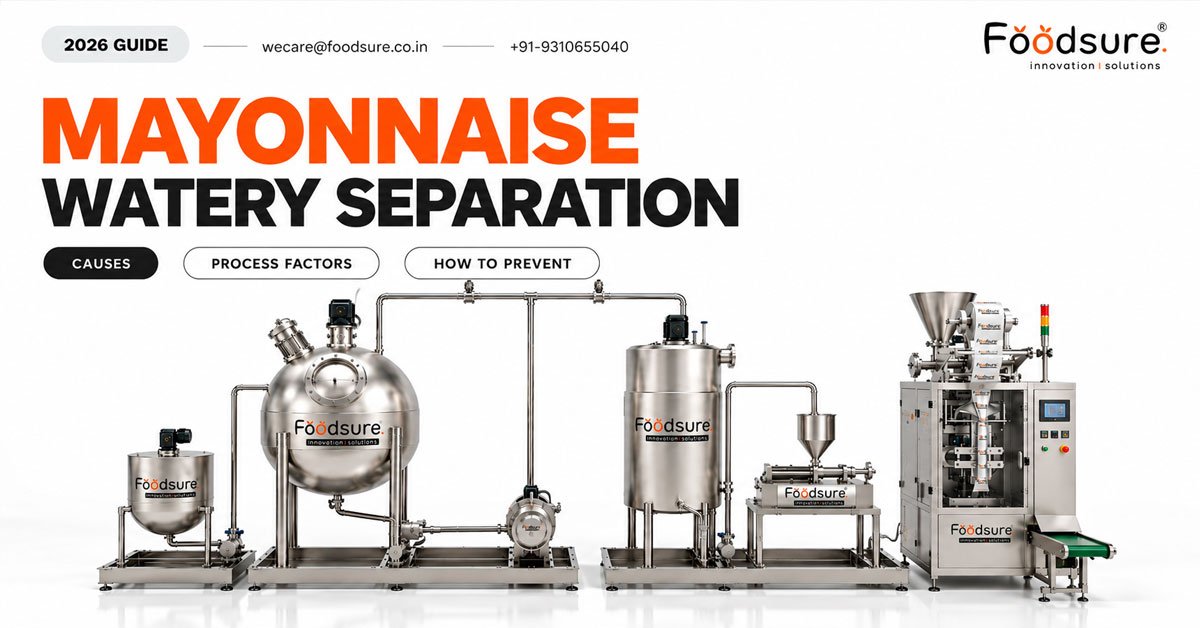
Mayonnaise is an oil-in-water emulsion and requires the correct proportion of oil, water, emulsifiers, and processing conditions to remain creamy. In hot weather, there may be separation of water, oiling off, thinning, or improper texture of the final product. This will have implications for the appearance, packaging, shelf life, and consumer satisfaction with the product.
For commercial food manufacturers, mayonnaise watery separation is not simply a temperature-related issue. This can be attributed to an unstable emulsion, wrong proportions of ingredients, insufficient mixing, wrong processing temperatures, or poor storage conditions. It is important to find out the cause before altering the formulation or manufacturing process.
In India, where temperatures rise significantly during summer months, it is essential for mayonnaise manufacturers to have proper control systems, the right equipment, and storage facilities for the same.
This blog discusses reasons behind the watery nature of mayonnaise in hot weather, methods by which manufacturers can solve the problem of separation, and the importance of proper processing equipment.
What Is Mayonnaise Watery Separation?
Mayonnaise watery separation is when the mayonnaise emulsion becomes unstable, and either watery separation, liquid pockets, or oil separation appears.
In a stable mayonnaise emulsion, the oil droplets are dispersed within the continuous phase of water. In the case where the emulsion becomes unstable, the droplets could merge, and the texture could change.
This would be accompanied by the release of liquid.
Manufacturers need to differentiate between an instance where there is a small amount of liquid from the mayonnaise and one where the emulsion is unstable.
Common warning signs include:
- Presence of a water film at the top or bottom of the container.
- Oil present or oil droplets.
- An unusually thin consistency.
- Uneven texture across different batches.
- Appearance change upon storage or transportation.
- Irregular filling weight or flow during packing.
A product that shows unexpected separation should be assessed against its approved quality specifications. Appearance alone cannot establish whether it is microbiologically safe.
Why Does Mayonnaise Turn Watery in Hot Weather?
Heat may reveal the deficiencies in the emulsion system or make the instability caused by ingredients, processing, and storage worse. The following considerations must be taken into account by commercial producers.
1. Temperature Fluctuations During Storage
The effects of heat and thermal cycling may affect the texture and emulsion stability of mayonnaise. Heat may affect the behavior of ingredients, while temperature variations during storage and transportation may increase stress on the product.
This will depend on the formulation, packaging, manufacturing process, and storage requirements. The heat factor must therefore be considered along with other factors that may cause the problem.
How to fix it:
- Finished goods should be stored at temperatures that have been tested for the specific formulation.
- Conditions of storage and transport should be monitored.
- Ensure that the goods are not unnecessarily exposed to direct sunlight or hot surfaces.
- Storage or transport of goods is used to determine when separation occurs.
Manufacturers should follow their validated food-safety and shelf-life requirements rather than assuming that refrigeration alone will correct an unstable emulsion.
2. Incorrect Oil-to-Water Ratio
The consistency of the mayonnaise is largely based on the ratio of the amount of oil in comparison to that of the water in the formulation. This is because any variation in the amounts of different ingredients in the formula will affect consistency.
This includes variations in ingredients like vinegar, water, oil, eggs, among others.
How to fix it:
- Standardize the quantities of ingredients through weighing procedures that are calibrated
- Adhere to the recommended formulation and the required ingredient specifications
- Monitor the quantities in each batch and investigate any inconsistencies
- Undertake controlled trials before changing the formulation
Any adjustment should be evaluated for taste, texture, emulsion stability, food safety, and shelf life.
3. Insufficient Emulsification
The process of emulsification results in the formation of oil droplets in the water phase. In case of improper droplet distribution from this process, the final product may be inconsistent and prone to instability.
It is not only mixing time that plays an important role in emulsification. The geometry of the mixer, speed of the rotor, batch size, addition rate of the ingredients, and their characteristics are influential as well.
How to fix it:
A processing system that can create the necessary emulsion regularly should be used. The manufacturers need to consider the mixing process, addition of ingredients, and batch consistency.
The right vacuum emulsifying mixer may help provide controlled mixing and emulsification, based on the design of the machine and needs of the product. The vacuum process will assist in removing air, although it doesn’t guarantee prevention of all forms of separation.
4. Incorrect Ingredient Addition Sequence
The sequence in which ingredients are added can impact emulsion formation. Adding the oil too rapidly, adding ingredients haphazardly, or not forming the required initial mixture can lead to an unstable mayonnaise.
This is especially pertinent when a manufacturer is scaling up from a recipe used on a small scale to large-scale production.
How to fix it:
- Establish a sequence on record for adding the ingredients.
- Establish consistency regarding the amount of oil added and how it is mixed.
- Check that the ingredients are prepared and measured accurately.
- Have operators use the same production process each time.
The appropriate sequence should be established through formulation trials and validated process instructions.
5. Unsuitable Emulsifier or Stabiliser System
Emulsifying agents from egg yolk can be used in the production of mayonnaise, and additional ingredients can be added as per the formulation of the product. The efficiency of the emulsifying system will depend upon the quality, amount, compatibility, and processing conditions of the ingredients.
Some formulations may have stabilizing agents as part of their ingredients. However, adding more stabilizer alone does not ensure an emulsification system.
How to fix it:
Check the formula with a qualified food technologist. Ingredient specifications, consistent supply, emulsification capability, and interaction with acidity and other ingredients should be checked.
If there is any modification in the ingredients, it should meet the regulations and requirements for sensory, processability, and shelf life properties.
6. Inadequate Mixing or Poor Batch Uniformity
If the mixer selected is not appropriate for the batch size, the ingredients may remain poorly mixed. Issues could occur if the mixing equipment has insufficient mixing capacity, the working volume is not appropriate, or the operating process varies from one batch to another.
How to fix it:
Examine the capacity of the mixer, mixing system, speed settings, and batch size. Run tests to ensure that the machine is capable of producing mayonnaise consistently within the desired production range.
A commercial mayonnaise making machine should be selected according to formulation requirements and production capacity, not just the advertised motor power.
How Can Manufacturers Prevent Mayonnaise Watery Separation in India?
Preventing mayonnaise watery separation in India requires coordinated control of formulation, processing, hygiene, storage, and packaging. Hot weather makes it especially important to assess how the product behaves throughout manufacturing and distribution.
| Process Area | Common Risk | Recommended Control |
| Ingredient handling | Inconsistent ingredient quality or quantities | Approved specifications and calibrated weighing |
| Emulsification | Poor droplet formation or unstable emulsion | Validated mixing conditions and suitable equipment |
| Batch processing | Variation in mixing time or ingredient addition | Standard operating procedures and batch records |
| Temperature management | Exposure outside validated conditions | Temperature monitoring and controlled storage |
| Filling and packaging | Product inconsistency or poor package integrity | Suitable filling settings and packaging checks |
| Quality control | Separation detected only after distribution | Routine stability checks and documented release criteria |
Producers must look into separation at various times, including right after mixing, right after filling, when stored, and when transported. This will help establish if it happens during processing or somewhere else afterwards.
A quality control program should have proper physical, chemical, and microbiological testing. All this has to be taken into account in the case of mayonnaise, particularly its acidity, formula, and processing.
What Role Does Mayonnaise Processing Machinery Play?
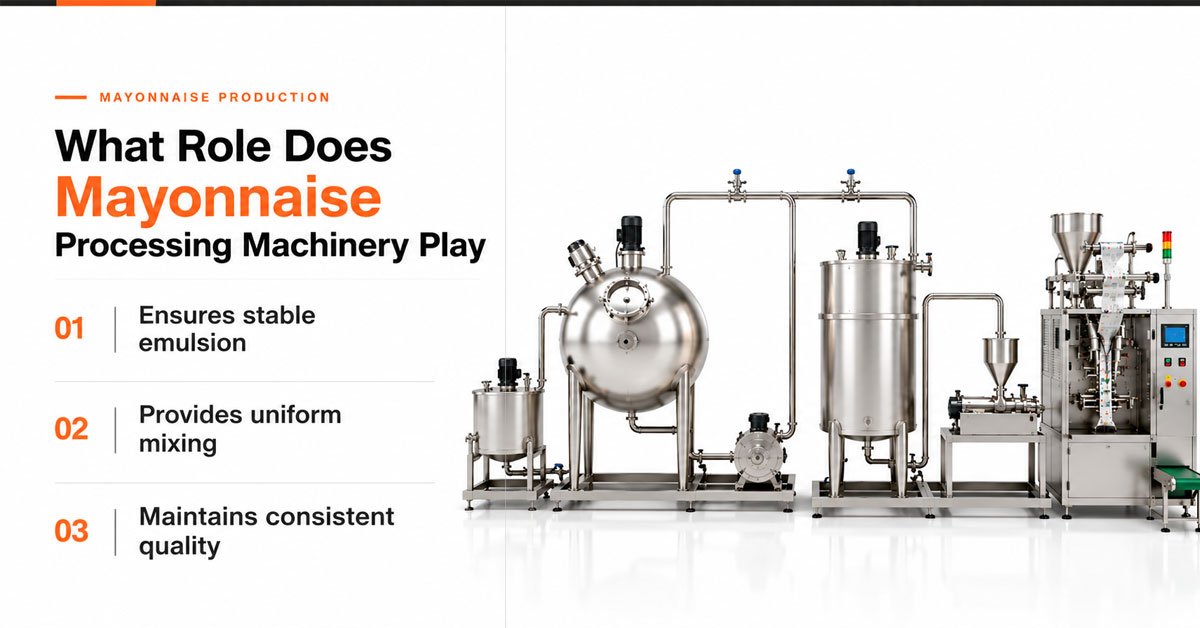
The choice of equipment can affect mixing consistency, batch homogeneity, production efficiency, and the reproducibility of process conditions.
If the firm is having recurring problems with separation, then new equipment might be considered if tests show that the current equipment is not up to the demands of the product. But new equipment alone won’t fix any formulation or storage problems.
Vacuum Emulsifying Mixer
A vacuum emulsifying mixer is engineered to blend components and generate an emulsion under controlled conditions. Depending on its design, it allows controlled ingredient blending and reliable processing.
In considering suitable equipment, a manufacturer should evaluate working capacity, mixing system, speed regulation, temperature control, accessibility for cleaning, and the capability of the vendor to prove the performance with the product formula.
Mayonnaise Production Line
A mayonnaise production line may include ingredient preparation, mixing and emulsification, transfer, filling, and associated processing equipment.
For commercial manufacturers, this production line should be designed based on the required batch size, hourly output, formula, hygiene requirements, and packaging style. The availability of compatible equipment and efficient product flow may minimize process variance.
Mayonnaise Filling Machine
The mayonnaise filling machine ensures that the product is delivered to the package according to the required volume. The filling mechanism needs to be able to meet the viscosity of the mayonnaise and the type of package used.
The filling equipment will not stabilize the unstable emulsion. The product must comply with its approved quality specifications prior to packaging, and the filling equipment must be validated for accurate dosing and hygiene.
Sauce Making Machine
A sauce making machine is a broad term that can refer to equipment used for mixing, heating, emulsifying, or processing different sauces. Not every sauce-processing machine is suitable for mayonnaise.
Businesses need to ensure that the suggested machinery fits the properties of the emulsion of the mayonnaise.
How to Select Machinery for a Mayonnaise Plant Setup
A suitable mayonnaise plant setup should support the entire manufacturing process, from ingredient handling to finished-product packaging.
Prior to buying the machinery, the manufacturers need to establish the formulation of the product, production capacity, schedule, package size, available space, and quality requirements.
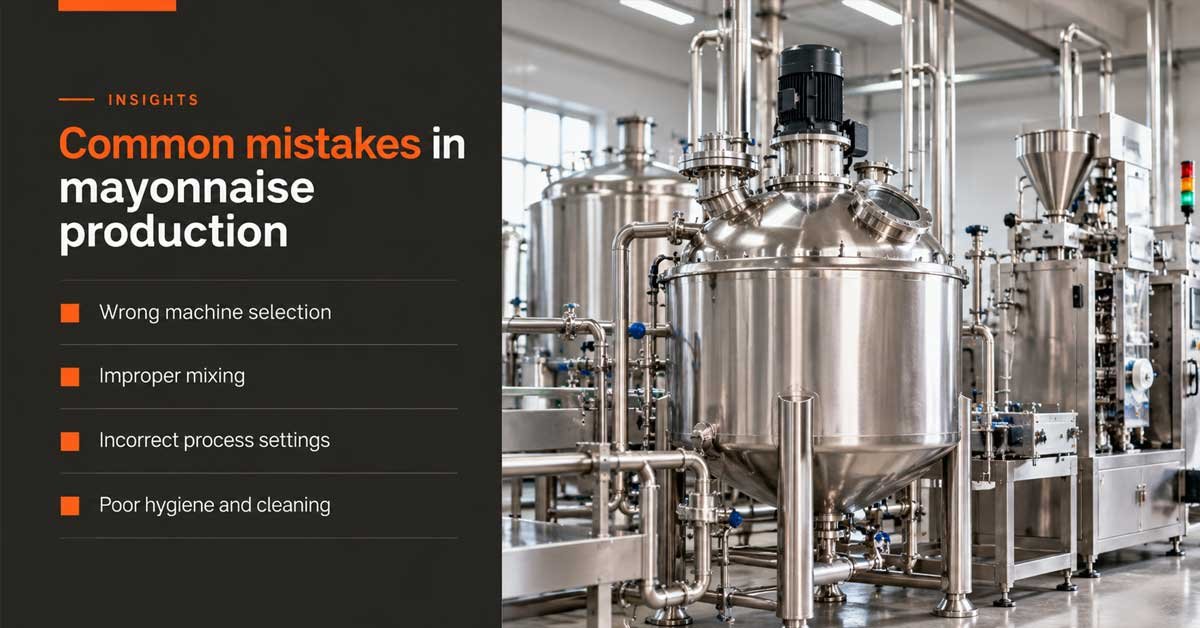
Key selection considerations include:
- Production capacity: See whether the capacity of production of the equipment satisfies the hourly and daily requirement.
- Performance in making emulsion: Test whether the mixer can produce the desired type of texture.
- Control of temperature: See whether processing temperatures can be controlled, if needed.
- Food contact construction: See whether the construction material is proper.
- Cleanability and maintenance: See whether the product contact surfaces are easy to clean.
- Automation: Select which functions can be automated depending on the scale of production and available budget.
- Technical support: Confirm installation guidance, operator training, spare-part availability, and after-sales service.
Small-scale manufacturers could find that a compact system would be better than a completely integrated line. Large manufacturers could consider synchronized systems for mixing, transferring, and filling where there is enough demand to warrant the expense.
Mayonnaise Machine Price and Plant Cost: What Affects the Investment?
Mayonnaise machine price is based on the capacity of the equipment, mixing technique, construction material, automation, and configuration of the machine. A simple mixer would definitely require different conditions compared to a whole manufacturing and packing plant.
The overall mayonnaise plant cost may include:
- Equipment for mixing and emulsifying
- Preparation and transfer of ingredients
- Equipment for filling and packaging
- Installation and electrical needs
- Plant layout and utility considerations
- Testing and quality control equipment
- Training and commissioning
- Maintenance and operating costs
Instead of comparing quotes based on price alone, the manufacturers should evaluate the equipment itself, its capacity, sanitation facilities, warranty, installation coverage, and technical assistance.
Businesses evaluating a mayonnaise machine manufacturer should request detailed specifications and confirm that the proposed equipment suits their formulation and production goals.
Companies planning to buy mayonnaise machine India should also compare service availability, spare parts, commissioning support, and the supplier’s experience with similar food-processing applications. A product trial can help establish whether the machine delivers the required texture and batch consistency.
The phrase mayonnaise watery separation price does not refer to a standard equipment category or a recognised fixed price. If the objective is to resolve separation, the investment should be based on the actual cause, whether it requires process adjustments, formulation development, or machinery upgrades.
Similarly, mayonnaise watery separation manufacturer and buy mayonnaise watery separation are not standard equipment descriptions. Businesses searching these phrases should identify whether they need a mayonnaise processing machine, technical troubleshooting, or support from a food-processing equipment supplier.
Best Mayonnaise Watery Separation 2026: A Practical Troubleshooting Guide
In exploring the best mayonnaise separation 2026 solutions, industry players need to focus more on evidence-based troubleshooting rather than adopting just one solution.
A practical investigation can follow these steps:
- Identify the symptom: Is the product experiencing an occurrence of watery liquid, oil separation, thinning or other texture?
- Check the time frame of appearance: Note whether it occurs just after mixing, during the filling process, or after the storage period.
- Examine Batch Records: Note down the proportion of ingredients used, mixing parameters, and total processing time.
- Examine storage conditions: Examine the storage temperature record.
- Conduct experiments: Make changes to one variable at a time under the guidance of trained staff.
- Conduct quality check on the product: Check the texture, emulsion stability, pH, microbial, and shelf-life properties.
- Conduct corrective action documentation: Make any changes to the approved procedure only when problem-solving is proven successful.
For mayonnaise separation for small business operations, a batch sheet, proper weighing, proper mixing, and proper storage will be useful ways to begin. Small businesses should not think that they need a bigger machine before they look into the formulation and operation.
Conclusion
When mayonnaise becomes runny due to heat, it could be a result of poor stability of the emulsion, formulation, process, or storage. In manufacturing companies, determining the exact cause is better than altering the formulation or processing without any confirmation.
Proper ingredient measurements, proven emulsification techniques, controlled storage, regular quality testing, and proper equipment can minimize the chances of mayonnaise separation. In cases where there is a problem with equipment, using a proper mixer or processing line could provide more consistent mayonnaise production.
For businesses that are planning to build a new factory or upgrade an old one, it is important to consider all these factors at once.
Frequently Asked Questions
Why does mayonnaise become watery in summer?
High temperatures and fluctuating temperatures may be responsible for changes in texture, but there is also a chance that separation could have occurred because of an unstable emulsion, improper ratio of ingredients, or poor processing technique.
Can a mayonnaise making machine prevent watery separation?
Appropriate equipment will aid in the production of a more uniform emulsion if this problem is related to insufficient mixing. This equipment will not solve other problems associated with formulas or storage.
Is a vacuum emulsifying mixer necessary for commercial mayonnaise production?
Not in every case. It all depends on the formulation, the scale of production, the needed texture, and the existing process. Manufacturers need to test the equipment performance before buying.
What affects mayonnaise machine price in India?
Factors like capacity, mixing technology, automation, construction materials, built-in equipment, and installation requirements may affect the cost. The complete quotation should be examined before proceeding with the purchase.
What should businesses check before expanding mayonnaise production?
It is important to examine the stability of products, consistency of batches, practical equipment capacity, cleanliness, storage, filling performance, and quality control methods. Expansion must be made from a process that has already proven its effectiveness.




