
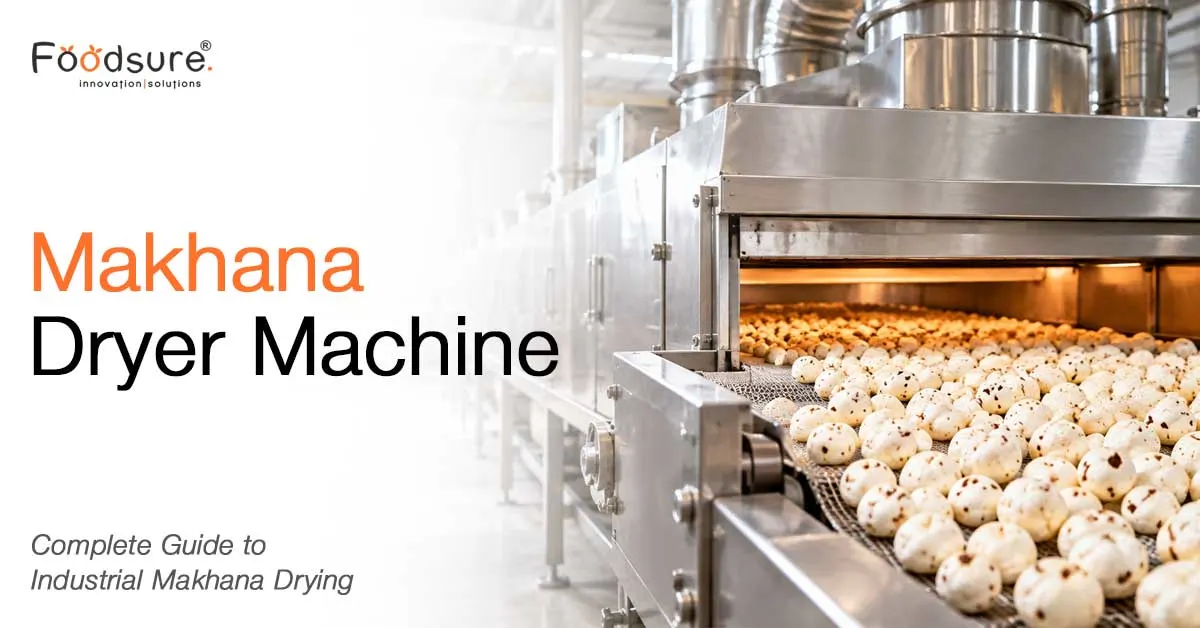
Drying plays a crucial role in the commercial makhana manufacturing process since the moisture content will determine issues such as storage, handling, process efficiency, and quality of the end product. While traditional drying in the sun works well on a small scale, it may become challenging to handle with increased volumes.
A makhana dryer machine provides a controlled approach to drying by managing factors such as temperature, airflow, drying time, and product handling. For commercial manufacturers, the right drying system can help improve process consistency while reducing dependence on weather conditions and manual drying practices.
What Is a Makhana Dryer Machine?
A makhana dryer machine is industrial food-processing equipment designed to reduce moisture from makhana at a controlled rate. The machine creates suitable drying conditions through controlled heat and airflow while allowing the product to be processed more systematically.
Drying can take place in trays, chambers, conveyor systems, or other handling methods, depending upon the design of the machine and the production needs.
The machines can be used for the purpose of setting up a complete processing line for makhana, wherein the cleaned or processed makhana is conveyed to the drying process.
Why Is Makhana Drying Important?
Moisture management is crucial in ensuring that makhana maintains its ideal characteristics in processing and storage. Too much moisture in the makhana could lead to problems in the later processing stages.
Traditional drying methods can also be affected by:
- Weather factors
- Moisture content
- Unequal heating
- Dirt and pollution
- Space requirement
- Handling manually
- Variable drying period
Commercial makhana drying equipment provides a more controlled environment and can help manufacturers maintain a consistent drying process across production cycles.
How Does a Makhana Dryer Machine Work?
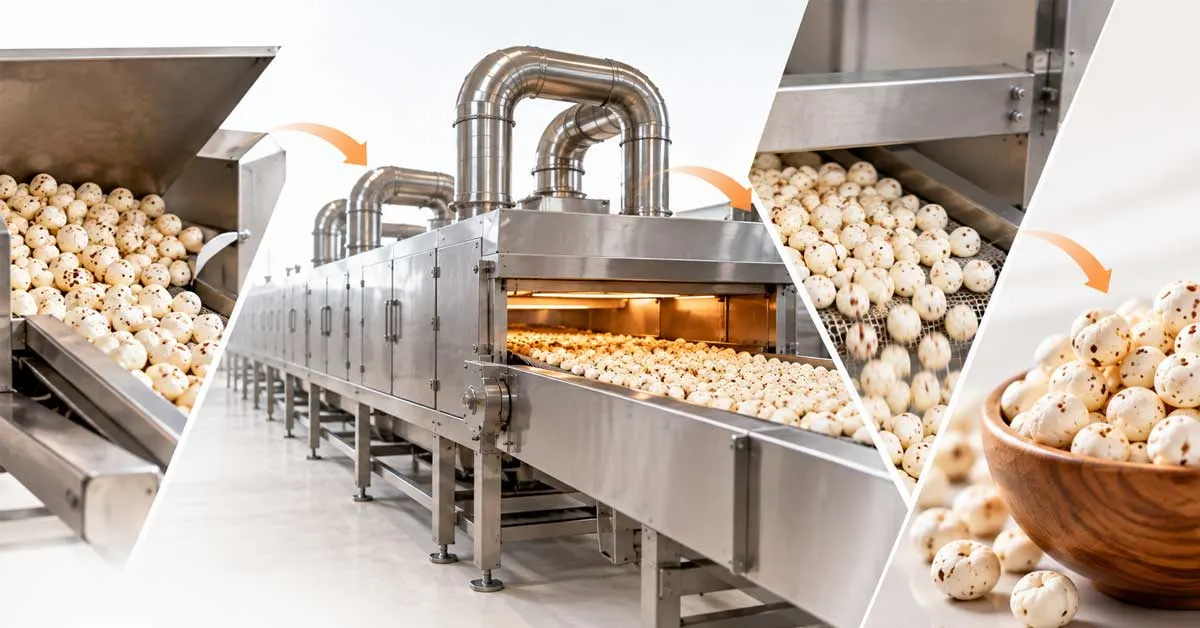
The working principle depends on the type of dryer used, but most industrial drying systems involve controlled heat and airflow.
A typical process can include:
Heated air is passed over the product during the drying process and removes moisture from the product. Circulation of air assists in spreading heat across the drying area, while controlled temperatures assist in preventing overheating.
Temperature, drying time, air flow, and loading must be determined based on the recommendations of the raw material and equipment manufacturer.
Key Features of Makhana Drying Equipment
The features of makhana drying equipment vary depending on capacity, configuration, and automation level. Commercial systems generally focus on controlled drying and efficient product handling.
Controlled Temperature
Temperature control is used by the operator to ensure that proper drying conditions are achieved. Too much heat might impact the look of the product.
Uniform Airflow
Consistent airflow helps expose the product to similar drying conditions. Proper air circulation can reduce variations between different areas of the drying chamber.
Adjustable Drying Conditions
Different production requirements may require different drying durations or operating conditions. Adjustable controls provide greater flexibility during production.
Food-Grade Construction
Appropriate materials should be used in food processing machines. Stainless steel is generally preferred since it is easy to clean and facilitates hygiene practices.
Easy Loading and Discharge
A practical feeding and discharge arrangement can reduce manual handling and improve material movement between different stages of the processing line.
Fox Nut Drying Machine for Commercial Processing
A fox nut drying machine is essentially a drying system designed for processing fox nuts, also known as makhana. For commercial applications, the machine should be selected according to the product condition, moisture-removal requirement, production volume, and overall processing workflow.
Drying equipment may be situated between different processing steps based on the type of production process being carried out.
An industrial drying system is able to ensure that consistency is achieved compared to open-air drying when dealing with large volumes of products.
Industrial Makhana Drying Machine vs Traditional Drying
Traditional sun drying relies heavily on environmental conditions, whereas an industrial makhana drying machine provides a more controlled drying environment.
| Factor | Traditional Drying | Industrial Drying |
|---|---|---|
| Heat source | Natural sunlight | Controlled heating |
| Weather dependency | High | Low |
| Drying environment | Open or semi-open | Controlled |
| Manual handling | Generally higher | Lower |
| Process consistency | Can vary | More controllable |
| Production scale | Suitable for smaller operations | Suitable for commercial production |
Industrial drying does not necessarily eliminate every manual operation, but it can provide better control over important drying parameters.
Benefits of Using a Makhana Dryer Machine
Uniform drying is necessary to ensure consistent moisture content. Controlled drying conditions can help minimize differences that might happen due to conventional drying techniques.
1. Better Drying Consistency
Controlled temperature and airflow can help manufacturers achieve more uniform drying conditions compared with uncontrolled outdoor drying.
2. Reduced Weather Dependency
Sun drying may be influenced by rain, humidity, cloudiness, and season. Machine drying makes it possible to conduct the process in controlled conditions.
3. Improved Production Planning
Because drying is less dependent on weather conditions, manufacturers can plan production schedules more systematically.
4. Reduced Manual Handling
Automated or semi-automated feeding, movement, and discharge arrangements can reduce repetitive handling during the drying stage.
5. Better Hygiene Control
A controlled drying chamber can reduce exposure to outdoor dust and other environmental contaminants compared with open-air drying.
6. Suitable for Commercial Expansion
With increased production, the use of industrial drying machines will assist the business to handle increased volumes of product.
Where Does Drying Fit Into Makhana Processing?
Drying can form part of different stages of makhana processing depending on the raw material and final product.
A broader processing workflow may include:
The exact sequence depends on the type of makhana being processed and the desired finished product.
A makhana cleaning machine can be used at the cleaning stage before suitable drying operations, helping reduce manual cleaning and improve the consistency of raw-material preparation.
How to Choose the Right Makhana Dryer Machine?
Selecting a dryer requires consideration of both production requirements and process conditions.
Production Capacity
Determine the amount of makhana that needs to be dried per batch or per production hour. Choosing a machine that matches the required throughput helps avoid production bottlenecks.
Drying Method
The various drying systems employ various heat transfer methods and material handling techniques. Manufacturers need to consider the method that suits their specific requirements.
Temperature Control
The machine should provide suitable control over drying temperature so that the product is not exposed to unnecessary heat.
Airflow
Efficient airflow is important for moisture removal and uniform drying. Manufacturers should understand how air is circulated within the drying chamber.
Construction Material
For food-processing purposes, the contact surfaces must employ proper materials for food-grade applications. For industrial food-processing equipment, stainless steel construction is normally employed.
Cleaning and Maintenance
The machine should provide practical access for cleaning and routine inspection. A design that is easier to maintain can help reduce unnecessary downtime.
Space Requirements
Manufacturers need to ensure that the size and loading configuration of the machine can be accommodated within the existing plant facility. The dryer must be installed in such a way that handling of materials in and out of other machinery becomes convenient.
Energy Consumption and Drying Efficiency
Drying involves heating and air movement, making energy efficiency an important consideration for commercial operations.
Energy consumption can depend on:
- Heating method
- Drying temperature
- Operating duration
- Product loading
- Moisture content
- Insulation
- Airflow
- Machine capacity
Sizing the dryer appropriately will help minimize energy waste due to underloading and long drying cycles. Effective insulation is another way to minimize heat loss.
It would be better if manufacturers analyzed the energy use in terms of their output production instead of the rated power consumption of the machine.
Maintenance and Hygiene
Maintenance can help ensure steady drying efficiency. It is necessary to check all heating elements, fans, motors, sensors, electrical contacts, and other moving parts in accordance with the manufacturer’s instructions.
Cleaning plays a major role in food processing facilities. There should not be any product residues left on the dryer interior walls, trays, conveyors, or any other product contact surfaces.
Operators need to perform proper cleaning procedures before preparing for the next run.
Integrating the Dryer With a Makhana Processing Line
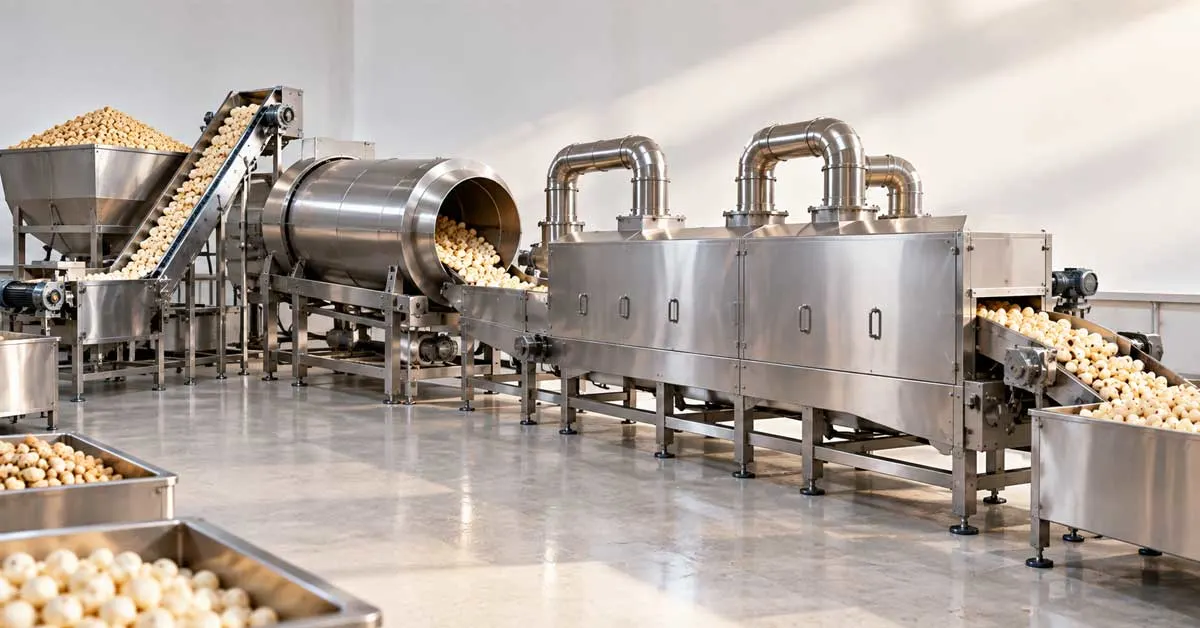
A dryer can be installed as an individual machine or incorporated into a larger makhana processing machine setup.
When included in a total assembly line process, the dryer will be able to function in concert with machines that do the cleaning, sorting, roasting, flavoring, and packing of the product.
Integration is dependent on production capacity, available space, the nature of the product being produced, and the extent of automation required.
Who Should Invest in a Makhana Dryer Machine?
A makhana dryer machine can be considered by commercial makhana processors, packaged snack manufacturers, processing units, and businesses planning to scale their production.
It is especially important for companies that require greater control of the drying process or that want to lessen reliance on outdoor drying techniques.
Before making a purchase, it is wise for businesses to determine their production capacity, drying needs, space availability, energy needs, and compatibility needs.
Conclusion
A makhana dryer machine offers manufacturers an efficient and organized way of removing moisture from makhana during industrial processing. Machine drying is more efficient than conventional drying since it provides more control over factors such as temperature and airflow.
When selecting makhana drying equipment, manufacturers should consider capacity, drying method, temperature control, airflow, construction, energy consumption, maintenance, and compatibility with the overall processing line.
For businesses looking to establish or expand commercial operations, the right industrial makhana drying machine can become an important part of a consistent and efficient production workflow.
Have a Question? Let’s Connect
Need expert guidance on food processing machines, production setup, or process optimization? Our team is ready to help you choose the right solution for your business.
Frequently Asked Questions
What is a makhana dryer machine?
A makhana dryer machine is food-processing equipment designed to remove moisture from makhana under controlled temperature and airflow conditions.
Why is drying important in makhana processing?
The drying process plays an important role in controlling the moisture content, and it may be beneficial if done according to process standards.
Is a fox nut drying machine suitable for commercial production?
Yes, because we can develop a commercial version of the fox nut dryer with the right capacity and the right drying mechanism.
What factors affect the performance of makhana drying equipment?
Product moisture content, amount loaded, temperature, flow rate, drying time, insulation, and machine capacity can all influence drying efficiency.
Can a makhana dryer be integrated with other processing machines?
Yes. A dryer can be integrated with equipment used for cleaning, grading, roasting, flavouring, and packaging to create a more coordinated makhana processing line.




