
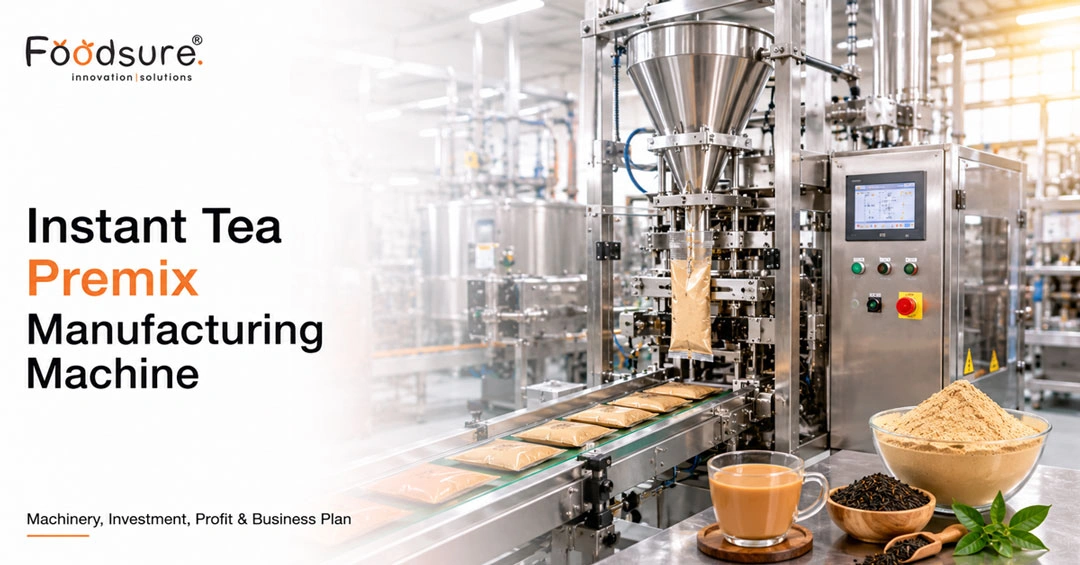
Premix tea drinks are increasing in demand in café shops, offices, hotels, vending machine companies, and retail stores. Whether it is traditional tea premixes or Masala chai, ginger tea, or cardamom tea, a variety of ready-to-use beverages are being offered by the manufacturers. But making quality tea premix involves a lot more than just the combination of tea powder, milk powder, and sugar.
First-time blenders often encounter problems like ingredient separation, inconsistency in taste, milk powder formation, and lack of shelf stability, as they do not understand the intricacies of the blending procedure. This not only affects the quality of the end-product but may result in customer grievances and wastage as well.A successful production process involves the proper use of the correct Instant Tea Premix Manufacturing Machine, proper formulation, proper blending parameters, as well as a good Tea Premix Mixing Machine. This blog will provide all the necessary information about the manufacturing process and the machines to be used, as well as some of the challenges.
Why Instant Tea Premix Manufacturing Is More Complex Than It Appears
It seems that instant tea premix manufacturing is a very easy process of mixing the ingredients. However, different particle sizes, densities, and the ability to absorb moisture may lead to ingredient separation, uneven taste, lump formation, and decreased shelf life.
Typical manufacturing problems include:
- Lump formation with milk powder
- Ingredient separation
- Uneven taste distribution
- Inconsistency between batches
- Insufficient flowability
- Poor dissolution properties
A well-designed Instant Tea Premix Machine helps solve these challenges by ensuring uniform mixing, reducing ingredient segregation, and improving overall product consistency.
Understanding the Ingredients Used in Tea Premix Manufacturing
Different components used in instant tea premix have their own properties while undergoing the mixing process. This is important as it helps the manufacturers choose appropriate machinery.
Tea Solids
Tea solids act as the main constituent of the premix and add to the characteristic flavor and color of the final product. Due to their light nature, it is imperative that there is an even distribution of tea solids in each batch in order to maintain consistency in taste.
Milk Powder
The milk powder ingredient poses great challenges in the process of instant tea premix production. This is because it is highly hygroscopic and hence is likely to absorb water from its surrounding environment, leading to the formation of clumps during the blending and storage processes.
Sugar or Sweeteners
The sugar particles are heavier than those of tea solids and milk powder. In the absence of adequate mixing, the particles will tend to settle down during handling and transportation, leading to inconsistency in the level of sweetness of each sachet.
Flavouring Agents
Spices like cardamom, ginger, cinnamon, cloves, and extracts of various spices may be present in smaller quantities. Though their quantity may be less, they significantly affect the flavor quality. Dosing and mixing play a crucial role in ensuring the desired flavor is achieved.
Complete Instant Tea Premix Manufacturing Process
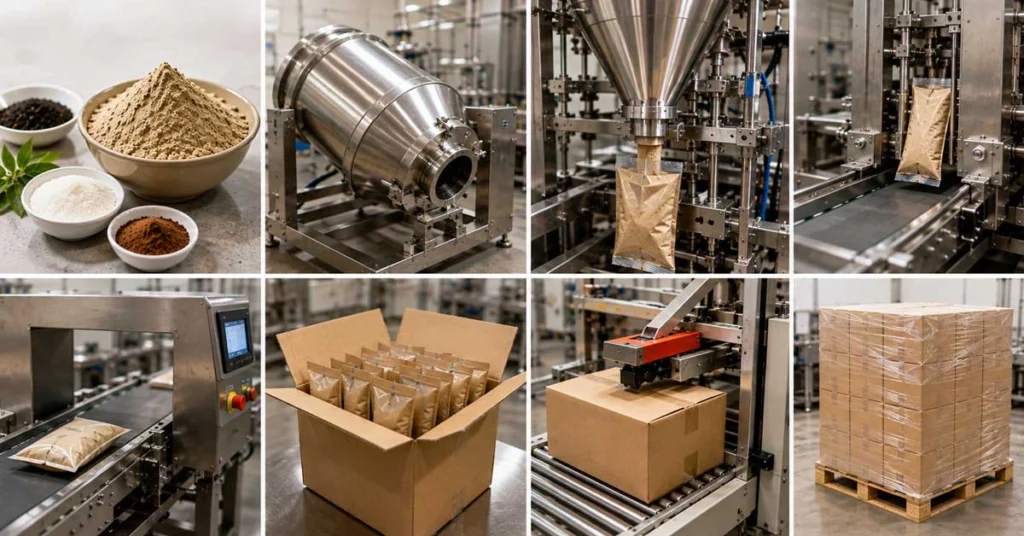
A modern Tea Premix Mixing Machine helps automate each stage of production while maintaining consistent quality throughout the manufacturing process.
Step 1: Preparation of Raw Materials
Every raw material is inspected and weighed as per the approved formula. Digital scales are recommended in this case due to their accuracy and because even slight variation in quantity can impact both flavor profile and nutritional content of the blend.
Step 2: Pre-Mixing of Basic Ingredients
Generally, tea solids and sugar are blended first, and thus, a basic mixture is obtained in order to ensure proper distribution of ingredients before adding sensitive raw materials like milk powder.
Step 3: Slow Mixing of Milk Powder
Milk powder is slowly mixed in a controlled manner to reduce the chances of caking in the powder. Time is adjusted by manufacturers to attain even mixing without heating up the powder.
Step 4: Addition of Flavoring Agents
Cardamom, ginger, masala spices, or any other flavoring agents are blended carefully to get even distribution of flavor in the batch. It is very important at this step due to the low quantities used in each blend.
Step 5: Final Homogenization
Another homogenizing step is taken to ensure that all ingredients have been thoroughly mixed prior to packing the product. This step is vital in ensuring batch-to-batch uniformity during mass production.
Step 6: Packaging
After being homogenized, the mixture is packed directly without delays to reduce the effect of settling. The use of moisture-proof packaging is an additional measure to ensure high quality.
Tea Premix Manufacturing Workflow
Following a standardized production workflow helps manufacturers minimize blending errors, maintain batch consistency, and improve overall production efficiency.
A controlled workflow ensures every batch follows the same production standards while reducing product variation and manufacturing losses.
Instant Tea Premix Manufacturing Machine Requirements
Choosing the appropriate tea premix machine can be regarded as one of the most crucial decisions in industrial operations. This is because tea premixes consist of substances with various particle sizes, densities, and moisture susceptibility; hence, the equipment needs to provide uniform mixing without segregation or overheating.
Food Grade Construction
The machine must be fabricated from food-grade stainless steel SS304 to maintain hygiene, avoid corrosion, and make cleaning after each production cycle easy. This is the standard material used in food processing machinery.
Appropriate Mixing Technology
Ribbon blenders are usually used to blend tea premix because of their efficiency in gently blending without destroying sensitive materials. For formulations that use more oil-containing flavors, paddle blenders will perform better.
Anticaking Properties
Milk powder is very hygroscopic and absorbs moisture easily while being processed. Machines that do not generate a lot of heat and facilitate quick blending processes help prevent caking.
Proper Ingredient Dosage
Flavoring ingredients such as cardamom, ginger, cinnamon, or spices can be present in minimal amounts in the tea blends. It is important to have an accurate system for ingredient dosage in order to ensure even distribution of all these ingredients.
Selection of Batch Capacity
The selection of appropriate machine capacity requires consideration of expected production quantity and possible business expansion. Buying machines that match the business growth is essential to reduce unnecessary costs.
Recommended Machine Capacity by Production Scale
Common Challenges During Instant Tea Premix Manufacturing
Though the products are made using quality raw materials, several production problems arise. However, most of these problems are easily preventable through good process control and proper equipment choice.
Clumping of Milk Powder
The milk powder has a high affinity for moisture from the atmosphere, resulting in the formation of clumps when blended or stored. Controlling humidity and proper blending time will avoid the problem.
Segregation of Ingredients
Variation in particle size and density could lead to segregation of sugar, tea solids, and flavoring agents. Blending should be done uniformly to ensure a consistent product.
Over-Blending
Blending for a long time does not necessarily result in improved quality of the product. It may produce excessive heat and increase moisture content.
Settling Before Packaging
In case of long storage of blended premix before packaging, heavier components might settle down, making sachets of varying composition. Direct connection of the blending unit to the packaging unit prevents this problem.
Wrong Equipment Selection
Choosing machines according to cost can lead to various problems in the future. In order to choose a machine for the production of tea premix, manufacturers have to take into account many factors.
Best Practices for Consistent Tea Premix Production
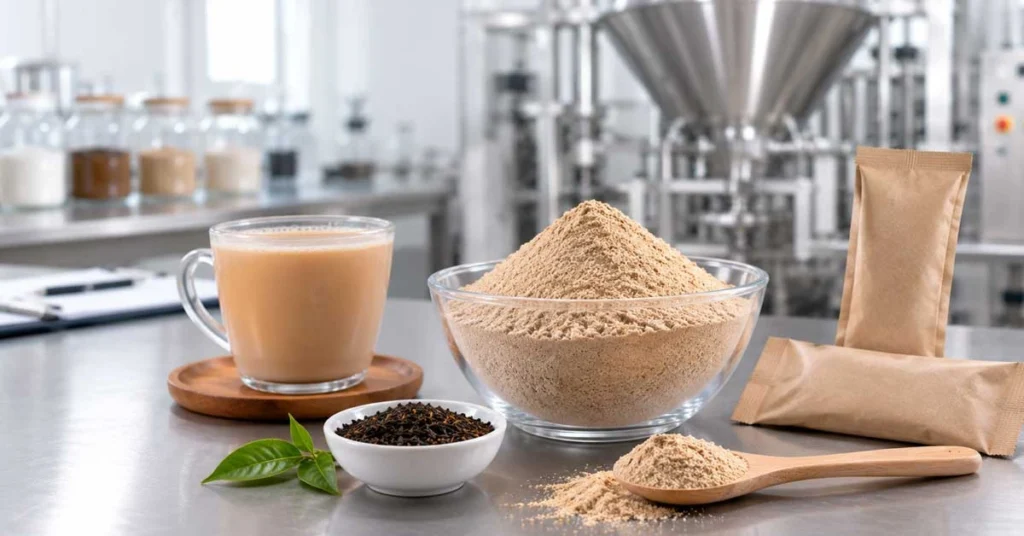
A standardized instant tea premix manufacturing process will help to increase consistency within each batch produced while minimizing production losses.
Manufacturing companies should:
- Standardize ingredient weighing procedures.
- Maintain controlled humidity during production.
- Follow optimized blending times.
- Use compatible ingredient particle sizes.
- Minimize delays between blending and packaging.
- Clean equipment thoroughly after every batch.
- Conduct routine quality checks before packaging.
These practices help improve product quality while extending shelf life and reducing customer complaints.
How Foodsure Machines Supports Tea Premix Manufacturers
Foodsure helps manufacturers select the most suitable Instant Tea Premix Manufacturing Machine, Tea Premix Mixing Machine, and complete production solutions based on product formulation, production capacity, and future expansion plans. Foodsure helps tea premix manufacturers select an appropriate machine by taking into consideration product formulation, volume of the product, capacity of production, and any expansion plans that you might have in mind.
Check out more information about us on our About Us page, or you can directly contact us.
Conclusion
Investing in the right Instant Tea Premix Manufacturing Machine is essential for producing high-quality tea premixes with consistent flavour, texture, and shelf stability. Combined with proper process control and an efficient Instant Tea Premix Machine, manufacturers can improve production efficiency while reducing product losses. With the help of appropriate tea premix machines, the use of proper manufacturing procedures, and adequate quality control methods, you can avoid production issues and ensure that your products always meet customer requirements.
Frequently Asked Questions
What type of machine is widely used for tea premix production?
The ribbon blender is the most commonly used machine for tea premix due to its capability to blend tea solids, milk powder, sugar, and flavors gently and evenly.
Why does milk powder get lumpy during tea premix production?
Milk powder is very hygroscopic; thus, it has the capability to absorb moisture. Humidity, longer blending time, and wrong storage conditions can make the product lumpy.
How can manufacturers ensure that there is no segregation of ingredients in tea premix?
This can be prevented through the use of compatible ingredient particle size, proper blending cycle optimization, reduction in delay before packaging, and use of suitable blending machinery.
What capacity of production plant should be selected by a new tea premix manufacturer?
New manufacturers start with machines that can produce 50-150 kg/hour. They later upgrade their machines in line with increased demand.
Can SS304 stainless steel be used in the tea premix manufacturing process?
Yes. SS304 food-grade stainless steel is commonly used in instant tea premix manufacturing due to its hygienic properties.




