The health and wellness industry in India is expanding rapidly and so does the demand for healthy ready-to-eat food. Increasing numbers of people prefer choosing nutrition bars, protein bars, energy bars, and meal replacement bars over any other snacking options. It makes the category an ideal one for food processing businesses, subject to having the right equipment and production processes in place.
The right equipment can help the company make its production process easier and more efficient, including blending and packaging. Selection of the equipment requires taking into account such aspects as formulation, capacity, automation and space availability.
This blog highlights all the aspects that must be considered prior to purchasing the machinery.
Why Invest in Nutrition Bar Manufacturing Business in India?
Shape, texture, size and consistency of nutrition bars should be the same for all bars.
When the demand increases, manual manufacturing becomes complicated since it is impossible to guarantee uniform weight, thickness and mixing of the dough manually.
This issue confronts many new manufacturers, and purchase of proper nutrition bar manufacturing equipment can help to deal with it.
The main advantages of proper manufacturing equipment are:
Increased productivity: Machines manufacture the products much faster than manual labor.
Uniformity of sizes: Cutting machines guarantee constant bar weight, length and shape in different batches.
Process control: Time, dough temperature and viscosity of the binder should be controlled to maintain consistency of the texture of the bars.
Efficient handling: Conveyors and forming machines transport dough and bars with minimum hand handling and waste.
Flexible manufacturing process: Extrusion and sheeting technologies allow to manufacture different types of bars (granola, cereal, nut bars).
Integration of processes: All operations – mixing, forming, cutting, cooling, packaging – can be performed in one sequence, without waiting for completion of any operation.
The type of equipment depends on particular recipe and production volume.
What Is a Nutrition Bar Production Line?
The production process of nutrition bar involves using a series of machines that will mix ingredients, prepare the dough, shape/form, cut, cool, and pack the bars.
A machinery solution for the production of the nutrition bars can focus on serving only one step in the production process, like cutting, or be an entire production line.
Typical manufacturing process includes:
Mixing → Dough Preparation → Extrusion/ Forming → Cutting → Cooling → Packing
Every product does not require the same process flow. Choose machinery depending on the desired product.
Essential Equipment for a Nutrition Bar Production Line
A commercial setup may include several machines working together, depending on formulation, capacity and product specifications.
1. Mixing Equipment
Ribbon Blender/Paddle Mixer is used to blend the dry ingredients like oats, protein powder, cocoa, and vitamin mixes for about 10-20 minutes. Binder is first heated using a jacketed kettle and then combined with the dry mix using the sigma mixer.
The selection is dependent on formulation and batch size as the final mixture needs to be cohesive.
2. Extruder
A nutrition bar extruder pressurizes the dough material into a stream of bar form. The product boasts fast production, consistent bar form and minimal wastage.
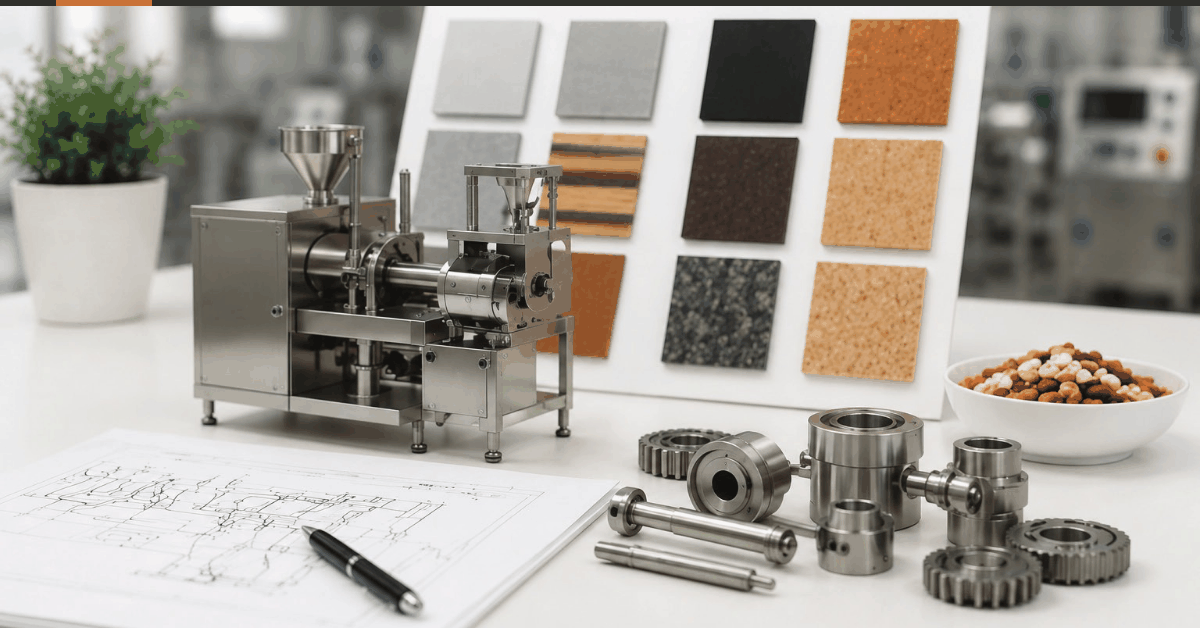
Select based on the characteristics of the dough material and required speed of production.
3. Forming and Cutting
The slab forming unit and compressor roller spread the dough to form a sheet, fix its height, and flatten the top of the sheet; this is best suited for granola bars, cereal bars, and nut bars.
Bar size affects selection, and it also impacts the cost of the entire equipment for making nutrition bars. The common weight range is 40-80g for protein bars, 25-60g for energy bars, and 60-120g for meal replacement bars.
4. Cooling and Coating
Cutting requires the bars to be cooled and stabilized before packaging. Ambient cooling racks are cheaper to operate than a cooling conveyor with a controlled tunnel. The normal cooling time is from 20 to 60 minutes.
In case your product requires a coating, plan for it in this step. Ensure that the cooling capacity matches the cutting speed and bar size.
5. Packaging
The flow wrapper packs each bar in metallized film, laminated pouches, or high-barrier films. The carton packs either 6, 12, or 24 bars.
Ensure that the packaging capability matches the upstream capability to avoid buildup of bars at the end of the line. The metal detector inspects for ferrous, non-ferrous, and stainless steel contaminants before packaging.
Automatic vs Semi-Automatic Nutrition Bar Machines
The choice depends on production requirements, workforce availability and investment priorities.
| Factor | Semi-Automatic Setup | Automatic Setup |
|---|---|---|
| Operation | Operators handle some stages by hand | Stages run in a connected sequence |
| Production volume | Suits lower to moderate volumes | Suits regular, higher-volume orders |
| Labour | Needs more operators | Needs fewer operators, with technical supervision |
| Flexibility | Easier to switch products in small batches | Best for steady, repeated product runs |
| Integration | Machines often work as separate stations | Machines work as one coordinated line |
| Expansion | Machines can be added as demand grows | Expansion is planned around the full line |
The small firm may start with semi-automation, but the manufacturer that takes orders from commerce may want to go with full automation. Determine need based on demand rather than automation alone.
How to Choose the Right Machinery to Start a Nutrition Bar Manufacturing Business in India
Match the machine to your product, volume and site before you compare quotes.
Production Capacity
Establish realistic production capacity first. The capacity determines the size of the machine and the space required for the equipment.
Product Formulation
Raw materials like oats, protein powder, nuts, seeds, and syrup binders influence dough handling characteristics. Choose mixers, formers, and cutters which are compatible with your formulation.
Bar/Product Dimensions and Weight
Set the bar size and weight first, before proceeding to select the cutters and packaging. The weights used by protein bars, energy bars, and meal replacement bars are different.
Level of Automation
Select either semi-automatic or automatic configuration depending on your quantity, labor, and finance. Think about expanding the line.
Available Space and Utilities
Compare the floor area, electricity, and storage requirements with the machine layout. The raw materials and the bars require clean and controlled storage.
Maintenance and Technical Support
Enquire about spare parts, service, and technical assistance following installation to ensure continuity of production.
Nutrition Bar Machinery Cost: What Affects the Investment?
Typically, entrepreneurs consider the price of the protein bar machine in India prior to investment plans. The pricing will be determined by machine configurations as well as your production needs.
Consider the full range of equipment and its operation needs, rather than just the cost. The approximate prices may be ₹2-5 lakhs for the mixer, ₹5-15 lakhs for the extruder, ₹2-8 lakhs for the bar cutter, ₹1-5 lakhs for the cooling conveyor and ₹4-20 lakhs for the packaging machine. The entire line of machines is priced at ₹20-75 lakhs.
Important factors include:
- Capacity & Automation
- Mixing, forming, extruding and cutting machine
- Cooling, coating and packaging machine
- Installation and commissioning
- Power & Infrastructure
- Cleaning, maintenance and spares
- Training & Technical support
When you ask for a machine quotation, be sure to give the intended product, desired output, size of the bars and automation level. Machine quotation will also help you get the basis of the project report for nutrition bars which includes the cost of machines.
The cost of setting up the overall plant also takes care of other factors apart from the cost of machines. These should be considered when estimating the start-up cost for the nutrition bars.
How to Start Nutrition Bar Manufacturing Business in India
Starting involves both commercial planning and manufacturing preparation.
Step 1: Define Your Product
Choose one category, for example, protein, energy, meal replacement, keto, vegan, granola, or fiber bars. Each type is targeted at a unique audience.
Step 2: Research the Market
Analyze factors that drive the demand for products like health & fitness trends, snacking at corporate workplace, e-commerce and sports nutrition. Apply the analysis into determining pricing, which is essential in establishing your profit margin.
Step 3: Plan the Manufacturing Setup
Plan for the acquisition and storage of raw materials as well as factory space based on capacity requirements. Plan a nutritious snack bars business based on capacity, working capital, and break-even analysis of nutritious snack bars manufacturing.
Having a nutritious snacks manufacturing business plan increases the likelihood of securing financing.
Step 4: Address Compliance Requirements
Get FSSAI license prior to manufacturing, and be mindful of the food safety practices and labeling regulations. There might also be other registrations that you need, for example, GST and factory license.
Step 5: Select Machinery and Test the Process
Select the equipment for your formulation and capacity. Conduct trial batches to check the texture, weight of bars, and cooling process.
Step 6: Plan Packaging and Distribution
Choose packaging film/cartons and have batch numbers printed on all packs. Channels can be decided in the form of supermarkets, gymnasiums, online websites, health stores, and pharmacies.
Small-Scale Nutrition Bar Manufacturing for Startups in India
An ideal option for an entrepreneur who wants to go with minimal production and build capacity as the need arises is the small scale setup. Based on reference figures, the investment involved in setting up nutrition bar plant in small scale operations is estimated at about ₹15–30 lakhs, whereas automated operations begin from ₹50 lakhs onwards into crores.
Selection of the startup automatic machine should be based on output requirements.
Before investing, consider:
- Projected first production quantity
- Types of products
- Size and weight requirement
- Space and labor availability
- Compatibility with the formula
- Future possibility of additional equipment
Start with an appropriately sized setup that fits current demand and leaves room to grow.
Why Choose Foodsure for Nutrition Bar Machinery?
FoodSure Machinery is one of the companies that provide food processing machines such as mixers, extruders, bar cutting machines, cooling conveyor, packaging machines, and many more for small, medium, and large factories. This company has more than 13 years of experience providing assistance to food companies.
Our team can help you analyze your production requirements, machinery layout, automation, and integration of the food processing phases.
Make sure that you know everything about the equipment before placing an order. Feel free to consult us regarding your production objectives.
Conclusion
Before planning to initiate manufacturing of nutrition bars in India, consider aspects like specifications of the product, capacity, automation, infrastructure, and technical assistance. This is because these determine not only the machinery but also the capital investment required for the project.
Select the supplier of your nutrition bar machinery according to your requirements of the product. Small machinery can be selected for initial production and integrated machines for continuous commercial orders.
Frequently Asked Questions
How do I select the right machine for learning how to start nutrition bar manufacturing business in India?
Consider capacity, formulation, size of the bar, automation, and space before comparing suppliers on installation and support.
What factors affect nutrition bar machinery cost, and how much does it cost to start a nutrition bar factory in India?
Capacity, automation, and configuration affect machinery cost. Starting cost estimates are ₹15-30 lakhs for small-scale and ₹50 lakhs to crores for automated factories.
Is it possible for startups to use an automatic machine in nutrition bar manufacturing business?
Yes, if the demand justifies. Choose according to your output requirement, type of product, and automation, or consider starting semi-automatic initially.
What should be asked from the supplier before purchasing the machine?
Inquire about scope of equipment, installation, training, spares, and technical support. Ensure that the machine is suitable for your bar size and formulation.
Can I purchase the complete line of nutrition bar manufacturing machine?
Yes, Foodsure Machines provides mixers, extruders, cutter, cooling conveyor, and packaging machines individually or as a line. Quote can be used in your nutrition bar project report along with machinery cost.