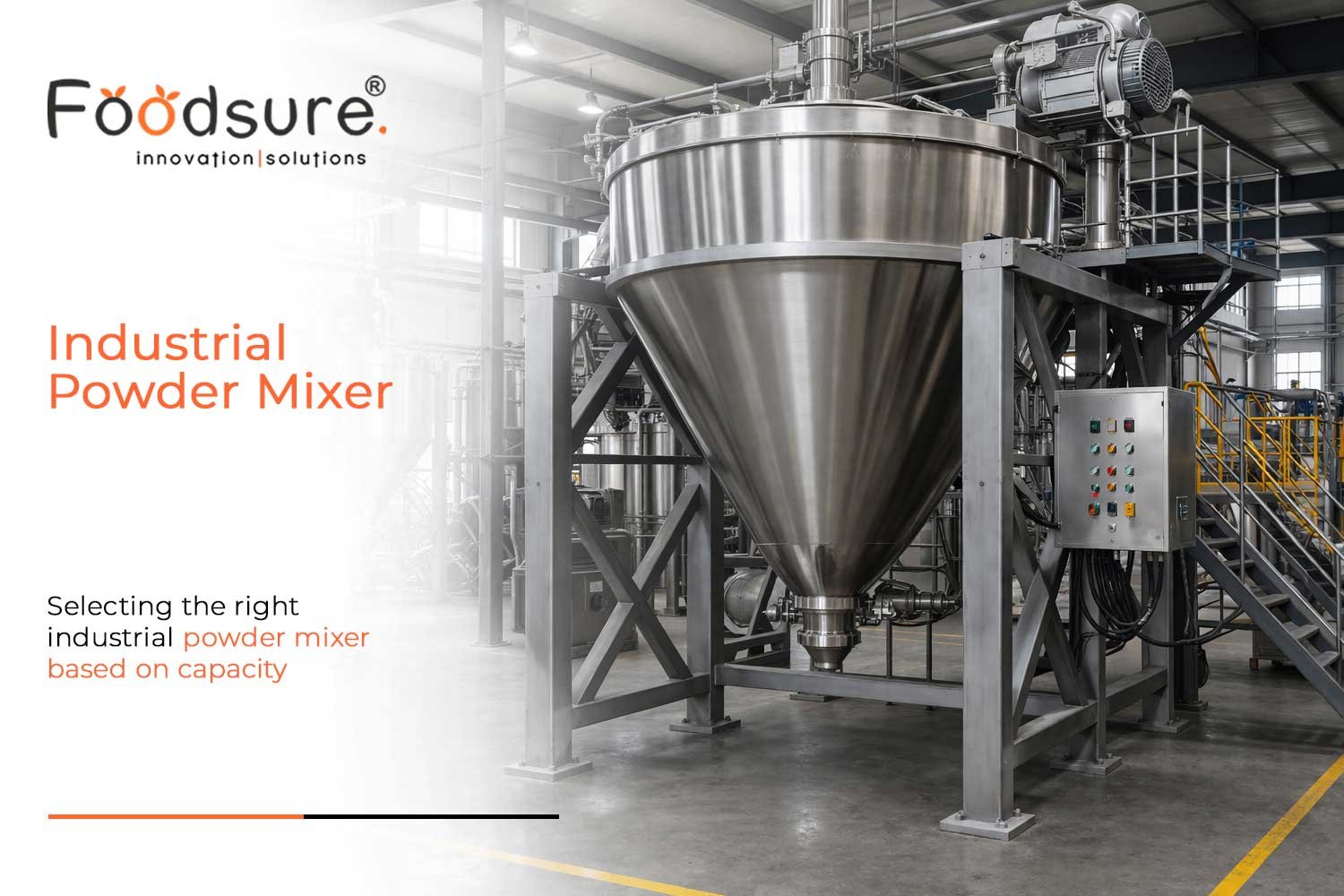
Selecting the right industrial powder mixer based on capacity and output is a critical engineering and procurement decision that directly impacts product quality, production efficiency, and operating cost. The selection process needs to follow systematic procedures because three types of mixers, which include ribbon blenders, paddle mixers, and continuous systems, each have particular batch volume requirements and output specifications.
This blog explains how to calculate batch powder mixer capacity using working volume and bulk density, convert batch size into real hourly output, compare different industrial powder mixer types based on production requirements, identify common capacity and discharge inefficiencies, and apply a step-by-step framework to select the most efficient system for maximum throughput and ROI.
The Real Problem: Why Most Industrial Powder Mixer Selections Fail
Most manufacturers select an Industrial Powder Mixer based on total capacity, not actual output efficiency. This leads to:
- Underutilized equipment.
- Longer cycle times.
- Inconsistent mixing quality (high CV).
- Lower-than-expected ROI.
The core mistake: Ignoring the relationship between capacity, cycle time, and material behavior.
Correct approach:
Volume to Throughput (Kg/hr):
- Stop Choosing by Liters Only, Real Efficiency is determined by the Total Cycle Time (Loading + Blending + Discharge).
- On a daily basis, a smaller, 1000L, automated (pneumatics) and high-speed paddle mixer outproduces a 2000L mixer that has a slow (manual) discharge.
The “Bulk Density” Factor:
- Ignoring material weight leads to motor burnout. A mixer sized for 500kg of light flour will fail if loaded with 500kg of heavy minerals due to insufficient torque.
- High-performance selection requires matching the agitator tip speed to the specific flowability of your particles.
The 40–70% “Sweet Spot”:
- Equipment must operate within its optimal working volume to ensure a homogenous blend.
- Operating outside this range creates dead spots and compromises the Coefficient of Variation (CV), directly impacting your product quality.
Eliminating Discharge Bottlenecks:
- The most expensive part of your process is the time the mixer sits idle while emptying.
- Prioritize automated discharge and rapid-loading systems over larger vessel sizes to maximize long-term profitability.
Industrial Powder Mixer Selection: Understanding Capacity vs Output Efficiency
The operational limits of every Industrial Powder Mixer specify their required fill amounts. Production output will stop when either of these two limits is exceeded or not achieved.
| Mixer Type | Optimal Working Range |
|---|---|
| Ribbon Blender | 40–70% |
| Paddle Mixer | 30–70% |
| V-Blender | 50–60% |
| Plough Shear | 50–75% |
- Overfilling – Causes particles to remain unchanged in size, which results in inefficient mixing and increased motor load.
- Underfilling (<30%) – Creates dead zones, which prevent the agitator from accessing the material and cause particle segregation.
Bulk Density: The Hidden Variable
Your mixer occupies the same physical space all the time, but its weight capacity for materials keeps changing.
Mass = Volume * Bulk Density
Key Rule:
- Always size equipment based on the maximum density scenario.
- A flour motor will stop functioning when it receives an excessive mineral load. The design process needs to create solutions that can handle multiple operational scenarios while maintaining safety during extreme weight conditions.
- The relationship between Volume and Mass determines how effectively you can maintain consistent batch quality throughout your different product SKUs.
ALSO READ
Industrial Powder Mixer Selection Strategy Focused on Output and Batch Efficiency
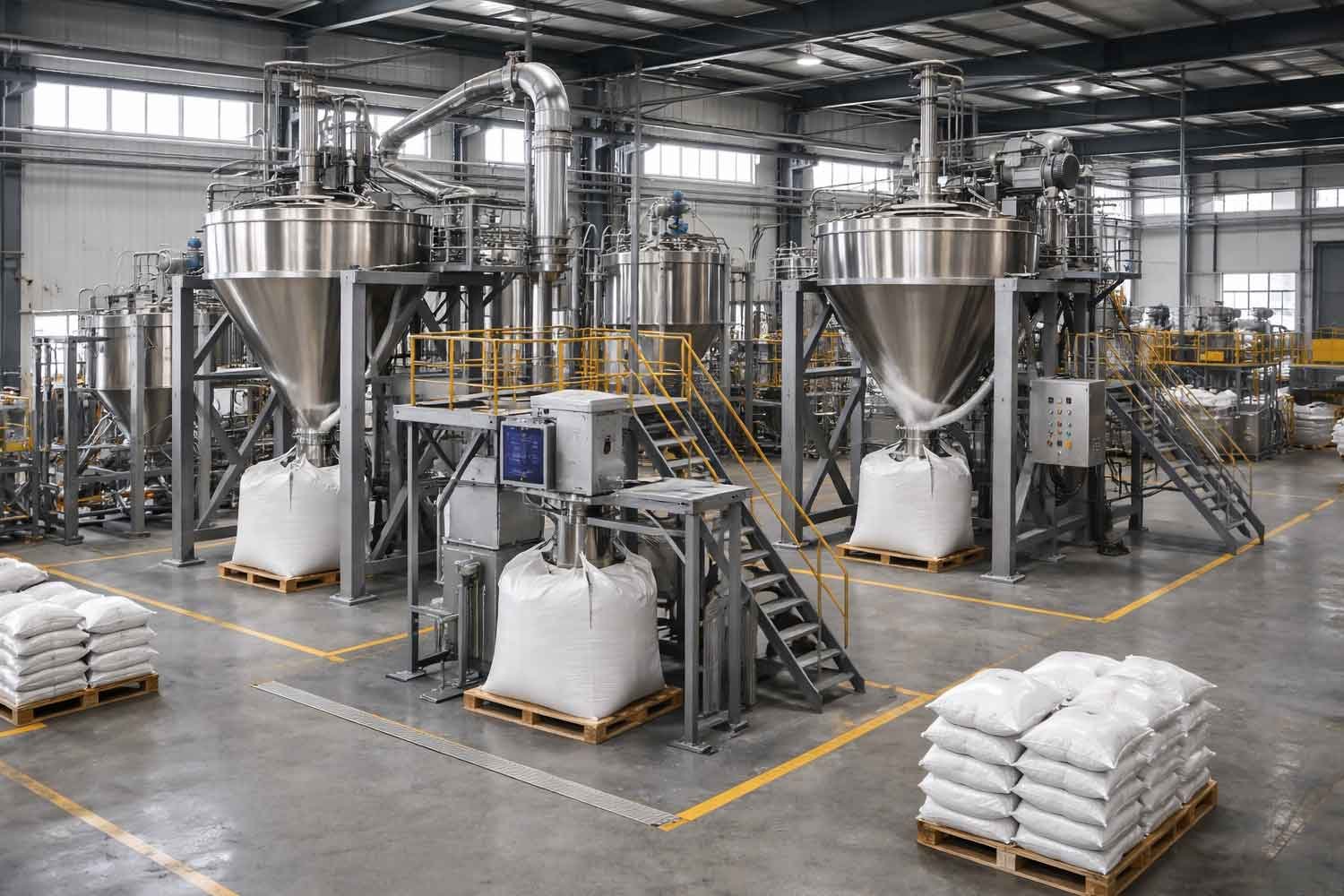
The method used to choose a bulk powder mixing machine through its static volume measurement needs to be corrected because it represents outdated practices. The process of establishing industrial efficiency demands that organizations determine their required production capacity before proceeding with their operations.
The 4-Step Selection Logic
Step 1: Define Hourly Output Target
The production target for a 6-hr shift requires the processing of 5000 kg, which results in an hourly requirement of 833 kg.
Step 2: Calculate Real Cycle Time
The Mixing phase is often the shortest operation within the entire process.
Total cycle includes:
- Loading: 5-10mins
- Mixing: 8-15 mins
- Discharge: 5-20mins, which represents the main operational bottleneck.
Step 3: Calculate Required Batch Size
The production process requires you to produce 416 kg batches because your equipment operates at a 30-minute cycle.
Step 4: Convert to Mixer Volume
- You require a working volume of 832L because your material has a density of 0.5 kg/L.
- The 70% working limit requires you to choose a 1200-L Industrial Powder Mixer as your selection.
Critical Efficiency Pointers
- The 40% Mixing Myth: Actual blending in most plants requires 40% of the total operational time. The remaining 60% (loading/unloading) is where most hidden capacity is lost.
- Automation vs. Volume: The 1000L mixer with an automated vacuum loader system becomes a more affordable solution compared to the 2000L mixer, which needs manual operation.
- The Bottleneck Rule: Your slowest operation determines your total output capacity. The mixer operates at 50% efficiency because it takes 10 mins to complete its work, while the bagging machine needs 20 mins to remove the finished product.
- Headroom for Growth: Your equipment selection needs to match current usage, which should remain below 60%-70% of the mixer’s total capacity. This enables business growth to occur without needing to replace existing equipment.
- Density-Driven Torque: You must confirm that the motor and gearbox specifications match the maximum bulk density of all your product SKUs. This requirement protects against mechanical failures during maximum production periods.
Heavy Duty Powder Mixer Types for Output Efficiency and High Volume Processing
Your Industrial Powder Mixer choice should use the batch time and hourly throughput relationship as its base because this approach delivers optimal investment return.
| Mixer Type | Batch Time (min) | Output Efficiency | Optimal Scale (kg/hr) |
|---|---|---|---|
| Ribbon Blender | 8–15 | Moderate | <1,000 |
| Paddle Mixer | 2–5 | High | 1,000–5,000 |
| Plough Shear | 3–8 | Very High | 1,000–5,000 |
| V-Blender | 15–30 | Low | <500 (Precision) |
| Continuous | 0 (Steady) | Ultra High | >5,000 |
- The 240-Minute Shift Reality: After you finish cleaning and loading, your available time for mixing work during an 8-hr shift becomes 4-6hrs. Use Effective Runtime to compute kg/hr instead of using the clock time.
- Agitator Tip Speed: High-output mixers (Plow/Paddle) achieve their particle fluidization through their use of higher m/s tip speeds. The new mixing method reduces mixing time by 400% when compared to standard Ribbon Blenders.
- The Zero-Downtime Continuous Model: The primary cost driver for batching logistics starts at scales larger than 5,000 kg/hr because at this point, loading and unloading operations become essential. The Continuous Mixer system removes the 15 to 20 minute dead time that occurs between batch operations.
- Power-to-Volume Ratio: The operation of high-efficiency mixers requires motor power (kilowatts) per liter of mixer capacity. Your electrical system needs to handle 30 to 50 % more startup torque than high-speed Paddle or Plow systems require during their initial operation.
- Discharge Diameter: Output is often throttled by the valve size. The Full-Length Bomb Bay Doors operate at 100% discharge capacity within 30secs for high-speed lines.
Final Verdict: Output requirements must dictate the mixer type. The slow vessel in a fast production line stands as the costliest manufacturing constraint for industrial production.
Industrial Powder Mixer Hidden Bottlenecks That Kill Output Efficiency
The most advanced Industrial Powder Mixer needs a matching infrastructure capacity to operate at its full potential. The production line needs its hidden productivity suppressors to see continuous production efficiency.
Underfilling (The Dead Zone Issue)
- The Problem: An industrial mixer needs to operate above 30% capacity because its agitator only functions properly at that level.
- The Result: The vessel contains particles that remain at the bottom and create poor blending results through dead zones that extend basic blending time requirements.
- The Fix: Your system should operate between 40-70% of its capacity. The Variable Frequency Drive (VFD) should be used to control Froude number adjustments because your batch sizes differ.
Slow Discharge System
- The Problem: Using a small manual butterfly valve on a high-capacity mixer.
- The Result: Your output efficiency decreases between 30-50% when the mixing duration requires 15 mins, and the vessel requires 20 mins to empty.
The Fix:
- Bomb Bay Doors: Full-length discharge for near-instant emptying.
- Pneumatic Slide Gates: The system delivers automated opening, which enables accurate and rapid flow operations.
- Surge Hoppers: The system discharges an entire batch into a secondary bin, which enables the mixer to start its next cycle without delay.
Heat Build-Up in Large Batches
- The Problem: Mixing operations that use large volumes or high-shear equipment, like Plow Shear, experience increased friction, which leads to higher internal temperatures.
- The Result: The process degrades heat-sensitive dairy products and probiotic and nutraceutical powders, resulting in product shelf-life and quality deterioration.
- The Fix: The system requires you to implement Cooling Jackets while you track Agitator RPM because this process keeps mixing speed and thermal stability balanced.
Manual Loading Bottleneck
- The Problem: Relying on manual labor to tip bags into a mixer larger than 1000L.
- The Result: Your loading section takes more time than any other process because it requires 60% of your shift to keep your costly equipment stationary.
The Fix:
- Vacuum Conveyors: The system delivers automated powder transfer without dust through its dust-free operation.
- Screw Feeders: The system delivers steady, high-volume material transfer into the mixer inlet.
How to Optimize Industrial Powder Mixer Output Without Increasing Capacity
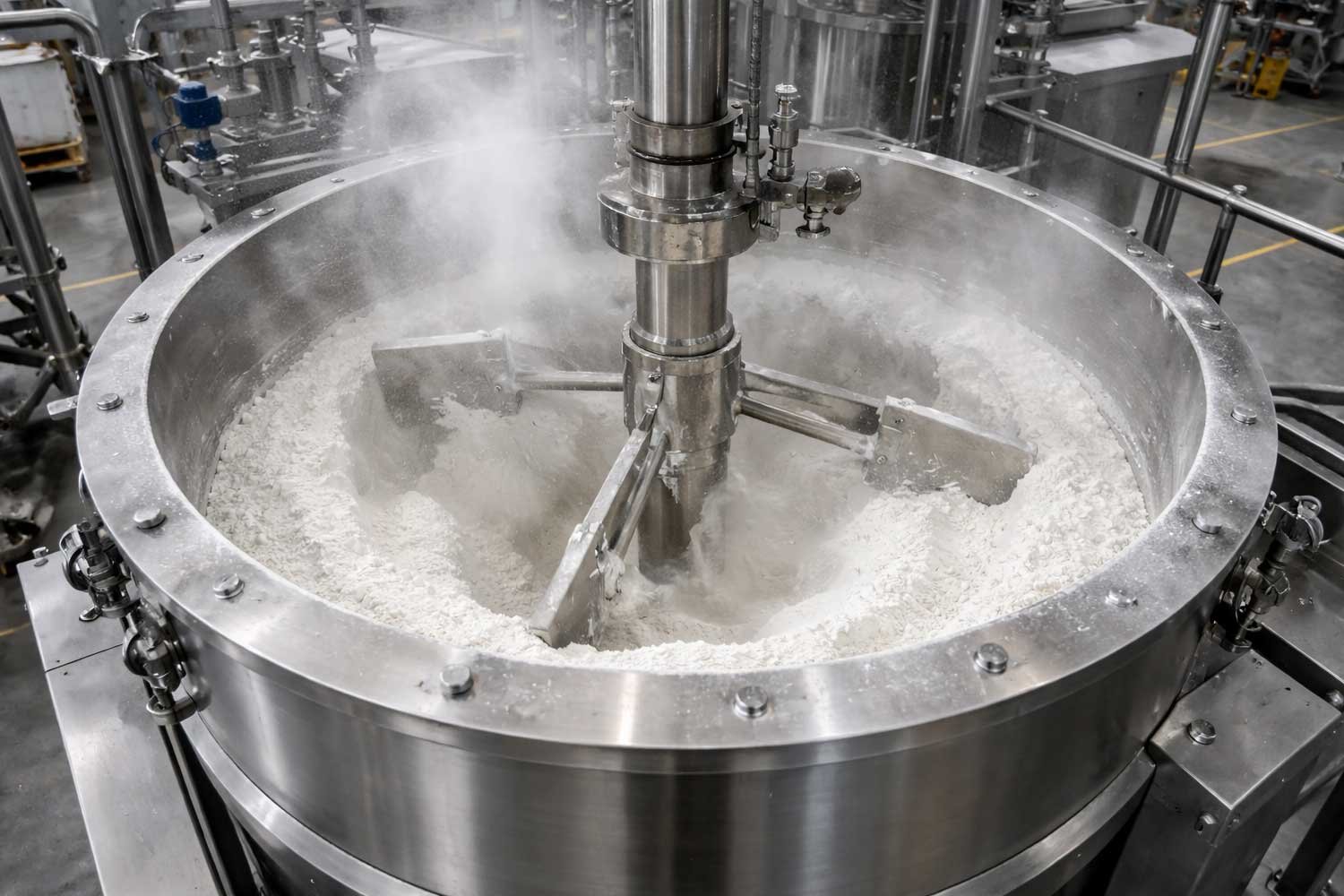
The most efficient method for increasing production capacity requires organizations to enhance their Total Cycle Time through improvements to their current Industrial Powder Mixer operation.
Facilities achieve only 50-60% of their complete mechanical capacity because they treat mixing as an individual task instead of a coordinated operation.
The Efficiency Formula
Output (kg/hr) = Batch Size (kg) * Batches per Hour
You need to eliminate all periods of non-mixing dead time to boost your hourly output without investing in a new, larger vessel. Your shift capacity will double when you concentrate on improving the In-Process logistics system.
Core Strategies for Throughput Gains
- The Surge Hopper Advantage: enables instant mixer operation because the completed batch can be discharged into a secondary surge hopper, which initiates the next production cycle. The process eliminates 15-20 mins of dead time because the system needs to wait until the downstream packing machines finish their work.
- Pneumatic Pre-Staging: The transition from manual bag tipping to a vacuum or screw conveying system enables operators to complete loading operations for a 1000L batch within three mins instead of needing 15 mins. The staging process enables zero waiting time because it prepares ingredients for the next batch while the current batch remains in the mixing process.
- Automated Discharge Logic: The replacement of a manual butterfly valve with a Pneumatic Bomb-Bay Door system enables output enhancements between 20-40%. The production line continues its flow because the full-length discharge system enables all batch contents to drop within seconds instead of taking multiple minutes.
- VFD RPM Calibration: A Variable Frequency Drive system enables you to customize tip speed for various bulk densities, which include 0.5L-1.5kg/L. The system achieves maximum homogenization speed because it prevents motor stall conditions and protects against heat damage.
- Sequential Processing Alignment: Your output is only as fast as your slowest stage. The Industrial Powder Mixer needs operational capacity for feeding, mixing, and bagging functions, which should match each other to prevent the equipment from becoming inactive.
Conclusion
The definition of a successful industrial powder mixer lies in the ability to achieve consistent output from a given capacity rather than size. Optimizing working volume, reducing discharge time, and all other activities within the mixer subject to throughput are interrelated. A company that centers its search for a mixer on output effectively links that output to greater productivity and lower cost per batch. When comparing prices of industrial powder mixers in India, it is critical to base comparisons on actual performance in the workplace.
Foodsure Machines supplies manufacturers with precision-engineered mixers to ensure the proper capacity is utilized effectively while also allowing for faster cycle times and scalable production efficiencies when used in various powder processing industries.
Need Help Choosing the Right Mixer Capacity?
Get expert guidance on batch size, output per hour, and the best industrial mixer for your production needs.
✅ Capacity & Output Calculation
✅ Machine Type Recommendation
✅ Cost & Efficiency Planning
FAQ
What is the difference between a batch powder mixer and a bulk powder mixing machine?
Although batch mixers work on set quantities each cycle, bulk mixers are for larger quantities and for continuous or larger production runs.
When should you choose a heavy duty powder mixer for your plant?
Heavy-duty powder mixers are used when mixing materials that are heavy or denser than typical materials. They also provide high torque with very strong constructions.
What are the advantages of a large capacity industrial powder mixer?
Mixing in a larger capacity means smaller batches, less downtime, and therefore a higher throughput at a manufacturing facility.
How does a powder mixer for continuous production improve efficiency?
Producing continuously eliminates the need for downtime associated with making a batch by providing a constant output. This style of mixing is ideal for high-volume production.
Can one machine handle both batch and continuous powder mixing needs?
In general, there are two distinct kinds of mixing systems are state-of-the-art batch mixers and continuous mixers (with hybrid applications).