

Impact of Short Shelf Life on Brand and Revenue
When it comes to functional foods, the longevity of their shelf life cannot be viewed only from a technical perspective – rather, this is an issue that affects your bottom line. As soon as protein bars go bad too fast, you are losing money due to lower sales, higher costs associated with recalling your products, and potential damage done to the relationships with your retailers. Consumers will not have second thoughts when faced with expired or poorly textured protein bars.
Reasons for Premature Protein Bar Spoilage
There are many reasons for premature spoilage, which include the oxidation of fats to create rancidity, microbial growth due to uncontrolled water activity, and the breakdown of physical properties due to water migration. The interaction between ingredients can expedite these spoilage mechanisms.
How to Extend Protein Bar Shelf Life & Solve Moisture Issues in Protein Bars
What Is Moisture Migration in Protein Bars?
The migration of water from high water-activity areas to low water-activity areas in protein bars is known as moisture migration. It occurs because the water wants to achieve equilibrium by moving to where there is less water activity. For example, in a multilayer food, it will migrate from a highly hydrated caramel core to a crispy rice layer or a protein layer to a chocolate coating layer. This phenomenon causes moisture in the center, blooming, and cracking of the coating among others.
Protein Bar Moisture Migration Prevention Techniques
There are three main methods of preventing moisture migration in protein bars. One should control the water activity of individual ingredients before forming the product. Humectants such as glycerol, sorbitol, and propylene glycol should be incorporated to trap moisture in one spot. Edible moisture barriers such as fat coating can be used to separate components that have different levels of Aw. The order of ingredient addition also plays an important role.
Protein Bar Machine 🚀
Automate protein bar production with fast, hygienic and high-output technology.
Impact of Water Activity on Extending Shelf Life of Protein Bars
Water activity can be considered as the strongest tool for extending the shelf life of protein bars. The optimum levels would lie within the range of 0.55 to 0.65 Aw, which is not only conducive for preventing microbial proliferation but also for maintaining desirable taste and non-brittle texture. Aw measurement devices are crucial for any manufacturer aiming to extend the shelf life of their product.
Packaging Strategies On How to Extend Protein Bar Shelf Life
Selecting Appropriate Barrier Packaging Materials
- High barrier aluminum foil and metallized films are the top choice for protein bar packaging materials.
- They prevent moisture transfer, oxygen penetration, and light passage.
- All three factors contribute to the deterioration of proteins.
Modified Atmosphere Packaging (MAP) for Protein Bars
- Nitrogen purging reduces the amount of oxygen present in the package headspace before sealing.
- This significantly reduces the rate of oxidation and aerobic bacteria.
- This one step alone increases the shelf life of a bar by months without increasing costs.
Sealing and Headspace Management
- Sealing equipment determines the quality of sealing.
- Improper sealing equipment produces weak seals that allow minute oxygen leaks over time.
- It ruins the product well before the best-by date.
- The presence of oxygen in the headspace after sealing is equally important.
| Material | Moisture Block | Oxygen Block |
|---|---|---|
| Foil Laminate | Excellent | Excellent |
| Metallized Film | Good | Good |
| Standard Plastic | Poor | Poor |
| Biodegradable Wrap | Moderate | Weak |
| Paper-Based | Very Poor | Very Poor |
| Hybrid Barrier | Excellent | Very Good |
Ingredient Selection and Formulation Tips
Shelf-Stable Protein Sources
- Whey protein isolate is much lower in residual moisture than whey protein concentrate.
- Thus, it is the better option when formulating for shelf life sensitivity.
- Pea, rice, and hemp protein all differ greatly in their contribution to water activity.
- It is best to test each individually before mixing.
Management of Fat and Oils to Avoid Rancidity
- Fats rich in polyunsaturates are very reactive to oxidation.
- Reformulating with a fat that has less PUFA improves oxidative stability.
- Adding tocopherol and rosemary extract accomplishes this without artificial antioxidants.
Natural Preservatives for Increasing Shelf Life
- Cultured dextrose, buffered vinegar, and natamycin provide natural protection against mold and yeast.
- This addresses an often asked question by clean-label manufacturers.
- It works effectively in extending protein bar shelf life without artificial preservatives.
| Bar Type | Avg Shelf Life | Key Risk |
|---|---|---|
| Whey Isolate | 12-18 Months | Oxidation |
| Plant Protein | 9-12 Months | Moisture Uptake |
| High-Fat Bar | 6-9 Months | Rancidity |
| Coated/Enrobed | 10-14 Months | Bloom |
| Layered Bar | 8-12 Months | Migration |
| Clean-Label Bar | 9-15 Months | Mold Growth |
Temperature and Relative Humidity During Manufacturing Process
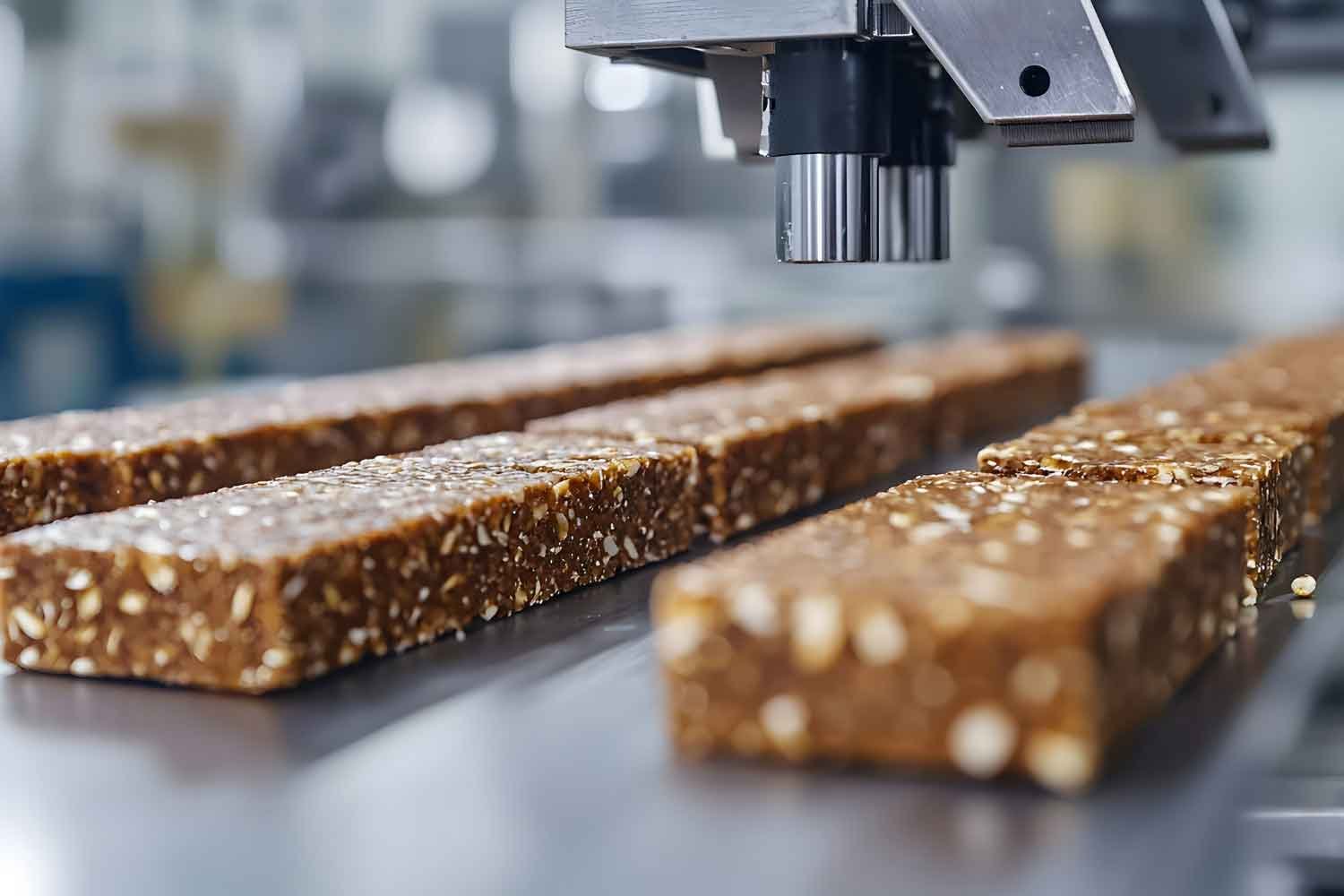
Controlled environment rooms with monitoring for the dew point are needed for preventing moisture absorption due to mixing, deposition, and cooling operations. A small amount of exposure to high relative humidity levels leads to increased Aw levels throughout the batch.
Chocolate/Compound Coating & Cooling
The prevention of water uptake in a chocolate or compound coating process needs temperature regulation of both the coating agent and bar. The cooling tunnel should not allow condensation on the surface of the bar prior to packaging.
Sanitation Procedures and Hygiene
Avoiding microbial contamination that results in increases in Aw levels post-manufacturing is accomplished through proper sanitation procedures and hygiene-certified equipment.
Storage, Transport, and How to Extend Protein Bar Shelf Life
- In ambient storage, humidity and temperature control have to be maintained with strict discipline.
- Such environmental controls must ideally be monitored continuously.
- “First in, First out,” or FIFO, as regards product turnover is crucial in both retail and distribution environments.
- But the shelf life test under real time conditions remains the ideal approach for verification purposes.
- Accelerated Shelf Life Test or ASLT provides fast results by accelerating the process of aging via higher temperatures and humidity.
| Bar Type | Avg Shelf Life | Key Risk |
|---|---|---|
| Whey Isolate | 12-18 Months | Oxidation |
| Plant Protein | 9-12 Months | Moisture Uptake |
| High-Fat Bar | 6-9 Months | Rancidity |
| Coated/Enrobed | 10-14 Months | Bloom |
| Layered Bar | 8-12 Months | Migration |
| Clean-Label Bar | 9-15 Months | Mold Growth |
Labeling and Compliance
Best before and use-by date labeling have different implications under various laws and regulatory frameworks. Each agency, such as FDA, EFSA, and GCC, stipulates its own specific guidelines for labeling and certification. Batch documentation, moisture activity records, microbiological analysis data, and certificates of conformance, like HACCP and ISO 22000, are key elements of this system.
How Technology and Equipment Impact Protein Bar Shelf Life
- Automatic mixing and depositing systems ensure uniform dispersion of ingredients.
- Such equipment greatly minimizes the moisture differences caused by manual operations.
- Real-time inline Aw detectors linked to production software systems alert operators before out-of-spec products reach packaging.
- Exact enrobing and cooling tunnel technology ensure precise coating sealing throughout all bars.
- Vision systems incorporated into packaging machines identify even minute defects in seals prior to shipping.
- The last technology control step saves your entire logistics system from spoilage due to a single defective seal.
Common Mistakes That Shorten Protein Bar Shelf Life
Formulation Problems
- The disparity in Aw (water activity) between two adjacent layers is the commonest formulating error.
- Excess use of hygroscopic sugars such as fructose leads to a system that has plenty of free water.
- This results in faster moisture movement within the layers and an environment for bacteria multiplication.
Packaging/Sealing Problems
- Opting for cheap, non-barrier packaging is a flawed decision.
- A slight mis-calibration of the heat-sealing process leads to hidden failures.
- Usually, such problems become evident through consumer complaints after some months.
Storage/Transportation Problem
- Temperature variations during transportation lead to condensation within the packaged material.
- Poor pallet loading applies pressure on the sealed regions.
- This weakens the packaging before reaching retail stores.
Conclusion
Increasing the shelf life of protein bars is an issue that crosses disciplines and demands a systematic approach throughout the process of manufacture. To highlight the essential points:
- Prevention of moisture movement is the most important thing for maintaining texture and guaranteeing food safety.
- Monitoring water activity between 0.55 and 0.65 AW is a non-negotiable necessity at all stages of manufacturing.
- High barrier packaging and nitrogen flushing provide maximum protection against oxidation and moisture penetration.
- Natural preservatives and stable sources of protein enable clean label initiatives while extending shelf life.
- Shelf life testing and compliance ensure the highest standards of food safety and product reputation.
- Making mistakes during formulation, sealing, and handling has as much effect as following best practices.
- Foodsure Machines design custom machinery for protein bar manufacture specifically to increase shelf life, monitor moisture content, and ensure superior seal integrity.
Looking to establish your own line of protein bars? Join forces with Foodsure Machines for full service from formulation assistance through cutting-edge equipment, resulting in an extended shelf life and high-quality products.
Launch Your Protein Bar Brand 🚀
Machines, setup & expert support — all in one place.
FAQs
What is the typical shelf life of a protein bar?
The average shelf life of a protein bar is 6–12 months. Using the right formulation, high-barrier packaging, and nitrogen flushing will enable an achievable 18+ months shelf life goal.
In what way does moisture migration harm the quality of protein bars?
Moisture migration leads to product failure by resulting in soft crispy layers, coating bloom, stickiness, and promoting the growth of molds and yeasts.
What should be the water activity value of a protein bar for optimal shelf life?
Water activity between 0.55–0.65 Aw is ideal. Any water activity higher than 0.70 would pose significant spoilage risk.
What kind of package is the most suitable for avoiding spoilage of protein bars?
High-barrier foil laminated packaging, together with MAP nitrogen flushing and proper sealing, would offer maximum protection from spoilage by providing barrier properties from moisture vapor and oxidation.
Is it possible to use natural preservatives instead of artificial preservatives in protein bars?
Yes, cultured dextrose, buffered vinegar, tocopherols, natamycin, and other natural preservatives can successfully protect protein bars without posing any risks for consumers.




