
Mayonnaise exposed to heat will spoil quickly due to oil separation, loss of texture, and reduced shelf life. To food producers operating high-throughput operations, this is an expensive predicament. Income’s emulsification technology makes this a thing of the past by providing enhanced heat stability improvement in mayonnaise, removal of any air entrapment during production, and construction of robust emulsion structures using optimal mixing processes.
The outcome is clear that the product remains smooth and uniform regardless of the heating effects of transportation or preparation in restaurants or bakeries.
In this guide, we have looked at the processes involved in the use of income emulsification technology for superior-quality mayonnaise production.
Why Heat Stability Matters in Mayonnaise Production
Food safety in commercial mayonnaise manufacturing is important to prevent separation or breakdown of the emulsion in the event of temperature changes during production, storage, and transport. Finally, when the mayonnaise is applied or cooked. Standard mayonnaise can be quite susceptible to heat. When exposed to temperature increases, the proteins and emulsifiers break down, causing the oil and water to separate, resulting in loss of structure, oil release, and a breakdown of the mayonnaise consistency and texture.
For food manufacturers and QSR chains, the quality and safety of products, such as baked products or hot-serving meals, depend on the thermal stability of the mayonnaise that is being incorporated.
Read More :- how to start a mayonnaise manufacturing business
Benefits of Heat-Stable Mayonnaise:
- Preserves emulsion: Prevents oil separation and phase failure at increased temperature conditions (cooking, storage, and shipping).
- Consistent Culinary Performance: Holds the texture and consistency when in contact with heat (cooked dishes, baked foods).
- Decreased losses and rejection rates: Minimises product losses during manufacturing.
- Longer Shelf Life: Physical stability over time.
- Defends brand reputation: Aesthetically and structurally pleasing sensory characteristics, regardless of how the end consumer chooses to use the product.
How Vacuum Emulsification Improves Heat Stability Improvement in Mayonnaise
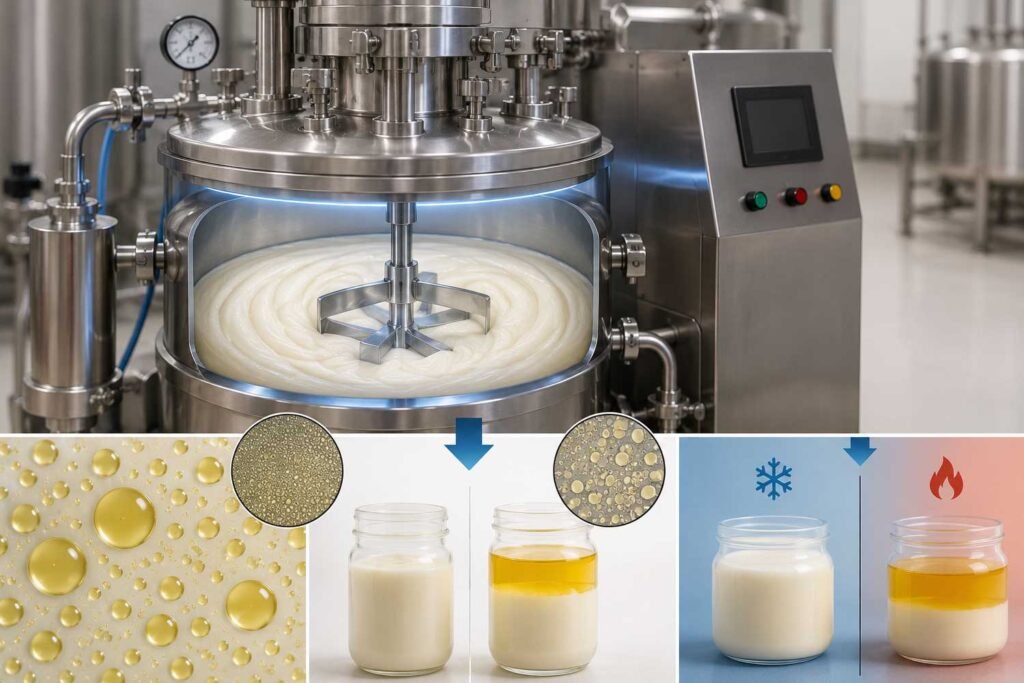
Vacuum emulsification is the benchmark process for producing heat stability improvement in mayonnaise, relying on the physical modification of emulsion microstructure. Because it uses negative pressure, the vacuum process negates the defects in mayonnaise emulsion microstructure, which compromise its stability at high temperatures (non-uniform droplet size, trapped air).
Key processing improvements
Uniform Micro-Droplet Creation
- High Shear Homogenization: Mechanical shear in precision machines ruptures oil globules to microscopic proportions.
- Uniform Dispersion: As oil globules remain dispersed, the coalescence effect, which can cause breakdown when the product reaches high temperatures, is diminished.
- Dense Network: A smaller droplet size leads to a tightly packed emulsion microstructure, boosting the viscosity and heat stability of the final product tremendously.
Air-Free Environment
- Elimination of Voids: Air pockets expand upon heating, thus bursting the emulsion; in a vacuum, this is removed.
- Improved Density: A heavier product that physically maintains its integrity during baking or hot filling processes.
- Visuals: The elimination of air leads to a shiny and smooth finish to the product, as light does not scatter from microscopic air bubbles within the emulsion.
Enhanced Ingredient Activation
- Optimised Hydration: Pressure generated during vacuum processing allows the stabilisers and thickeners to fully hydrate and bond with the aqueous phase.
- Protein Efficiency: Dispersion of egg proteins into the oil and water phases of the emulsion is increased so that the protein film is more robust and forms a tight shield around the oil globule.
- Syneresis Control: Water is entrapped within the protein-stabiliser complex, which greatly reduces weeping or moisture release post-heat treatment.
Uniform Aqueous Phase Dispersion:
- Structural Integrity: Water is evenly distributed throughout the emulsion, so “pockets” do not develop in a manner that promotes instability.
- Moisture Retention: Keeps moisture in place when undergoing the stresses of frozen meal processing or high-temperature manufacturing.
Oxidation Protection:
- Chemical Stability: Minimal air contact greatly limits exposure of lipids and proteins to oxidising influences.
- Extended Shelf Life: Fresh flavours and textures are preserved over time, even through varied temperature ranges.
Role of High-Shear Homogenization in Thermal Stability
The workhorse of vacuum emulsification systems, high-shear homogenization ensures that everyday blends are turned into durable, heat-resistant emulsions. As the name suggests, the strong mechanical action applied by the homogeniser breaks down large fat globules and creates the smallest possible droplets, dispersed uniformly throughout the water phase, in turn creating a very dense and stable emulsion matrix.
Why is High-Shear Homogenization Important?
- Improves emulsion structure: The rapid reduction of droplets reduces oil-water droplet interaction and thereby prevents coalescence during heating by establishing a tighter network structure.
- Enhances ingredient incorporation: High-shear action adequately activates all emulsifiers, proteins, and thickeners present in the formulation, thereby preventing weak points in the emulsion network.
- Resists stress: Uniformly fine structures are resilient enough to overcome stresses like temperature and physical vibration in transportation or storage.
- Guarantees consistency: Mayonnaise machine manufacturers can be sure that every batch is equally dense, making the system perfectly capable of producing products to endure harsh conditions like hot-fill processes or frozen storage.
Read More :- mayonnaise machine price india
Key Processing Parameters That Affect Heat Stability
To ensure heat stability improvement in mayonnaise, several critical processing variables are meticulously controlled. Because the emulsion is particularly sensitive to processing conditions, close control of the processing environment is crucial to ensure the resulting emulsion retains its structure during heat treatment.
Critical Processing Factors
- Oil Phase Ratio: Maintaining the correct ratio of oil to water. The oil concentration is critical, as the concentration determines the body and viscosity of the emulsion that can support the oil phase during cooking.
- Homogenization speed: Optimum shear is critical. The level of shear must be sufficient to obtain small droplets but not so great that the protein emulsifiers are damaged.
- Vacuu level: Optimum vacuum is non-negotiable. Vacuum is important in producing a stable emulsion with no air dispersed within it, and this prevents internal pressures from forming within the emulsion that would cause the emulsion to break when cooked. Increasing the vacuum also increases density and decreases the oxidation potential.
- Temperature: The temperature profile used during the emulsification process must be closely controlled, especially to ensure optimum hydration and behaviour of the protein and stabiliser systems. Inconsistent temperature can create weakness within the emulsion.
- Stabiliser hydration: Gum thickeners and hydrocolloid stabilisers have to hydrate to maximise the water-holding potential to provide a protective layer around the oil droplets. Optimised processing technologies can improve stabiliser dispersion for a greater effect.
Why Food Manufacturers Prefer Vacuum Emulsifiers
Within a competitive industrial food production setting, vacuum emulsification has shifted from an application-specific tool to an indispensable piece of technology. Industrial manufacturers have quickly adopted this system due to the high degree of control needed to meet demands for consistent quality, long shelf-life, and improved sensory qualities, eliminating the fundamental flaws found in open mixing systems.
Strategic Advantages for Industrial Manufacturing
- Unparalleled Consistency and Repeatability: The automation of key variables such as shear intensity and vacuum pressure allows a vacuum emulsification system to turn out a consistent product that meets identical specifications with each run, minimising the variables present in manual, open-system operation.
- Superior emulsion quality: High-shear homogenisers integrated into the system under vacuum are able to achieve a finer emulsion than a conventional approach, resulting in a smoother, richer texture expected by consumers.
- Operational Efficiency: Products manufactured by vacuum systems require less batch processing time due to more effective hydration and dispersion, ultimately contributing to higher throughput and improved manufacturing yields.
- Economic savings: Due to lower reject rates resulting from oil separation, thermal breakdown, and inconsistent product, manufacturing businesses improve their profitability and brand reputation significantly.
- Better thermal performance: An air-free, dense emulsion produced by vacuum systems helps prevent products such as sauces and dressings from breaking down in high-temperature applications such as hot-filling, commercial catering, and sterilisation.
Choosing the Right Vacuum Emulsifier for Mayonnaise Production
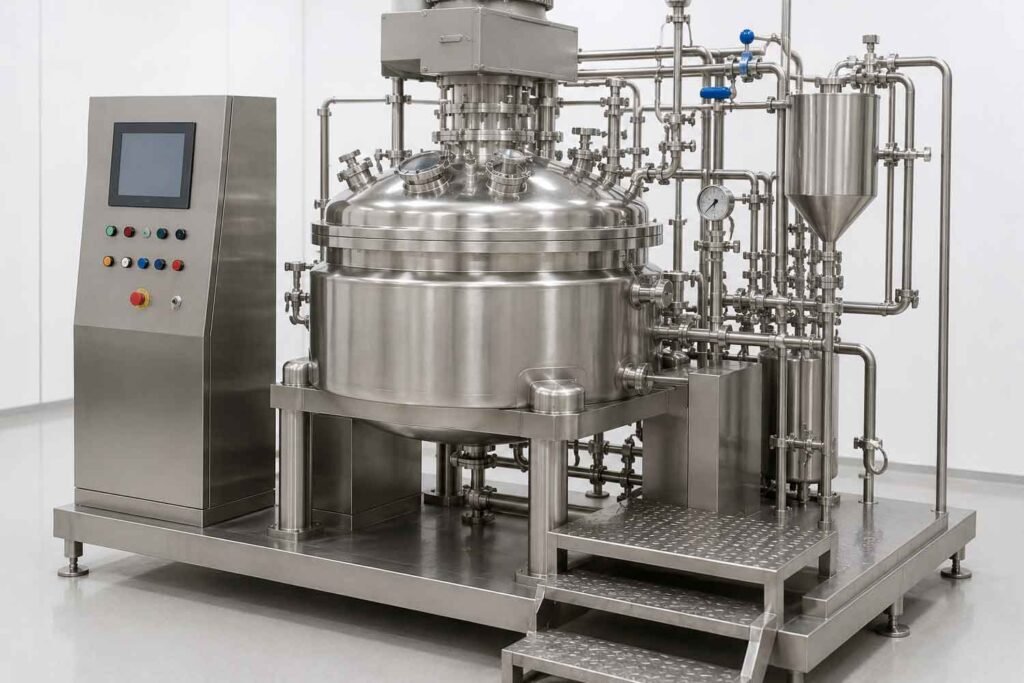
Choosing the right heat stability improvement in mayonnaise will also make a difference to your overall mayonnaise machine production line, from the level of production scale and safety to product quality. Since industrial demands vary greatly from those of small-scale artisan products through to mass-scale commercial volumes, selecting machinery with the right specifications is essential for efficient long-term use. A reliable machine forms part of your “raw-to-retail” workflow.
Industrial Equipment – Criteria of Selection
- Batch Capacity: Choose machines to suit your present daily volume of production, and ensure your equipment can be scaled up to accommodate growing demand.
- Homogeniser Power: High-shear energy is indispensable for obtaining fine particle sizes. The correct shear power is necessary for stable, heat-resistant mayonnaise.
- Vacuum Efficiency: An effective vacuum pump is indispensable for the continuous elimination of air, the quality and texture of mayonnaise, and its shelf-life.
- Material of Construction: Use food-approved stainless steel (e.g., SS316L), which guarantees a longer life, has higher corrosion resistance, and fulfils international food safety regulations.
- Automation: PLC-controlled automated recipes and process control are beneficial; this avoids human error and guarantees repeat accuracy for all runs.
- CIP (Clean-in-Place): Systems with CIP functions help to reduce process downtime, minimise labour costs, and can streamline food safety audits, e.g., FSSC 22000 or ISO 22000.
Read more :- mayonnaise-machine
Conclusion
At Foodsure Machines, we recognise that achieving uniform emulsion quality is the cornerstone of modern mayonnaise production. Our state-of-the-art vacuum emulsifier systems enable enhanced heat stability improvement in mayonnaise, uniform texture, increased thermal stability, and dependable large-scale food processing performance.
We are dedicated to providing food manufacturers with solutions to efficiently manufacture and process high-quality heat-stable mayonnaise, minimising variations between batches while maximising long-term production sustainability. The Foodsure Machines processing solutions offer the crucial advantages of vacuum processing, such as reduced air incorporation, better shelf-life stability, and increased uniformity for a food processing application.
Heat stability improvement in mayonnaise 🚀
heat stability improvement in mayonnaise. setup support in India.
FAQ
How does heat affect regular mayonnaise during processing?
It leads to weakening the emulsion structure, with free oil separated, the texture becomes thinner, and the product stability is weakened.
Why is a vacuum emulsifier important for mayonnaise production?
A vacuum emulsifier enhanced the mixing performance and achieved an even and stable mayonnaise structure.
What makes heat-stable mayonnaise different from standard mayonnaise?
A heat-stable mayonnaise shows better stability in texture and structure under high temperatures.
How does thermal stability improve mayonnaise’s shelf quality?
Better thermal stability reduces water release, emulsion destabilisation, and texture inconsistency during storage.
What are the practical vacuum processing benefits for food manufacturers?
Better emulsion quality, decreased air incorporation, more consistency, and better industrial sauce processing performance can be achieved by vacuum processing.




