
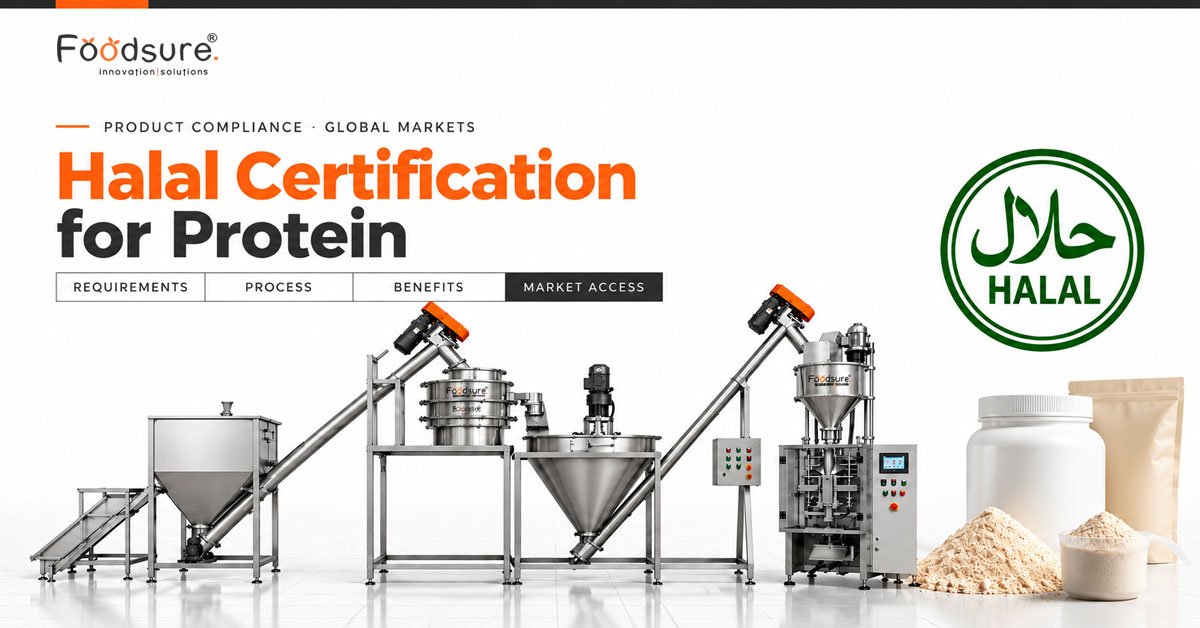
There is an increasing trend of protein supplements in the GCC region due to rising levels of health and fitness awareness. In relation to the above trend, there has been an increased focus on Halal protein powder, especially among people and organizations serving a predominantly Muslim customer base.
Nevertheless, Halal certification for protein entails more than just examining the main protein ingredient in a product; other aspects to be considered include additional ingredients, processing methods, equipment, etc.
The purpose of this blog is to discuss the important requirements that are needed for Halal certification for supplements, including ingredients, machinery, manufacturing practices, and more.
Why Halal Certification for Protein Matters
Halal protein powder is becoming more and more in demand along with the growth of the sports nutrition industry. In the case when a producer targets Muslim clients, especially those located in GCC countries, the Halal requirement is an essential aspect of product acceptance and brand recognition.
A protein product may consist not only of the main protein ingredient. Other ingredients such as flavorings, sugar, vitamins, minerals, emulsifiers, etc., should also be considered.
In this context, Halal certification for protein is a very crucial factor that should be considered from the very beginning of the product development process, rather than at the stage of the final product launch.
For a company starting its activity in the field of Halal supplement manufacturing, a proper Halal strategy will help manage all processes of production and documentation much better.
Understanding Halal Requirements for Protein Supplements
Compliance with Halal entails a review of the entire manufacturing chain. Manufacturers have to know the origin of their materials and ensure that the production practices comply with the relevant certification requirements.
For Halal certification for supplements, businesses may need to maintain control over areas such as:
- Raw material: Raw materials should originate from acceptable and well-documented sources.
- Supplier information: The relevant requirements and documents should be available.
- Manufacturing process: The manufacturing and handling process should be in line with Halal requirements.
- Equipment: Appropriate equipment must be used based on the production system.
- Storage: Proper storage of the raw materials and finished products.
- Traceability: Materials should be tracked through the manufacturing process.
Certification requirements differ based on country, product, ingredient, and certifying organization, among other factors. Manufacturers are required to check the certification requirements before developing their production system.
Ingredients That Need Careful Verification
The Halal certification for protein begins with ingredient verification, which is one of the key initial stages. It is obvious that the main source of protein seems simple enough, yet a number of other components are usually present in a finished supplement.
It depends on the product whether the manufacturer uses:
- protein concentrate or isolate
- flavoring agents
- sweeteners
- vitamins and minerals
- emulsifying agents
- stabilizing agents
- coloring agents
- functional additives
Every ingredient has to be verified with respect to its origin and relevant Halal requirements.
Protein Sources and Their Halal Status
The type of protein may affect Halal certification. Proteins from dairy, plant, and any other sources may be treated differently, based on how they were made and the other materials used in their production process.
In order to make Halal protein powder, it is necessary to keep proper records about the protein ingredient sources.
It becomes very important when multiple sources of materials are considered.
Flavours, Sweeteners and Other Ingredients
Supporting ingredients should not be overlooked during Halal certification for supplements. A product can contain a relatively small quantity of flavouring or functional ingredients, but their source may still need to be evaluated.
Manufacturers should therefore review the complete ingredient list rather than focusing only on the primary protein component.
Halal Certification for Supplements: What Manufacturers Need to Know
Halal certification for supplements usually involves the manufacturer showing that the product and the process meet the criteria set out in the particular certification program.
This may include an assessment of:
- Source of ingredients
- Specifications of ingredients
- Supplier documents
- Manufacturing process
- Cleaning process
- Storage process
- Labelling of the product
- Traceability system
For manufacturers planning Halal supplement manufacturing, maintaining organised documentation can make compliance management more practical and transparent.
Key Manufacturing Requirements for Halal Compliance
A compliant production system should cover more than formulation. Proper receiving, storage, weighing, blending, transfer, and packaging procedures are also important for maintaining Halal requirements.
Good manufacturing practices could ensure that:
- Material handling remains controlled.
- Traceability is ensured.
- Production is hygienic.
- Unwanted contamination is prevented.
- Processing is consistent.
- Documentation is easy.
In terms of Halal certification for protein, such systems would ideally have to be considered during production facility planning.
Role of Machinery in Halal Supplement Manufacturing
Machinery on its own is not sufficient to produce the Halal product, but hygienic design, good cleaning, and controlled handling facilitate Halal supplement manufacturing. Protein processing needs controlled handling of the dry material as well.
A typical setup may include:
- Ingredient weighing and dosing systems
- Vibro sifter
- Powder transfer equipment
- Powder blender
- Holding hopper
- Filling machine
- Sealing and packaging equipment
Equipment should match the product, capacity, powder characteristics, hygiene needs, and Halal requirements. Properly selected machinery can support controlled and hygienic Halal supplement manufacturing.
How Powder Mixing and Premix Processing Should Be Managed
Powder mixing is crucial in Halal supplement manufacturing for uniform ingredient distribution and consistent batches. For Halal certification for protein, controlled transfer and proper cleaning help maintain hygienic processing.
A suitable blending system can support:
- Uniform mixing: Helps distribute protein and supporting ingredients consistently throughout the batch.
- Controlled handling: Reduces unnecessary manual contact with the product during processing.
- Repeatable batches: Supports more consistent production from one batch to another.
- Efficient processing: Helps manufacturers handle commercial production volumes more effectively
Preventing Cross-Contamination During Production
The issue of cross-contamination is something that needs to be considered in the manufacturing process of products in a Halal production system, especially when the facility produces different kinds of products/ingredients through the same equipment.
The manufacturer needs to come up with appropriate measures for cleaning, handling, and changing production. The goal here is to control the materials in the manufacturing process.
For Halal certification for supplements, documentation on cleaning and production controls can be necessary.
Documentation and Traceability for Halal Production
Documentation plays an important role in Halal certification for protein because manufacturers need to demonstrate control over the materials and processes used to produce the finished product.
An effective documentation process may consist of:
- Ingredient documents: Documentation on the approved ingredients along with their sources.
- Supplier documents: Appropriate certificates and information.
- Manufacturing documents: Information regarding batch and manufacturing processes.
- Cleaning documents: Information on cleaning operations and changeover.
- Traceability documents: Documents linking the ingredients with the final manufactured batches.
It will help in making the audit and certification processes easier for you along with improving production controls.
Halal Protein Powder Manufacturing Process
The production of Halal protein powder generally involves controlled handling of dry ingredients from receiving through final packaging. The exact process depends on the product formulation and manufacturing requirements.
A simplified production flow can be:
Ingredient Receiving → Weighing → Sieving → Powder Blending → Holding → Filling → Sealing → Labelling → Packaging
Each stage should be planned according to the applicable food-safety, quality, hygiene, and Halal requirements.
Choosing Equipment for Halal Nutraceutical Manufacturing
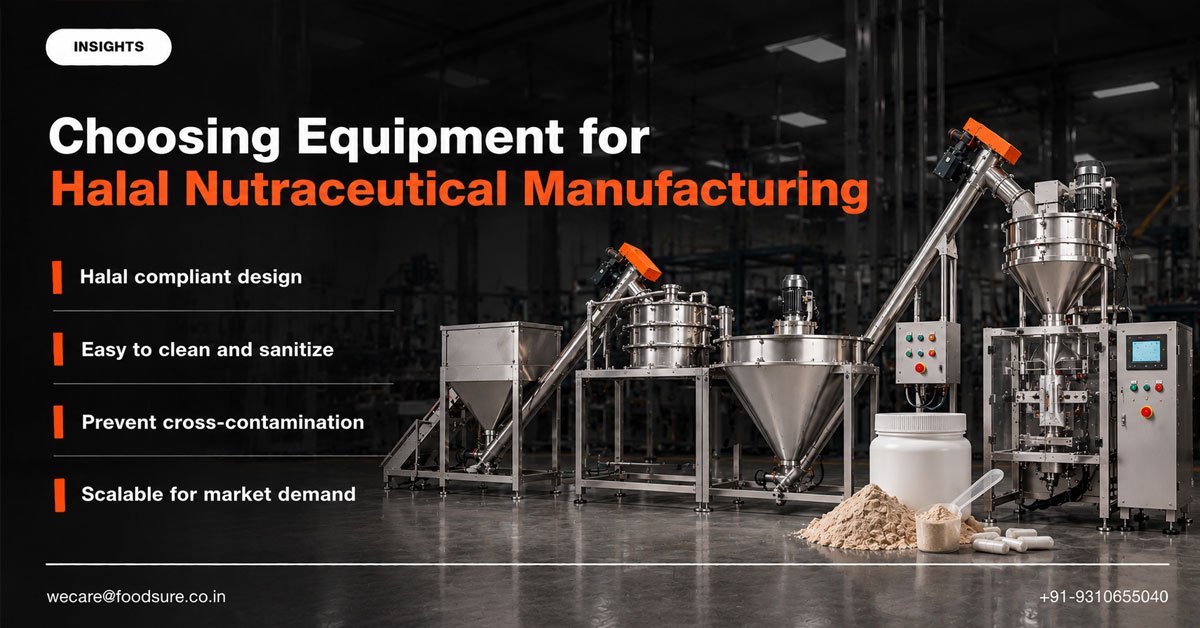
Selection of the machinery that would be used in the Halal supplement manufacturing process needs to be done taking into account not only efficiency but hygiene too. Machines must not be selected based only on their capacity or cost.
Some of the considerations include:
- Construction for food contact: Contact surfaces should be suitable for the particular application.
- Cleanability: Equipment should be easy to clean and sanitize.
- Powder handling capability: The blenders and transfer equipment should be suited for the product.
- Production capacity: Machinery should be able to produce according to the required batch and production volumes.
- Automation: Equipment should give the required automation capability.
- Expandability: Machinery should have enough room for future expandability in production.
For businesses pursuing Halal certification for supplements, machinery selection should form part of the wider compliance and production planning process.
How a Protein Supplement Production Line Supports Compliance
A well-integrated production line will allow producers to have better control of materials and their processes. Rather than using many manual transports, automated machines can ensure that there is proper organization of the entire production process.
Automation will also ensure:
- Uniform weighing and dosing
- Organized transfer of powder
- Proper blending
- Less manual handling
- Production monitoring
- Batch record management
This is especially important when trying to get Halal certification for protein production, but ultimately it is all dependent on the standards of the Halal authority.
UAE and GCC Considerations for Halal Supplement Manufacturing
The GCC is an interesting market for nutritional and protein products, and hence Halal supplement manufacturing becomes relevant for companies considering future expansion into this region.
Companies that are considering entering the GCC market have to keep in mind the specific needs of the destination country as far as product registration, labeling, ingredients, and Halal certification are concerned.
Firms could even go ahead and consider relevant powder processing equipment when designing the plant. For instance, a coffee premix machine in UAE will become relevant for firms that manufacture various dry premix products in the same processing environment.
The protein supplement market GCC also creates business opportunities for companies that are able to manufacture consistently in an appropriate compliance system.
Common Halal Compliance Mistakes Manufacturers Should Avoid
It is important that while designing Halal certification for protein, compliance issues be considered in the early planning phase itself. Any efforts to ensure compliance at a later stage could unnecessarily complicate things.
Mistakes may occur such as:
- Neglect of supportive ingredients: Paying attention to the primary source of protein but ignoring flavors, additives, vitamins, or any other ingredients.
- Insufficient documentation of suppliers: Using the ingredients without proper documentation of their sources and certifications.
- Poor cleaning processes: Lack of proper cleaning and changeover methods for shared equipment.
- Inadequate traceability: Lack of proper record-keeping connecting raw ingredients with finished batches.
- Use of equipment without hygiene in mind: Purchase of the machinery on the basis of capacity rather than its cleaning and handling of the products.
- Certification at the last minute: Considering certification once the product is ready for launch.
This way, these problems could be avoided, and Halal supplement manufacturing would become easier and well-organized.
Building a Halal-Compliant Production System
A Halal protein powder facility should combine suitable ingredients, hygienic machinery, controlled processing, and proper documentation from the start.
This helps maintain compliance, traceability, and consistent production.
If carefully planned, such a system will allow for better control over:
- Acquisition of raw materials
- Handling of ingredients
- Blending of powders
- Cleanliness of equipment
- Production information
- Traceability of finished products
It can also help businesses maintain uniformity as production volume increases.
Why Machinery Selection Matters
Machinery supports Halal certification for supplements by enabling hygienic processing, easy cleaning, controlled material transfer, and consistent blending.
In relation to the premixes of proteins and supplements, the machinery could be composed of:
- Powder sifter
- Dosing machinery
- Powder blender
- Material conveying machinery
- Hoppers for storage
- Powder filling machine
- Packaging machinery
The design will largely depend on the specific product, capacity, formulation, packaging type, and manufacturing requirements.
Foodsure Machines for Halal Supplement Processing
Foodsure Machines offers a complete processing solution for powder food and supplement production. This equipment can be set up based on the type of product, production capacity, nature of the powder, automation, and packaging.
In the case of businesses planning Halal supplement manufacturing, the equipment setup can include weighing, screening, mixing, conveying, filling, and packaging equipment. It will be more about setting up a production line than choosing equipment individually.
Businesses can also look at equipment for other premix applications, such as a coffee premix machine in UAE, based on the range of products they manufacture.
Foodsure Machines can assist businesses with equipment selection, production line design, installation, commissioning, and training.
Conclusion
The Halal certification for protein powder must be thought of in terms of the overall manufacturing process, rather than simply being something that is done at the end of the process.
In the development of Halal protein powder products in the GCC, companies that incorporate these needs from the beginning are able to create a much more organized and scalable system for producing these products.
For new companies looking to enter into the manufacture of Halal supplements, combining the right ingredients, the right machines, and the proper documentation can be a good way to get started.
FAQs
What does Halal certification entail for proteins?
Certification for Halal protein could entail the ingredients, the ingredients’ source, processes involved in production, equipment, etc.
Does protein powder automatically become Halal?
No. Halal protein powder should be determined by the source of its proteins, other ingredients present in it, the process, and certification requirements.
What is the importance of having Halal certification for supplements?
The process of certification of Halal supplements can enable the manufacturer to prove that his products have satisfied the relevant Halal requirements.
What machines will be required for Halal supplement manufacture?
Some of the equipment required includes a weigher, sifter, powder blender, transfer system, storage hopper, filler, and packaging machine.
Can the same machinery be used to produce several different supplement products?
Yes, depending on the type of products and certification requirements, suitable procedures should be developed.




