
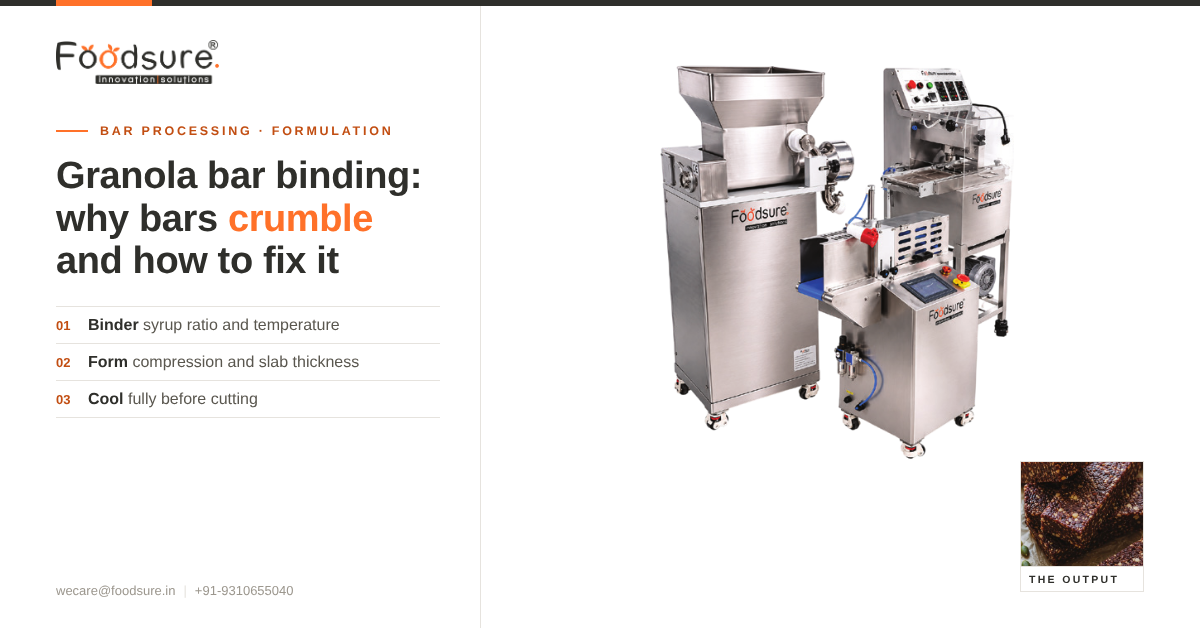
Granola bars are a popular snack choice because of their convenience, texture, and variety of ingredients, including oats, nuts, seeds, dried fruits, and sweeteners. However, maintaining the right structure during commercial manufacturing can be challenging. Granola bars that break during slicing, packaging, or transportation can lead to product wastage and financial losses.
Several factors contribute to granola bar binding problems, including an incorrect binder-to-ingredient ratio, improper mixing, unsuitable heating conditions, insufficient compression, and incorrect cooling or cutting. The problem does not always arise because of insufficient binder. Ingredient proportions, particle size, and moisture distribution can also affect the final product.
For commercial snack manufacturers, identifying the actual reason behind crumbling is essential before changing the formulation or investing in new machinery.
This guide explains why granola bars fail to stick together, how manufacturers can fix common binding problems, and how suitable granola bar manufacturing machinery can improve production consistency.
What Are Granola Bar Binding Problems?
Granola bar binding problems occur when the ingredients fail to form a strong structure that allows the finished bar to maintain its shape. A properly manufactured granola bar should remain intact during cooling, cutting, packaging, storage, and transportation while retaining its intended texture.
Binding depends on the interaction between dry ingredients and the binder used in the formulation. Common binding ingredients include syrups, honey, sugar, nut butter, and fats. Heat and compression also contribute to the formation of the bar structure.
Common signs of poor granola bar binding include:
- Bars breaking during cutting and slicing.
- Loose oats, nuts, or seeds falling from the surface.
- Edges crumbling after cooling.
- Bars breaking during packaging or transportation.
- Inconsistent firmness across the same production batch.
- Excessive loose material remaining after forming.
- Finished bars becoming either too fragile or excessively hard.
The appropriate solution depends on when the problem occurs. If the mixture falls apart before forming, the issue may involve binder distribution or ingredient proportions. If the bars hold their shape initially but crumble after cooling, manufacturers may need to investigate the setting conditions, moisture balance, or cutting process.
Why Do Granola Bars Crumble During Production?
Several factors can contribute to granola bar binding problems. Manufacturers should evaluate the formulation and processing conditions together rather than assuming that adding more syrup will solve every issue.
1. Incorrect Binder-to-Dry-Ingredient Ratio
The binder holds oats, nuts, seeds, and other inclusions together. When the binder quantity is insufficient compared with the dry ingredients, the mixture may lack cohesion during forming.
On the other hand, excessive binder can make granola bars too sticky, soft, or difficult to process. The ideal proportion depends on the formulation and manufacturing technology.
How to fix it:
- Review the approved formulation and batch records.
- Measure ingredients accurately using calibrated weighing equipment.
- Check whether changes in dry ingredient quantities have affected the binder ratio.
- Conduct controlled formulation trials before adjusting the recipe.
Manufacturers should evaluate the finished bar’s cohesion, texture, stickiness, and shelf stability after making any formulation changes.
2. Uneven Binder Distribution
Even when the correct quantity of binder is used, poor distribution can result in inconsistent binding. Some parts of the mixture may receive sufficient binder, while other areas remain dry and loose.
This problem can occur when ingredients are added too quickly, the mixer is overloaded, mixing time is insufficient, or the binder is not prepared at a suitable temperature.
How to fix it:
Use an appropriate mixing process to distribute the binder evenly throughout the dry ingredients. Standardise the ingredient addition sequence, mixing duration, batch size, and binder preparation conditions.
Operators should also inspect the mixture before forming. Visible dry pockets or uneven coating indicate that the mixing process may require adjustment.
3. Unsuitable Binder Temperature
Temperature influences the flow and handling properties of syrups used in granola bar formulations.
If the binder is too cold or thick during mixing, it may not coat the ingredients uniformly. If it is excessively warm, it can affect moisture content, ingredient texture, and the setting behaviour of the mixture.
The suitable temperature depends on the binder type and manufacturing process.
How to fix it:
- Establish an appropriate operating temperature for the specific binder.
- Monitor temperature during preparation and transfer.
- Minimise uncontrolled temperature changes between preparation and mixing.
- Avoid excessive heating that could alter the binder or affect product quality.
Temperature settings should be validated for the formulation rather than applying the same conditions to every granola bar recipe.
4. Incorrect Moisture Balance
Moisture content influences ingredient binding and the way granola bars set during cooling. Insufficient moisture or unsuitable binder characteristics can prevent ingredients from forming a cohesive structure, while excessive moisture may make the bars sticky or unstable.
Dried fruits, syrups, nut butters, and other ingredients can contribute different amounts of moisture and fat to the formulation.
How to fix it:
Measure ingredients consistently and investigate changes in raw material moisture. Review the formulation and processing conditions before adjusting water or syrup quantities.
Manufacturers should also evaluate finished-product moisture content and water activity where relevant. These are different measurements, and neither should be used alone to establish microbiological safety or shelf life.
5. Poor Ingredient Particle Size
Granola bars can contain oats, nuts, seeds, dried fruits, crispy ingredients, and other inclusions. If their particle sizes are unsuitable for the formulation, the mixture may develop weak areas that cause breakage.
Large inclusions can interrupt the bar structure, while excessive fine particles may affect texture and binder distribution.
How to fix it:
Standardise ingredient specifications and evaluate particle size during product development. If necessary, adjust chopping, screening, or ingredient preparation procedures to improve uniformity.
The objective is not to make every ingredient identical in size. It is to establish a suitable particle distribution that supports the intended texture and binding performance.
6. Insufficient Compression During Forming
After mixing, the granola mixture needs to be shaped into a slab or individual bars. Insufficient or uneven compression may prevent the ingredients from making enough contact to form a stable structure.
However, excessive compression can also create problems by producing overly dense bars or damaging delicate inclusions.
How to fix it:
Review the forming equipment’s pressure settings, roller gap, feed distribution, and operating speed. Check whether the mixture is spread evenly across the forming area.
A suitable forming process should produce consistent thickness and density without damaging inclusions or making the finished bar excessively compact.
7. Incorrect Cooling and Cutting Conditions
Granola bars may appear stable while warm but become fragile after cooling. Premature cutting can also cause deformation or breakage if the binder has not set sufficiently.
Cutting equipment can contribute to the problem when blades are blunt, misaligned, or operating at unsuitable speeds.
How to fix it:
Establish a suitable cooling period and temperature profile for the formulation. Confirm that the bars have reached the required condition before cutting.
Inspect cutting blades, cutting speed, and product alignment. If breakage mainly occurs during cutting, evaluate the cutting process before changing the binder formulation.
How to Troubleshoot Granola Bar Binding Problems
A systematic investigation helps manufacturers identify the actual cause without making several formulation or process changes simultaneously.
| Observed Problem | Possible Cause | Recommended Action |
| Mixture falls apart before forming | Insufficient binder or poor distribution | Review formulation and mixing |
| Dry patches in the mixture | Uneven ingredient incorporation | Adjust mixing sequence and batch loading |
| Bars break during compression | Unsuitable forming pressure or mixture consistency | Review feed distribution and forming settings |
| Bars crumble after cooling | Weak structure or unsuitable setting conditions | Check binder system and cooling process |
| Edges break during cutting | Incorrect cutting conditions or fragile bars | Inspect blades, timing, and product alignment |
| Bars become sticky during storage | Moisture migration or formulation imbalance | Assess moisture, packaging, and storage |
| Some bars are firm while others are fragile | Inconsistent mixing, forming, or ingredient distribution | Standardise operating conditions and inspect equipment |
Effective troubleshooting requires recording the point at which breakage occurs, the affected batch, ingredient quantities, operating conditions, and observations from finished products.
How Can Manufacturers Improve Granola Bar Binding?
Preventing granola bar binding problems requires consistent control over the formulation and every major processing stage.
Standardise the Recipe
Maintain an approved formulation with clearly defined ingredient quantities and specifications. Changes in oats, nuts, seeds, dried fruits, or syrups can affect the behaviour of the mixture.
Control Mixing Conditions
Establish standard operating procedures for ingredient addition, batch size, mixing time, and binder temperature. Operators should follow the same process unless a controlled change is introduced.
Monitor Forming Pressure
Maintain consistent slab thickness and compression across the forming area. Inspect products regularly for loose edges, weak sections, and variations in density.
Validate Cooling and Cutting
Test different cooling conditions and cutting configurations during product development. The process should produce bars that maintain their shape without becoming excessively hard or brittle.
Review Packaging and Storage
Packaging protects granola bars from physical damage and environmental changes. Select suitable packaging materials according to the product’s moisture content, fat composition, and storage requirements.
Conduct Finished-Product Quality Checks
Quality control should include relevant measurements such as:
- Bar dimensions and weight.
- Texture and firmness.
- Breakage rate.
- Moisture content.
- Water activity, where applicable.
- Packaging integrity.
- Product stability during storage.
Testing should follow the product specifications and intended storage conditions.
What Role Does an Energy Bar Making Machine Play?
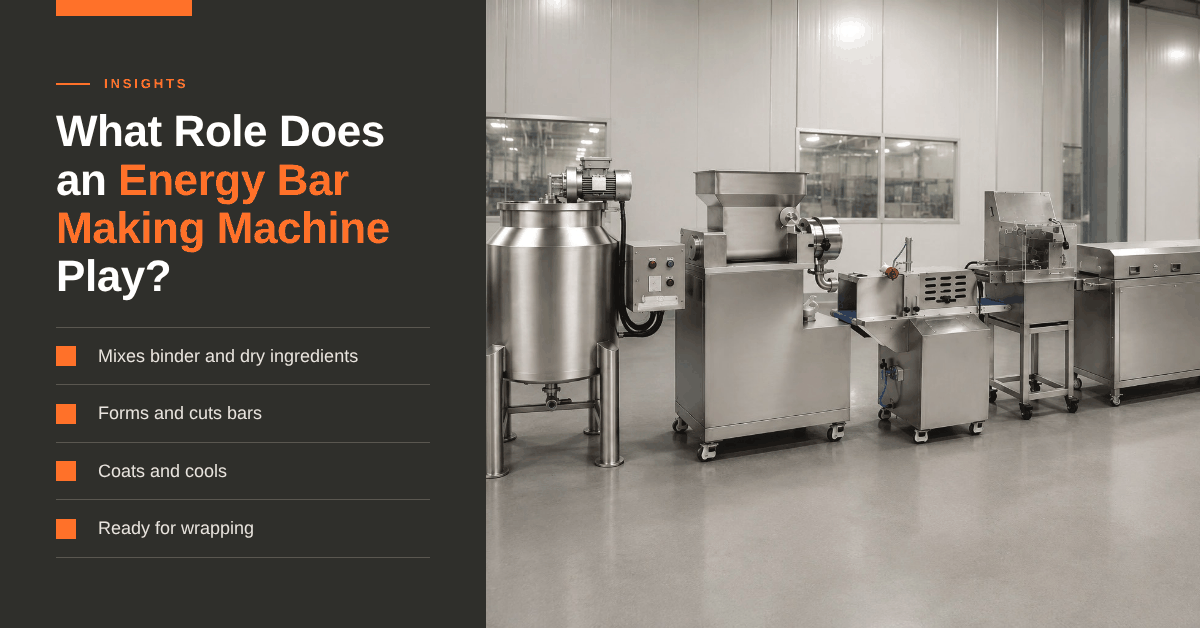
An energy bar making machine automates operations such as mixing, forming, moulding, slab preparation, and cutting, depending on the machine configuration.
Suitable machinery can help manufacturers maintain consistency through better control over production parameters and material handling.
However, machinery cannot compensate for every formulation problem. An incorrectly balanced recipe may still produce fragile bars even when processed using advanced equipment.
When evaluating an energy bar making machine, manufacturers should check:
- Mixing performance and binder distribution.
- Compatibility with the formulation and particle size.
- Compression and thickness control.
- Cutting accuracy and product handling.
- Cleaning and maintenance requirements.
- Practical production capacity under intended operating conditions.
Equipment trials using the actual granola mixture can help determine whether the machine meets the required product quality and production output.
Commercial Granola and Energy Bar Manufacturing with Foodsure Machines
Setting up a commercial granola bar or energy bar manufacturing facility requires machinery that can handle different ingredient combinations, binder systems, forming requirements, and cutting operations.
Foodsure Machines provides food processing machinery solutions for businesses planning to manufacture granola bars, protein bars, and other high-protein snack products.
With in-house manufacturing capabilities, Foodsure develops machinery configurations based on the manufacturer’s product requirements, production capacity, and automation preferences.
The machinery setup can be evaluated according to different stages of production, including ingredient mixing, slab forming, compression, cutting, and integration with subsequent packaging operations.
Whether you are launching a granola bar startup or expanding an existing snack manufacturing facility, selecting suitable machinery can help establish a more consistent production process.
Choosing a Granola Bar Machine for Commercial Production
A granola bar machine should be selected according to the formulation, target production output, product dimensions, and level of automation required.
Small manufacturers may benefit from a batch-processing system that allows recipe adjustments and smaller production runs. Large manufacturers may require automated ingredient feeding, forming, cutting, cooling, and packaging systems.
Before purchasing equipment, evaluate its suitability for handling the actual ingredient blend. Granola containing large nuts, seeds, or dried fruits may behave differently from a smoother cereal mixture.
A nutrition bar machine may also be suitable when a business plans to manufacture multiple varieties of snack bars. However, compatibility should be confirmed for each formulation, particularly when products differ in stickiness, fat content, moisture, and inclusion size.
Similarly, a cereal bar machine or muesli bar machine may be suitable for certain granola products. However, terminology can vary between machinery suppliers. Buyers should confirm the machine’s specific functions, production capacity, and product-handling capabilities before purchasing.
Why Choose Foodsure Machines for Granola Bar Manufacturing Machinery?
Selecting the right granola bar machine manufacturer involves more than comparing equipment prices. Manufacturers must also evaluate machine specifications, production consistency, installation, operator training, and technical support.
Foodsure Machines manufactures food processing machinery in-house and provides solutions for startups, food entrepreneurs, and established manufacturers.
Key advantages include:
In-House Manufacturing
Foodsure Machines manufactures machinery in-house rather than operating only as a machinery reseller. This allows greater control over equipment design and production.
Customised Machinery Solutions
Equipment configurations can be planned according to the product formulation, target output, available space, and automation requirements.
Installation and Operator Training
Installation, commissioning, and operator training support help manufacturers prepare their production facilities for commercial operations.
After-Sales Assistance
Technical assistance and spare parts support help businesses manage their machinery and production requirements.
Turnkey Project Support
Foodsure can assist manufacturers in evaluating machinery requirements as part of a larger food processing plant setup.
With experience across 95+ food processing projects and over 13 years of industry experience, Foodsure Machines works with businesses looking to establish or expand their commercial food manufacturing operations.
Planning to start a commercial granola or energy bar manufacturing business?
Contact Foodsure Machines to discuss your product requirements, production capacity, and machinery specifications.
- Phone: +91 9310655040 | +91 88263 13121
- Email: wecare@foodsure.in
Best Practices for Small Granola Bar Businesses
For manufacturers exploring granola bar binding problems at a smaller scale, a structured production process can help improve product consistency without immediately investing in a fully automated manufacturing line.
Start by recording the recipe and measuring the quantities of each ingredient accurately. Prepare the binder consistently, mix the ingredients uniformly, and inspect the mixture before moulding.
Next, standardise the conditions for compression, cooling, and cutting.
Conduct small-scale experiments when evaluating formulation changes. Modify only one variable at a time so that its influence on the binding process can be identified.
Before increasing production, check whether the bars maintain their structure during cooling, packaging, and storage. Products that hold their shape immediately after moulding may still become fragile or sticky later.
Manufacturers should also confirm that their existing equipment can reproduce the small-scale process consistently. Increasing batch sizes can affect mixing, heating, and ingredient distribution.
Conclusion
Granola bars crumble when their ingredients fail to create a cohesive structure. The problem may result from an incorrect binder ratio, uneven mixing, unsuitable temperature conditions, moisture imbalance, improper compression, or incorrect cutting conditions.
The best way to address granola bar binding problems in commercial manufacturing is to evaluate the entire production process, starting from ingredient preparation and ending with packaging.
Manufacturers should maintain consistent formulations, control mixing conditions, use suitable forming equipment, validate cooling and cutting parameters, and conduct regular quality checks.
If machinery limitations are contributing to product inconsistency, selecting the right granola bar or energy bar production line can help improve manufacturing control and support higher production requirements.
For businesses planning to establish or expand a commercial snack manufacturing facility, Foodsure Machines offers in-house manufactured food processing machinery, installation, operator training, and after-sales support to help evaluate suitable production solutions.
Planning your granola or energy bar manufacturing setup?
Contact Foodsure Machines for machine pricing, technical specifications, and production requirements.
- Call: +91 93106 55040 | +91 88263 13121
- Email: wecare@foodsure.in
Frequently Asked Questions
1. How much does it cost to solve granola bar binding problems in India?
The cost of resolving granola bar binding problems depends on the formulation, binding ingredients, product development trials, and manufacturing machinery. Small formulation adjustments may require minimal investment, while larger changes involving new ingredients, mixers, heating systems, or granola bar manufacturing machinery can increase production costs.
2. How do I choose the right solution for granola bar binding problems?
Choose a binding solution based on ingredient composition, moisture content, texture, shelf life, and desired product consistency. Common granola bar binding ingredients include honey, glucose syrup, brown rice syrup, date paste, and other suitable food-grade syrups. The formulation should provide sufficient adhesion without making the bars excessively sticky, hard, or chewy.
3. What capacity do I need for a granola bar manufacturing startup?
A 50–100 kg/hr granola bar manufacturing line can be a practical starting point for startups targeting local retailers, online customers, and regional distribution. Businesses expecting larger orders can consider 200 kg/hr or higher-capacity production lines depending on market demand, investment plans, and production targets.
4. Manual vs automatic granola bar manufacturing machine: Which is better?
Manual or semi-automatic granola bar manufacturing machines are suitable for startups producing smaller batches with limited investment. Automatic granola bar production lines are better for commercial manufacturers requiring consistent mixing, slab forming, cutting, cooling, and packaging at higher production volumes.
5. What FSSAI licence is required for granola bar manufacturing in India?
Granola bar manufacturers require the appropriate FSSAI Registration or Manufacturing Licence based on their turnover, business activity, and eligibility. Under the revised FoSCoS criteria effective April 2026, businesses with annual turnover up to ₹1.5 crore generally require FSSAI Registration, those above ₹1.5 crore and up to ₹50 crore require a State Licence, and those above ₹50 crore require a Central Licence. Manufacturers should also check applicable food product standards, labelling, hygiene, and manufacturing requirements.




