
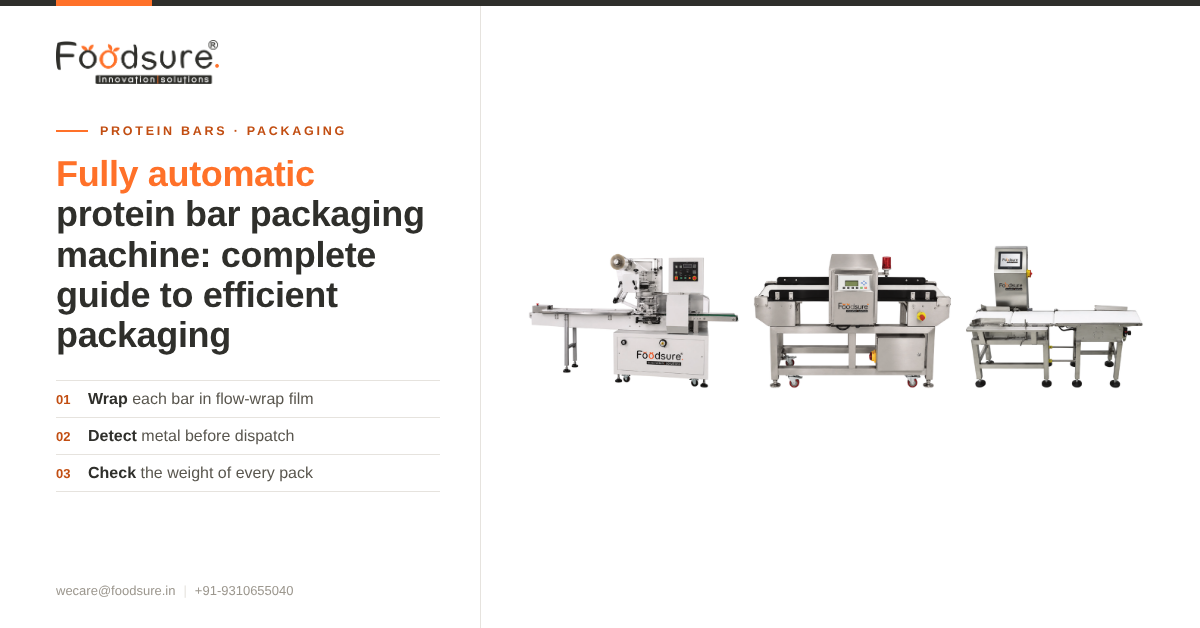
Packaging of protein bars should be done with the help of a machine that can ensure good quality and uniformity in appearance along with proper commercial distribution. When the volume of production increases, the process of packaging manually becomes tedious. This is where the fully automatic protein bar packaging machine comes into play.
Today’s packaging systems can be combined with the cutting system, conveyors, and inspection system to ensure a well-coordinated production process. For both retail packages and large commercial packages, using the right equipment will help businesses increase the consistency of their packaging and prepare their products for storage and shipping.
If you are looking to establish a nutrition brand or expand your production facility, knowing about protein bar packaging equipment, packaging materials and automation needs can help you choose the right packaging system.
What Is a Fully Automatic Protein Bar Packaging Machine?
Fully automatic protein bar packaging machine are types of industrial packaging machinery that automatically seal or wrap each bar with as little human interaction as possible. Based on how they are set up, such machinery can automatically feed bars, align products, form packs, seal packs, and remove packs.
A commercial packaging setup may include:
- Product feeder and aligner conveyors
- Automated bar spacing and transfer mechanisms
- Film unwind and feed mechanism
- Forming area to form the pack around the product
- Sealing and cutting mechanisms
- Discharge conveyors for finished packs
- Inspection and rejection systems
- PLC-based control system
The exact configuration depends on the product dimensions, packaging material, required output, and production-line arrangement. Some systems are designed for individual bar wrapping, while others can be integrated with upstream cutting and forming equipment.
Why Is Protein Bar Packaging Important?
Packaging is more than the final step in manufacturing. It influences product protection, shelf presentation, handling, and distribution.
A suitable protein bar packaging system helps manufacturers establish a repeatable process and maintain consistency across production batches.
Improved Product Protection
Protein bars can be prone to damage from moisture, oxygen, light, and temperature changes. Proper packaging could help prevent excessive exposure to external elements and ensure that the bar retains its original form.
Consistent Packaging Appearance
Automatic feeding, wrapping, and packaging will help ensure that packages look consistent since it will help prevent variations in appearance. Consistency in appearance is required when products are brand-name products and distributed by retailers and distributors.
Minimal Manual Intervention
Wrapping and packaging products automatically helps avoid repetitive handling of each item and allows staff to monitor the process.
Improved Package Production
Properly set up systems can synchronize packaging with the product feeding process in order to avoid delays in the process.
Commercial Scalability
Higher demand means higher order volumes and therefore greater packaging needs. Automatic wrapping and packaging help companies manage higher order volumes and do not rely solely on manual packing.
How Does a Fully Automatic Protein Bar Packaging Machine Work?
The working process depends on the packaging technology and product configuration. A typical flow-wrapping process follows these stages:
1. Feeding and Alignment of Product
The completed protein bars move from the cutting or cooling operation to the packaging machine. Feeding and alignment systems are used to orient the bars correctly for packaging.
Product spacing is important, as improper product feeding could disturb the entire packaging process.
2. Film Feed
Packaging film moves from the roll through the film handling mechanism in a packaging machine.
Control of the tension and film alignment ensures consistent package production.
The chosen film type must be suitable for the operating conditions and the packaging process.
3. Package Formation
In the normal flow wrapping machine, the film is formed by the movement of the product in the packaging machine.
The packaging dimensions must suit the product while allowing adequate sealing locations.
4. Longitudinal and End Sealings
The machine seals the edges of the packaging film together in order to form the complete package from the film. The sealing method and settings will depend upon the chosen packaging film type.
Sealing in suitable conditions will ensure that there will be fewer defective packages.
5. Cutting of Completed Packs
The pack cutting mechanism cuts the packaged continuous film into individual packs.
A protein bar packaging machine with cutting can be useful for manufacturers seeking a coordinated wrapping and separation process.
6. Finished-Pack Discharge
The completed packs move onto a discharge conveyor for inspection, secondary packing, or further handling. Additional equipment may be incorporated according to the manufacturer’s quality-control requirements.
Protein Bar Wrapping Machine vs Flow-Wrap Packaging
A protein bar wrapping machine is a general term for equipment used to wrap individual protein bars. Flow wrapping is one common packaging method used for this application.
A flow wrap machine for protein bar production typically uses a continuous film roll to create individual packages around products moving through the machine.
Flow wrapping may be suitable for:
- Individually wrapped protein bars
- Energy and nutrition bars
- Cereal and granola bars
- Snack bars with uniform dimensions
- Items needing a sealed retail wrapper
Suitability of flow wrapping is based on the design of the bar, its surface finish, and the materials used for packaging and sealing. Care should be taken when handling products such as soft or sticky bars.
Choosing the Right Protein Bar Packaging Film
Selecting the right protein bar packaging film is important for product protection, machine performance and final pack appearance.
Different products will require different barriers. A bar with moisture-sensitive ingredients may need different protection than a product where the main issue is oxidation.
Common packaging-material considerations include:
| Material Consideration | Why It Matters |
| Moisture barrier | Helps limit moisture transfer that can affect texture |
| Oxygen barrier | Helps reduce oxygen exposure where oxidation is a concern |
| Sealability | Supports reliable package closure |
| Mechanical strength | Helps resist tearing and damage during handling |
| Film flexibility | Supports smooth movement through the packaging machine |
| Print compatibility | Allows branding, product information, and required labelling |
| Food-contact suitability | Helps ensure the material is appropriate for its intended food use |
The final structure can be made with one film or several layers, depending on the required barrier properties and packaging form. The material must be chosen considering the product features as well as its storage conditions.
Best Packaging Material for Protein Bar Shelf Life
The best packaging material for protein bar shelf life depends on the ingredients, moisture sensitivity, fat content, storage conditions, and desired shelf life of the finished product. There is no single packaging material that is ideal for every protein bar.
Before choosing a material, manufacturers should consider:
- Whether the absorption of moisture would make the bar soft or affect its texture
- Whether the exposure to oxygen would affect any other ingredient, like fats or flavors
- Whether the product is light sensitive
- The strength of the package seal
- Storage and distribution conditions
- Compatibility with the packaging machine
Shelf life is not dependent on packaging alone. The recipe formulation, hygiene during production, moisture content of the product, processing conditions, and storage conditions are also factors that affect shelf life.
The selected packaging must be tested for shelf life in the appropriate conditions, rather than depending solely on the information provided by the film supplier.
Protein Bar Packaging Line for Startups
A protein bar packaging line for startups should match expected sales, production capacity, and the available facility infrastructure. New businesses may not require a fully integrated high-output line immediately, especially if they are producing a limited range of products.
A practical startup setup may include:
- Suitable system of feeding and alignment
- Semi-automatic or automatic wrapping machine
- Packaging film compatible with the machine
- Inspection of packages
- Packing equipment (secondary), where applicable
For companies anticipating fast growth, the option of using a modular design that would permit adding conveyors, inspection systems, or high-capacity packaging systems at a later date should be explored.
In assessing the protein bar packaging line for startups firms, it is critical to take into account not just packaging speed but cleaning, changeover time, operator training, and maintenance, as well as the upstream process.
Fully Automatic Protein Bar Packaging Machine Price: What Affects the Investment?
The fully automatic protein bar packaging machine price depends on the machine’s capacity, packaging technology, automation level, and overall configuration.
In the comparison of the protein bar packaging machine price, the manufacturers should take into account the whole equipment specification and not just the purchase price.
Important factors include:
Packaging Speed
Greater speed may necessitate an enhanced feeding, sealing, and cutting system. The chosen capacity needs to be consistent with realistic production demands.
Product Dimensions
Bar length, width and thickness can influence the machine setup and changeover requirements.
Packaging Material
The machine must be compatible with the selected protein bar packaging film, including its thickness, sealing characteristics, and handling requirements.
Automation and Controls
Product feeding, alignment, monitoring, and rejecting could have an impact on the design of the complete line.
Cutting and Sealing Section
The cutting and sealing mechanisms must be suited to the type of packaging and the necessary rate of operation.
Other Equipment
Conveyors, inspection equipment, coding equipment, and secondary packaging equipment may be needed as part of the complete packaging line.
Businesses must ask for a specification that spells out what equipment will be provided and its performance and installation requirements.
How to Buy Protein Bar Packaging Machine Equipment
Before you buy protein bar packaging machine equipment, prepare a clear description of the product and packaging requirements. This helps the supplier recommend a configuration that fits the production process.
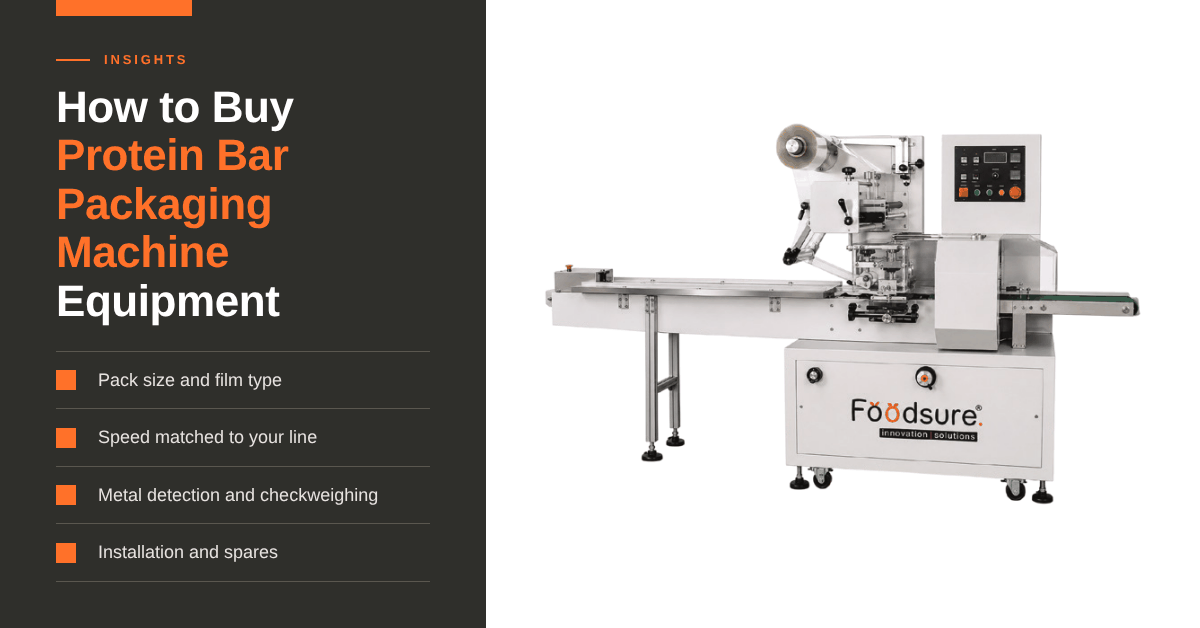
Consider the following factors:
- Dimensions and Texture of Protein Bars
- Amount of Required Packs per Minute or Hour
- Method of Packaging
- Sealing Needs
- Plant Floor Area and Facilities Available
- Integration with Cutting, Cooling and Conveying Systems
- Cleaning and Maintenance
- Installation, Training and Technical Support
- Potential for Future Expansion
A reliable protein bar packaging machine supplier should be able to explain the equipment’s operating requirements and compatibility with the intended product.
Why Choose Foodsure for Protein Bar Packaging Solutions?
Foodsure offers machines and equipment for food processing and packaging for companies who plan to start or increase the production of protein bars.
In choosing a fully automatic protein bar packaging machine, manufacturers should consider how the machine works with the formation, cooling, cutting, and transfer processes.
Foodsure can assist companies in determining what machinery is suitable by assessing the packaging needs, size of products, production goals, and automation.
When looking for a protein bar packaging machine manufacturer India, some of the key aspects to consider would be technical specifications, packaging compatibility, installation requirements, maintenance requirements, and scalability. It is important to go through such aspects prior to purchasing.
Conclusion
A fully automatic protein bar packaging machine is useful for manufacturers to ensure consistent packaging, decrease manual intervention, and facilitate the commercial packaging process. The appropriate equipment to be used will depend upon the dimensions of the product, the packaging film, sealing needs, production rate, and automation required.
Both startups and existing manufacturers have to undertake a proper analysis of the manufacturing process and product protection requirements before purchasing the right protein bar packaging equipment. Through specification comparison, material compatibility, and planning for expansion, businesses will be able to create a packaging process that will produce marketable protein bars.
Frequently Asked Questions
1. What is a fully automatic protein bar packaging machine?
A fully automatic protein bar packaging machine automatically wraps and seals individual protein bars with minimal manual intervention. Depending on its configuration, it can include feeding, alignment, film handling, sealing, cutting, and finished-pack discharge.
2. What is a flow wrap machine for protein bar packaging?
A flow wrap machine for protein bar production forms a package around the bar using film supplied from a roll. It is commonly considered for individual snack-bar packaging when the product dimensions and material are compatible with the equipment.
3. How do I choose the best packaging material for protein bar shelf life?
Assess the moisture and oxygen sensitivity, fat content, storage conditions, sealing needs, and shelf life of the product. Test your chosen packaging materials in the correct conditions.
4. What affects the protein bar packaging machine price?
The investment will rely upon packaging speed, automation capabilities, package sizes, film suitability, cutting and sealing, as well as extra equipment.
5. How can I get a protein bar packaging line quote?
Provide the supplier with your product measurements, packaging specifications, anticipated volume, film specifications, and degree of automation required. Such information will help the supplier to suggest an effective configuration and offer a suitable quotation.




