
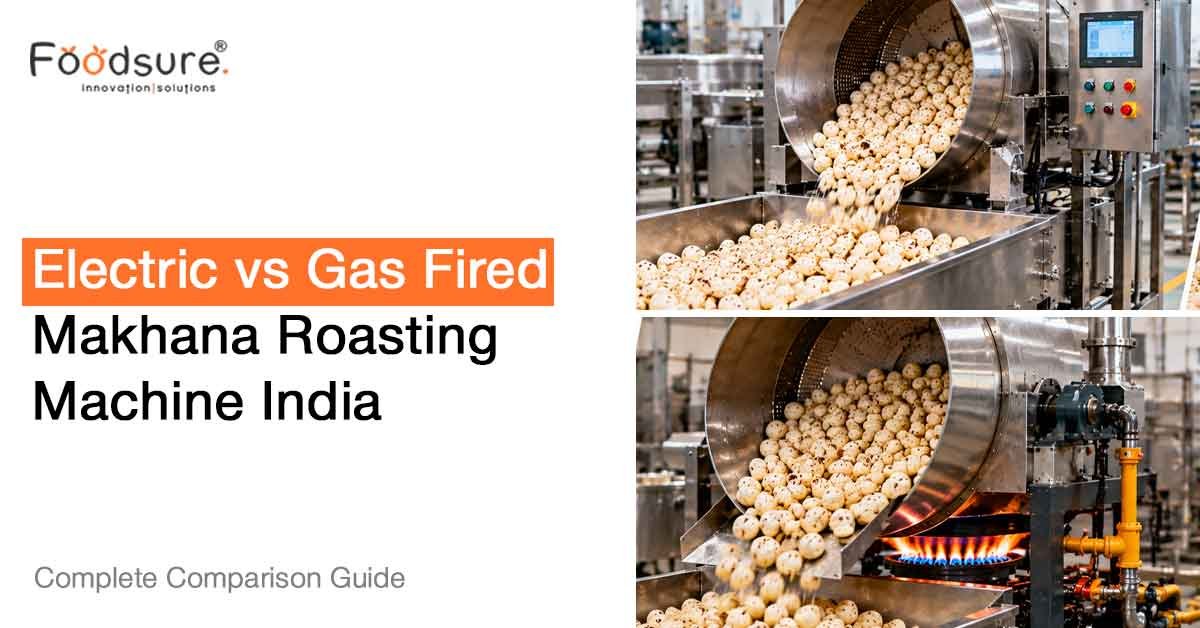
Roasting of makhana plays a significant role in the industrial preparation of makhana. In view of the increasing popularity of roasted and flavored makhana products, industrialists are searching for equipment that ensures uniform heating and has suitable production capacity.
The other major decision to be made when buying the roasting machine is whether to go for an electric one or one fired by gas. Knowing electric vs gas fired makhana roasting machine India may help manufacturers make the right choice.
Either type of roaster can be used for business purposes, yet both may have different heating systems, installation procedures, operating practices, and maintenance requirements.
What Is a Makhana Roasting Machine?
The Makhana Roasting Machine is a food processing machine that roasts makhana through a controlled heating process. The device uses a combination of heat and movement of the product in its operation.
A typical roasting process includes:
Raw Makhana Feeding
↓
Controlled Heating
↓
Product Movement
↓
Roasting
↓
Cooling
↓
Flavouring / Packaging
The heating source can be electric, gas-fired, or another configuration depending on the machine design.
In order to use the machine for business purposes, it must ensure proper temperature regulation, appropriate material flow, sanitary design, and ease of operation.
What Is an Electric Makhana Roaster?
An electric makhana roaster uses electrical heating elements to generate and control the heat required for roasting.
Electric heating can provide controlled temperature control, thus making it suitable for companies with well-established electricity infrastructure and simple temperature control.
The general process is:
Electric Heating Elements
↓
Heat Generation
↓
Controlled Temperature
↓
Makhana Roasting
↓
Cooling
The actual heating arrangement depends on the machine design and capacity.
What Is a Gas Fired Makhana Roaster?
In a gas fired makhana roaster, a gas-burning system is used to create heat for roasting.
For businesses having an existing gas supply network or those preferring gas as the source of heat, a gas-based system can be selected.
A typical setup involves:
Gas Supply
↓
Burner System
↓
Heat Generation
↓
Controlled Roasting
↓
Cooling
The installation requires appropriate gas connections, ventilation, safety systems, and operating procedures.
Electric vs Gas Roaster: Key Differences
The electric vs gas roaster decision should be based on the complete operating environment rather than only the heating technology.
| Factor | Electric Roaster | Gas-Fired Roaster |
| Heat source | Electricity | Gas |
| Temperature control | Generally straightforward | Controlled through burner system |
| Utility requirement | Electrical power | Gas supply |
| Installation | Electrical infrastructure | Gas and ventilation infrastructure |
| Emissions at heating point | No combustion gases from the heater | Combustion gases |
| Maintenance focus | Heating elements and electrical components | Burners, gas lines and related components |
| Suitable for | Facilities with suitable electrical supply | Facilities with suitable gas infrastructure |
Actual performance depends on machine design, insulation, heating efficiency, capacity, and operating conditions.
Electric vs Gas Fired Makhana Roasting Machine India
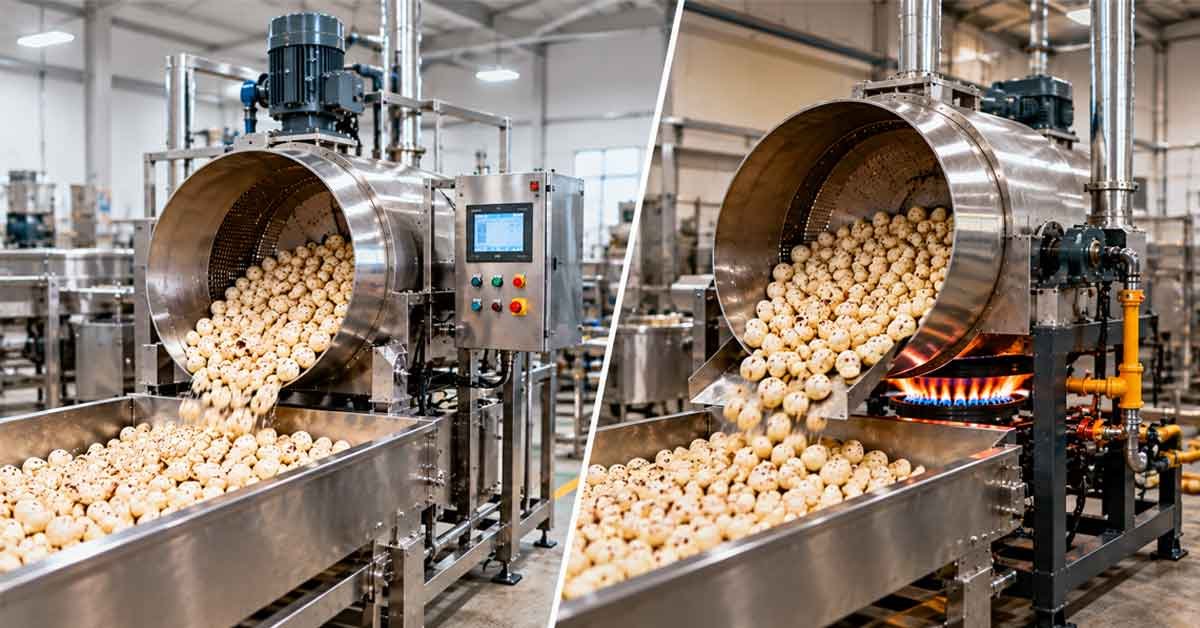
When comparing electric vs gas fired makhana roasting machine India options, manufacturers should consider several practical factors.
1. Availability of Utilities
First of all, one needs to consider the provision of either electricity or gas supply to the plant. For example, if there is a steady electricity supply to the plant, then there should not be any problem in using an electric system. On the other hand, a company that has gas supply facilities can adopt a gas system.
2. Temperature Control
Temperature regulation is significant in controlling the roasting process.
In electric heaters, temperature regulation can be achieved directly using heating elements and control systems. In gas-fired heaters, burners and a gas regulation system are used to regulate the temperature.
The degree of temperature regulation is determined by the machine itself.
3. Production Capacity
The capacity should be determined independently from the heat source, since both electrically heated machines as well as gas heated machines can be customized according to production requirements.
First of all, one should define the capacity that is needed per hour.
4. Installation Requirements
Electric systems primarily require appropriate electrical infrastructure and safe connections.
Gas-fired systems require suitable gas connections, ventilation, burner installation, and safety provisions.
The available factory infrastructure can therefore influence the choice.
Advantages of an Electric Makhana Roaster
An electric makhana roaster can offer several benefits for commercial food-processing facilities.
Controlled Heating
Systems using electrical heat can have easy temperature control when coupled with proper controls.
Cleaner Installation Environment
Because the heating elements themselves do not involve combustion, electric systems do not produce combustion gases at the heating point.
Easy Integration
Electric equipment can be convenient to integrate into facilities that already have adequate electrical infrastructure.
Suitable for Controlled Production
However, electric heating can be appropriate in cases when the manufacturer opts for roasting the product in a controlled fashion.
However, companies should consider their electrical load availability and operating costs.
Advantages of a Gas Fired Makhana Roaster
A gas fired makhana roaster can also be suitable for commercial processing.
High Heat Availability
Gas burners can provide substantial heat output, depending on the burner and machine configuration.
Suitable for Certain Industrial Facilities
If businesses have installed equipment that runs on gas, then they can consider using a gas heater system.
Flexible Heating Configuration
Gas burners can be configured according to the machine’s heating requirements.
However, gas-fired systems require proper installation, ventilation, burner maintenance, and safety controls.
Energy and Operating Cost Considerations
Operating cost is one of the most important factors when comparing heating systems. However, there is no universal answer as to which technology will always be cheaper.
The actual cost depends on:
- Costs of local power supply
- Local cost of gas
- Efficiency of machinery
- Production capacity
- Operating hours
- Heat losses
- Insulation
- Maintenance needs
- Utility services available
Businesses should compare expected energy consumption under their actual operating conditions rather than relying only on general assumptions.
Safety Considerations
Safety considerations are important in both cases.
Proper electrical wiring, electrical earthing, electrical insulation, control, and electrical protection measures are needed in electrical systems.
Gas connection, burner safety, ventilation, leak prevention, ignition, and combustion safety are needed in gas-fired systems.
The manufacturer’s operating guidelines and workplace safety standards must be followed.
Maintenance Comparison
Both types of roasting machines require preventive maintenance.
Electric Machine Maintenance
Important areas include:
- Heating elements
- Electrical connections
- Temperature sensors
- Control panels
- Moving components
- Insulation
Gas Machine Maintenance
Important areas include:
- Burners
- Gas lines and connections
- Ignition components
- Temperature controls
- Ventilation
- Moving components
Regular inspection can help identify wear and operating problems before they cause production downtime.
Which Roaster Is Better for Commercial Makhana Production?
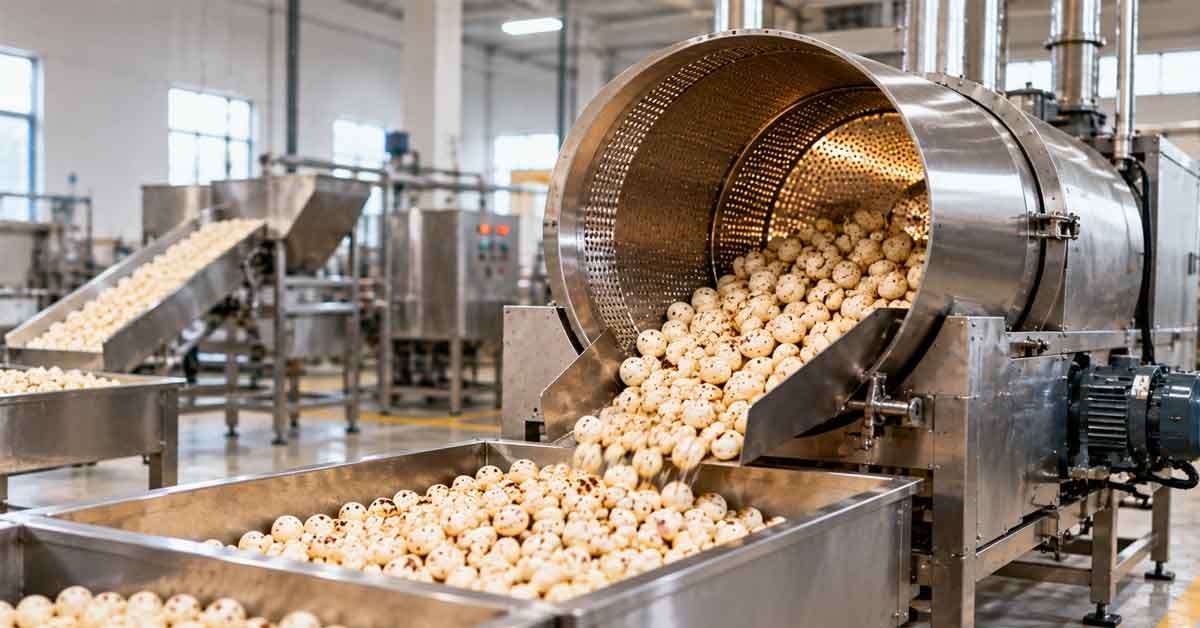
It cannot be answered since the choice of which one will perform better is dependent on the production facility itself.
Electricity will prove to be an appropriate source for companies that focus on simple electricity-driven temperature control systems and have good access to electricity.
Gas can work well for facilities that have a ready supply of gas and gas-powered heating systems.
Ultimately, it should be chosen based on production capacity, utility availability, working environment, and cost factors.
Electric vs Gas: Factors to Check Before Buying
Before finalising a roasting machine, businesses should compare:
- Production Capacity Required
- Electrical Load Availability
- Availability of Gas
- Expected Operating Hours
- Temperature Control Considerations
- Installation Requirements
- Maintenance Requirements
- Safety Requirements
- Machine Construction
- Supplier Assistance
Choosing the Right Machine Manufacturer
It is important for a company to take into account various issues concerning the construction of the machinery, its technical features, the heating process, automation, installation, and service.
It would be useful for companies to cooperate with the professional makhana machine manufacturer in order to choose the most appropriate roasting machine.
It is necessary to provide detailed information about the capacity needed, the utilities available, the area for installation, the product specifications, and the level of automation before buying.
Electric or Gas: Which Should You Choose?
The decision can be simplified by looking at the facility’s existing infrastructure.
Choose an electric system when:
- Access to electricity is dependable
- Electric temperature regulation is easier to use
- The plant is already based on electric machines
- There is enough electrical load capacity
Consider a gas-fired system when:
- Suitable gas infrastructure is available
- Gas-based heating is already used at the facility
- The production setup is designed for burner-based heating
- Appropriate ventilation and safety systems can be provided
Neither technology should be selected without considering the complete production environment.
Conclusion
Knowledge of electric vs gas fired makhana roasting machine India is vital to companies that wish to venture into the manufacturing of commercial makhana. Both systems can perform an efficient roasting process when properly set up.
An electric makhana roaster may be suitable for facilities with reliable electrical infrastructure and a preference for controlled electrical heating. A gas fired makhana roaster can be considered where gas infrastructure and appropriate safety provisions are available.
The right electric vs gas roaster should ultimately be selected based on production capacity, utility availability, installation requirements, energy costs, maintenance, safety, and long-term business needs.
A careful evaluation of these factors can help manufacturers invest in a roasting system that supports consistent production and future expansion.
FAQs
Which is better, an electric or gas-fired makhana roaster?
Neither approach is universally better. The choice depends on production capacity, availability of utilities, cost of operation, installation conditions, and needs of the manufacturer.
Is an electric makhana roaster suitable for commercial production?
Yes, electric roasting machines can be used for manufacturing purposes where there is sufficient electrical setup to support the operation of the machine.
What are the main requirements for a gas fired makhana roaster?
A gas-fired system requires a suitable gas supply, burner system, proper ventilation, appropriate safety provisions, and regular inspection of gas-related components.
Does electric roasting always cost more than gas roasting?
Not necessarily. Operating cost depends on local electricity and gas prices, machine efficiency, production volume, operating hours, and heat losses.
What should I check before buying a makhana roasting machine?
Think about capacity, heating mechanism, power requirements, temperature control, construction, safety, maintenance, installation, supplier assistance, and the assembly line compatibility of the equipment.




