
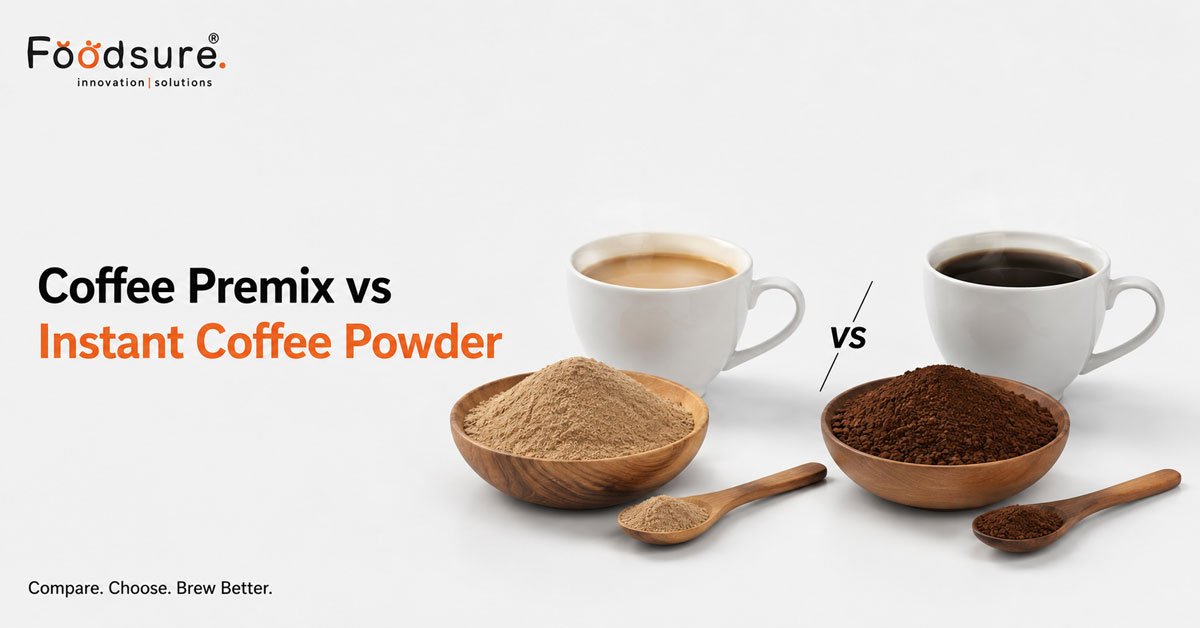
Somewhere between “I want to launch a coffee brand” and “which machine should I buy,” almost every founder gets stuck on the same question: is my product actually instant coffee, or is it a coffee premix? The two get used interchangeably in casual conversation, but on the factory floor and on the ingredient label, they are entirely different products, made through entirely different processes, on entirely different equipment.
This guide breaks down Coffee Premix vs Instant Coffee Powder in plain terms what each product actually is, how each is manufactured, and what that means for the kind of setup you’ll eventually need. If you’re still researching the category before you start pricing out machinery, this is where to start.
What Is Instant Coffee Powder?
Instant coffee powder is a single-ingredient product made entirely from roasted, ground coffee that has been brewed into a concentrated liquid extract and then dried either through spray drying or freeze drying until only soluble coffee solids remain. Nothing is added to it. When you spoon it into hot water, it dissolves because it was already dissolved once, during brewing, before it was dried back into powder or granules.
Because it’s a single-ingredient product, the entire challenge of instant coffee powder manufacturing lies in extraction efficiency, aroma retention, and drying consistency not in blending. There’s nothing to homogenize with anything else. The product’s flavour quality is decided almost entirely at the extraction and drying stage.
What Is Coffee Premix?
A coffee premix, by contrast, is a blended, multi-ingredient product commonly sold as 3-in-1 or 2-in-1 sachets that combines instant coffee solids with milk powder or non-dairy creamer, sugar or a sweetener, and sometimes flavourings like cardamom, chocolate, or hazelnut. Nothing about a coffee premix involves brewing or extraction on-site. Instead, it’s a dry-blending operation: pre-made coffee solids, dairy or non-dairy powders, and sweeteners are combined in precise ratios until the mix is uniform from the first sachet to the last.
This is really the core of the Difference Between Coffee Premix and Instant Coffee: one product is created through extraction and drying, the other through precision blending of already-dried ingredients. A manufacturer of instant coffee is, in effect, running a beverage-extraction plant. A manufacturer of coffee premix is running a dry-powder blending operation, closer in principle to a spice or protein-powder facility than to a coffee roastery.
Difference Between Coffee Premix and Instant Coffee: Side-by-Side Comparison
| Parameter | Instant Coffee Powder | Coffee Premix |
|---|---|---|
| Composition | 100% coffee solids | Coffee + milk powder/creamer + sugar |
| Core Process | Extraction, concentration, drying | Dry blending of pre-made ingredients |
| Primary Equipment | Extraction unit, evaporator, spray/freeze dryer | Ribbon blender or paddle mixer, sifter, filler-sealer |
| Raw Material Sourcing | Green/roasted coffee beans | Instant coffee, milk powder, sugar as bought-in inputs |
| Key Quality Risk | Aroma loss, extraction yield, moisture control | Ingredient segregation, caking, uneven blend density |
| Typical End Use | Cafés, HORECA, standalone jars, export bulk | Vending machines, offices, D2C sachets, gifting packs |
| Shelf-Life Sensitivity | Moisture and oxidation | Caking from hygroscopic ingredients such as milk powder and creamer |
Understanding this table is really the fastest way to grasp Coffee Premix vs Instant Coffee Powder as a manufacturing decision rather than a marketing one because the equipment list, the raw material relationships you’ll need to build, and even the factory layout follow directly from which side of this table your product sits on.
Instant Coffee Powder Manufacturing Process, Step by Step
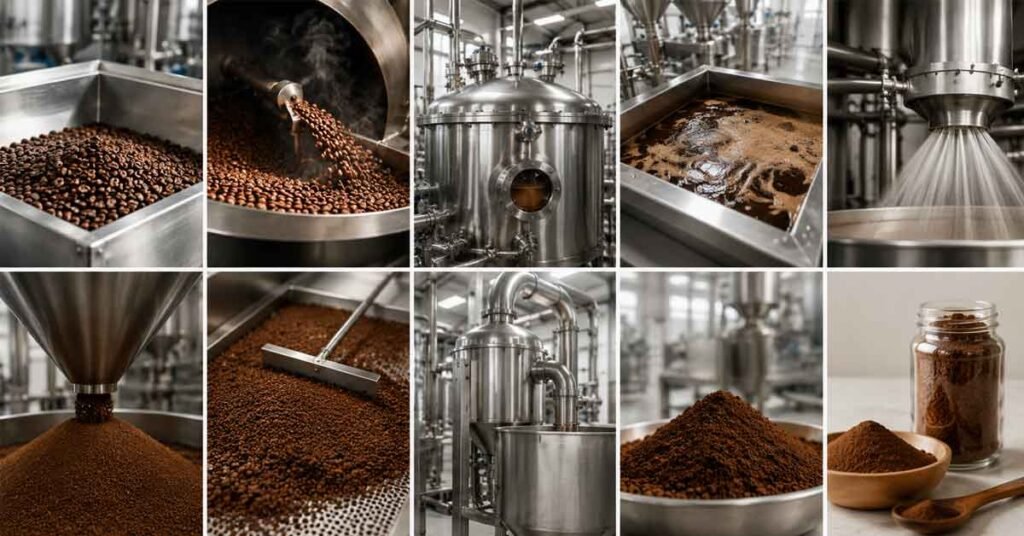
- Roasting and grinding Green coffee beans are roasted to the desired profile and ground to a size optimised for extraction, not for direct brewing.
- Extraction Ground coffee is brewed at controlled temperature and pressure to pull out soluble solids, producing a concentrated coffee extract, typically at food-grade extraction ratios well above what a café brewer would use.
- Concentration The extract is concentrated further, often through evaporation, to reduce the water content before drying. This step directly affects yield and energy cost.
- Drying This is the step that defines Instant Coffee Powder Manufacturing at scale. Spray drying atomises the concentrate into a hot air chamber for fast, granular results at lower cost; freeze drying (lyophilisation) preserves more aroma and produces the characteristic coarse granules of premium instant coffee, at a meaningfully higher cost per kg.
- Cooling, sifting, and packing Dried powder or granules are cooled, sifted for uniform particle size, and packed under moisture-controlled conditions, since instant coffee is highly hygroscopic.
Because every stage in this extraction-to-drying chain depends on the one before it, a break anywhere along the way under-extraction, over-concentration, or inconsistent drying temperature shows up directly in the final cup, which is why instant coffee plants are built around process control instrumentation, not just mixing capacity.
Coffee Premix Manufacturing Process, Step by Step
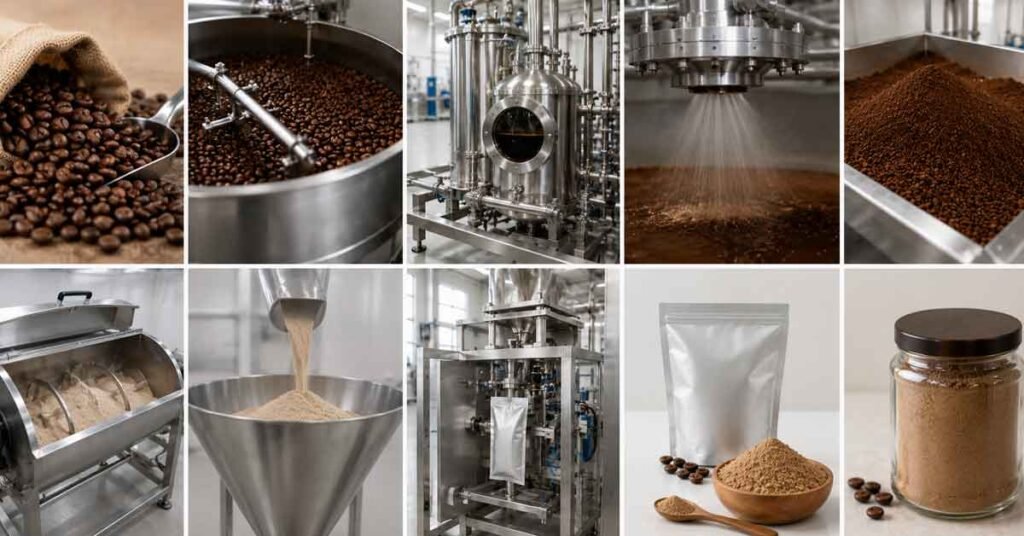
- Ingredient sourcing and testing instant coffee powder, milk powder or non-dairy creamer, sugar or sweetener, and any flavourings are sourced and checked for moisture content and particle size before blending even begins; this single step prevents most downstream caking issues.
- Pre-weighing and batching Each ingredient is weighed to an exact formulation ratio, since even small deviations in the coffee-to-creamer-to-sugar ratio change taste consistency from batch to batch.
- Dry blending This is the heart of the Coffee Premix Manufacturing Process. A ribbon blender or paddle mixer combines ingredients of very different densities and particle sizes light coffee granules, fine sugar, and powdery creamer until the mix is homogeneous, with anti-caking measures built in for the hygroscopic ingredients.
- Quality checks Samples are drawn from multiple points in the batch to confirm even distribution; an uneven premix shows up as sachets that taste noticeably different from one another, which is the most common quality complaint in this category.
- Filling and sealing The finished premix is filled into sachets, sticks, or pouches and heat-sealed under controlled humidity, since a compromised seal quickly leads to caking and clumping on the shelf.
Where instant coffee manufacturing is essentially about what happens to the coffee bean, the Coffee Premix Manufacturing Process is about what happens after the coffee has already become a powder which is exactly why the machinery, the skill set on the floor, and even the factory’s humidity-control needs are so different between the two.
Machinery: Where the Two Paths Actually Diverge
If you’re researching this category before pricing out equipment, this is the part that matters most. Instant coffee production needs an extraction system, evaporators, and a spray or freeze dryer capital-intensive, extraction-focused equipment that few small or mid-sized brands manufacture in-house; most buy instant coffee powder as a raw material instead. Coffee premix production, on the other hand, is built around a powder mixing machine typically a ribbon blender or paddle mixer along with a sifter for particle uniformity and a filling-sealing line for sachets or pouches.
This is also why most new entrants to the category start with a coffee premix machine rather than an instant coffee extraction plant: the entry cost is dramatically lower, the process is far more forgiving to learn on, and it lets a brand build its formulation and its market before committing to the far larger capital outlay that extraction and drying equipment demands.
Which One Should You Manufacture? A Founder’s Framework
Choose the extraction-and-drying route if: you want full control over flavour from the bean up, you’re targeting café, HORECA, or export-bulk customers who buy pure coffee solids, and you have the capital for extraction and drying infrastructure this is a beverage-manufacturing business first, and a packaging business second.
Choose coffee premix manufacturing if: you’re targeting vending machines, offices, D2C sachets, or gifting packs, you want to launch with a lower capital outlay, and you’re comfortable sourcing instant coffee as a raw material rather than producing it yourself this is fundamentally a formulation and blending business.
Consider both, sequenced, if your long-term plan is a full-range coffee brand. Many Indian coffee brands start with premix lower capital, faster time-to-market, easier quality control while the brand is still small and only invest in extraction and drying equipment once premix sales validate demand and justify the larger capital commitment.
Frequently Asked Questions
What is the actual Difference Between Coffee Premix and Instant Coffee?
Instant coffee is a single-ingredient product made purely from extracted and dried coffee solids. Coffee premix is a blended product combining instant coffee with milk powder or creamer and sugar. One is an extraction process; the other is a dry-blending process, and they require entirely different manufacturing setups.
Is Coffee Premix Manufacturing cheaper to start than instant coffee production?
Yes. Coffee premix manufacturing needs a powder mixing machine, sifter, and filling line, while instant coffee production needs extraction, evaporation, and drying equipment, a far larger capital investment. Most new entrants start with premix because it’s faster to launch and easier to run at small batch sizes.
Can Instant Coffee Powder Manufacturing be done without a spray dryer?
Not commercially. Spray drying or freeze drying is the step that actually converts liquid coffee extract into powder or granules. Without a dryer, you’re left with a concentrated liquid, not instant coffee. This is the single most capital-intensive stage in the entire process.
What causes coffee premix sachets to taste inconsistent from one to the next?
Uneven blending is the most common cause. If the powder mixing machine doesn’t run long enough, or ingredients with very different particle sizes and densities aren’t blended thoroughly, the mix segregates some sachets end up coffee-heavy, others sugar-heavy, even from the same batch.
Do I need different machinery if I want to produce both products eventually?
Yes, largely. Your premix line blender, sifter, and filling equipment won’t extract or dry coffee, and an extraction-drying plant doesn’t blend. Most brands that eventually run both keep them as separate production lines, sequenced by when the business can support each investment.
Choosing With Clarity, Not Guesswork
The Coffee Premix vs Instant Coffee Powder decision isn’t really about which product is “better” it’s about which manufacturing process matches where your business actually is right now: your capital, your target customer, and how fast you need to get to market. Get clear on that first, and the machinery conversation becomes a lot simpler, because you’ll already know which side of the process you’re building for.




