
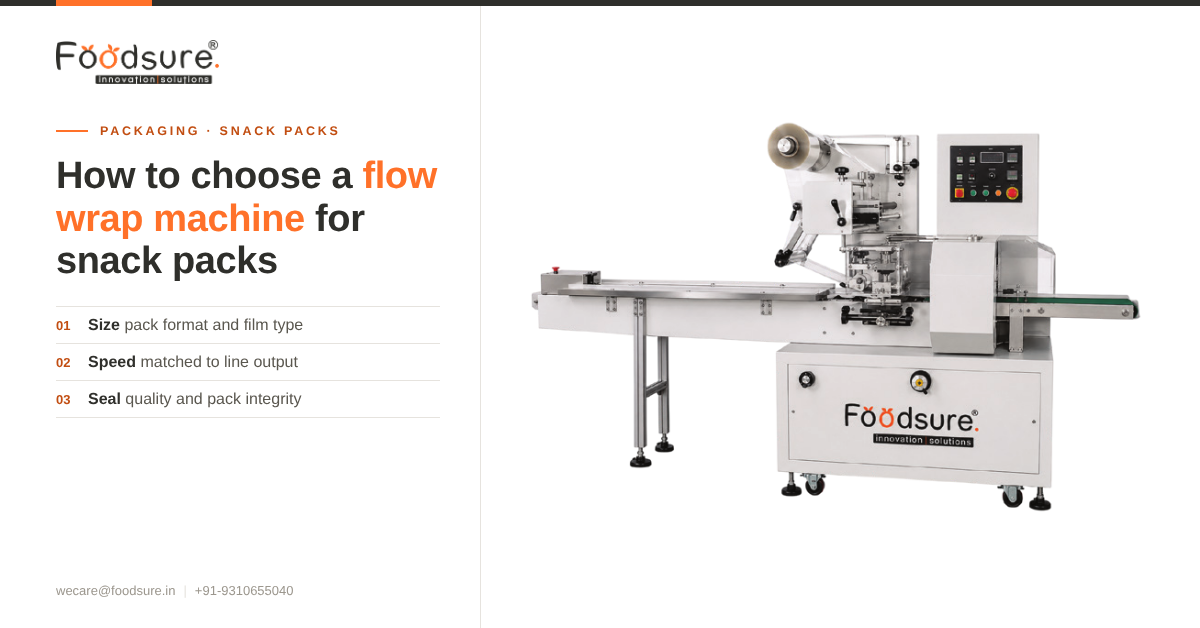
Food producers depend on effective packaging that helps keep their products fresh, safe, and attractive to customers. The most popular machine for packaging such individual food items as biscuits, cookies, wafers, protein bars, namkeen, and others is the flow wrap packaging machine.
However, choosing the right machine requires more than comparing prices. Flow wrap machine selection depends on product dimensions, packaging material, required production speed, sealing quality, and automation requirements. The right setup can improve packaging consistency, reduce material wastage, and support efficient production.
For companies that are considering installing a new food plant setup, it is important that they know about the capabilities of machines. The following are some of the things to consider when buying a flow wrap machine for commercial snack packaging.
What Is a Flow Wrap Machine?
The flow wrap machine is an example of a horizontal type of packaging machine that is used to enclose the product in flexible film and then seal it. This packaging machine is mostly used for the packaging of snacks since it can handle different sizes of products.
A typical flow wrapping process includes:
- Product feeding: Snacks are placed individually or in groups onto the feeding conveyor.
- Film forming: Packaging film is shaped around the product.
- Sealing: Longitudinal and end seals create an enclosed package.
- Cutting and discharge: The finished packs are separated and transferred for inspection or secondary packaging.
A suitable food packaging machine helps manufacturers achieve consistent pack appearance, reliable seals, and an organised packaging workflow.
Why Is Flow Wrap Machine Selection Important?
Selecting the right machine can affect packaging speed, product protection, operating costs, and overall production efficiency. A machine that does not match the product or packaging requirements may cause frequent stoppages, film wastage, or inconsistent sealing.
Careful flow wrap machine selection helps businesses:
- Enhance packaging uniformity and sealing.
- Synchronize packaging speed with production rate.
- Minimize film waste and avoid downtime.
- Handle products of varying sizes.
- Optimize labor use by automating.
- Facilitate future production growth.
The machine should be selected according to actual production needs rather than maximum advertised speed alone.
Key Factors to Consider When Choosing a Flow Wrap Machine
Before investing in a packaging system, manufacturers should evaluate the following factors.
1. Product Type and Dimensions
Firstly, decide what items are to be packed. Biscuits, wafers, snack bars, cookies, and other types of snacks may vary in size, shape, weight, and fragility.
It is important that the feeder, forming box, and sealing unit of the machine suit the item without damaging it too much or misaligning it. When there are several sizes of the item, ask about the possibility of changing them.
2. Required Packaging Speed
The packaging speed needs to be equal to the production rate of the upstream production machinery. Overly slow packaging machinery can result in bottlenecks, whereas excess capacity is likely to lead to unnecessary investments.
In choosing among alternatives, it is important to look at the anticipated output based on your specific product and pack specifications. Maximum speeds may differ based on the specifications of the product, film type, and operator.
3. Packaging Film Compatibility
It is important to choose equipment that is compatible with the type of packaging film to be used. Thickness, width, sealing ability, and construction of the packaging film may affect machine performance.
Talk to the supplier regarding your choice of packaging film and ask to try out the packaging machine. Testing is needed to verify whether the machine produces good seals.
4. Sealing Quality and Product Protection
Good, reliable seals are crucial to preserve snacks throughout transportation and processing operations. Poor sealing could create problems with open packs, contamination possibilities, and problems with product quality.
Assess the sealing process, temperature regulation, and cutting processes. For moisture or air-sensitive snacks, ensure that the entire package specifications satisfy the life expectancy of the product.
5. Level of Automation
Flow wrap machines may come with various degrees of automation, ranging from simple systems that require manual loading to sophisticated systems that include automation of product loading and packing.
A semi-automatic system may be preferred by small-scale producers, while large-scale producers may need an automatic system for feeding and counting products.
Select automation based on production capacity and budget instead of choosing automation that will not be used.
6. Machine Construction and Hygiene
The food processing machinery must be engineered in terms of its use in the intended operating environment. Consider the quality of construction, access to the product contact surface area, and ease of cleaning and maintenance.
Although SS tanks are more commonly associated with liquid or ingredient-processing sections, they may be required elsewhere in a complete food-processing facility. Their inclusion should depend on the actual process, not on the flow wrap machine itself.
7. Maintenance and Technical Support
Maintenance is an important factor that ensures the reliability of the packaging process. When buying equipment, make sure to inquire about spares availability, service, training, and maintenance.
A dependable food machine manufacturer should provide clear technical information and guidance on installation, operation, and routine servicing.
How to Match a Flow Wrap Machine With Your Production Line
It is advisable for the flow wrap machine to run effectively together with the other machinery installed. In the event that the packaging process fails to synchronize with the production process, snacks will pile up.
A suitable conveyor machine can help move products smoothly from one stage to another. The feeding arrangement should maintain correct product spacing and orientation so that each item enters the wrapper consistently.
When planning a complete food plant setup, manufacturers should consider the capacity of each stage, available floor space, operator access, electrical requirements, and the movement of raw materials and finished products.
What Affects Flow Wrap Machine Cost?
The cost of a flow wrap machine varies according to its configuration and intended application. Businesses comparing food processing machine price should assess the complete package rather than looking only at the initial quotation.
Important cost factors include:
- Packaging speed and machine capability.
- Manual, semi-automatic, or automatic control.
- Methods for product feeding and conveyors.
- Film adaptability and sealing method.
- Construction and machine characteristics.
- Installation, training, and startup.
- Spare parts, service, and running costs.
The overall food plant setup cost may also include upstream processing machinery, conveyors, electrical work, facility preparation, inspection equipment, and secondary packaging systems.
For this reason, manufacturers should compare quotations using the same product specifications, output requirements, and scope of supply.
Common Mistakes to Avoid During Flow Wrap Machine Selection
Even a capable machine may not perform as expected if it is poorly matched to the production requirements.
Choosing Only by Price
An initial low quotation may not include installation costs, training, extra conveyors, and many other related costs. Consider the overall cost and operational needs.
Ignoring Product Trials
A machine that performs effectively with one snack will not necessarily perform as effectively with another type of product. It is possible to perform product trials to confirm this before purchasing the machine.
Overlooking Film Requirements
Using unsuitable film can affect sealing performance and packaging consistency. Confirm compatibility before finalising the machine.
Buying More Capacity Than Needed
Excess capacity can increase capital and operating costs if production demand is insufficient. Choose a machine based on realistic output projections and future growth plans.
Neglecting Line Integration
The packaging machinery should match the flow rate from the machines upstream. Check the entire flow process to ensure there are no bottlenecks.
How to Choose the Right Food Machinery Supplier in India
Selecting a suitable supplier is an important part of the purchasing process. A food machine manufacturer India should understand the product, required packaging format, production capacity, and installation conditions before recommending a machine.
Before making a decision, ask the supplier about:
- Machine Specifications and Possible Output.
- Compatibility with your snack products and packaging film.
- Installation and Commissioning Services.
- Training and Maintenance Assistance.
- Availability of Spare Parts and After-Sales Support.
- Compatibility with your processing and packaging machinery.
Businesses planning to buy food machinery India should also compare the supplier’s scope of work, delivery terms, warranty conditions, and technical support.
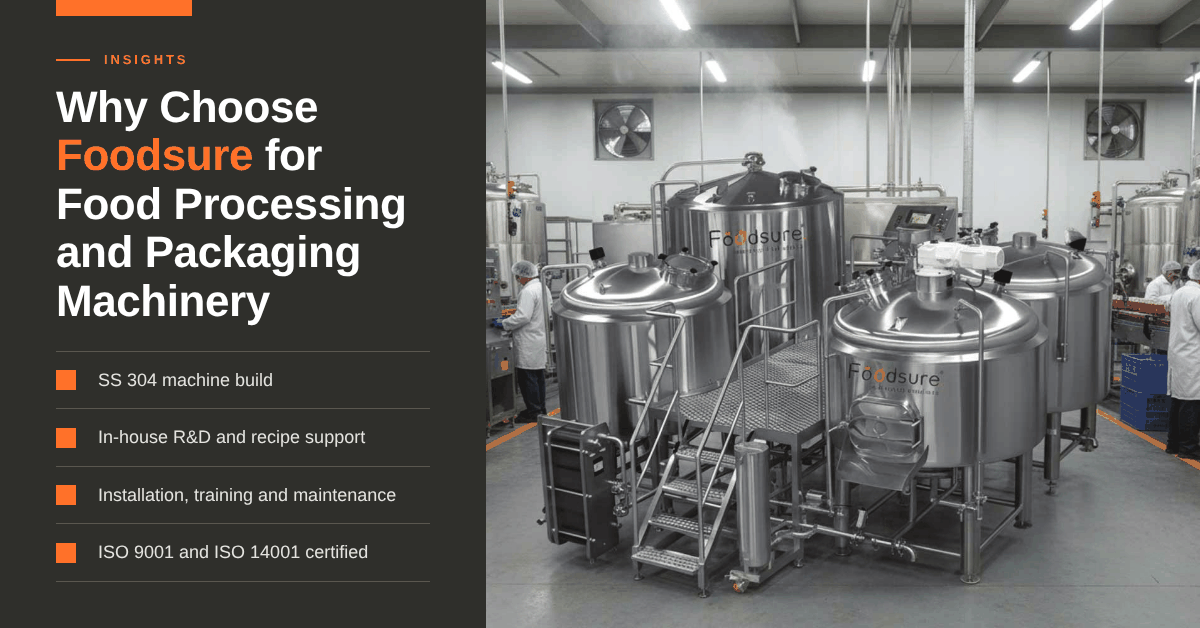
Why Choose Foodsure for Food Processing and Packaging Machinery?
Foodsure offers food processing machines and production systems to businesses that have plans to start or expand their commercial manufacturing business operations. The choice of equipment could be made depending on production needs, available space, workflow, and automation level desired.
When choosing a flow wrap machine for a manufacturer, the main concern should be selecting a machine that will suit the snack product, packaging materials, production rate, and overall production system.
Conclusion
Selecting an appropriate flow wrap machine selection will enable snack producers to enhance the consistency of their packaging, avoid unnecessary downtime, and balance the rate of packaging with that of production. Various factors must be considered prior to the acquisition of the machine.
Businesses comparing flow wrap machine selection price or searching for a flow wrap machine selection manufacturer should focus on overall suitability and long-term operating requirements, not just the initial cost. If you plan to buy flow wrap machine selection solutions for a commercial snack line, assess the machine alongside conveyors, processing equipment, and the complete packaging workflow to make a practical investment.
Frequently Asked Questions
1. Which products can be packaged using a flow wrap machine?
Flow wrap machines are usually employed for biscuits, cookies, wafers, snack bars, and many other individual foods. This depends on the food’s form, size, and its requirements for packaging.
2. How do I select the right packaging speed?
Calculate your requirement in packs per minute and then match it against the speed attainable by the machine with your product and film. Keep in mind the capacity of upstream machines as well.
3. Is an automatic flow wrap machine suitable for small businesses?
It would also be good where there is enough production volume and need for labor to make it worthwhile. Small firms need to evaluate between semi-automatic and fully automatic packaging machines.
4. What should I check before buying a flow wrap machine?
Be aware of the product compatibility, speed of packaging, film used, sealing capability, automation, space needed for installation, maintenance issues, and supplier support. Product trials will help at this stage as well.
5. What is the difference between a food processing machine and a food packaging machine?
A food processing machine prepares or transforms the product, while a food packaging machine wraps or packs the finished product for storage and distribution. A commercial facility may require both types of equipment.




