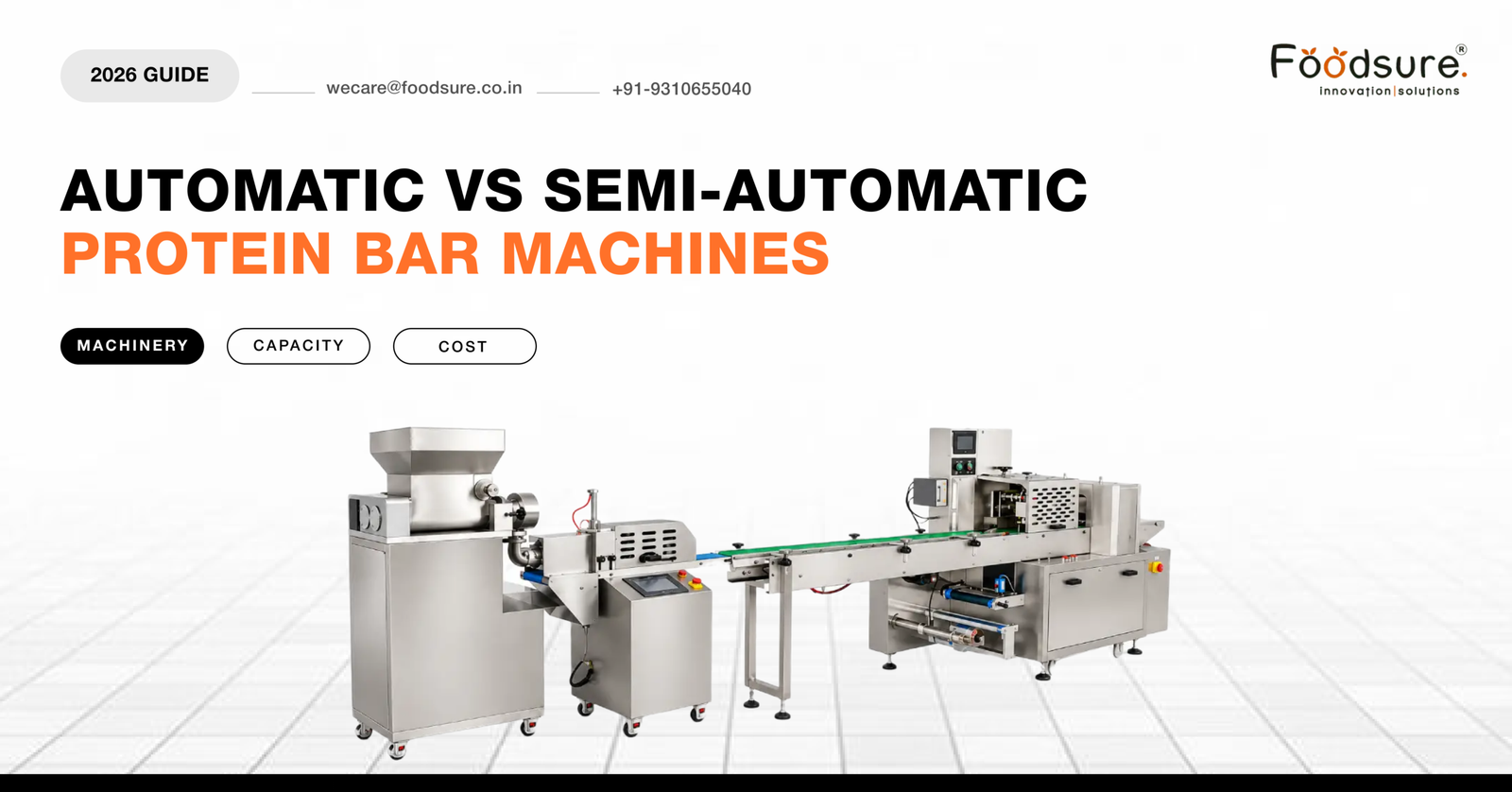
Choosing the right equipment is vital to establishing a commercial protein bar manufacturing unit. Choosing between an automatic and a semi-automatic system depends on output levels, labor availability, product specifications, available space, and long-term business plans.
An automatic vs semi automatic protein bar machine comparison helps manufacturers understand which setup best suits their operations. While the semi-automatic machinery is more flexible due to the manual effort involved, the automatic machinery could make the entire manufacturing process faster and easier.
The knowledge of the difference between these two systems will enable startups and even manufacturers to choose a suitable protein bar making machine without buying extra capacity.
What Is a Semi-Automatic Protein Bar Machine?
The semi-automatic protein bar machine is a combination of mechanical processing and manual intervention. It depends on the design whether the operators have to feed the mix, transport products from one stage to another, change the settings, or cut and pack the product separately.
The semi-automatic protein bar forming machine can be an option for start-ups and small companies wishing to ensure the consistency of the manufacturing process without full automation.
Key characteristics include:
- Forming or cutting processes are partially automated.
- Increased role of the operator in production.
- Flexibility for small production runs.
- Relatively simple production process.
- Possibility for expansion as demand rises.
A semi-automatic setup can be a practical option when production volumes are manageable, and the business needs flexibility to develop different product varieties.
What Is an Automatic Protein Bar Machine?
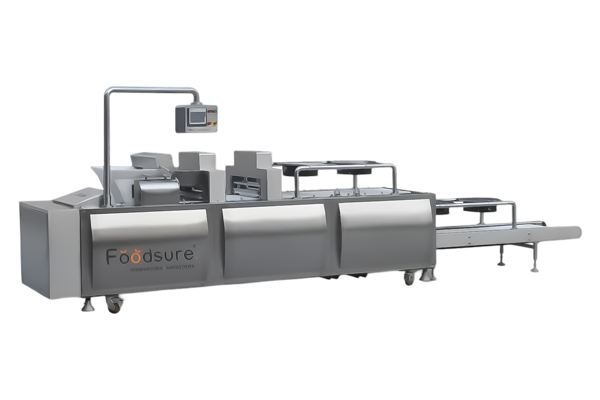
The automated protein bar manufacturing machine incorporates all these mechanisms in a system that is capable of performing several processes within the manufacturing process. This process varies depending on the design adopted.
A fully integrated protein bar production line can reduce manual handling and help manufacturers maintain a more consistent production flow.
Important characteristics include:
- Product feeding and processing that is automated.
- Forming and cutting processes that are combined based on the setup.
- Repetitive human involvement is minimized.
- Consistent production procedures.
- Capability to interface with other machinery, like coolers and packaging lines.
The automatic system seems to be a better fit for firms that have steady commercial demands and/or increased production capacities.
Automatic vs Semi Automatic Protein Bar Machine: Key Differences
The main difference lies in the level of automation, production workflow, labour involvement, and ability to scale.
| Comparison Factor | Semi-Automatic Machine | Automatic Machine |
| Operation | Requires manual intervention | Automates more production stages |
| Production capacity | Suitable for smaller requirements | Suitable for higher-volume requirements, depending on configuration |
| Labour involvement | Generally higher | Generally lower for automated tasks |
| Product flexibility | Useful for smaller batches and product trials | Suitable for standardised, repeatable production |
| Production workflow | Some stages may require manual transfer | Multiple stages can be integrated |
| Installation requirements | May require a simpler setup | May require more space and supporting equipment |
| Maintenance | Depends on machine design and components | May require more specialised maintenance |
| Scalability | Can be expanded with additional equipment | Can support larger integrated production systems |
The most suitable option depends on actual production needs. An automatic system is not always the better investment if the business cannot utilise its capacity efficiently.
Production Capacity and Efficiency
Production capacity is among the most crucial aspects to consider when evaluating the automatic and semi-automatic machines.
The semi-automatic machine may be adequate in situations where production needs are few and the production schedule varies. But manual feeding, product transfer, and handling will limit production capacity as production demands increase.
Automated systems can enhance the production process because of their ability to coordinate several processes. But the real protein bar machine capacity per hour is affected by the machine setup, size of the bars, nature of the mixture, speed, and time needed to make changes in the machine.
Before choosing equipment, one must estimate their daily output and see if the machine will be able to do that.
Cost, Labour, and Operating Considerations
The cost that needs to be put in to install an automatic or semi-automatic system will depend on its capacity, configuration, the equipment available, and integration.
The initial cost of installing a semi-automatic system is lower because there will be less automation. Manual intervention will make labour requirements high as the output increases.
The initial cost of installation of an automatic system is higher. It will decrease repetitive manual labour. Its utility will depend upon usage, maintenance, power use, and demand.
Firms considering the cost of an automatic protein bar machine in India should consider the full specification and operational requirements of the machine instead of just looking at the cost.
Which Machine Is Best for Startups?
For a startup in the protein bars industry, the ideal machine should correspond to the initial production plan while leaving room for future growth.
The best protein bar making machine for startups does not necessarily have to be the one that is highly automated. A semi-automated machine may be appropriate where the market demand is still growing, batch sizes are small, or testing different types of bars is required.
Startups should consider:
- Expected daily output volume.
- Number of types and sizes of bars.
- Amount of available labor and production space.
- Required forming and cutting operations.
- Ease of cleaning and maintenance.
- Capability of equipment expansion based on demand.
A business that can confirm its commercial orders along with having a need for increased production should seriously consider using a mechanized system right from the start. It is the demand that matters and not assumptions.
When Should You Choose an Automatic Protein Bar Production Line?
An automatic setup becomes worth considering when manual operations begin limiting production efficiency or consistency.
It may be suitable for manufacturers that:
- Manage routine, bulk orders.
- Want repetitive bar lengths and weights.
- Would like to cut down repetitive handling activities.
- Look for integrated forming and cutting.
- Wish to incorporate cooling, coating, or packaging equipment.
- Anticipate increased production rates.
A protein bar production line has to cater to all the steps in its process. Increasing automation of only one step in this process will not improve the efficiency of the whole operation.
How to Choose a Protein Bar Machine
To know how to choose a protein bar machine, one needs to understand that choosing such a machine involves more than its degree of automation.
Product Type and Mixture Characteristics
The protein bar could have a combination of proteins, binders, sugar, fibers, nuts, and other components. Consistency of the mix influences feeding, extrusion, and shaping. The selected equipment should match the intended product.
Forming and Cutting Requirements
The protein bar machine with cutting and forming can help improve the manufacturing process by forming the mixture and making individual bars out of it. The manufacturers need to know if these functions are available together or separately.
Extrusion System
A protein bar extruder pushes the prepared mixture through a forming die to create a continuous product profile. The machine should accommodate the mixture’s texture and the required bar dimensions.
Capacity and Future Expansion
Compare the estimated output with the actual capacity of the machine to operate. Include changeovers, cleaning time, downtime, and varying products while estimating production requirements.
Maintenance and Technical Support
Evaluate cleaning access, spare-parts availability, operator training, and after-sales service. A reliable protein bar machine manufacturer should be able to explain the machine’s capabilities and recommend a configuration suited to the production requirement.
Why Choose Foodsure for Protein Bar Machinery?
Foodsure offers solutions for the machinery needed in manufacturing protein bars for companies interested in setting up or scaling up their operations. It all depends on the production capacity, features of the items, formability, preference for automated systems, and infrastructure.
If you need a semi-automatic system, a line production system, or anything in between, Foodsure can help determine which equipment would best fit your needs.
Conclusion
The selection between an automatic and semi-automatic system will depend on the needs of production, personnel, nature of products, and prospects. A semi-automatic protein bar manufacturing machine will suit small-scale business, while an automatic protein bar production line will favor larger volume production and integration.
Through analysis of such factors as forming, extrusion, cutting, capacity, and maintenance, a firm may choose a suitable machine setup.
Frequently Asked Questions
1. What is the main difference between automatic and semi-automatic protein bar machines?
A semi-automatic machine requires manual intervention in some operations, while an automatic machine can coordinate more production stages with less repetitive handling.
2. Which is the best protein bar making machine for startups?
The best protein bar making machine for startups company will depend on a number of factors, including production quantity, cost, variety of products, workforce, and demand. While semi-automatic machines may be sufficient for small-scale manufacturers, automatic machines might be required for some startups with high demands.
3. What determines protein bar machine capacity per hour?
The protein bar machine capacity per hour depends on operating speed, bar dimensions, mixture properties, feeding arrangements, and the number of integrated processing stages.
4. Can one machine handle protein bar forming and cutting?
A protein bar machine with cutting and forming can perform both functions when designed with the required mechanisms. Confirm the included features and product compatibility with the manufacturer.
5. How do I compare automatic protein bar machine price in India?
When comparing automatic protein bar machine price in India, assess capacity, automation, included equipment, installation requirements, operating costs, maintenance, and technical support without relying on the purchase price alone.