
Protein bars are no longer just for elite athletes and body building specialists. The market for the wider sports nutrition and health food market in Bangladesh is developing because urban consumers have increased interest in convenient nutrition and exercise diets.
Just because a product exists, however, doesn’t mean it will succeed in the market.
What needs to happen is the development of a product that suits the consumer, is manufactureable, meets Bangladeshi food safety standards and is economically viable in the retail environment.
For anyone researching a Protein Bar Manufacturing Business in Bangladesh, the starting point should therefore be bigger than buying a machine. Understanding of the market, product development, source of ingredients, manufacturing process, regulations, packaging, distribution and cost per unit is required before any investment in machines.
Here is an overview of all these factors in detail.
Protein bar manufacturing business in Bangladesh may be set up at small scale, semi-automatic scale or large-scale industry level. The investment will depend highly on the formulation, manufacturing capability, automation, packaging and the option of whether you make your product in-house or not at the very beginning.
Protein Bar Manufacturing in Bangladesh: Market Overview
The opportunities in Bangladesh lie within a much wider trend of processed foods and nutritional consumption.
As per a 2024 report from the USDA, the food processing industry of Bangladesh was valued at US$8 billion in 2023 and was expected to grow at an annual rate of 8% between 2005 and 2023.
There has also been a growing presence of protein bars within the country’s sports nutrition segment.
A 6Wresearch report suggested that the sports nutrition market in Bangladesh had been valued at US 337million in 2025 and would reach US 448 million by 2032 with a projected CAGR of 4.2% from 2026 to 2032.
Additionally, the plant-protein market of Bangladesh was valued at US 85.6 million in 2024 according to a 2025 Consumer Intel 360 report and is expected to grow to approximately US349.6 million by 2029. The report included protein bars as one of the categories in the plant-protein market.
They do, however, show why entrepreneurs are looking at protein foods as part of Bangladesh’s expanding health and convenience-food ecosystem.
Why the Protein Bar Market Is Growing in Bangladesh

There are several forces working together.
1. Fitness and sports nutrition are becoming more visible
Gyms, fitness centres and health stores remain important channels for sports nutrition in Bangladesh. Euromonitor notes that sports nutrition in the country remains relatively small and is still influenced by imported products, but also identifies online retail and digital promotion as growing channels.
That creates room for locally manufactured products that can compete on price, flavour and availability.
2. Convenience matters
A protein shake requires preparation. A protein bar can be carried to work, university, the gym or while travelling.
That makes the format relevant beyond bodybuilding.
A well-formulated bar can target:
- Gym-goers
- Students
- Office professionals
- Runners and recreational athletes
- Consumers looking for convenient snacks
- People interested in higher-protein diets
- Consumers seeking plant-based alternatives
3. Plant protein is gaining attention
The Bangladesh plant-protein market is particularly interesting. ConsumerIntel360’s 2025 report estimates strong historical growth and continued expansion through 2029.
For manufacturers, that opens opportunities beyond traditional whey-based products.
Depending on the formulation and target consumer, bars can use ingredients such as soy protein, pea protein, rice protein, milk proteins, whey protein, nuts, seeds, oats, dates and other carbohydrate or fibre sources.
Bangladesh Protein Bar Consumer Landscape (Dhaka, Chittagong & Beyond)
A Protein Bar Manufacturing Business in Bangladesh should not treat Bangladesh as one homogeneous market.
Dhaka is likely to be the first testing ground for premium sports nutrition because of its concentration of gyms, modern retail, e-commerce activity, corporate consumers and higher-income urban customers.
Chittagong can be approached as another important urban market, while distribution can gradually expand into other major cities through supermarkets, pharmacies, fitness centres, specialty retailers, online stores and distributors.
The positioning also matters.
A bar marketed only as a bodybuilding product limits the potential audience. A product positioned around convenient protein, everyday nutrition and portability can potentially address a wider consumer base.
This is particularly important because Euromonitor describes sports nutrition in Bangladesh as a relatively small category and notes that high prices can restrict category development.
That means affordability should be considered during formulation, not after the product is launched.
Is a Protein Bar Manufacturing Business Profitable in Bangladesh?
Potentially, yes but profitability depends on the relationship between selling price, formulation cost, production utilisation, packaging cost, distribution margin and wastage.
Protein is often one of the most expensive components of the recipe. Imported protein ingredients can also expose manufacturers to currency and supply-chain fluctuations.
A manufacturer therefore needs to work backwards from the intended retail price.
For example:
This approach is more useful than deciding on a recipe first and discovering later that the finished bar is too expensive for the intended market.
Investment Required to Start Protein Bar Manufacturing
There is no single investment figure for a Protein Bar Manufacturing Business in Bangladesh.
A startup using a small semi-automatic line will have a very different capital requirement from a manufacturer installing automated forming, cooling, cutting, enrobing and flow-wrapping equipment.
Your investment normally falls into these categories:
| Investment Area | What It Covers |
|---|---|
| Facility | Rent, deposit, food-grade flooring, drainage and utilities |
| Processing Equipment | Mixer, forming/extrusion, cutting and related equipment |
| Cooling | Cooling conveyor/tunnel depending on product |
| Packaging | Flow wrapper, sealing, coding and inspection |
| Utilities | Electrical installation, compressed air, ventilation and other requirements |
| QA/QC | Weighing, testing and basic laboratory equipment |
| Raw Materials | Protein, binders, grains, nuts, flavours, sweeteners and other ingredients |
| Packaging Stock | Film, cartons, labels and secondary packaging |
| Licensing | Applicable registrations, licences, certifications and professional fees |
| Working Capital | Inventory, wages, utilities, logistics and marketing |
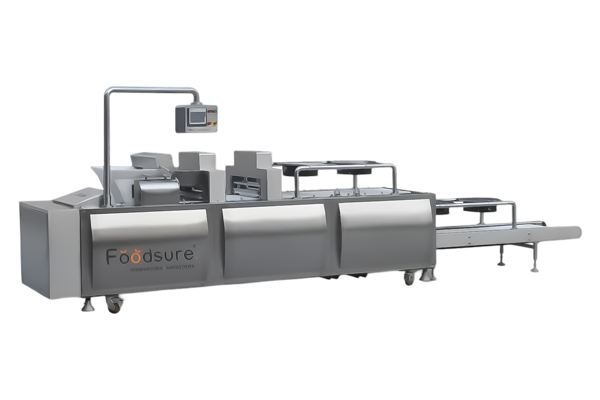
As a real equipment benchmark, Foodsure’s published protein-bar machinery specifications currently show an 80–100 kg/hour commercial machine priced at approximately ₹25 lakh in India, with food-grade SS304 construction, around 15–16 kW power and PLC/HMI controls.
That is an equipment benchmark, not a complete factory setup cost.
Expected ROI and Payback Period
ROI should be calculated using actual production assumptions rather than a generic industry percentage.
A simple model looks like this:
Monthly contribution = Monthly sales − variable production costs
Then:
Payback period = Initial investment ÷ monthly operating cash contribution
Consider a hypothetical example:
| Parameter | Illustrative Assumption |
|---|---|
| Production Capacity | 80 kg/hour |
| Operating Time | 6 hours/day |
| Working Days | 25/month |
| Theoretical Monthly Output | 12,000 kg |
| Average Bar Weight | 50 g |
| Theoretical Output | 240,000 bars/month |
Actual production will be lower because of changeovers, cleaning, downtime, maintenance, rejection and market demand.
This is why buying a 100 kg/hour machine does not mean you automatically have a 100 kg/hour business.
The machine needs to be matched to realistic sales volume.
Regulatory & Licensing Requirements for Protein Bar Manufacturing in Bangladesh
Regulatory compliance should be addressed before commercial production begins.
Bangladesh’s food ecosystem involves several authorities depending on the nature of the business, product and activity. The Bangladesh Food Safety Authority (BFSA) regulates food safety activities covering manufacture, processing, storage, distribution and sale, while BSTI handles national standards, testing and certification, including mandatory product standards where applicable.
For a factory, other requirements can also involve trade licensing, environmental clearance, fire safety, factory licensing and tax registrations.
BFSA Food Manufacturing License Process
The exact regulatory pathway should be confirmed against the current classification of your product before launch.
BFSA operates an online Food Business Operator platform covering registration and licensing processes. The application system asks for details such as the food being manufactured or processed and the daily or annual production quantity.
For a manufacturer, the practical process should therefore include:
- Identify how the protein bar is legally classified.
- Confirm the applicable BFSA registration/licensing requirement.
- Prepare business and factory documentation.
- Define the product and production capacity.
- Prepare the required food-safety information.
- Submit the relevant application through the applicable BFSA system.
- Complete inspection or other requirements where applicable.
- Maintain records and renew approvals as required.
Do not treat the word “protein” as a licence category by itself. A bar’s formulation, claims, ingredients and intended use can affect the regulatory pathway.
This becomes particularly important if the product is positioned as a dietary supplement, food for special dietary use or similar specialised product. BFSA has published regulatory work covering health foods and dietary supplements, so manufacturers should verify the current applicable rules before making claims on pack or in advertising.
Export Compliance for Protein Bars (If Targeting GCC/South Asia)
If the long-term plan includes Saudi Arabia, the UAE, Qatar or other GCC markets, export compliance should influence product development from day one.
The Export Promotion Bureau (EPB) provides guidance for Bangladeshi exporters of processed foods, including specific guidance for Middle Eastern markets.
For GCC exports, the manufacturer may need to consider:
- Destination-country food regulations
- Ingredient restrictions
- Nutrition labelling
- Allergen declarations
- Shelf-life requirements
- Microbiological specifications
- Packaging requirements
- Halal requirements
- Product registration where applicable
- Certificates of origin
- Export documentation
- Country-specific testing
BFSA’s export-testing database also demonstrates that destination countries can apply specific microbiological and product requirements, including references to GSO standards for Middle Eastern markets.
The lesson is simple: formulate for the market you eventually want to enter, rather than reformulating everything after domestic launch.
Step-by-Step Process to Start a Protein Bar Manufacturing Business
A practical Protein Bar Manufacturing Business in Bangladesh can be built through six major stages.
Step 1: Market Research & Product Formulation
Start with the consumer, not the machine.
Decide:
- Who will buy the bar?
- How much protein should one bar provide?
- What will the bar weigh?
- What retail price can the target consumer accept?
- Will it be whey-based, plant-based or blended?
- Will it be high-protein, high-fibre, low-sugar or another positioning?
- What flavours are suitable for the local market?
- Will the product require chocolate coating?
- What shelf life is required?
Then develop laboratory and pilot-scale samples.
The formulation needs to survive manufacturing.
A recipe that works beautifully when mixed manually can behave very differently during continuous production. Protein concentration, moisture, binder viscosity, fat content, particle size and temperature can all affect extrusion and cutting.
This is one reason product development and machinery selection should happen together.
Step 2: Sourcing Raw Materials & Ingredients
Typical protein-bar ingredients may include:
Protein sources
- Whey protein
- Milk protein
- Soy protein
- Pea protein
- Rice protein
- Other plant proteins
Carbohydrate and binding systems
- Dates
- Syrups
- Nut butters
- Oats
- Fruit ingredients
- Fibre systems
Texture ingredients
- Nuts
- Seeds
- Crisps
- Cocoa
- Chocolate
- Cereals
Functional ingredients
- Flavours
- Sweeteners
- Vitamins or minerals where legally permitted
- Emulsifiers
- Stabilising ingredients
Supplier qualification matters.
You should check specifications, allergen declarations, certificates of analysis, microbiological requirements, heavy-metal limits where relevant, storage conditions and consistency between batches.
A cheap raw material that creates inconsistent texture or short shelf life can be much more expensive than a reliable ingredient.
Step 3: Choosing the Right Protein Bar Machine
This is where many new manufacturers make an expensive mistake.
They select machinery based on the advertised capacity instead of the product.
A Protein Bar Machine Bangladesh project should be designed around:
- Bar formulation
- Bar dimensions
- Required throughput
- Automation level
- Number of SKUs
- Coating requirements
- Cooling requirements
- Cleaning requirements
- Packaging format
- Future expansion
For example, a soft date-and-protein bar may require a different forming approach from a firmer baked or compressed nutrition bar.
The machine should therefore be selected after product trials.
Step 4: Setting Up the Manufacturing Unit
A food manufacturing facility should be designed around the process flow.
A typical layout may include:
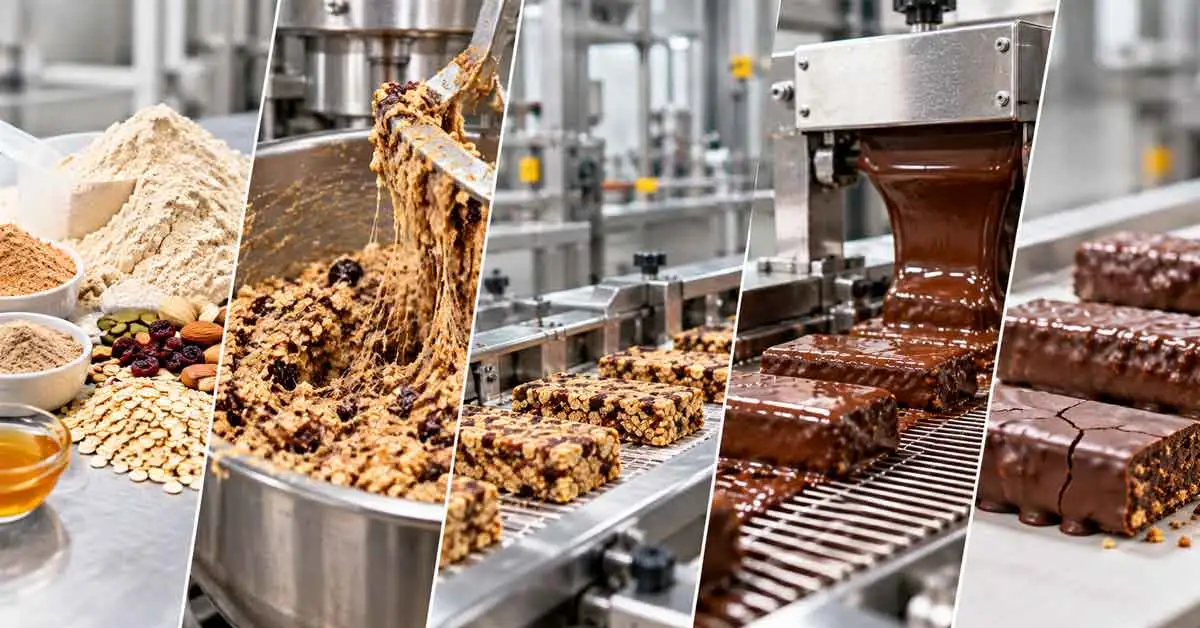
Raw-material receiving → storage → weighing → mixing → forming/extrusion → cooling → cutting → coating → final cooling → packaging → finished-goods storage
The objective is to reduce unnecessary movement and prevent cross-contamination.
The factory should also account for:
- Hygienic personnel movement
- Raw and finished material segregation
- Cleaning areas
- Pest-control measures
- Temperature and humidity considerations
- Waste handling
- Drainage
- Equipment access for maintenance
- Electrical load
- Fire safety
- Environmental requirements
BIDA’s guidance for factory trade licensing identifies documents such as machinery descriptions, factory maps, fire licensing and environmental clearance among the requirements applicable to factories.
BIDA’s One Stop Service also integrates services involving environmental clearance, fire licensing, factory layout approval and factory licensing.
Step 5: Licensing, Packaging & Branding
Your packaging is not just a marketing asset.
It is also part of compliance.
BSTI’s certification guidance specifies information that may be required on applicable food labels, including product name and brand, quantity, batch number, ingredients, production and expiry dates, manufacturer details and maximum retail price, among other information.
However, the exact labelling requirements depend on the applicable product standard and regulatory category.
Before printing thousands of wrappers, verify:
- Product classification
- Applicable BSTI standard
- BFSA requirements
- Ingredient declaration
- Allergen information
- Nutrition information
- Batch coding
- Date coding
- Claims
- Storage instructions
- Manufacturer details
BSTI currently maintains a mandatory-product list, which was updated to 328 products in 2026. Whether your specific protein bar falls within a mandatory category should be checked against the latest applicable list and standard rather than assumed.
Step 6: Distribution & Market Entry
Don’t launch everywhere at once.
A practical first-stage strategy could be:
Dhaka → selected gyms/fitness stores → online channels → modern retail → Chittagong → wider distributor network
Potential channels include:
- Brand website
- E-commerce marketplaces
- Gyms
- Fitness centres
- Health stores
- Pharmacies where permitted
- Supermarkets
- Convenience stores
- Corporate wellness programmes
- Distributors
Online distribution is particularly relevant because Euromonitor has identified rising e-commerce and online promotion within Bangladesh’s sports nutrition category.
Protein Bar Machine Bangladesh: What Equipment Do You Need?
A complete production setup usually involves more than one machine.
Depending on your recipe and capacity, the line can include:
- Ingredient weighing system
- Mixer
- Slab former or extruder
- Cutting machine
- Cooling conveyor/tunnel
- Enrobing machine
- Chocolate tempering system
- Conveyors
- Metal detector/checkweigher
- Flow-wrapper
- Batch/date coder
- Secondary packaging equipment
For smaller businesses, some of these operations can initially be semi-automatic.
As volumes grow, automation can be added around the bottleneck.
Types of Protein Bar Machines (Extrusion vs. Forming vs. Enrobing)
Extrusion
Extrusion is useful when the product needs to be continuously shaped into a consistent profile before cutting.
It can work particularly well for soft, cohesive formulations such as date-based and protein-rich bars.
Slab forming
The mixture is formed into a sheet or slab before being cut into individual bars.
This can be suitable for formulations that behave well under compression and are intended to produce a uniform sheet.
Enrobing
Enrobing is used when the bar needs a coating such as chocolate.
The product passes through a coating system and then requires controlled cooling to set the coating.
Not every protein bar needs all three.
The correct configuration depends on the formulation.
Protein Bar Machine Price in Bangladesh
There is no universal Protein Bar Machine Bangladesh price because suppliers quote different configurations.
A basic machine, a semi-automatic production line and a complete automated plant are very different investments.
For example, Foodsure’s currently published commercial protein bar machine is listed at ₹25 lakh, with a stated throughput of 80–100 kg/hour, SS304 food-contact construction, approximately 15–16 kW power and PLC/HMI controls.
At approximately ₹1 = BDT 1.28, that is roughly BDT 32 lakh before Bangladesh-specific shipping, duties, installation and configuration.
Other published market references show substantially different prices for complete lines, with equipment configuration being a major reason for the difference.
Therefore, instead of asking only:
“What is the price of the machine?”
ask:
“What is the landed cost of the complete production system required for my formulation and target capacity?”
That number is much more useful for financial planning.
How to Choose the Right Protein Bar Machine Supplier
A supplier should be evaluated on more than machine price.
Look for:
- Product trials
- Demonstrated throughput
- SS304 food-contact construction
- PLC/HMI controls
- Adjustable bar dimensions
- Consistent cutting
- Easy cleaning
- Spare-parts availability
- Installation support
- Operator training
- Warranty
- After-sales service
- Ability to scale the line
- Packaging integration
A supplier that understands formulation behaviour can also help prevent a common problem: purchasing a machine that technically works but does not work well with your actual recipe.
This is one area where Foodsure Machines can be considered as part of the equipment evaluation process. Its published specifications include commercial protein-bar machinery in the 80–100 kg/hour range and configurable semi-automatic and automatic options.
Small-Scale vs. Industrial-Scale Protein Bar Manufacturing
| Factor | Small/Semi-Automatic | Industrial |
|---|---|---|
| Production | Lower | High |
| Labour | Higher per kg | Lower per kg |
| Initial Investment | Lower | Higher |
| SKU Flexibility | Generally easier | Requires planning |
| Automation | Limited/moderate | High |
| Quality Consistency | Operator-dependent | More controlled |
| Best For | Market testing, established demand, modular expansion | Large-scale production |
A sensible route for a new brand can be to validate demand first and then scale.
If the business already has confirmed institutional orders, distributor commitments or strong demand projections, a larger line may make economic sense from the beginning.
Foodsure Machines can also be positioned here as a scale-up partner rather than simply a machine vendor: the important conversation is about capacity, formulation, line configuration and future expansion, not just equipment price.
Common Challenges in Protein Bar Manufacturing (and How to Solve Them)
1. The bar becomes too hard
This can happen because of moisture loss, binder selection, protein concentration or storage conditions.
Solution: conduct formulation and shelf-life trials under controlled conditions before commercial production.
2. Bars break during cutting
A formulation may look stable after mixing but fracture during mechanical cutting.
Solution: optimise moisture, binder ratio, temperature and forming pressure, then test the recipe on the intended machine.
3. Chocolate coating cracks
Temperature differences between the bar and coating can create problems.
Solution: control coating temperature, product temperature and cooling conditions.
4. The protein content is too expensive
A high protein claim can increase ingredient cost significantly.
Solution: build the formulation around a target cost per bar and determine the protein level that gives the desired nutritional positioning without making the product commercially unviable.
5. Shelf life is shorter than expected
Protein bars can experience texture changes, oxidation, moisture migration and microbial issues depending on the recipe.
Solution: conduct proper shelf-life testing using the final packaging and realistic storage conditions.
6. The machine is underutilised
This is a business problem rather than a machine problem.
Solution: calculate expected monthly sales before purchasing equipment. Build scenarios at 30%, 50%, 70% and 85% utilisation.
7. Packaging becomes the bottleneck
A production line may make bars faster than the packaging line can wrap them.
Solution: balance forming, cooling, cutting and packaging capacities instead of evaluating individual machines in isolation.
8. Regulatory claims create problems
Words such as “high protein”, “sugar-free”, “healthy”, “weight loss” or disease-related claims should not be used casually.
Solution: verify claims against the applicable Bangladesh regulations and product category before finalising packaging or advertising. BFSA has also been developing specific rules around food advertising and claims, making regulatory verification particularly important for functional and nutrition products.
Conclusion
The opportunity in Bangladesh is not simply about selling another gym snack.
The more interesting opportunity is building a locally manufactured, consistently formulated and correctly positioned nutrition product for consumers who want convenient protein.
The country’s broader processed-food industry, growing sports-nutrition category and expanding interest in plant protein create a market worth investigating. At the same time, the category remains price-sensitive, which means formulation economics and manufacturing efficiency matter from day one.
If you are planning a Protein Bar Manufacturing Business in Bangladesh, the logical sequence is:
Market research → formulation → pilot trials → cost calculation → regulatory review → machinery selection → factory setup → packaging → controlled market launch → scale-up.
Do not start with the machine.
Start with the product and the numbers.
Once you know your target bar weight, protein level, monthly demand, formulation cost and desired production capacity, selecting a Protein Bar Machine Bangladesh solution becomes much easier.
For manufacturers evaluating machinery, formulation compatibility and production capacity together, Foodsure Machines’ protein bar manufacturing solutions can be explored for equipment specifications, capacity options and consultation.
The objective is not to buy the biggest line available.
It is to build a manufacturing system that can produce the right bar, at the right cost, at the right volume and scale when the market proves it deserves to.
Have a Question? Let’s Connect
Need expert guidance on food processing machines, production setup, or process optimization? Our team is ready to help you choose the right solution for your business.
Frequently Asked Questions
How much does it cost to start a protein bar business in Bangladesh?
The cost depends on whether you start with semi-automatic production or a fully integrated industrial line. A commercial machine benchmark from Foodsure is around ₹25 lakh for an 80–100 kg/hour system, equivalent to roughly BDT 32 lakh at a September 2026 exchange rate before freight, duties, installation and other local costs. The complete business investment will be higher after adding the factory, utilities, packaging, raw materials, licences and working capital.
What machine is needed for protein bar manufacturing?
A typical protein-bar production line may require a mixer, slab former or extruder, cutting machine, cooling system and packaging machine. Chocolate-coated products may additionally require an enrober and tempering system. The correct configuration depends on the formulation, bar size, coating, throughput and automation level, so machinery should ideally be selected after product trials.
Is protein bar manufacturing profitable in Bangladesh?
Protein bar manufacturing can be commercially viable when the manufacturer controls ingredient costs, production efficiency, packaging costs, distribution margins and utilisation. Bangladesh’s broader sports nutrition and processed-food categories are expanding, but Euromonitor also notes that sports nutrition remains a relatively small category and that high prices can restrict growth. Profitability therefore depends on the individual product’s unit economics rather than market growth alone.
What licenses are required for protein bar manufacturing in Bangladesh?
A manufacturer may need food-business registration or licensing through BFSA, applicable BSTI certification or standards compliance, a local trade licence, tax registrations and factory-related approvals. Depending on the facility, environmental clearance, fire licensing and factory licensing may also apply. BIDA’s investor guidance specifically identifies trade licensing, fire and environmental clearances and factory-related approvals within the industrial setup process.