
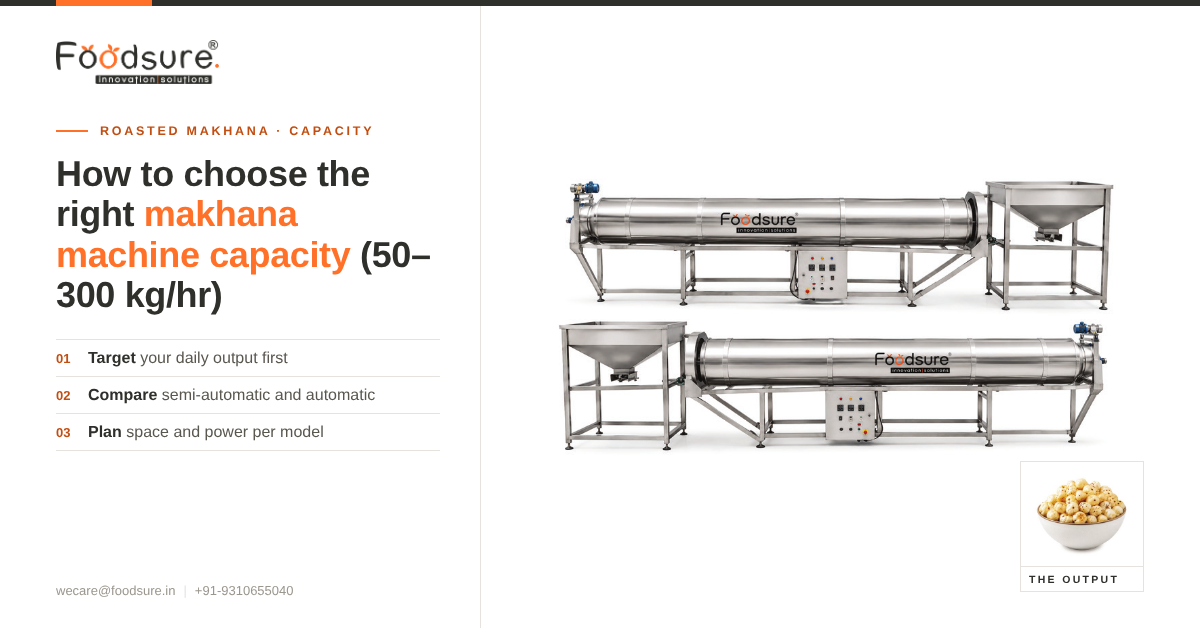
The majority of makhana producers don’t incur losses from the purchase of a wrong machine but from a wrong-sized machine. A 300 kg/hr machine that operates at 30% loading consumes electricity and locks capital. A 50 kg/hr machine in a setup with 2 tonnes of raw seed stored in the godown means lost business.
Makhana machine capacity selection revolves around one single question: how much raw seed can I process and sell every day, and how much room have I got for future growth? This article will help you understand the math behind, capacity range, hidden parameters and common errors.
By the end of it, you’ll be able to pinpoint your exact position within 50 and 300 kg/hr and what to ask a machine manufacturer before paying an advance.
What Does Makhana Machine Capacity Actually Mean?
Makhana processing machinery capacity is defined by the number of kilograms of gurri, which is fox nut seeds, that can be processed by a machine or production line in one hour and is expressed in kg/hr.
This is the only information that confuses many first-time customers. The machine that is “100 kg/hr” does not give you 100 kg of popped lava makhana per hour. This machine works with 100 kg of seeds.
Input capacity vs. finished output
Fox nut (Euryale ferox) popularly referred to as lotus seed or gorgon nut experiences considerable weight loss during roasting, tempering and popping. Popped makhana generally weighs around 35-45% of the raw weight. This is dependent on the size of the seed, the moisture content, grade of seed, among others.
Therefore, when considering the hourly output capacity of a makhana machine from different suppliers, it is important to inquire whether this is based on raw seed weight or processed seed weight and moisture content.
Rated capacity vs. effective capacity
Rated capacity is the maximum performance that can be achieved under perfect operating conditions. Effective capacity, however, is the performance level that is achieved during the average workday taking into consideration loading periods, cleaning operations, changeovers, power outages, and rest periods of operators. Rely on 75-85% of the rated capacity figure.
There are many stages of processing makhana, including cleaning, size grading, roasting, popping, polishing and sorting. The processing line works as fast as the slowest operation. Balancing all these operations is more important than getting an oversize machine.
Makhana Machine Output Per Hour: What 50, 100, 200 and 300 kg/hr Look Like
The table below shows indicative figures for an 8-hour shift at about 80% effective running time and a 40% yield. Treat these as planning numbers. Your actual results will vary with seed quality and machine design.
| Rated capacity (raw seed) | Seed processed per 8-hr shift (approx.) | Finished makhana per shift (approx.) | Typical user |
|---|---|---|---|
| 50 kg/hr | 320 kg | 120–140 kg | Start-ups, FPOs, small snack brands |
| 100 kg/hr | 640 kg | 240–270 kg | Established small units, regional suppliers |
| 200 kg/hr | 1,280 kg | 490–540 kg | Mid-size processors, private-label packers |
| 300 kg/hr | 1,920 kg | 740–800 kg | Large processors, exporters, multi-SKU brands |
Notice how the numbers scale. Doubling the rated capacity doesn’t just double output. It also doubles the seed you must buy, store and finance, plus the grading, packaging and labour that sit around the machine.
What Capacity Makhana Machine Do I Need? A 5-Step Method
Take your finished product target for one day, divide it by the yield of 0.40, then divide by 6.4 productive hours in a workday. Then add 20–25% for headroom.
This is the heart of any makhana plant sizing calculation tool. Do it yourself.
- First determine your reliable supply of seed. You need to consider what you can really buy and stock up on, not what you want to buy. Since gurri harvest occurs mostly in August-October, it makes sense for many processors to store up on seed during this period and run the factory throughout the rest of the year.
- Set your daily finished product output target. Start working backwards from your orders and export inquiries, not forwards from machinery brochures.
- Calculate the corresponding raw material needed. Divide your finished product target by 0.40. So, 500 kg/day will mean 1,250 kg of seeds.
- Divide by effective hours in a workday. If you work in 8-hour shifts at 80% efficiency, then there are 6.4 productive hours per shift.
Worked examples
| Business | Finished target/day | Seed needed (÷0.40) | Required kg/hr (÷6.4) | With 20–25% headroom | Machine class |
|---|---|---|---|---|---|
| New snack brand | 200 kg | 500 kg | ≈78 | ≈95–100 | 100 kg/hr |
| Regional processor | 500 kg | 1,250 kg | ≈195 | ≈235–245 | 200 kg/hr (single shift, add a second shift at peak) or 300 kg/hr |
| Export-focused unit | 700 kg | 1,750 kg | ≈273 | ≈330+ | 300 kg/hr, or 200 kg/hr on two shifts |
The second row shows why the nearest size isn’t always the right one. A 200 kg/hr machine can meet a 500 kg/day target, but only with very little buffer. Running a second shift is often cheaper than jumping a size class.
Makhana Machine Capacity Selection for Makhana Manufacturers in India
Makhana machine capacity selection india looks different from other markets because of where the seed comes from and how the season runs. Bihar produces the overwhelming majority of the country’s makhana, and Mithila makhana carries a Geographical Indication (GI) tag, granted in 2022. If your plant is outside the main growing belt, freight and storage costs change the maths.
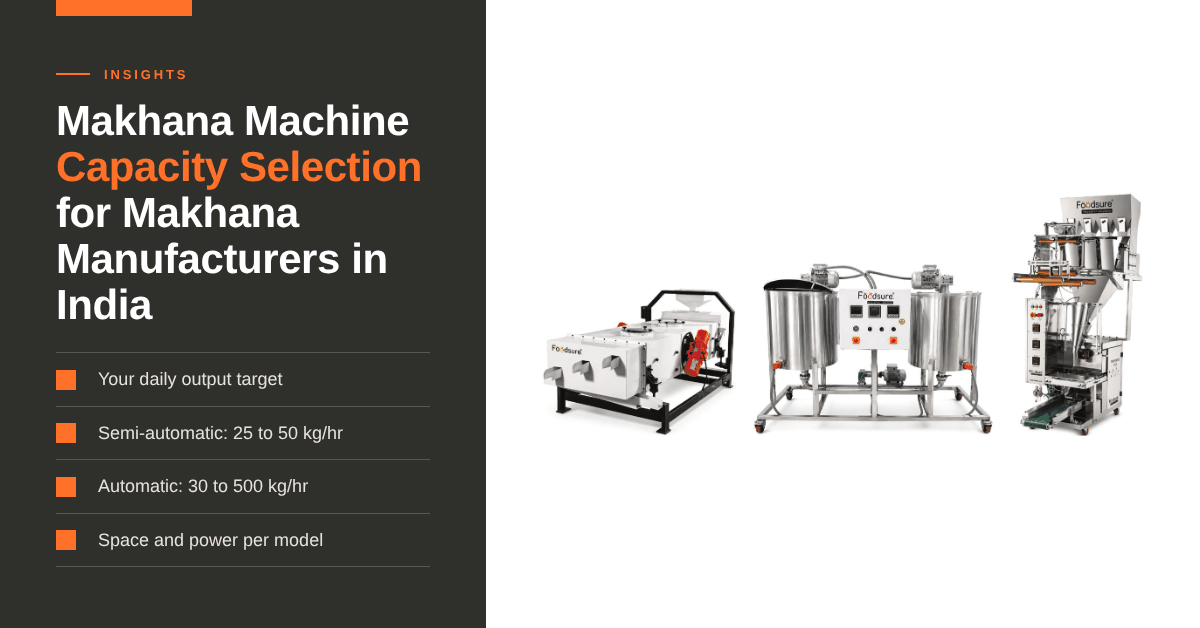
Four local factors deserve extra attention.
- Seasonal buying. Prices are lowest during harvest time. The processors having sufficient cash flow and dry storage capacity will buy more at that time, sizing the plant capacity to process within 8-10 months.
- Power supply. Ensure that the power supply in your location is reliable with a 3 phase connection and its load capacity sanctioning. Voltage variation is detrimental to motors and affects popping uniformity.
- Fuel selection. There are three kinds of fuel for use by roasting machines – electric, LPG and biomass. Availability and cost of fuel in your location can be an important factor in operational cost per kg rather than capital cost of the machine.
- Licenses and assistance. You would require FSSAI registration or license. Additionally, MSME (Udyam) registration will help in getting a loan. The small units might also be eligible for assistance through the PM Formalization of Micro Food Processing Enterprises (PMFME) scheme that provides credit linked subsidy. Please check the current eligibility and limit with your district industries center.
Weather conditions matter as well. The monsoon weather increases moisture content of seeds and products, resulting in lower roasting rate and shorter shelf-life of popped makhana. Facilities in humid locations can have enclosed storage and packaging.
Makhana Machine Capacity Selection 2026: What’s Different This Year
Makhana is now a snack food rather than the festival fast food that it once was, and is now being marketed in roasted and flavored packs, protein-snacks, and increased interest for exports. There have been indications from the government also with the setting up of the Makhana Board for Bihar in the Union Budget 2025-26.
For potential buyers in planning in 2026, there are three clear changes that need to be anticipated:
- Increasing SKU’s with decreasing production runs. Flavoring and processing the makhana require flexibility rather than huge batches, and consider how quickly the machine can switch between different grades.
- Increasing quality specifications. Potential buyers are expecting uniform size, popping ratio, low broken percentage, and clean color. The grading and polishing equipment has to be matched to the popping machine.
- Energy cost considerations. Fuel and power account for major operating costs. Request the energy consumption per kg of processed product rather than the machine’s wattage.
Demand forecasts can be over optimistic, hence design the plant on order plus some buffer rather than market talk.
Factors Beyond kg/hr That Affect Your Choice
Capacity is the headline number. These factors decide whether you actually achieve it.
| Factor | What to ask | Why it matters |
|---|---|---|
| Pop rate | What percentage of seeds pop fully at your tested grade? | Low pop rate cuts finished yield and profit per batch |
| Seed size range | Which grades can the machine handle without re-calibration? | Mixed sizes pop unevenly and increase breakage |
| Automation level | Which stages are manual: feeding, shelling, sorting? | Labour cost and consistency depend on it |
| Fuel and power | What’s the consumption per kg of output? | Running cost can outweigh the price gap between models |
| Material and build | Is the contact surface food-grade stainless steel (SS 304)? | Hygiene, FSSAI compliance and machine life |
| After-sales support | Are spares stocked and is installation training included? | Downtime during peak season is costly |
One large machine or two smaller ones?
Two 100 kg/hr lines are equal to one 200 kg/hr line and provide a level of redundancy. In the case of a breakdown, the process can continue running but at half capacity.
- One big line costs less per kg/hr to operate than two smaller lines.
- Choose two smaller lines if you need reliability and intend to run more than one grade at any time. Choose one larger line if you have only one product and good supervision.
Common Mistakes in Capacity Selection
- Planning for peak demand, not average demand. A machine that is suited for peak production will be doing nothing during the rest of the year.
- Not considering other processes. A popper with a capacity of 200 kg/hr is useless when the capacity of grading and packing is limited to 100 kg/hr.
- Confusing input and output kg/hr. You must be sure to write down from whom you have been told what kg/hr means.
- Neglecting the trial run. Make sure that the supplier uses your seeds for processing during the demo.
- Miscalculating the working capital. The cost of storing seeds and packing materials may exceed the cost of the machine.
- Failing to consider the scalability of the machine. Find out whether your line may be upgraded by adding grading and packing modules later on.
Pre-Purchase Checklist
- Use this checklist when you contact Foodsure Machines or any other supplier.
- Confirmation of daily seeds required and space for storage
- Target for daily output and packaging form
- Rated capacity based on the raw seeds input along with testing conditions
- Pop rate, broken percentage, and yield based on a live test
- Power consumption, fuel type, and running costs per kilogram
- Floor area, ceiling height, and drainage details
- Warranty information, spare parts list, installation process, and training for operators
- FSSAI and Udyam certifications and subsidy details available
Key Takeaways
- Machine capacity depends upon raw seed capacity; expect finished makhana to be about 35-45% of that amount.
- Apply the equation: daily finished goal ÷ 0.40 ÷ 6.4 hours, and then add an additional 20-25% buffer.
- 50-100 kg/hour is appropriate for start-up businesses, 100-200 kg/hour is right for growth-stage enterprises, and 200-300 kg/hour is right for export-oriented firms or large companies.
- The processes of grading, roasting, popping, and packing have to be in balance, since the rate-limiting process will dictate the production rate.
- Try out your seed to determine pop rate and operating cost per kg.
Conclusion
Selection of makhana machines is not necessarily getting the largest machine you can afford. It is ensuring that there is a good match between the reliability of seed source, verified demand, and working capital with a machine that is scalable.
Use the five-step process for selection, verify its suitability within the constraints of power supply, fuel and storage and make sure you have a trial using your own seeds. Most buyers usually end up selecting machines that fall in the 100-200 kg/hour category whereas for new entrants, the 50-100 kg/hr machines work out fine.
If you want us to recommend a machine for your seed source, desired output and budget, we can provide you a free quotation.
FAQs
What makhana machine capacity should I choose?
Divide your target per day by 0.40 and then by 6.4 hours and add 20%–25% extra capacity. Most businesses require 50–100 kg/hr.
What makhana machine capacity is the output per hour?
The ratio is around 35%–45% of the raw seed feed rate. If you buy a 100 kg/hr makhana machine, you will have 35-45 kg/hr of popped makhana.
What is the makhana machine capacity selection criteria for Indian makhana producers?
Depends on seed stock, season stock, power availability, fuel price and requirements. Match your orders and add 20%–25% excess.
Is there any guide to makhana machine capacity selection for beginners?
Yes, estimate your seed stock, set target, convert into kg/hr taking into account yield and effective hours and select the closest size class.
What will change in makhana machine capacity selection 2026?
More flavours SKU, quality requirements and energy prices. Opt for flexible lines allowing quick grade change.
Which is better – to buy one 200 kg/hr line or two 100 kg/hr lines?
Two machines allow back-up and flexibility. One large line is cheaper per kg/hr and requires less labour.




