
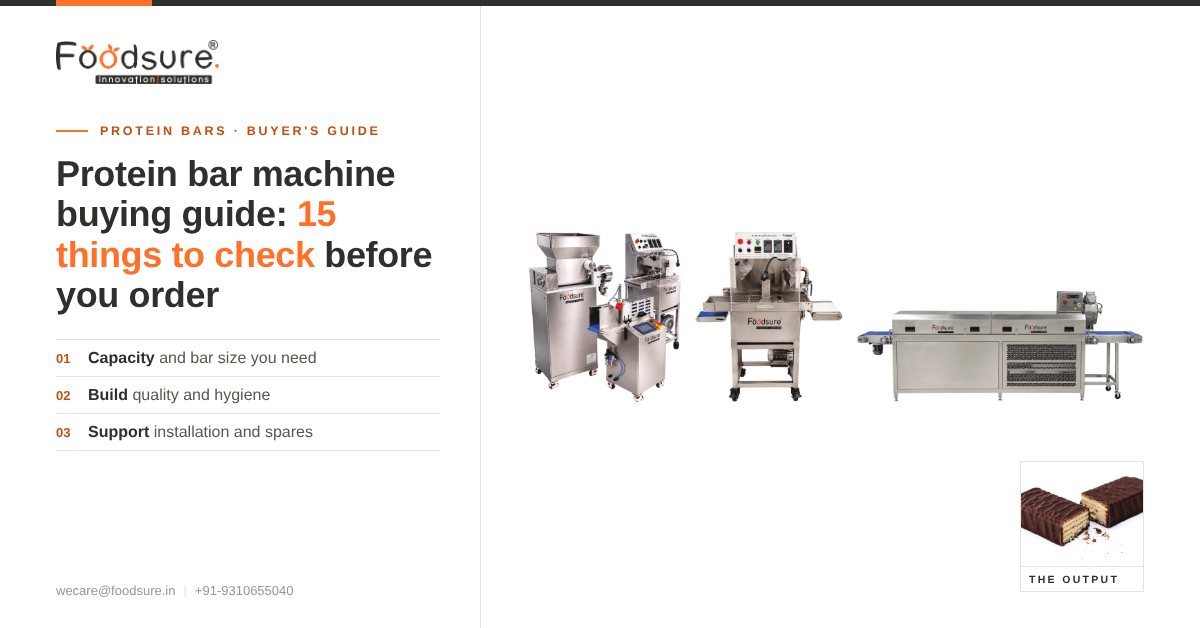
The ultimate guide to buying the perfect protein bar machine is: Get the correct machine that suits your product, your production capacity, and your factory and don’t get swayed by the cheapest quote out there. Consider capacity, accuracy of forming and cutting, food-grade components, hygiene, utility considerations, line integration and post-purchase support before you commit to any down-payment.
The common mistakes made after the purchase usually stem from lack of consideration of factors no one bothered to find out about, such as space required for the line installation, three-phase load requirements, change-over time and operator training.
Below is a list of 15 points in the exact sequence in which they should be considered, geared towards food producers who have never bought a protein bar forming and cutting machine before.
What Does a Protein Bar Machine Actually Do?
The machine shapes the mixture of the bound protein and cuts them into equally shaped and sized bars. It acts between the stages of mixing and packaging or cooling.
The protein bar machine of Foodsure is designed for efficient shaping, accurate cutting, hygienic processing, and commercial manufacturing. An electrical heating system as well as push button controls is used in this machine. The food items manufactured by the machine are protein bars and energy bars.
This is the machine. The list below deals with all other aspects of the machine.
Protein Bar Machine Buying Guide India: Start With Your Product and Volume
These first three checks decide everything that follows. Get them wrong and even a well-built machine will be the wrong purchase.
1. Define Your Bar Format Before You Call Any Supplier
Select bar types, weight, and dimensions first. All other machine parameters, including heat and cut length, follow.
Protein bars differ greatly. A soft, chewy bar with syrup binder reacts quite differently from a hard, high-protein bar or a nut and seed bar. Please note the following
requirements and attach them with all inquiries:
- Desired weight per bar and desired length and width
- Key ingredients, such as protein crisps, nuts, seeds, dates, or chips
- Sticking properties of the mass at forming temperature
- Coating or layers to be added after forming
It should be considered an alarm signal if your potential supplier offers a quote without the information requested above.
2. Match Capacity to Real Demand
Pick capacity from your realistic sales plan plus about a year of growth, not from your best-case dream. Foodsure supplies 50, 100 and 200 kg/hour models, and the table below shows how they differ.
| Capacity | Power (approx.) | Area required (approx.) | Suits |
|---|---|---|---|
| 50 kg/hour | 14–18 kW | 2,000 sq ft | Start-ups and smaller contract manufacturers beginning commercial production |
| 100 kg/hour | 30–35 kW | 5,000 sq ft | Food processing companies needing steady, consistent output |
| 200 kg/hour | 50–55 kW | 10,000 sq ft | Larger-volume manufacturers wanting to limit manual work |
Here’s a quick way to translate kg/hour into bars. Divide the hourly output in kilograms by the weight of one bar in kilograms. A 50 g bar at 100 kg/hour works out to roughly 2,000 bars per hour.
Treat that as a ceiling. Real output depends on shift length, cleaning breaks and changeovers.
3. Ask for Weight and Shape Consistency, Not Just Speed
Inquire about the variability in bar weights that the machine handles during its regular operation, and also view some samples produced. Consistent bars help you ensure your pack weight and reduce giveaway.
Speed is an easy one to give. Consistency is reflected in your rejection rate and customer complaints.
Check the Machine Build and Controls
4. Test the Cutting Accuracy
Formation gives you the block, but cutting gives you the bar. Inquire how it cuts, how easy it is to adjust lengths, and whether its edges remain intact and smooth.
The best way is to give them your own formula to test. A demonstration using their own mixture will tell you very little about your own.
5. Understand the Heating and Binder Handling
Syrups used as binders become thicker when cooled down, therefore, direct heating plays an important role in achieving proper compaction. The heater used by the machine produced by Foodsure is electrical, which implies that there is no need for an extra fuel supply line for the machine.
Inquire about heating speed, heating ability, and coping with a viscous mass, which becomes relevant especially on a cold morning shift.
6. Verify the Material of Construction
The food contact parts need to be made of food-grade SS304. Foodsure manufactures food contact parts using SS304 and the same should be expected of any other supplier.
You must ask in writing which parts are made up of SS304 and which parts make the frame and what material it is made up of. Request material certification also.
7. Check Hygiene Design and Cleaning Access
Allergens like nuts and milk or soy protein can be found in the mass of a protein bar. It is vital to have smooth surfaces, few crevices and easy access to the contact parts.
The time spent cleaning reduces your production time. A piece of equipment that will take 90 minutes to dismantle will lose production daily.
8. Decide How Much Automation You Need
Push-button operation is used by Foodsure in its protein bar machine, thereby making the training process easy. As the level of automation increases, there will be increased use of recipe memory and process controls; however, the price and skill requirement will also increase.
- Manual/Push-button: low price, easy to train, suitable for start-up operations and low volumes
- Semi-automated: connection of machine stages and reduced handling
- Fully Automated: Suitable for high volumes and repeatability; however, increased price
Select the level that you can actually run and maintain.
Plan Power, Space and Your Production Line
9. Confirm Your Power and Utilities
The Foodsure machine operates on 415V, 3-phase, 50Hz power. The power load requirement will be approximately 14-18 kW at 50 kg/hr, increasing to 50-55 kW at 200 kg/hr.
Make sure your electrician checks this before you make your purchase, and not afterwards.
10. Measure Floor Space Honestly
The dimensions of the machine itself measure 2,375 x 690 x 1,630 mm (length x width x height). These areas are much bigger than those listed in the table above, so ask the supplier what they actually include.
Take into consideration the entire production line, trolleys, staging of ingredients, movement of the operators, and accessibility to clean. A small layout will slow down each and every shift.
11. Check How It Fits Into the Full Line
Forming machines never operate in isolation. Before the process, there is mixing and binder preparation. After the process, cooling, coating/enrobing, packaging and metal detection might be required.
Request an illustration layout for your products after the cutting process and ensure that the height and speed of conveyors match.
Read our guide on Setting Up a Protein Bar Production Line.
12. Ask About Changeover and Flexibility
The majority of brands produce more than one flavor or bar size. Find out how much time is needed for changing the weight of the bars, switching recipes, and cleaning between the allergen groups.
In case you are planning to launch new products in the future, communicate that information to the manufacturer right away.
Verify Compliance, Support and Total Cost
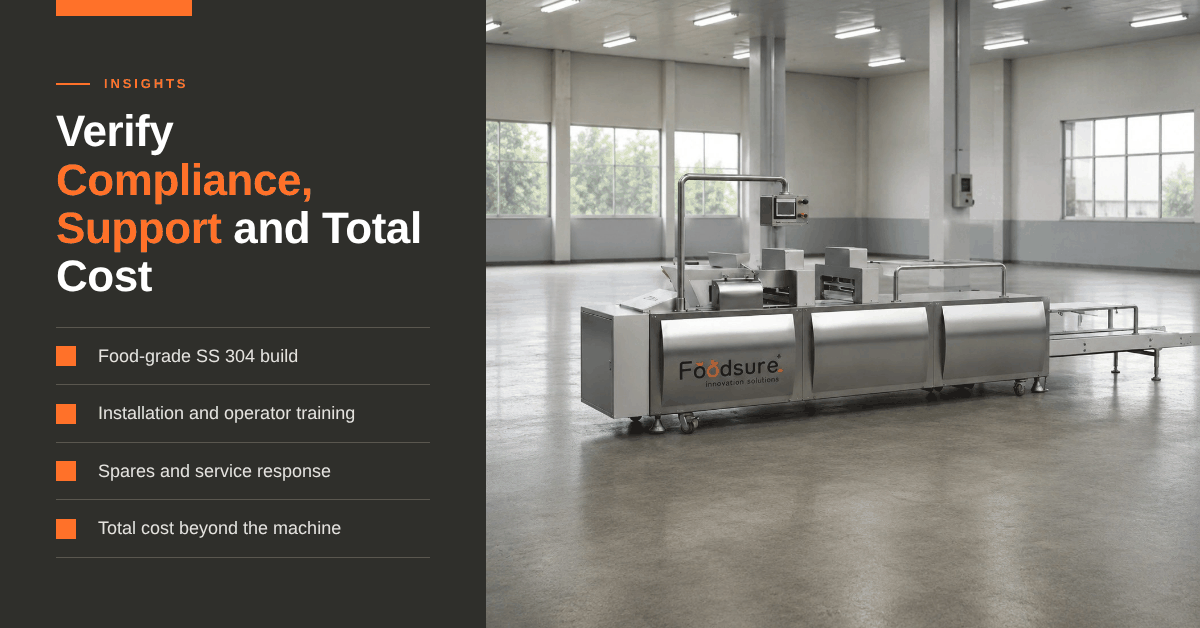
13. Confirm Compliance and Documentation
The correct FSSAI license/registration is required when selling food products in India and this is confirmed by the equipment records that you have. Make sure you request material certificates, electrical safety information, and drawings from the suppliers. If you intend to export your product, find out early about their audit requirements. Hygienic design and traceability will make it much easier.
Read our guide on FSSAI Requirements for Protein Bar Manufacturers.
14. Get Installation, Training and After-Sales Terms in Writing
The Foodsure protein bar machine has a warranty of one year. Ask what the warranty covers, how quickly the manufacturer fixes any faults, and where spare parts are supplied from.
Check that installation and training are included in the quotation because if not, you are wasting your money on a machine that you can’t operate.
15. Compare Total Cost, Delivery Time and Supplier Track Record
The price of a protein bar machine is dictated by its size, automation, and setup, so ensure that quotes are comparable apples-to-apples. Take into consideration more than just the machine price itself there is freight, installation, utilities, and spare parts to think about.
Get an indication of how long it will take to deliver in weeks and what factors might cause delays. Next, make sure that the company is who they say they are.
Read our guide on Protein Bar Machine Maintenance Tips.
Questions to Ask Every Supplier
Use this table as your shortlist script. A confident supplier answers each point specifically.
| Ask this | A good answer sounds like |
|---|---|
| Which parts are SS304? | A clear list of contact parts, with material certificates on request |
| Can you run a trial with my recipe? | Yes, with a defined trial plan and sample output |
| What are the power and area requirements? | Specific kW, voltage and sq ft figures, plus what the area covers |
| What’s included in the warranty? | A written scope and response time, not a general promise |
| Are installation and training included? | A yes or no in the quotation, with who does it and for how long |
| What’s the delivery time? | A number of weeks, with stated assumptions |
Machine Forming vs Manual Forming: When Does It Pay Off?
Manual forming works for pilot batches and recipe development. It struggles once orders become regular, because bar weight and size drift from one operator to the next.
| Factor | Manual forming | Protein bar machine |
|---|---|---|
| Bar weight consistency | Varies by operator and shift | Set by the machine and its settings |
| Labour need | High per kilogram produced | Lower, mainly loading and monitoring |
| Hygiene control | More hand contact | Less hand contact with food-contact surfaces |
| Scalability | Limited by headcount | Scales by choosing a higher capacity model |
| Upfront investment | Low | Higher, with utilities and space to plan |
If you’re still testing recipes or selling a few hundred bars a week, manual forming or contract manufacturing may be the smarter first step. Once demand is steady, the machine usually pays for itself through consistency and labour savings.
When Is a Protein Bar Machine Not the Right Fit?
Machines aren’t always the answer. Don’t proceed if your formulation is not ready because any alteration to your formulation will necessitate alterations in your process and possibly your machinery.
Don’t proceed also if you don’t have plans on how to cool down, pack, and store your product because a rapid forming machine just shifts the bottleneck downstream.
How to Read a Machine Quotation
A useful quote sounds like a specification rather than an advertisement. Ensure that the quote includes the following:
- Model number, capacity in kg/hour, and the bar weight range for which it is quoted
- Materials used, with SS304 cited for contact parts
- Power requirement, voltage, and space needed
- Length of warranty and its coverage
- Lead time, terms of payment, and items not included
- Installation and operator training, if any
In case of doubt about any of the above, clarify. Quotes that lack details usually end up becoming costly surprises once the advance is paid.
Red Flags to Watch For
- Questions regarding the recipe or bar design
- No willingness to conduct a trial or show a functioning machine
- Specifications that alter from the call through to the quotation
- Inability to provide spares and services
- Pushing for full payment before confirming utility and layout
Common Mistakes Buyers Make
- Purchasing based only on price and not on consistency, hygiene, and support
- Sizing capacity to a desired level that will take years to be achieved
- Avoiding trials using their own formulation
- Ordering before determining available electrical power and floor space
- Overlooking equipment needed downstream such as cooling and packing
- Relying on an oral agreement regarding warranty and training
Which Capacity Should You Choose? A Simple Framework
- Calculate your estimated monthly sales in bars for the coming year.
- Multiply this by your bar weight to convert it into kilograms.
- Divide by your actual monthly running hours.
- Make an allowance for cleaning time, changeover time, and growth.
- Compare your calculation with the 50, 100, or 200 kg/hr machine, then verify power and floor area needs.
If you fall in between two sizes, it is safer to go for the smaller one but with room for upgrades. If you have confirmed bulk orders, go for a bigger machine.
Key Takeaways
- Specify your bar format, weights, and formulation prior to contacting suppliers.
- Select capacity based on realistic demand, as well as power and floor space requirements.
- Demand stainless steel contact parts, SS304, good hygienic design, and a trial run using your formula.
- Plan the whole line, starting with the mixing system and ending with packaging.
- Confirm the warranty, installation, training, and delivery date in writing before placing the order.
Conclusion
The ultimate checklist on protein bar machine purchasing is not all about getting the least expensive machine but rather choosing the machine, line, and supplier that suits both your products and plans.
Follow the list of 15 checklists and get a trial after submitting your bar specification to the supplier. When you are ready for comparison, send your capacity and product details to Foodsure Machines for a quote.
FAQs
What do I need to know about buying a protein bar machine?
You need to know about bar format, capacity, accuracy, SS304 contact parts, power consumption, line fitment and after-sales service. All these 15 points are covered above.
Do you have a protein bar machine buying guide for protein bar manufacturers in India?
Yes, this is it. It addresses the aspects of 415 V three-phase power consumption, FSSAI requirement and service aspect that Indian protein bar manufacturers must consider.
Is this protein bar machine buying guide 2026 in tune with the latest models available in the market?
Yes, this reflects the models from Foodsure at 50 kg/hr, 100 kg/hr and 200 kg/hr production rates. Get exact specifications in your quotation.
Which capacity should I go for for a start-up?
The capacity of 50 kg/hr is usually suited to a start-up. Plan on a higher capacity only once you get orders.
How much power consumption does the protein bar machine require?
The required power consumption is 14–18 kW, 30–35 kW and 50-55 kW for 50 kg/hr, 100 kg/hr and 200 kg/hr respectively. The voltage is 415V three-phase, 50 Hz.




