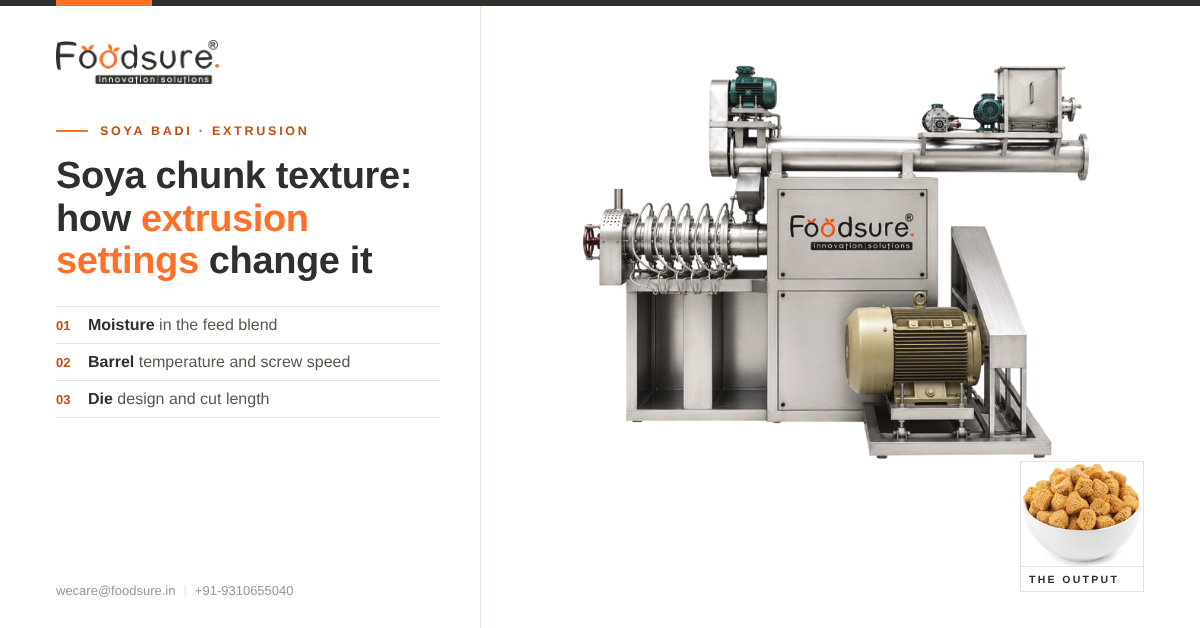
The texture of soya chunks determines their firmness, chewiness, water absorption, and overall eating quality. For food manufacturers, achieving consistent soya chunk texture is essential for producing textured vegetable protein (TVP) that meets consumer expectations and performs reliably during cooking.
Extrusion is among the key stages of production of soya chunks. In this process, the soy protein isolates go through a combination of heat, pressure, water, and mechanical stress. The result is a textured protein food with a meat-like structure.
However, even minor changes in the extrusion process can have an impact on the end product. Too much moisture will result in a soft structure, whereas too little moisture or inappropriate conditions will cause hard and brittle chunks. Temperature, screw speed, feed rate, and die design also play a role in the final texture.
Understanding these variables helps manufacturers optimise production, minimise defects, and maintain consistent product quality. Selecting the right soya nugget making machine and establishing suitable operating conditions are therefore important steps in commercial TVP manufacturing.
What Determines Soya Chunk Texture?
Soya chunks are often manufactured from defatted soy flour or any other soy protein material by means of extrusion cooking. The ingredients are heated, mixed, compressed, and restructured during the extrusion process.
The texture formed depends on the nature of the raw material and the processing conditions.
Several factors influence the finished product:
- Moisture content: Controls the behaviour of the protein-based raw materials during extrusion processing and influences expansion, density, and structure.
- Extrusion temperature: Affects the denaturation of the proteins, melting, and the formation of the structure.
- Screw speed: Influences the mixing, shearing, residence time, and the energy input into the process.
- Feed rate: Influences the loading of the extruder and the amount of time for processing.
- Die geometry: Affects material flow, pressure, and the shape of the extrudate.
- Composition of raw materials: Protein content, residual fat, particle size, and other factors affect the extrusion process.
- Drying conditions: Influence the final moisture, firmness, stability, and hydration properties of the chunks.
These variables interrelate with each other. Modification in one variable without taking other variables into account might enhance one characteristic of the texture but at the same time it might hamper another.
For instance, adding more moisture to increase flow might alter expansion and density. Likewise, raising the temperature for protein conversion might harm the product if not properly controlled.
How Extrusion Works in Soya Chunk Manufacturing
Extrusion cooking combines heat, pressure, moisture, and mechanical energy to transform soy-based ingredients into a structured product. In commercial production, the extruder must maintain stable operating conditions to deliver consistent output.
A typical soya chunk manufacturing process follows this sequence:
1. Raw Material Preparation
The procedure starts with the selection of the proper ingredients, which are usually de-oiled soy flour. Consistency of the ingredients and size of particles need to be kept constant since any changes may have an impact on moisture uptake and extrusion properties.
2. Feeding and Conditioning
The ingredients are fed into the extruder in a controlled manner. Water or steam is added to meet the moisture requirement of the process.
This helps in maintaining consistent texture by avoiding fluctuations in the process.
3. Extrusion Cooking
In the extruder, the material undergoes mechanical shear, compression, and heating. This leads to structural changes in the proteins and gets the material ready for molding.
The right combination of temperature, moisture, and mechanical energy is based on the formulation, machine, and final product properties.
4. Die Shaping and Cutting
The processed material passes through a die that determines the product’s shape and dimensions. The extrudate is then cut into suitable pieces.
Die conditions, material flow, and cutting consistency influence the uniformity of the finished chunks.
5. Drying and Cooling
The product after extrusion will have high moisture content and needs to be dried. The drying process ensures that the product reaches the desired moisture content.
After drying, the chunks are cooled before packing. If proper drying and cooling are not done, it can have an impact on storage.
How Moisture Content Changes Soya Chunk Texture
Moisture is one of the most critical factors in extrusion. Moisture influences the flow of material, viscosity, mechanical energy input, expansion, and structure of the extrudate.
The appropriate moisture content depends on the kind of soy components, the design of the extruder, extrusion temperature, and the desired texture. There is no universal moisture setting suitable for all production lines.
Low Moisture Conditions
In case moisture is not sufficient for the operation of the machine, then the material will become very hard to process. Higher resistance in the extruder may affect the mechanical energy input.
Depending on the formulation and machine, this may result in:
- Excessive hardness or brittleness
- Uneven expansion
- Irregular product dimensions
- Increased variation between batches
- Greater mechanical load on the equipment
However, low moisture does not automatically produce a harder or better-structured product. The outcome depends on how moisture interacts with temperature, screw configuration, and other process variables.
High Moisture Conditions
Higher moisture generally changes the flow behaviour of the material and may reduce the mechanical energy transferred through shear under otherwise similar conditions.
Depending on the process, excessive moisture may contribute to:
- Softer or denser chunks
- Reduced expansion
- Changes in internal structure
- Different drying requirements
- Variations in rehydration behaviour
For manufacturers, the goal is to establish a moisture level that supports stable extrusion and the intended product structure.
Why Moisture Control Matters
Adding varying amounts of water would also yield inconsistencies regardless of whether the temperature of the machine and the speed of the screw stay constant. An accurate feed conditioning system is vital for ensuring more consistent material characteristics prior to the extrusion process.
Moisture levels, along with other factors such as water addition, feed rate, and finished product attributes, must be considered collectively by manufacturers.
How Extrusion Temperature Affects Soya Chunk Texture
Temperature affects protein transformation, material viscosity, moisture behaviour, and the development of the extruded structure.
A soya extruder typically operates across different temperature zones. Each zone serves a role in transporting, heating, mixing, and processing the material. The required temperature profile depends on the formulation and equipment design.
Lower-Than-Required Temperature
If the material does not receive sufficient thermal energy, protein transformation and structural development may be inadequate for the intended product.
Potential results include:
- Poorly developed texture
- Uneven expansion
- Inconsistent shape
- Variations in density
- Reduced processing stability
The actual outcome also depends on moisture content and mechanical energy input. A temperature setting should therefore be evaluated alongside the other operating variables.
Higher-Than-Required Temperature
An increase in temperature has the ability to affect the melt flow and facilitate processing in certain instances. Excessively high temperatures can have negative effects on quality and the process itself.
Possible issues include:
- Unwanted changes in colour
- Excessive expansion or structural irregularity
- Greater sensitivity to moisture fluctuations
- Changes in protein functionality
- Inconsistent product texture
Temperature should be adjusted according to product trials and equipment recommendations instead of relying on a single fixed value.
Maintaining a Suitable Temperature Profile
Temperature should be measured along the entire extruder and not just at one point by commercial producers. Consistent temperatures, consistent feeding, and regular calibration of equipment could help with repeatability.
Consistency of temperature will ensure a proper texture without the need for any adjustment.
How Screw Speed and Feed Rate Influence Texture
The screw speed and the feed rate influence the motion of the materials within the extruder and how much mechanical energy is imparted to the compound.
These two factors need to be analyzed in unison since one can change the other’s influence on the system.
Screw Speed
Screw speed influences mixing, shear, residence time, and energy input. Depending on the extruder design, increasing screw speed may improve mixing and increase mechanical energy transfer, but it can also shorten residence time.
The final effect on texture depends on the balance between these factors.
If screw speed is unsuitable, manufacturers may observe inconsistent expansion, changes in density, unstable output, or variations in product structure.
Feed Rate
Feed rate determines how much material enters the extruder over a given period. A feed rate that exceeds the machine’s processing capability can disrupt stable operation.
An unsuitable feed rate may contribute to:
- Pressure and torque fluctuations
- Uneven heating/conditioning
- Non-uniform product size
- Expansion and density variations
- Texture variations in the final product
A stable feed rate helps the machine operate within its intended processing range.
Balancing Screw Speed and Feed Rate
Instead of varying these settings randomly, manufacturers should first develop a baseline based on the suggested state of equipment. This way, variations could be made while observing changes in the texture of products, their productivity, and other factors.
This will make it easier to distinguish which variables cause the problem in question.
The Role of Die Design in Soya Chunk Texture
The die is the last shaping element from which the processed material comes out of the extruder. It influences the flow resistance, pressure conditions, and the shape of the extrudate.
Though the die does not influence the texture alone, it plays an important role in providing uniform dimensions of the product and process conditions.
Die Opening and Shape
The opening size and shape influence the dimensions of the extruded product. Different chunk sizes may require different die configurations.
An unsuitable die can create irregular shapes, uneven flow, or dimensional variation.
Pressure and Material Flow
Resistance of the die affects pressure upstream of the die. Variations in die design will, thus, impact how the material behaves in the extruder.
Product designers need to incorporate the choice of dies along with temperature, moisture, and screw design while designing a new product.
Cutting Consistency
After extrusion, the material is chopped up into individual chunks. Uneven chopping can lead to inconsistency in chunk size, impacting drying time, packing, and cook quality.
Using an appropriate die and cutting mechanism can help maintain consistency throughout each batch of production.
Why Raw Material Quality Matters
Settings for extrusion cannot be used to account for variations in quality of raw material. The characteristics of ingredients affect the absorption of water, melting, protein conversion, and the formation of the end product.
Manufacturers should consider the following factors when evaluating raw materials.
- Protein content: Any variation in protein content can influence structural formation and functionality of the end product.
- Particle size: Any variation in particle size can influence the hydration process and the flow of the material.
- Fat content: Fat content may influence lubrication and mechanical properties of the material.
- Ingredient moisture: Any variation in moisture content of the ingredient will impact the moisture content within the extruder.
- Consistency of ingredients: Consistent supply and regular testing of the ingredients can ensure reduced variability between batches.
For commercial production, maintaining consistent ingredient specifications is an important part of achieving predictable soya chunk texture.
How Drying Conditions Affect the Final Texture
The texture of soya chunks is affected not only by the extrusion process but also by the drying process. The newly extruded soya chunks may need controlled drying in order to reach the desired moisture content.
Too vigorous or uneven drying may alter the structure of the product, while insufficient drying may result in the wrong moisture content of the product.
Important considerations include:
- Drying temperature
- Airflow and circulation
- Product loading depth
- Residence time
- Uniformity of moisture removal
- Cooling before packaging
The ideal drying conditions depend on the size, density, composition, and moisture content of the extruded chunks.
Manufacturers should evaluate the dried product for firmness, breakage, colour, and rehydration performance. Testing only the freshly extruded material may not reveal the final texture that customers experience after cooking.
Common Soya Chunk Texture Problems and Their Possible Causes
When product texture changes unexpectedly, manufacturers should investigate the complete process rather than immediately increasing temperature or changing screw speed.
| Texture Problem | Possible Contributing Factors | What to Check |
| Chunks are too hard | Moisture imbalance, unsuitable extrusion conditions, or excessive drying | Ingredient moisture, water addition, temperature profile, and drying conditions |
| Chunks break easily | Weak internal structure, uneven processing, or excessive drying | Feed consistency, screw speed, die flow, and final moisture |
| Chunks are too soft | Excessive moisture, unsuitable processing conditions, or inadequate drying | Moisture addition, temperature, extrusion stability, and dryer performance |
| Chunk sizes vary | Unstable feeding, die-flow variation, or inconsistent cutting | Feeder performance, die condition, and cutter settings |
| Product expands inconsistently | Fluctuating moisture, temperature, pressure, or mechanical energy | Conditioning system, temperature profile, feed rate, and screw speed |
| Texture varies between batches | Raw material differences or unstable operating conditions | Ingredient specifications, calibration, and process records |
| Rehydrated chunks feel rubbery | Product structure, processing conditions, or cooking method may be unsuitable | Extrusion settings, drying conditions, and standardised rehydration tests |
These are diagnostic starting points rather than universal explanations. The same defect can have more than one cause, and adjustments should be validated through controlled trials.
How to Optimise Extrusion Settings for Consistent Soya Chunk Texture
The structured approach to optimisation is more dependable than trying to change several things simultaneously. Manufacturers must start by creating a repeatable benchmark before looking into how different variables affect the quality of their products.
1. Define the Desired Product
Choose whether the final products should be hard, porous, dense, or specialized for certain hydration and cooking process purposes. The criteria used for the product dictate what texture properties must be measured.
2. Establish Baseline Operating Conditions
Note down the current level of moisture, temperatures, screw speed, feeding rate, and all other settings. Note the load on the machine, the output, and quality defects, if any.
3. Adjust One Variable at a Time
When possible, vary one factor while maintaining all other factors constant. This will help determine the impact of that factor on texture.
As extrusion variables work in conjunction with each other, additional testing is required to examine the joint impact of critical factors.
4. Evaluate the Finished Product
Inspect the dried chunks for size uniformity, colour, breakage, firmness, and structural consistency. Conduct standardised rehydration and cooking tests to determine whether the texture meets the intended application.
5. Record and Standardise Results
Document successful operating conditions and establish acceptable process ranges. Routine checks can help operators identify deviations before they lead to larger batches of inconsistent product.
This method supports more predictable production and reduces dependence on repeated trial and error.
Choosing the Right Soya Chunk Machine for Commercial Production
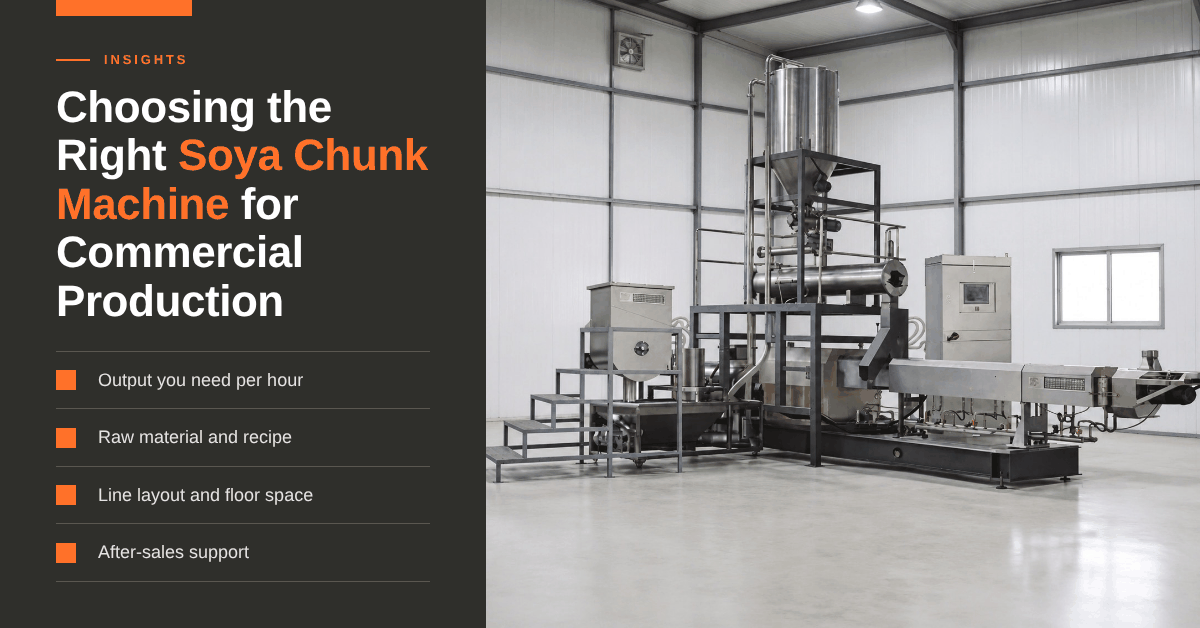
The machine configuration affects how effectively manufacturers can control temperature, moisture, feeding, pressure, and other variables that influence product texture.
A soya chunk machine should be selected according to the desired product, production capacity, raw material, automation requirements, and available facility space.
When evaluating a machine, consider the following factors.
Processing Capacity
Determine the required hourly or daily output before choosing equipment. The selected capacity should match actual demand and account for expected production growth.
Extruder Configuration
Go through the extruder design, screw design, heating sections, and control. The supplier will be able to tell how the equipment fits your desired soy protein ingredients and products.
Moisture and Feeding Control
Consistent feeding and moisture conditioning are important for maintaining stable extrusion conditions. Check how these functions are managed and monitored.
Temperature and Speed Controls
It is essential for the machine to provide the ability for the operators to control processing parameters that are within the working limits of the equipment.
Die and Product Options
If the business plans to manufacture different shapes or sizes, confirm whether suitable dies and cutting arrangements are available.
Drying and Auxiliary Equipment
The extruder is only one part of a commercial setup. Feeding, conditioning, cutting, drying, cooling, and packaging equipment may also be needed depending on the intended production line.
A suitable TVP machine configuration should be assessed as a complete processing system rather than on the extruder alone.
Soya Nugget Making Machine Price and Soya Chunk Plant Cost
The capital investment required for a commercial soya chunks production plant depends on many factors. There is not one particular cost applicable for each machine setup.
The soya nugget machine price may vary according to capacity, extruder design, automation, control systems, construction materials, and the accessories included in the supply.
The overall soya chunk plant cost can also include equipment beyond the extruder, such as raw material handling, feeding systems, moisture conditioning, cutting equipment, dryers, conveyors, cooling systems, packaging machinery, installation, and commissioning.
Before comparing quotations, manufacturers should clarify:
- Required Production Capacity
- Type of soy chunks/TVP
- Specifications of raw materials
- Auxiliary equipment used
- Power & utility consumption
- Scope of installation & commissioning
- Operator training/technical assistance
- Availability of spare parts & maintenance requirements
When comparing a soya nugget machine manufacturer, businesses should evaluate the proposed configuration, operating requirements, and after-sales support instead of comparing only the initial purchase price.
If you plan to buy soya machine India, share your target output, intended product, available space, and automation needs with the supplier. These details help determine a more suitable equipment configuration.
The phrases soya chunk texture price, soya chunk texture manufacturer, and buy soya chunk texture may also appear in online searches, but texture itself is a product-quality characteristic rather than a standard machine category. Buyers looking for machinery should clarify whether they need a soya chunk extruder, a complete TVP production line, or equipment for a specific processing stage.
Applications of Textured Soy Protein
Textured soy protein is used in a variety of food products because it can provide a structured, protein-rich ingredient suitable for different recipes.
Depending on the product specifications, soya chunks and other TVP formats may be used in:
- Curries & Gravies
- Ready to Cook Meals
- Institutional Food Preparation
- Convenience Foods
- Meat Alternatives
- Food Service Applications & Bulk Ingredients
Various applications would demand various degrees of hardness, porosity, size, and moisture absorbency. Therefore, the manufacturers need to decide the desired product before completing the process of extrusion.
A textured soy protein machine should be selected according to the desired TVP format, raw material, output requirement, and the characteristics needed in the finished food application.
Conclusion
Consistent soya chunk texture is dependent upon the cumulative influence of moisture, temperature, screw speed, feed rate, die design, raw materials used, and drying. The slightest alteration in these factors can have an influence on the texture of the soya chunks.
For industrial manufacturers, the recommended procedure would be to set up controlled base conditions and then test any changes in a systematic manner, before testing out the dried food under standard cooking conditions.
Selecting the right soya nugget making machine, soya chunk machine, or complete TVP machine setup is equally important. Equipment should match the required product, capacity, automation level, and process-control needs.
Through the proper combination of machinery and consistent raw material, coupled with effective monitoring of the process, the manufacture of soya chunks will become easier and less prone to errors.
Frequently Asked Questions
1. What affects soya chunk texture during extrusion?
The main factors include moisture content, temperature, screw speed, feed rate, die design, raw material composition, and drying conditions. These variables interact, so texture should be evaluated across the complete production process.
2. Why do soya chunks become hard after drying?
Excessive drying, moisture imbalance, unsuitable extrusion conditions, or differences in raw material can contribute to excessive hardness. Manufacturers should check the final moisture level and compare standardised rehydration results before changing extrusion settings.
3. How does moisture affect soya nugget quality?
Moisture plays a role in the movement of material, the transfer of mechanical energy, expansion, density, and structure. The correct amount will depend on the extruder and formulation used.
4. Can extrusion settings improve water absorption?
The structural and porosity aspects of soya chunks depend on the extrusion conditions. Nevertheless, there are other factors that affect water absorption in the soya chunks, such as the ingredients used, drying process, and product structure. Standardized testing should be carried out.
5. What is the difference between a soya extruder and a complete TVP production line?
The soya extruder does the job of extruding, cooking, and forming. The total TVP manufacturing process line may consist of other machinery such as for handling of raw material, feeding, conditioning, cutting, drying, cooling, and packing.
“`html
“`