
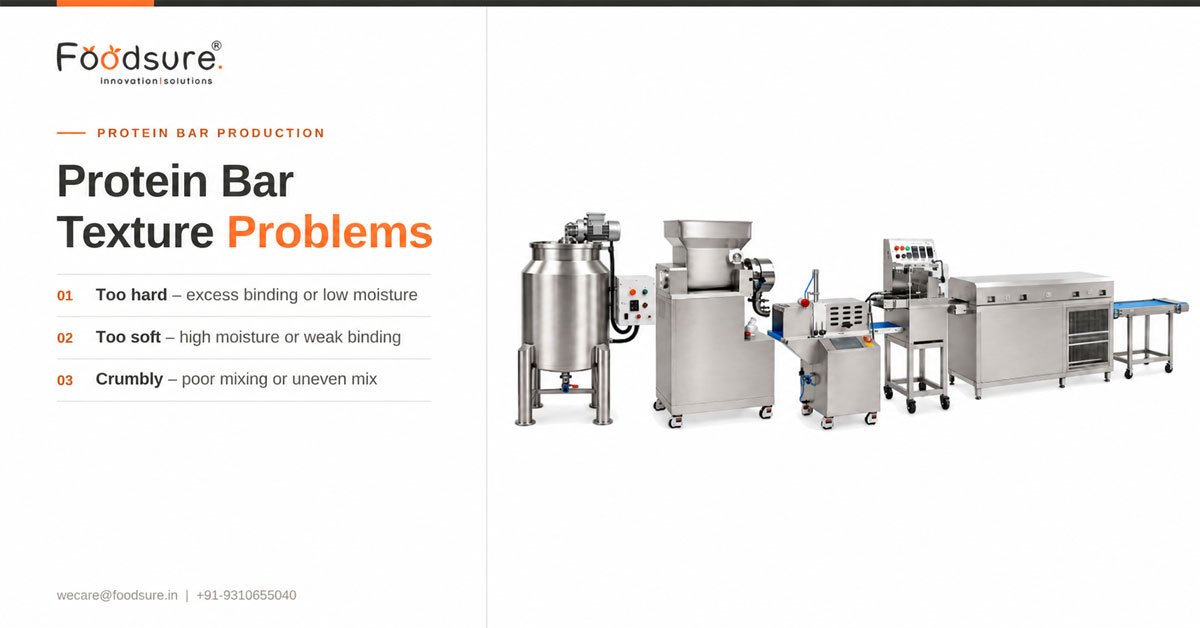
Your protein bar has an awesome taste and feel the very first day. But six weeks down the line, customers will be returning your rock solid bars or crumbling bars when they try to remove them from their wrapper. In India, protein bar texture issues are the number one reason why bar brands fail to retain their customers.
The good news is that there are specific reasons why such problems arise. They may lie in the formula, in the processing, in the machinery, and even in the packing. This article will discuss all of them so that you can identify what’s wrong with your bars before you invest in any equipment.
What Are Protein Bar Texture Problems?
Problems with protein bars are alterations in the sensory and mechanical properties of a bar, particularly toughening during shelf-life, crumbling when handled, or sticky and dry state at consumption time. They typically result from protein-carbohydrate interactions, water migration, wrong formulation of the binder, or incorrect processing parameters like mixing, pressing, and cooling.
The texture is dynamic. A product, which is soft on the day of manufacture, may turn hard by the time it reaches a store in a tropical city. Therefore, you have to evaluate the texture both at day zero and during shelf-life.
Why Do Protein Bars Turn Hard Over Time?
Protein bars turn hard mainly because proteins and sugars keep reacting after production, while moisture moves out of the binder into the dry ingredients or out through the packaging. Higher protein loads, lower fat, and warm storage speed it up.
Here are the usual suspects:
- Aggregation and crosslinking of proteins: milk and whey proteins slowly link to one another and to the binder; the bar becomes more rigid. Milk protein concentrate tends to do this.
- Maillard reaction: reducing sugar reacts with proteins and increases with rising temperature.
- Moisture transfer: water travels from the soft binder into the dry materials such as protein crisps and oats, making the binder stiff.
- Sugar crystallization: a stiff binder, rich in crystallizing sugars, crystallizes and develops a brittle structure.
- Insufficient fat or humectant: in the absence of glycerol, some polyols, and fats, the bar becomes less elastic.
- Heating in transportation and storage: a warehouse maintained at 40°C will age the bar within weeks.
Why Do Protein Bars Turn Crumbly?
Protein bars become crumbly because of inadequate binding material or inadequate wetting of the particles by the binder material. This problem is further aggravated due to inadequate compression and incorrect temperature at which cutting is done
- Insufficient proportion of the binder relative to the dry mix, especially for high protein powders which absorb large amounts of water.
- The binder is too cool or too viscous in its composition.
- Uneven particle sizes: fine powder with large inclusions.
- Low compression in the forming process.
- Bars are cut at a temperature when they are too brittle.
- Too much fiber and/or protein crisps make bars absorb moisture and dry internally.
Protein Bar Texture Problems: Causes and Fixes at a Glance
| Symptom | Likely cause | First fix to try |
|---|---|---|
| Hard after 3 to 6 weeks | Protein cross-linking, low humectant, warm storage | Switch part of the whey to a hydrolysate or add humectant; check storage temperature |
| Hard immediately | Over-compression, too little binder moisture | Reduce forming pressure; raise binder ratio slightly |
| Crumbly at cutting | Low binder, cold slab, dull cutter | Increase binder; cut at a warmer, steadier temperature; service the blade |
| Crumbly after packing | Under-compression, weak binder set | Increase density at forming; allow proper cooling before wrapping |
| Dry and chalky | High protein load, moisture lost through packaging | Add fat or humectant; upgrade barrier film and seals |
| Sticky, soft, loses shape | Excess syrup, high water activity | Cut binder syrup; dry or cool more; check water activity |
How Formulation Controls Bar Texture
Choose the Protein Source Carefully
The whey protein concentrate, whey protein isolate, milk protein, soy, and pea protein all have vastly different properties when used in a bar. The taste is better with whey and milk proteins, but they are also the hardest ingredients to avoid forming into a hard bar.
Formulators typically blend the protein sources or utilize partially hydrolysed whey to combat this. Protein bars that contain 20 grams of protein or more in a 50-60 gram bar are the hardest to formulate.
Build the Binder System Deliberately
The binding agent binds all elements together and retains the major share of water content. The list includes such materials as glucose syrup, brown rice syrup, date paste, honey, jaggery syrup, as well as low-calorie syrups such as maltitol and IMO.
Use syrups with various properties of crystallization – when one of them remains liquid, and another one creates structure. Check out the binder under the real temperature of the production line.
Use Fat and Humectants to Keep the Bar Soft
Butter made from nuts, cocoa butter, and stable vegetable fats provide lubrication to the matrix. Glycerol and some polyols keep water in the bar; thus, they delay the setting process. They are expensive, and they impact water activity.
Manage Water Activity
Water activity is used to measure the amount of free water, which is a more reliable indicator for both the texture and safety from bacteria than moisture content. The majority of shelf stable chewy bars range from 0.50-0.65. Too high aw means mold growth and tackiness; too low aw means dry and hard texture.
Make sure you test water activity for every new batch that you try.
How Machines and Process Settings Affect Texture
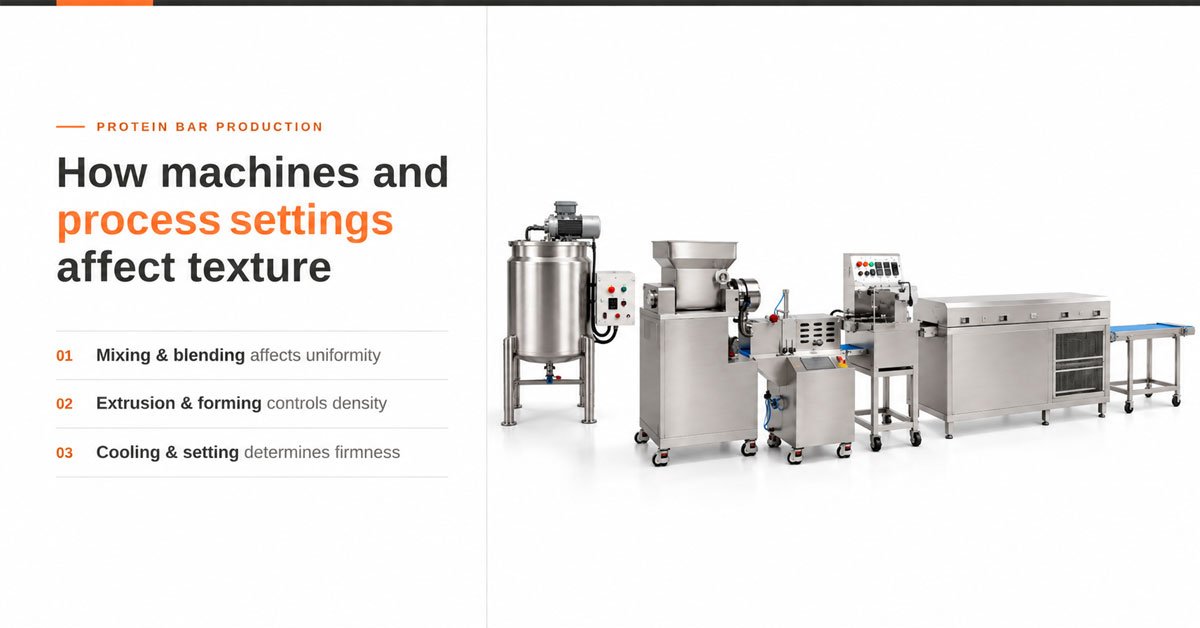
A recipe that works in the laboratory may not work in the factory setting due to different methods of heating, shearing, and applying pressure. A machine setup for manufacturing protein bars should have the ability to achieve uniform mixing, temperature control, density, and slicing. Deficiencies in any of these aspects will translate into poor-quality bars.
Mixing: Getting the Binder to Wet Everything
There must be sufficient shearing power for coating all the particles without making the mixture so hot or so agitated that inclusions break up. The temperature of the binder will play an important role here since if it is not warm enough, it will not coat the dry mixture; if it is too hot, it might denature proteins or melt chocolate chunks.
Time of mixing is another variable. Inadequate mixing results in crumbling dough while excessive mixing turns the dough into gummy and then hard one.
Forming: Sheeting, Extruding, or Moulding
Forming sets the density of the bar, and density sets much of the texture. A bar forming machine that compresses unevenly gives you soft centres and crumbly edges in the same batch.
| Method | How it works | Best for | Watch out for |
|---|---|---|---|
| Sheeting and slab cutting | Mass is rolled into a slab, then cut into bars | Granola-style and chewy bars | Uneven roller pressure; cold, brittle slabs |
| Cold extrusion | Mass is pushed through a die and cut to length | Dense, uniform protein bars, filled or coated bars | Mass too stiff for the die; barrel heating |
| Moulding | Mass is pressed into trays or moulds | Small batches, shaped bars | Slow output, sticking |
A protein bar extruder suits dense, high-protein masses because it gives tight control over density and shape. Sheeting lines handle lighter, inclusion-heavy bars better. Many plants end up using both.
Cooling and Cutting: Where Many Bars Crack
The bars take some time to harden before cutting, but not so much as to make them brittle. A cooling tunnel with a set air temperature will work consistently well. If you cut the slab while it is too hot, it spreads; if it is too cold, it shatters on the edges.
The sharpness of the blade and cutting speed are far more important than most think.
Packaging: Texture Insurance
The best bar will become tough even if there is a loss of moisture from the wrapper. A protein bar packaging machine, which is normally a flow wrapper, requires consistent seals and appropriate barrier films, which include the metallised laminate.
It is important to ensure that there are no pinholes, poor end seals, and the wrong type of film that does not suit your shelf-life objective.
The Protein Bar Production Line: What a Complete Setup Includes
A protein bar production line moves the mass through six stages: ingredient handling, mixing, forming, cooling and coating, cutting, and packaging. Each stage influences texture, so they need to be matched in capacity and temperature.
| Stage | Equipment | Texture role |
|---|---|---|
| Ingredient handling | Powder sieve, syrup heating tank, weighing | Accurate ratios and lump-free blends |
| Mixing | Sigma or planetary mixer | Even binder coating |
| Forming | Bar forming machine or protein bar extruder | Controls bar density |
| Cooling and coating | Cooling tunnel, enrober | Sets structure and seals the surface |
| Cutting | Guillotine or ultrasonic cutter | Clean edges, no crumbling |
| Packaging | Flow wrapper, metal detector, cartoning | Protects moisture and shelf life |
Protein Bar Plant Setup: Conditions That Protect Texture
The best layout of a protein bar plant takes care of climate (temperature and humidity) and hygiene, which directly affect bar texture. Dry and cool process area makes the mixture workable and prevents any syrup from absorbing humidity.
- Climate control: The humidity from the Indian monsoon season and summer heat in India affect the forming and cooling process adversely, hence, air conditioning should be taken into account during early stages of the facility development.
- Low-moisture hygiene: dry cleaning and strict pest control, as the presence of moisture in a bar plant increases microorganism contamination risks.
- Storage of raw material: storage of protein powder and crisps in a cool environment and sealed containers, as they are easily absorbing moisture.
- Quality control lab corner: water activity meter and texture analysis equipment will prove their cost efficiency very soon.
- Facility layout: one-way flow from raw materials to the final product, with a nearby location of cooling area relative to forming.
Depending on capacity and automation level, costs will vary. Make sure to get written quotations from at least two manufacturers for the same capacity of machines.
How to Diagnose Texture Problems Step by Step
Work through these steps in order, and change only one variable at a time:
- Determine water activity and moisture content of freshly made bars and of aged bars.
- Perform a hardness test at days 0, 30, and 90, along with keeping a sample of bars in warm storage conditions to accelerate the aging.
- Verify the manufacturing process: binder temperature, mixing time, forming pressure, cooling time, and cutting temperature.
- Verify packaging: seal quality and performance of the film barrier.
- Adjust the formula only after: protein source, binder-to-protein ratio, humectant, and fat content.
- Repeat the full shelf-life test for each change.
Accelerated shelf-life test for one to two weeks at 35 to 40°C provides a preliminary indication, though not always a good predictor of the actual shelf life.
When to Fix the Recipe and When to Fix the Equipment
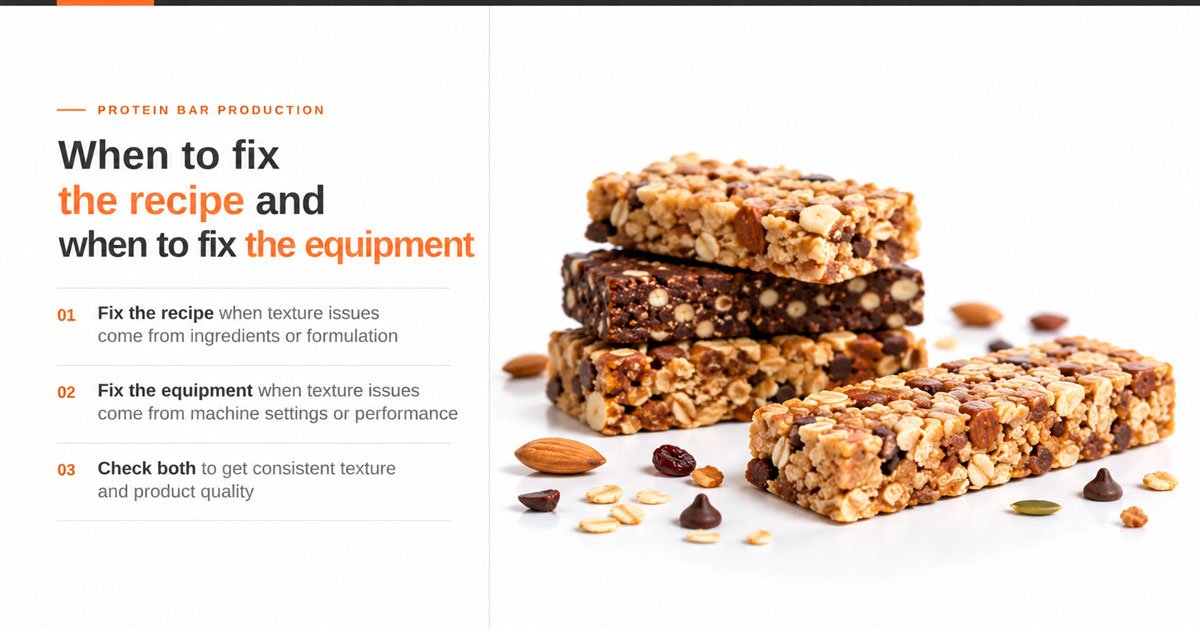
Change the formula if your bars take weeks to harden despite uniform packaging and process control. This suggests problems with protein, binding, or water activity.
Change the equipment if there is inconsistency between batches or even within a single batch. Uneven density, variable slicing, or poor sealing are machine issues, and no change in formula will fix them.
Common Mistakes That Cause Texture Problems
- Judging texture solely by the first day’s results.
- Messing with too many factors at once, so you don’t know what did it.
- Increasing the protein level without re-calculating the binder and humectant levels.
- Neglecting water activity and focusing on moisture instead.
- Going for a forming machine based solely on cost, only to run into density problems.
- Under-specified packaging film and poor heat sealing.
- Lacking an actual test under Indian storage and transportation conditions.
If you need some equipment planned, contact Foodsure Machines – we’ll match the forming and packaging system to your formula and volume requirements.
Key Takeaways
- Hardening results primarily from protein cross-linking, Maillard reaction, moisture migration, and storage at higher temperatures.
- Crumbling results from insufficient binder, poor wetting, compression, or incorrect temperature for cutting.
- The most reliable predictor of texture and safety in the earliest stages of shelf life is water activity.
- The method of formation and density determine the texture, thus choose a matching bar forming machine or extruder to your mass.
- Test during the entire shelf life, since even if the product is soft during the first day, it may be defective after six weeks.
Conclusion: Solving Protein Bar Texture Problems for Good
The issues with the texture of protein bars do not have a single cause, hence why the solutions that promise fast results do not work. Follow the formula, process, equipment, and packaging step-by-step, and conduct tests throughout the shelf-life period.
By doing this, your bars will remain soft, cohesive, and consumers will be loyal to them.
FAQs
Why do protein bars become harder with time?
They react and lose moisture from their binder. High temperatures in storage and increased protein content accelerate the process.
How does a protein bar making machine influence the texture?
It regulates mixing, temperature, and density so that the texture of all the bars will be consistent.
What does a protein bar manufacturing line consist of?
Handling ingredients, mixing, forming, cooling, cutting, and packaging. The capacity of all the steps is to be coordinated in order to have consistent texture during all the stages.
Is protein bar extrusion better than sheeting?
Yes, in most cases, especially when producing dense high protein content products. Sheeting is used for lighter and inclusion-rich bars.
Can a protein bar forming machine correct the crumbly texture?
In part. Proper compression can help, but maybe the product requires a larger amount of binder or a more stable cutting temperature.
Does a protein bar packaging machine influence hardness?
Yes. If the sealing is weak or barrier film isn’t good enough, moisture will evaporate making the bars harder than according to the recipe.




