
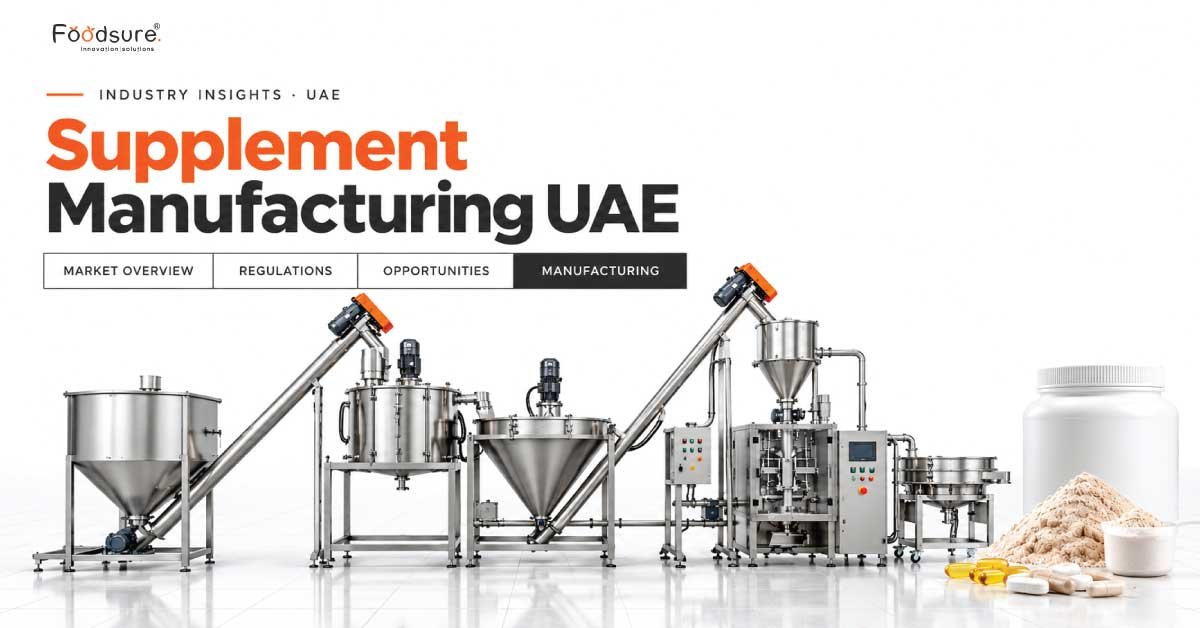
Increasing popularity of fitness, sports nutrition, wellness, and functional nutrition amongst the GCC consumers provides various supplement brands with a great chance to develop new business possibilities. The growing demand for protein powders, nutritional formulas, sports supplementation, and wellness items provides more possibilities for companies to explore this promising market niche.
Entrepreneurs who are interested in supplement manufacturing UAE will have to consider not only starting their own brand but also creating a proper production facility that will enable them to control the process of producing, quality of items, packaging, and further growth. Those who aim at supplement manufacturing Saudi Arabia will find this approach suitable too.
This guide will assist in describing how companies may look at manufacturing supplements and protein brands in the UAE and Saudi Arabia through product planning, regulations, machinery, manufacturing, packaging, and scaling up.
Why Supplement Manufacturing UAE Is Creating New Business Opportunities
The UAE’s growing fitness and wellness sector is creating more opportunities for supplement brands through gyms, retailers, pharmacies, and e-commerce platforms. Instead of competing directly with large international brands, new businesses can target specific consumer needs with focused product ranges.
A new manufacturer may explore categories such as:
- Sports nutrition drinks
- Functional nutritional drink mixes
- Vitamin or mineral-fortified products
- Protein shakes
- Specialised wellness items
- Private label supplements
This makes supplement manufacturing UAE relevant to both established businesses looking to expand their product portfolio and new entrepreneurs entering the nutrition sector.
Understanding the UAE and Saudi Arabian Opportunity
The UAE and Saudi Arabia both offer opportunities for supplement brands, but each market has different business and regulatory considerations. Businesses planning supplement manufacturing Saudi Arabia should evaluate their target market before finalising their production strategy.
Some important considerations include:
| Consideration | Why It Matters |
| Target consumers | Determines product positioning and product range |
| Product category | Influences processing and compliance requirements |
| Manufacturing location | Affects production and distribution planning |
| Packaging format | Determines filling and packaging machinery |
| Market expansion | Helps determine required production capacity |
Start With the Product, Not the Machinery
One of the biggest mistakes new supplement businesses can make is purchasing machinery before clearly defining the product.
Before selecting equipment for supplement manufacturing UAE, manufacturers should establish:
- Product Range: Establish the types of supplements and proteins that will be produced.
- Ingredients: Establish the ingredients and how they will be processed.
- Batch size: Determine the batch capacity.
- Production quantity per day: Determine the expected output.
- Packaging method: Establish the type of packaging – whether it will be in jars, packets, sachets, or others.
- Automation: Determine the level of automation/manual work.
- Future products: Plan for future products.
Choosing the Right Supplement Product Range
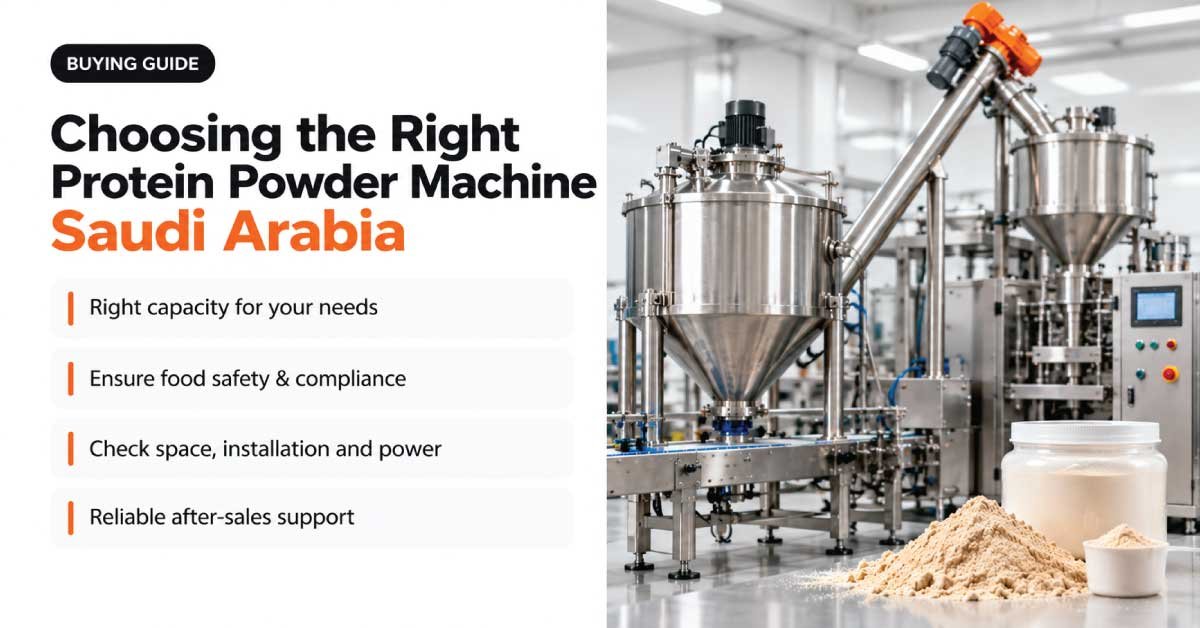
There is no obligation for a new supplement brand to start by launching an extensive line of products. Rather, it would be easier for planning production, managing inventories, maintaining quality standards, and establishing brand positioning.
As an illustration, a producer can start its operations with just a few protein products and add more flavors to the list in the future or expand into other nutritional products altogether.
Such considerations will also affect equipment specifications. In case a company intends to produce a couple of powder products, its blending and material handling systems must take into consideration the nature of such products.
For businesses entering supplement manufacturing Saudi Arabia, understanding the intended product portfolio is equally important because production requirements should be planned around the actual products rather than an assumed market size.
Understanding Ingredients and Halal Requirements
Ingredient selection is another important part of setting up a supplement manufacturing business in the GCC.
Businesses targeting Muslim consumers should consider Halal certification for protein during the product-development stage itself.
It requires reviewing:
- Protein sources
- Other ingredients
- Documentation from supplier
- Requirements of ingredients
- Processing aids
- Storage conditions
- Sanitation process
- Halal certification requirement for the above
A product is not automatically Halal based only on its main protein source. Ingredients, processing, and production practices should all meet applicable requirements, especially for businesses targeting supplement manufacturing UAE and wider GCC markets.
Planning the Supplement Manufacturing Process
Once the product and raw materials are determined, the next task would be to determine how the product will pass through the factory.
The process of manufacture for a standard dry powder supplement might look like this:
Receiving → Inspection → Weighing → Sieving → Mixing → Holding → Filling → Sealing → Labeling → Secondary Packing
The process of manufacture may vary depending on the particular product. It might be longer or shorter depending on the particular product or its particularities.
What is crucial is that the entire process of manufacture should be decided upon prior to machinery acquisition.
This is especially true in the case of supplement manufacturing Saudi Arabia.
Raw Material Handling and Preparation
Handling of raw materials is the first step towards the production of supplements. The raw materials have to be handled and prepared before entering into the production process. Proper handling of materials enables manufacturers to have better control of the contents of each batch that goes into production.
The preparation process may involve:
- Weighing of ingredients
- Dosage
- Sifting
- De-lumping
- Transfer of powder
It is critical to note that proper weighing of raw materials becomes crucial where several raw materials are mixed into one batch. Proper handling of raw materials will thus be key in ensuring production efficiency and quality.
Powder Blending: The Core of Supplement Production
Blending ensures uniform distribution of protein and other ingredients. The blender should be selected according to powder characteristics and batch size.
Proper mixing machines for powder blending could contribute to the following:
- Uniform mixing of ingredients
- Consistency of batches
- Decrease in manual handling
- Reproducibility in the production process
- Better control of large-scale commercial processing
In the case of supplement manufacturing UAE, mixing machines must be considered along with the whole production line system.
Why Powder Characteristics Matter
Not every powder behaves in the same way. Some materials flow easily, while others can be cohesive, dusty, or prone to forming lumps. This can affect how the material is transferred, mixed, stored, and filled.
Before deciding on the type of machinery, manufacturers should be aware of parameters such as:
- Size of particles
- Bulk density
- Flowability
- Moisture sensitivity
- Cohesiveness of powders
- Time required to blend powders
This is necessary to ascertain if that particular configuration of machinery will be appropriate.
Machinery Required for Supplement Manufacturing
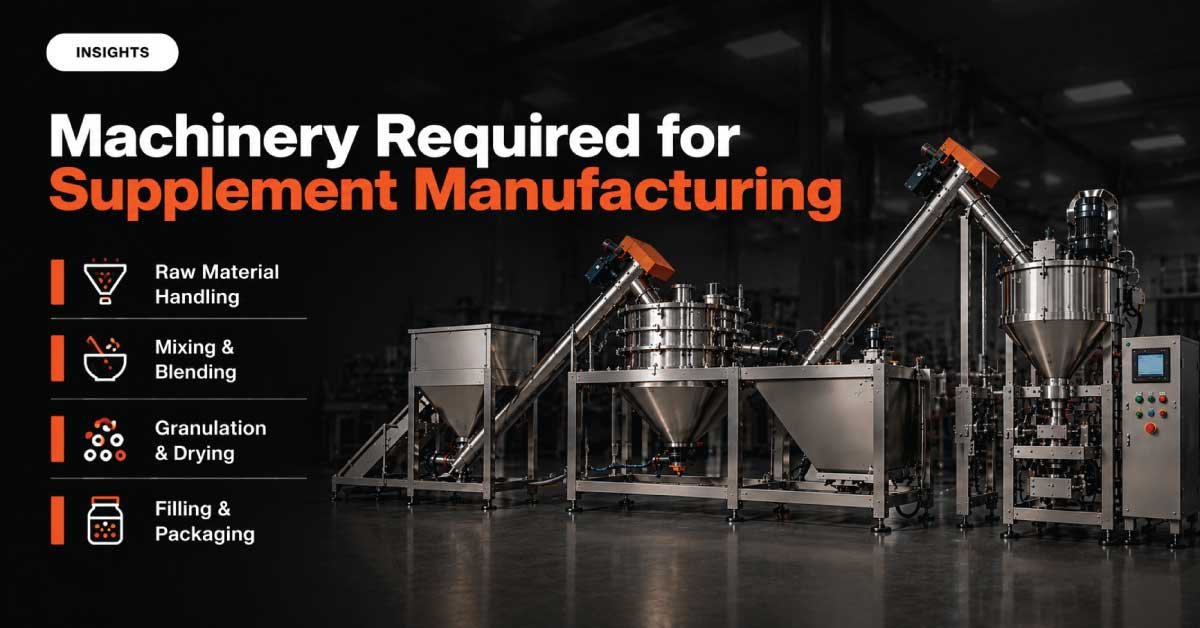
A commercial supplement production line can include several interconnected machines. The exact configuration depends on the product, capacity, formulation, packaging, and automation level.
Weighing and Dosing System
The weighing system measures the required quantity of each ingredient before blending. Accurate dosing is important for maintaining consistency between production batches.
Vibro Sifter
A sifter can help remove lumps and unwanted particles from powders before they enter the blending stage. This can support better material preparation and smoother downstream processing.
Powder Blender
The blender combines different powdered ingredients into a uniform mixture. Its capacity and configuration should be selected according to the batch size and powder characteristics.
Powder Transfer System
A controlled transfer system can move powders between processing stages while reducing unnecessary manual handling. This can help create a more organised production flow.
Storage Hopper
A holding or storage hopper can provide an intermediate stage between blending and packaging. It helps maintain a steady supply of finished powder for the filling system.
Filling Machine
The filling machine transfers the required quantity of finished powder into the selected container. The equipment should match the desired pack size and production speed.
Sealing and Packaging Equipment
After filling, containers or pouches need to be properly sealed and prepared for labelling and secondary packaging. The equipment depends on the selected packaging format.
For businesses planning supplement manufacturing UAE, these machines should ideally be considered as one integrated system.
Selecting Equipment for Future Growth
Machinery should meet the current production requirement, but manufacturers should also think about future capacity. A new supplement brand may initially have limited demand. As distribution expands, production requirements can increase significantly.
A scalable system would help with:
- Batching increase
- Product addition
- Flavor addition
- Packaging volume increase
- Automation
- Expansion of production capability
For companies that plan on supplement production in Saudi Arabia, this kind of planning will prove helpful, especially if they intend to cater to more than one region.
Automation in Supplement Manufacturing
Automation will become more and more beneficial as production volumes increase. Rather than manually moving from one stage to another, manufacturers can use the equipment to create a production process.
Automation will help with:
- Ingredient dispensing
- Powder transferring
- Mixing
- Filling
- Packing
- Production monitoring
Automation should match production volume, workforce, and product complexity, providing efficiency without unnecessary system complexity.
Packaging Strategy for a Supplement Brand
Packaging should be considered alongside the manufacturing process because the chosen format directly affects the filling and packaging equipment.
Nutrition and protein powders could be packed in:
- Jars: Can cater to larger volumes and are mostly used in protein powders.
- Pouches: Provide flexibility in packaging options and can cater to various sizes of packs.
- Sachets: Can cater to single or small servings.
- Other special packaging types: Based on product and brand.
The packing process must offer appropriate filling capacity, sealing, labeling, and protection for the product. Companies wishing to manufacture supplements in Saudi Arabia should also have a look at packaging regulations in the target market prior to finalising packaging lines.
Quality and Hygiene in Supplement Manufacturing
Quality should be controlled across the complete manufacturing process rather than checked only after the finished product has been packaged. This is especially important for businesses involved in supplement manufacturing UAE, where consistent production practices are essential for building consumer confidence and maintaining product quality.
Proper controls should be put in place by manufacturers on:
- Raw materials: the ingredients used should be correctly handled, identified, and stored before manufacturing.
- Equipment cleanliness: the surfaces that come into contact with the product during manufacture should be conducive to hygienic manufacturing and cleaning.
- Handling of the powder: material handling should minimize unnecessary exposure and direct handling.
- Blending: ingredients should be thoroughly blended to ensure homogeneity within the mixture.
- Packaging: filling and sealing should be controlled to safeguard the finished product.
All these become important considerations when manufacturers intend to achieve Halal certification of the protein.
Regulatory and Documentation Planning
GCC supplement production requires proper regulatory and documentation planning. Requirements may differ between UAE and Saudi Arabia, so manufacturers should verify the relevant rules before production.
Examples of documentation that may be important include:
- Specifications of ingredients and suppliers
- Formula and technical documentation
- Production and batch documentation
- Labelling details of the product
- QC records
- Traceability documentation
- Halal documentation where necessary
- Product registration documentation
Organising these documents will be beneficial as production and operations increase.
Halal Certification and Supplement Production
The Halal certification for protein for the GCC brands should be done as early as possible, and should involve consideration of the ingredients, suppliers, machinery, processes, clean-up, storage, and handling. Particular attention needs to be paid to difficult ingredients like flavors, emulsifiers, enzymes, and vitamins.
A suitable Halal production system should focus on:
- Approved and properly documented ingredients
- Controlled raw material handling
- Appropriate equipment cleaning
- Prevention of unwanted cross-contamination
- Clear production records
- Proper traceability
For businesses planning supplement manufacturing UAE, building these controls into the manufacturing system from the beginning can be more practical than trying to introduce them after production has already started.
Choosing the Right Protein Powder Machine Saudi Arabia
Businesses searching for a protein powder machine Saudi Arabia should first define the production requirements instead of selecting equipment based only on machine capacity.
Production Capacity
The equipment must correspond to the needed batch size and expected production per day. Selecting equipment that would not fit into the expected requirement will limit the growth potential, whereas choosing oversized equipment will result in an overly complicated installation.
Powder Properties
Different protein powders might have different properties like density, particle size, flowability, and moisture sensitivity. Such characteristics may affect the type of blenders, transfer equipment, and fillers used for such products.
Cleaning and Sanitation
It is essential to choose equipment allowing easy maintenance and cleaning, especially if the line produces several types of products. Access to the parts in contact with product might improve hygiene control.
Automation Level
It should be decided whether a manual, semi-automated, or automated process is necessary. It should depend on the volume of production, staff, consistency, and potential expansion in the future.
Packaging Type
The filling equipment should be matched with the packaging type being used by the company, i.e., jars, pouches, sachets, etc.
Building a Scalable Production Line
A supplement brand may start with a limited product range, but production requirements can change as the business gains customers and expands distribution. For this reason, businesses involved in supplement manufacturing UAE should consider scalability while planning the initial production line.
A scalable system will help in:
- Boosting production capabilities
- Launching new flavors
- Offering new protein items
- Including new packaging types
- Automation improvements
- Private label customers
- GCC markets
Expansion planning does not always mean that all of the high-capacity equipment is installed at once. Rather, the production system needs to be arranged such that further additions and upgrades will become easy in the future.
Expanding From UAE to Saudi Arabia
Supplement manufacturing UAE firms could ultimately think of expanding to Saudi Arabia and other GCC countries.
Expansion is not just about increasing production capabilities. The manufacturers need to consider the requirements of each new market for their products in terms of registration, labeling, certification, distribution, and import, wherever relevant.
Firms that have decided to undertake supplement manufacturing Saudi Arabia should therefore consider Saudi Arabia as a separate market and not simply replicate the UAE strategy.
However, a carefully planned manufacturing process could facilitate regional expansion through consistent production and adequate capacity.
Private-Label Supplement Manufacturing
Not every supplement business needs to build its own consumer brand. Private-label manufacturing can provide another opportunity for manufacturers with suitable production capabilities.
A facility can potentially manufacture products for:
- Fitness brands
- Gyms and wellness businesses
- Retailers
- Nutrition companies
- E-commerce brands
- Regional distributors
This can allow a manufacturer to use its production capacity across multiple customers and product lines. For businesses entering supplement manufacturing Saudi Arabia, private-label production can also provide a way to serve regional brands while developing their own manufacturing expertise.
Product Development and Manufacturing Flexibility
Consumer tastes may change rapidly in the nutrition and wellness industry. The initial strategy of a brand that is based on one particular protein product may at some point evolve and require a brand to offer different tastes, different proteins, various nutrition combinations, and functional products.
Flexibility can assist companies in dealing with such issues as:
- Various powder ingredients
- Various batches
- Different products
- Alternative packaging methods
- Varying production volumes
This is particularly valuable for businesses planning long-term supplement manufacturing UAE, where the objective is to build a manufacturing operation rather than produce only one product.
Common Mistakes When Starting a Supplement Brand
New manufacturers can face avoidable problems when product development, compliance, and machinery selection are handled separately.
Some common mistakes include:
- Buying machinery before defining the product: Equipment should be selected after understanding the formulation and production requirements.
- Ignoring powder behaviour: Different powders require different handling and blending considerations.
- Underestimating packaging capacity: A fast production line can still face delays if the filling and packaging section cannot match its output.
- Overlooking Halal requirements: Ingredient sources and supporting materials should be evaluated early.
- Ignoring future expansion: Equipment should be considered with future products and production volumes in mind.
- Focusing only on machine capacity: Hygiene, cleaning, maintenance, automation, and integration are equally important.
Avoiding these mistakes can help businesses create a more practical manufacturing strategy from the beginning.
Creating an Efficient Supplement Production Setup
For an effective supplement manufacturing facility, the components must act in synergy as opposed to being standalone machines. The material handling, blending, storage, filling, and packaging process must all be well coordinated for an efficient flow of production processes.
For supplement manufacturing UAE, manufacturers should consider the complete plant layout, including:
- Material handling: Raw materials should be able to be moved between storage areas and the processing areas efficiently.
- Machine coordination: The machines must coordinate with each other and not require manual transfer.
- Production process: This layout should have minimal backtracking and not create any bottlenecks during production.
- Cleaning: The equipment used should be easily accessible for cleaning and maintenance.
The right layout will help increase operational efficiency and make management of the plant easy.
Equipment for Powder-Based Supplement Production
The processing equipment needed will be determined by the products involved and the scale of production. In the case of protein production, the process line will comprise weighing equipment, sieving equipment, mixing equipment, transfer equipment, storage equipment, filling equipment, and packaging equipment.
A good protein powder machine Saudi Arabia has to be chosen based on the powder properties and the manufacturing needs and not by just adopting a generic solution for all products.
Manufacturers have to think about whether their goal is to manufacture protein powder only or to expand their portfolio to other nutrition and premix products.
Foodsure Machines for Supplement Manufacturing
The Foodsure Machines offers complete solutions for food and supplement manufacturing using powders. The equipment can be customized depending upon the nature of products, powders, production capacities, extent of automation, and packaging needs.
Businesses that are considering supplement manufacturing UAE or supplement manufacturing Saudi Arabia could opt for a complete line setup including weighing, screening, blending, transfer of powders, storage, filling, sealing, and packaging machines.
The Foodsure Machines can assist manufacturers in choosing appropriate equipment and designing the production line, installation and commissioning of equipment, and training of operators. Business organizations can choose an appropriate protein powder machine Saudi Arabia.
Frequently Asked Questions
1. How can I start supplement manufacturing UAE?
Start by defining product range, ingredients, market target, capacity, packaging format, regulations, and machinery required for full-scale manufacturing.
2. What kind of machinery is used in protein powder production?
The machinery in a powder supplements production line includes a weighing and dosing unit, a sifting unit, a blending unit, a transferring unit, a storage hopper, a filling unit, and a packaging unit.=
3. What to take into account when buying a protein powder machine Saudi Arabia?
It is necessary to take into account powder properties, batch size, capacity, blending, automation, hygiene, cleaning, filling format, and possibilities of expanding in the future.
4. Is Halal certification relevant for supplement brands?
For companies that plan to enter the Halal market, Halal certification of their protein and other supplement products may be important. Relevant requirements should be checked with the certification authority.
5. Can supplement manufacturers operate in both the UAE and Saudi Arabia?
Yes, businesses can expand into Saudi Arabia, but they should review the specific regulatory, product registration, labelling, certification, and distribution requirements applicable to the Saudi market.




