
Introduction
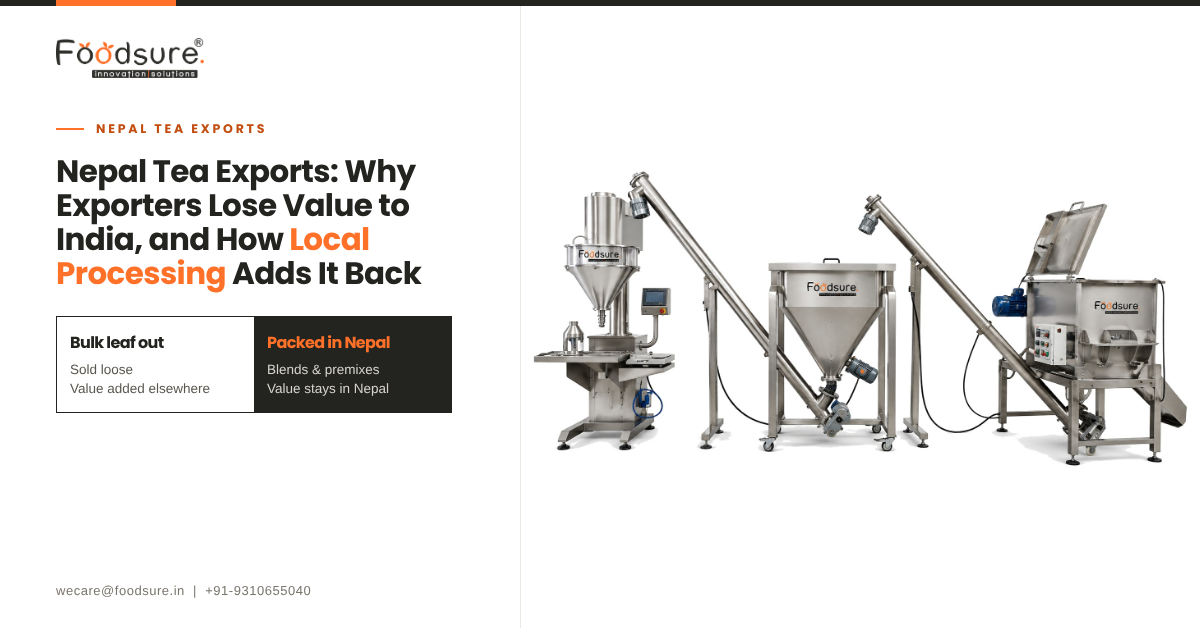
Ask any tea factory owner in Ilam or Jhapa about the problems faced in tea production in the country, and the answer will be more or less the same: Nepal produces some of the best orthodox tea in the world, and India makes all the profits off of it.
This is not an understatement but an actual process of trade. Tea exports from Nepal are mostly unprocessed or partly processed – they are simply produced, harvested, exported and sold by Indians at prices that make the profit of Nepal much lower than theirs.
This article is going to take an analytical look into exactly where the value is lost in the process, why it persists despite increasing restrictions on Indian imports of Nepali tea and what tea processing in Nepal might do to improve the situation without investing in a large factory.
Search intent note: this article is aimed at Nepali tea producers, tea factory owners and agriculture entrepreneurs who want to understand where the margin is lost in the business and how it can be fixed.
Nepal Tea Exports at a Glance
The tea industry in Nepal is not small at all, but it is organized in such a manner that most of the profits don’t benefit Nepal..
| Metric | Figure |
|---|---|
| Total tea production (CTC + orthodox) | Roughly 33.5 million kg a year |
| CTC tea production | About 27 million kg a year |
| Orthodox tea production | About 6.5–7 million kg a year |
| Share of orthodox tea sold to India | More than 90% |
| Share of CTC tea sold to India | Roughly 60% |
| Tea export earnings (FY 2025/26) | Around NPR 3.5–4.6 billion, depending on the reporting period |
| Tea-growing districts | 32, across roughly 21,000 hectares |
These numbers speak a coherent tale: Production is solid, although the export product mix is heavily reliant on a monopolistic neighbor to the east.
What Factors Cause Nepalese Tea to Lose Its Importance for Indians?
Why is Nepal losing value to India? Because Nepal exports its tea as an unbranded bulk product, while India is responsible for blending and branding it in order to create value.
These are concrete examples of how that works:
- Nepal Sells Leaves, India Sells Brand
The vast majority of Nepali CTC and orthodox tea is exported to India in bulk leaves form. Then the Indian tea houses blend it (with Darjeeling or Assam tea), package and sell as a finished branded product, earning a much higher price in return. It is a common practice in the tea trade in the region: Nepali orthodox tea has been historically bought by India as bulk product and re-branded without even mentioning that it is Nepali.
- India Sets the Terms of Access
Since India is the main buyer, it also sets the terms of access to the market. As early as in 2025, Tea Board of India has announced a Standard Operating Procedure, according to which all samples of tea consignments coming from Nepal had to be checked before entering the country, sometimes delaying it for weeks or even months. This has led to a situation when more than 50 orthodox tea factories in the eastern part of Nepal had to stop their operations in June 2025 due to inability to move stock to the other country quickly enough.
As a consequence, more than a million kilograms of tea have accumulated in the Nepali storages, not being sold there, while hundreds of thousands of kilograms are waiting to be checked in Kolkata.
- Nepal Has No Own Floor Price
If one buyer consumes 90% of your production, it means that this buyer determines the price of your tea. Nepali orthodox tea exports to India have gone down from almost 15,300 tons of tea worth of about NPR 4.17 billion in FY 2024/25 to about 13,000 tons of tea worth of NPR 3.53 billion – this is more than NPR 640 million lost due to price fluctuations and trade problems due to poor quality on the Indian side.
- Domestic Political Pressure in India as an Additional Threat
Duty-free access of Nepali tea exports to India, regulated by Nepal-India Trade Treaty, has been facing political pressure from the side of Darjeeling tea producers in West Bengal, who claim that the Darjeeling tea brand is diluted by cheaper Nepali tea imports under the same brand.
Raw Leaf vs. Processed Tea: Where the Money Actually Goes
A quick comparison makes the value gap obvious.
| Raw/Bulk Leaf Export | Locally Processed Tea (Branded, Instant, or Premix) | |
|---|---|---|
| Who captures blending margin | India | Nepal |
| Who captures packaging/retail margin | India | Nepal |
| Shelf life & logistics | Bulk, bagged, less durable | Sealed, longer shelf life, easier to ship far |
| Market reach | Almost entirely India | India, Middle East, Europe, US, domestic retail |
| Price exposure | Set by a single dominant buyer | Diversified across markets and product formats |
| Brand equity built | None — sold under Indian labels | Nepal-origin branding retained |
This is the core argument behind value-addition: the tea itself isn’t the problem. Nepal already produces internationally respected orthodox tea from Ilam, Panchthar, and Dhankuta. What’s missing is the processing step that turns raw leaf into a finished, brandable product.
What “Local Tea Processing” Actually Means
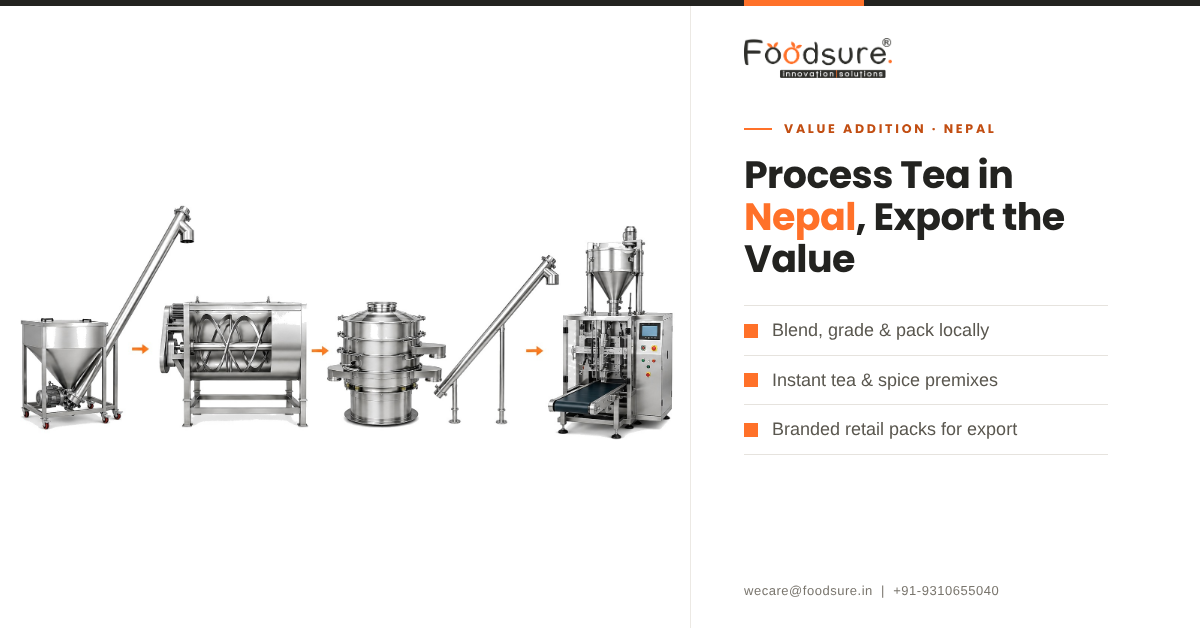
It does not mean immediately setting up a luxurious packing facility in the lines of Darjeeling right away. In practice, it is basically a number of steps that a Nepali manufacturer could take:
The grading and sorting according to export standards in order to avoid rejection when undergoing the Indian customs inspection.
In-house blending as opposed to exporting loose leaf tea to be blended by someone else further down the line.
Manufacturing instant tea by converting brewed tea into soluble powder/granules, allowing the product to become a ready-to-use mix with a much longer shelf life and better prospects for exports outside India.
Production of premixes – blending the tea with milk powder, sugar and various spices (e.g., ginger, cardamom, tulsi), putting the mixture into one sachet – this is where the retail margins are hidden.
Packaging for retail sale with a Nepal origin brand label.
This is where the equipment such as a tea premix machine comes in handy. Premixing line allows a mid-level Nepali company to combine tea along with milk solids, sugar, and other flavors into a stable form suitable for making tea sachets, which are the same type of products that Nepal imports and not manufacture. The combination with instant tea production in Nepal makes a company move on from selling raw materials to selling the end product.
Common Mistakes Nepali Tea Producers Make Right Now
Before jumping into equipment or new markets, it helps to know what’s currently holding producers back.
- Treating India as the sole viable market. While diversifying into Middle East, Europe, and US markets is increasing, it still remains relatively small compared to the amount exported to India.
- Lack of emphasis on consistency of quality. With the stricter testing regime of India, inconsistent batches are heavily penalized — the companies least affected by the shutdowns in 2025 were those who had consistent quality to begin with.
- Shipping green, not final products. Shipping bulk leaf without branding means leaving the most profitable part of the value chain to whoever does the processing.
- Thinking instant and premix tea manufacturing requires high capital investment. While instant and premix tea manufacturing does require an investment, entry-level manufacturing equipment is much less costly than people think.
- Not considering herbal and specialty blends. Nepal’s biodiversity provides great conditions for exporting tulsi, lemongrass, cardamom, and ginger infusions. These are very lucrative in export wellness markets.
When Local Processing Makes Sense (and When It Doesn’t)
It works when:
- There is an existing consistency with respect to leaf or grading.
- Loss of margin is happening because downstream buyers are branding and reselling the tea.
- There is a need to reach out to markets outside of India where instant and premix teas perform better than loose leaf.
It’s too early when:
- The leaf quality or grading itself is inconsistent since processing only exaggerates whatever quality issues there might be.
- There is no distribution strategy planned for the final product since manufacturing the premix tea without a buyer is not addressing any risk.
An approach that might work is gradual: improving the grading first, followed by the blending and premixes.
Key Takeaways
- Every year, Nepal exports about 33.5 million kilograms of tea, but more than 90 percent of the orthodox and 60 percent of the CTC tea is exported to India in crude or partially processed form.
- Most of the value addition takes place in India as they brand and reexport the tea back to us.
- As India implemented their mandatory test SOP for 2025, more than 50 tea factories in Nepal were closed, revealing how dangerous it is to be reliant on a single buyer.
- By processing tea locally, whether in premixed or instant tea, Nepalese can capture the margins from the blending and retailing that are being exported elsewhere.
- It is a practical approach that needs to be implemented step by step: first ensure the grade and quality, then go for premix and instant tea production..
Conclusion
The exports of Nepal do not have an issue with quality; the export process suffers from a value capture problem. The tea that grows in Ilam, Panchthar and Dhankuta has quality sufficient enough to get used in world’s best known tea blends. The problem lies in the fact that the value generated by this tea is being captured before the same reaches the borders of Nepal.
Processing of tea through such processes as grading, blending, making of instant tea, premix manufacturing etc. seems to be the realistic option at hand for Nepalese producers. It does not necessitate changing of the Indian relationship instantly. It only involves retaining more of the value created by the Nepalese tea.
FAQs
Why does Nepal lose money from its tea exports to India?
As a significant part of Nepal’s tea exports goes in raw form, Indian companies make profit in blending, branding and retailing stages.
What percentage of orthodox tea exported by Nepal ends up in India?
Over 90% of orthodox tea produced in Nepal is exported to India mainly as bulk, unbranded product.
How a tea premix machine helps Nepali tea producers?
With this equipment Nepali tea producers can blend their tea with milk, sugar and other spices making tea ready to pack in sachets.
What instant tea manufacturing in Nepal is used for?
Instant tea manufacturing allows Nepali tea producers to convert brewed tea into soluble powder giving Nepali producers an opportunity to export their tea directly.
Why mandatory per consignment testing in India hurt Nepal’s tea exports in 2025?
Indian mandatory per consignment testing slowed Nepal’s orthodox tea export significantly causing over 50 Nepali orthodox tea producers to cease operations.
Can Nepal export tea directly to the markets besides India?
Yes, but it will require much more processing and packing facilities than most of Nepali producers constructed yet.
Is it costly to enter into local tea processing in Nepal?
Actually entry-level instant tea and premix production is less costly than many first-time producers believe.




