
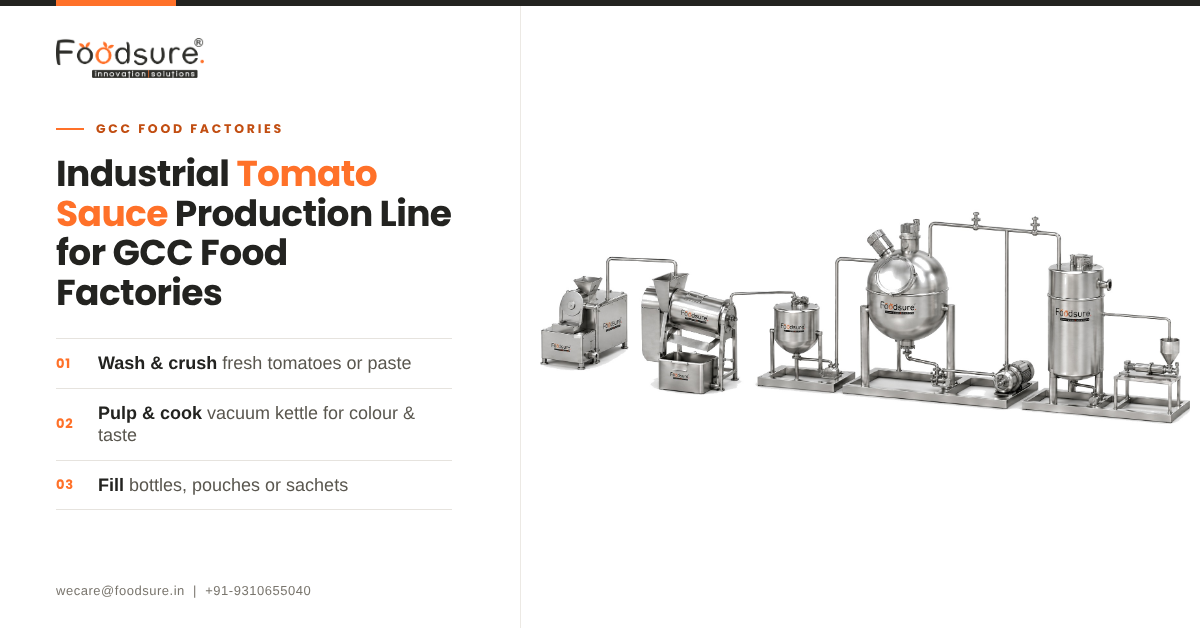
The installation of a tomato sauce processing production line is among the most important capital investments of any food processing company based in the Gulf region during this year. The design of the production line will either ensure a successful operation for a decade or result in bottlenecks, waste of raw material and non-scalable equipment.
This guide provides detailed information about what is required in order to build a contemporary tomato sauce production line, from the raw tomato intake to the bottles filling, sealing and labeling in a way that is especially relevant to factories that are working in Saudi Arabia, UAE, Oman, Qatar, Kuwait and Bahrain.
Whether you are starting a new tomato sauce processing plant or improving an existing one, the purpose of this guide is to provide sufficient amount of technical and commercial information to discuss these issues with your equipment supplier.
Who Is This Guide For?
This piece is directed at those who are truly considering purchasing:
- Owners and investors of food factories who want to consider installing a new production line for tomato sauce in GCC.
- Manufacturing plant managers who want to replace their existing semi-automatic lines with full-automatic ones.
- Procurement specialists who want to compare prices and other terms from Chinese, Italian, and Turkish machinery exporters.
- Entrepreneurs in the F&B industry who want to enter the market with their new products in such segments as ketchup, paste, and sauce.
If you belong to one of the above groups, then your search intent is definitely commercial in nature.
What Is an Industrial Tomato Sauce Production Line?
An industrial tomato sauce production line is an integrated assembly of machines that takes raw and semi-processed tomatoes and processes them into tomato sauce – cleaning, sorting, crushing, cooking, seasoning, packing, labeling, and filling in a single stream.
Unlike a kitchen production line, an industrial one is designed for consistency. At each step of the way, starting from cooking temperature regulation to fill weight in packaging, quality is controlled in such a way that the first bottle will be identical to the 100,000th one.
Almost all GCC companies use one of the two designs:
- Tomato fresh lines – processing of fresh tomatoes from the moment of their reception to the final product
- Tomato paste reconstitution lines – processing of imported tomato paste (reconstituting it into ketchup, sauce or salsa – because most countries of the GCC import tomato paste, not produce it)
Due to the majority of GCC tomato paste being imported from countries such as China, Iran, and Italy, reconstitution lines are more widespread than the fresh tomato ones.
Core Stages of a Tomato Sauce Production Line
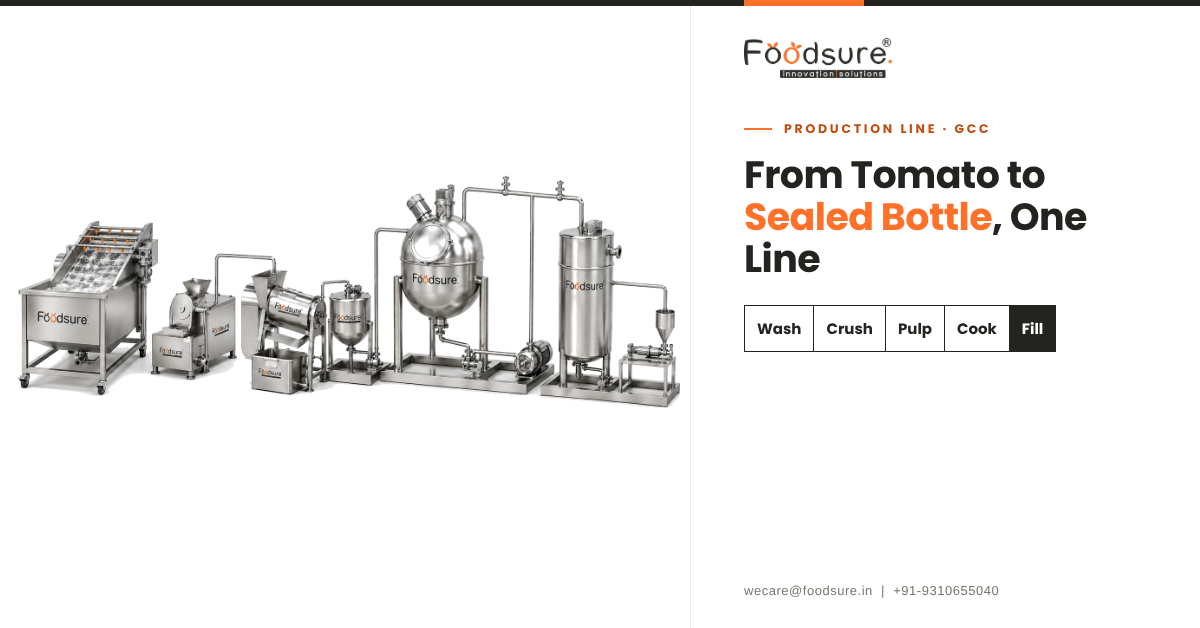
Here’s the sequence, stage by stage, along with what each machine actually does.
- Receipt and Cleaning of Raw Material
Raw tomatoes (or paste drums in reconstitution systems) enter the process and are washed in a bubble washer or a spray washing tunnel in order to clean the raw material from dirt, pesticide residue, etc.
- Selection and Sorting
There is an inspection conveyor to remove unripe and defective tomatoes. There are factories with optical sorters, using color and size detection technologies, which automate this stage and considerably decrease labor costs.
- Crushing and Pulping
Tomatoes are crushed and separated from skins and seeds with the help of a pulper/refiner. The final product’s consistency is defined here – more refined refiner screens result in smoother ketchup type sauces.
- Pre-heating and Enzyme Inactivation
The pulp is pre-heated (hot break or cold break technology) to stop the action of pectinase enzymes. This stage directly influences the final viscosity of the sauce, which is an important property for the ketchup.
- Concentration / Cooking in Kettle
Vacuum evaporator or double jacketed cooking kettle are used to concentrate the pulp with simultaneous mixing of ingredients (sugar, salt, vinegar, spices and preservatives where it is permitted).
- Homogenization
Homogenizer is used to reduce particles size even more thus providing a smooth and consistent consistency and no separation during storage in a container.
- Packing
Automatic dosing filler provides dosing of the sauce into bottles, pouches, cans etc. according to the volume or weight, capping, induction or heat sealing depending on the type of packing.
- Sterilization and Cooling
Packed containers go through the sterilization tunnel or retort system for shelf life extension, and then cooling tunnel for bringing the product back to ambient temperature before labeling.
- Labeling and Cartoning
Final stage consists of application of labels, date-coding the batch and cartoning with possible case packing and palletizing in case of big factories.
Production Capacity: What Should You Choose?
This is usually the first real decision point, and it depends entirely on your target market size.
| Capacity Range | Typical Buyer | Approx. Output | Best Suited For |
|---|---|---|---|
| 500 kg/hr – 1 ton/hr | Small/medium local brands | 8,000–15,000 bottles/day | Single-country GCC distribution |
| 1–3 tons/hr | Established regional brands | 15,000–40,000 bottles/day | UAE + Saudi + Oman multi-market supply |
| 3–5 tons/hr | Large manufacturers/exporters | 40,000–80,000+ bottles/day | Regional export hubs, private label contracts |
| 5+ tons/hr | Industrial-scale processors | 80,000+ bottles/day | GCC-wide distribution, retail chain supply |
A common mistake is buying beyond current demand “just in case.” It’s usually smarter to invest in a line with modular capacity — one that can be scaled up with additional cooking kettles or a second filling head — rather than over-investing upfront.
Why GCC Factories Have Specific Line Requirements
The configuration of the tomato sauce production line in the GCC does not exactly resemble the configuration in any other part of the world, such as Southeast Asia or Europe. There are several factors specific to the region that will influence the specification of the equipment:
- High temperature — the cooling equipment and evaporator capacity have to be designed based on the climatic conditions in the Gulf rather than default temperate zone conditions
- Halal certification — the processing equipment, especially equipment working with any kind of flavoring or preservation additives, has to be designed and documented with the required certifications
- Water quality and desalination processes — washing and cooking stages may require pretreatment of water because the composition of municipal water varies greatly between GCC countries
- Imported raw materials — because tomato paste is mostly imported, reconstituting tanks are a must, while fresh tomato intake is irrelevant
If your supplier offers you a quote on the tomato sauce processing plant without taking these into account, then you are getting an “off-the-shelf” line.
Semi-Automatic vs Fully Automatic Lines
| Factor | Semi-Automatic Line | Fully Automatic Line |
|---|---|---|
| Upfront cost | Lower | Higher |
| Labor requirement | Higher (more manual handling) | Lower (PLC-controlled) |
| Output consistency | Moderate | High |
| Best for | Startups, private-label testing | Established brands, export volumes |
| Typical GCC buyer | New F&B entrants | Mid-to-large processors |
If you’re testing a new product line or brand before committing to full-scale capacity, semi-automatic setups let you validate demand without locking in a large capital outlay. Once volume is proven, upgrading specific stages — filling, sealing, sterilization — is usually more efficient than rebuilding the whole line.
Common Mistakes GCC Buyers Make
- Given the usual course of events with such projects, there are some common errors:
- Undersizing of the cooking kettle compared to the line speed, resulting in bottlenecking during the most demanding phase
- Not having the halal compliance information included when choosing the equipment, thus resulting in delay in the certification process further down the road
- Choosing the packaging format after purchasing the line instead of before it – different filling heads are required for bottle, pouch, and sachet lines
- Neglecting after-sales and spare parts provision by the exporter, more important in the GCC due to delivery times
- Forgetting about utilities capacity needs – steam boilers, water treatment plant, and power upgrades are often overlooked
Choosing a Machinery Supplier
In choosing an exporter, particularly a manufacturer who supplies a tomato sauce machine in the Middle East region, go beyond just considering price per ton of capacity:
Experience in installing in the GCC – look for references for plants they have installed in the region
Language and time zone issues – technical support during installation is more important than what many buyers realize
Documentation – CE certification, stainless steel (SS304/SS316) specifications, and compliance with halal machine requirements
Availability of spare parts – verify if critical spares are available in the region or have to be imported
Commissioning training – it’s important that you get the right training for your operators
There are several experienced manufacturers that are presenting themselves as tomato ketchup machine exporters to the UAE and the region and should definitely be considered for that reason.
Estimated Investment Ranges
Actual pricing varies by capacity, automation level, and supplier origin, but as a general planning reference:
| Line Type | Approximate Investment Range (USD) |
|---|---|
| Small semi-automatic (500 kg–1 ton/hr) | $80,000 – $180,000 |
| Mid-size automatic (1–3 tons/hr) | $200,000 – $450,000 |
| Large-scale automatic (3–5+ tons/hr) | $500,000 – $1.2 million+ |
These figures typically cover core processing and filling equipment. Utilities infrastructure, factory shell, and civil work are usually separate line items in your capital budget.
Key Takeaways
- An industrial tomato sauce processing line involves washing, crushing, cooking, homogenization, filling, sterilization, and packaging into one integrated process flow
- Many GCC plants operate tomato paste reconstitution lines instead of fresh-tomato lines owing to regional reliance on imports
- Facility capacity needs to be in line with realistic sales projections, allowing for modular growth rather than overinvestment
- Equipment selection in the GCC context needs to consider halal requirements, water treatment, weather conditions, and energy cost considerations, besides the volume of output
- Supplier evaluation is just as important as equipment selection when it comes to spare parts and training
Conclusion
The good design of an industrial tomato sauce line depends on both the equipment and your ability to properly match the size and automation of the line with your market needs. Factories which consider their environment – halal compliance, weather, sourcing of raw materials – generally steer clear of the unnecessary expense of retrofitting when opting for the general global solution.
In the process of considering the different suppliers, you may want to consider getting a site-specific proposal rather than a standard catalog quotation because your utilities, packing, and desired capacity make all the difference.
FAQs
What would be the average capacity of the industrial tomato sauce line in the GCC?
In the majority of cases, the capacity starts from 1-3 tons/hr, reaching 5+ tons/hr in large export-oriented factories.
Is there any difference in designing a tomato sauce manufacturing line in the GCC from its European or Asian counterparts?
Indeed, the GCC line would need to consider halal certification requirements, increased ambient cooling capacity and reconstitution from imported paste, not fresh tomatoes.
How expensive is a tomato sauce line in the GCC?
Typical costs vary within the spectrum from $80,000 for a small semi-automatic line up to $1 million or more for a large fully automatic line.
What is the difference between the fresh-tomato line and a paste reconstitution line?
The first processes fresh tomatoes starting from the intake, while the latter works with the re-diluted imported tomato paste.
Where can I find a good tomato sauce machine for the Middle East market?
You should look for the exporters having references on installation of the line in the GCC, halal-compliant equipment design and local spare parts availability.
Who is the exporter of tomato ketchup machine trusted by UAE factories?
It should have a proven track record of successful installations in the UAE or at least in the GCC, CE certified equipment and locally based after-sales service teams.
Which mistakes should I better avoid while building the tomato sauce processing plant?
Three most typical errors are undersizing of the cooking kettle, missing halal certification at early stages and late decision on packaging format.




