Starting a soya badi manufacturing plant in Nepal can be an opportunity for entrepreneurs who want to enter the food processing industry. Soya badi, also known as soya chunks or textured soy protein, is a versatile food ingredient used in curries, noodles, fried dishes, and other everyday meals.
However, setting up a manufacturing plant requires more than purchasing a soya badi machine. You need to understand your target market, arrange suitable raw materials, choose the right production capacity, prepare a factory, obtain the required approvals, and build a distribution network.
For new entrepreneurs, the biggest challenge is often deciding where to start and how much to invest without spending money on equipment they do not yet need.
This guide explains how to start a soya badi manufacturing plant in Nepal, from market research and machinery selection to food safety, packaging, and cost planning.
Is Soya Badi Manufacturing a Good Business Opportunity in Nepal?
Before investing in machinery, assess whether you can build a profitable business around soya badi.
Soy-based foods are used in household cooking and commercial food preparation. Soya badi can appeal to customers looking for a convenient ingredient that absorbs the flavours of spices, sauces, and gravies.
Potential buyers for a Nepalese soya badi manufacturing business include:
- Grocery stores and neighbourhood retailers
- Wholesale food distributors
- Supermarkets and department stores
- Hotels, restaurants, and catering businesses
- Institutional kitchens and food-service suppliers
- Private-label food brands
These are potential customer groups, not proof of guaranteed demand. You should speak with buyers in your intended sales area to understand which products they already stock, their preferred pack sizes, and the prices they are willing to pay.
Nepal’s agricultural sector also provides relevant context for this business. The Ministry of Agriculture and Livestock Development publishes annual agricultural statistics covering crop production, including soybeans. You can consult its official agricultural statistics publications to understand domestic soybean production.
However, soybean production figures alone cannot tell you the size of Nepal’s soya badi market. Manufacturers must also consider the availability of suitable processing-grade ingredients, imports, competing brands, distribution costs, and consumer demand.
A practical starting point is to research your local market before selecting a machine. A small manufacturer supplying retailers in one city may need a very different production setup from a brand planning to distribute across Nepal.
Step 1: Research the Market Before Investing
Your first task is to identify who will buy your soya badi and how you will reach them.
Start by studying existing products in grocery stores, supermarkets, and wholesale markets. Compare their prices, pack sizes, appearance, ingredient information, and packaging quality.
Then speak to potential distributors and retailers. Ask how much product they purchase, how frequently they reorder, what pack sizes sell well, and whether they would consider stocking a new local brand.
Your research should answer four important questions.
Who will buy your product? Decide whether you will focus on households, wholesalers, restaurants, or a combination of these buyers.
Where will you sell it? You might begin in Kathmandu Valley, Pokhara, Biratnagar, Bharatpur, or another area where you can manage distribution effectively. These are possible target markets, not a ranking of demand.
What will make your product competitive? Price, consistent texture, reliable supply, suitable pack sizes, and clear labelling can all influence purchasing decisions.
How much can you realistically sell? Use feedback from potential buyers to estimate monthly demand instead of basing your investment on an ambitious sales forecast.
A useful approach is to secure initial buyer interest before committing to a large production line. This can help you choose a capacity that matches your expected orders.
Step 2: Understand the Raw Materials Required
Soya badi manufacturing depends on the raw material used in the extrusion process.
Commercial textured soy products are commonly made using defatted soy flour or other suitable soy-based ingredients. The exact formulation and processing requirements depend on the product you want to manufacture and the equipment configuration.
Before buying machinery, confirm the availability and cost of suitable ingredients in Nepal. Do not assume that locally grown whole soybeans can be fed directly into every soya badi machine. Some production processes require ingredients that have already undergone oil extraction and other preparation.
Check the following before finalising your supplier:
- Protein and moisture content
- Fat content and particle size
- Consistency between batches
- Availability throughout the year
- Transportation and storage costs
- Supplier documentation and quality specifications
Ask your machinery supplier to review your intended raw material and, where possible, conduct a trial before you place an order.
This step matters because unsuitable raw material can affect extrusion, expansion, texture, and the quality of the finished product.
Step 3: Select the Right Soya Badi Machine
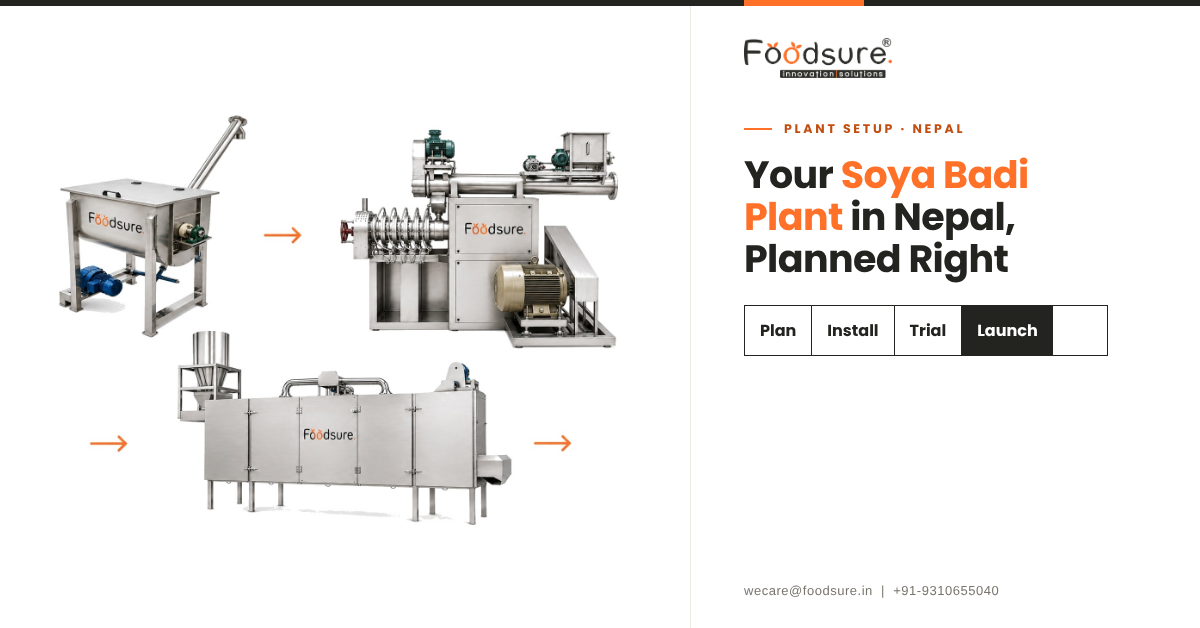
The soya badi machine is one of the most important investments in your plant. The right model depends on your target output, available space, budget, raw material, and preferred level of automation.
A commercial production line may include a mixer, feeding arrangement, extruder, cutting system, dryer, cooling arrangement, and packaging equipment.
Some suppliers provide only the extruder, while others offer a more integrated line. Always check the complete equipment list before comparing prices.
Which production capacity should you choose?
Consider these broad planning categories when evaluating machinery.
| Production capacity | Possible business application | Main consideration |
| 50–100 kg/hour | Small commercial production | Suitable for testing demand and building distribution, depending on actual sales |
| 100–200 kg/hour | Established regional supply | Requires coordinated drying, handling, and packaging |
| 300 kg/hour and above | Larger wholesale or multi-region operations | Needs stronger demand planning, utilities, storage, and distribution |
These are indicative planning categories, not guaranteed machine specifications or recommendations for every business.
Ask the supplier whether the stated hourly capacity refers to extruded material or finished, dried soya badi. Also confirm the expected operating conditions and the capacity of the complete line.
Semi-automatic or fully automatic machinery?
A semi-automatic setup may involve more manual feeding, material transfer, or packaging. It can be suitable for a business that is starting at a manageable scale and has workers available for these tasks.
A fully automatic line can reduce manual handling and coordinate more production stages. However, it generally requires a larger initial investment and appropriate technical support.
Choose automation based on your production requirements rather than assuming that the most automated machine is always the best choice.
What should you check before buying?
Request written details of:
- Hourly production capacity
- Raw material specifications
- Motor power and electrical requirements
- Dryer capacity and energy use
- Food-contact material grades
- Control panel and automation features
- Installation and commissioning
- Operator training
- Warranty and spare-parts availability
Foodsure Machines offers a Soya Badi Machine for commercial production. When evaluating it or any other supplier’s equipment, request a configuration that matches your intended output and ask for a written quotation covering the machine, accessories, installation, training, and delivery to Nepal.
Step 4: Plan Your Factory Space and Utilities
Your factory layout should support the complete production process, from receiving raw materials to dispatching packed soya badi.
You do not need to rent a large building simply because you want to manufacture food. You need sufficient space for the selected machinery, safe movement of materials, storage, cleaning, and finished-product handling.
The required area depends on production capacity, equipment dimensions, storage volume, and the way materials move through the facility.
A practical factory layout should provide separate, clearly organised areas for:
Raw material storage: Ingredients should be stored in clean, dry conditions and protected from moisture, pests, and contamination.
Processing: Mixing, extrusion, cutting, and drying equipment should be arranged to minimise unnecessary movement.
Cooling and packing: The product should be cooled under suitable hygienic conditions before packaging.
Finished-product storage: Packed products need protection from moisture, pests, physical damage, and other factors that can affect quality.
Cleaning and utilities: Plan access for equipment cleaning, electrical maintenance, waste handling, and other operating needs.
Before signing a lease, ask the machinery supplier for a layout drawing and utility requirements. Check the available electrical supply, floor conditions, ventilation, access for delivery vehicles, and room for future expansion.
Step 5: Understand the Registration and Licensing Requirements in Nepal
Food manufacturing requires regulatory planning before commercial production begins. You should not assume that registering a company alone gives you permission to manufacture and sell packaged food.
The exact requirements depend on your business structure, location, product, and applicable rules. Confirm the current process with the relevant authorities before investing in the premises.
Business registration
If you intend to establish a company, start by reviewing the requirements of Nepal’s Office of the Company Registrar. Other business structures may follow different registration procedures.
You should also confirm the applicable industry registration, tax registration, and local requirements for your proposed facility.
Food-industry recommendation and licensing
The Department of Food Technology and Quality Control operates the Nepal Food and Feed Industry Licensing System (NeFFILS).
The official portal explains that the system supports the recommendation process for establishing food and feed industries and the licensing process before their products enter the market.
DFTQC’s official FAQ identifies documents for a food-industry establishment recommendation, including an application, a letter from the relevant industry-registration office, the applicant’s citizenship copy, and a technical plan describing the proposed production process, raw materials, machinery, sanitation, and quality-control arrangements.
Use the current NeFFILS instructions and confirm the applicable requirements for your business before submitting an application. You should also verify the required food-industry licence before starting commercial production.
Labelling and food safety
Packaged food labels must meet the applicable Nepalese requirements. DFTQC’s official guidance identifies information such as the product name, ingredients, manufacturer details, registration information, production date, expiry or use-by information, and batch number as relevant label details.
Confirm the current mandatory particulars and applicable food standards for your specific product. Do not copy a competitor’s label without checking the requirements.
You can also consult the Department of Food Technology and Quality Control for food quality, laboratory testing, and licensing information.
Step 6: Understand the Soya Badi Manufacturing Process
The manufacturing process varies with the raw material, product shape, and machinery configuration. A typical commercial process involves preparing the ingredients, extrusion, cutting, drying, cooling, and packaging.
1. Prepare the raw material
Check that the incoming soy-based ingredient meets the required specifications. Store it properly and remove unsuitable material according to your quality-control procedure.
2. Mix the ingredients
Prepare a consistent mixture according to the selected process. Ingredient proportions and moisture conditions must follow the formulation and equipment requirements.
3. Process the mixture through the extruder
The extruder uses mechanical energy, heat, and pressure to transform the prepared material into a textured product. The operating settings depend on the raw material and the desired product.
4. Shape and cut the product
The extruded material is formed and cut into the required size. The cutting system should produce consistent pieces that match the intended product specification.
5. Dry the soya badi
The product passes through a suitable drying system to achieve the required moisture level. Drying conditions must be established through trials and appropriate quality checks.
6. Cool and inspect
The dried product is cooled under hygienic conditions and inspected for consistency, appearance, and other quality requirements.
7. Weigh and pack
The finished product is weighed and packed in the chosen format. Packaging should protect it from moisture and contamination during storage and distribution.
The dryer is particularly important. If the extruder can process more material than the dryer can handle, the line may not achieve its expected finished-product output.
Step 7: Choose Packaging That Fits Your Buyers
Packaging affects product protection, storage, transport, and how customers view your brand.
You may choose small retail packs for households, larger packs for regular consumers, or bulk packs for wholesalers and food-service buyers.
Before deciding on a pack size, research what your target customers actually purchase. Small packs may be convenient for individual households, while larger packs may suit families, retailers, and commercial kitchens.
Your packaging plan should account for:
- Suitable food-contact packaging material
- Protection against moisture and contamination
- Reliable sealing
- Clear product and manufacturer information
- Batch identification and date marking
- Packaging cost per kilogram
- Transport and storage conditions
Do not claim a long shelf life without supporting product-specific evidence. Establish the appropriate shelf life through suitable testing and storage assessment.
Step 8: Calculate the Investment Required
The total investment for a soya badi manufacturing plant depends on the scale of the business and the equipment supplied.
There is no reliable single figure that applies to every plant in Nepal. A standalone extruder, a semi-automatic setup, and a complete production line can have very different costs.
Prepare a budget that covers both initial setup and working capital.
| Cost category | What to include |
| Machinery | Extruder, mixer, cutting system, dryer, conveyors and controls |
| Packaging | Weighing, sealing and packing equipment |
| Factory | Rent, deposit, layout changes and installation space |
| Utilities | Electrical work, ventilation and other site requirements |
| Import and transport | Freight, insurance, applicable customs charges and inland delivery |
| Compliance | Applicable registration, licensing, testing and documentation costs |
| Staff | Recruitment, training and initial operating expenses |
| Working capital | Raw materials, packaging, wages, distribution and other recurring costs |
If you import machinery, confirm the correct tariff classification and applicable charges with a customs professional. Nepal’s Department of Customs publishes customs tariff information.
Do not calculate the budget using only the machine’s advertised price. The total cost of getting the plant operational is the more useful figure.
Step 9: Estimate Production Costs and Profitability
Before starting production, estimate how much it will cost to manufacture one kilogram of finished soya badi.
A basic calculation is:
Production cost per kg = Raw materials + Electricity + Labour + Packaging + Processing losses + Maintenance + Other production costs, divided by saleable output
Use actual supplier quotations and expected operating conditions to calculate these costs.
For a realistic financial plan, separate fixed costs from variable costs.
Fixed costs may include rent, administrative salaries, and other expenses that continue even when production is low. Variable costs include ingredients, packaging, electricity associated with production, and other costs that change with output.
Next, estimate your selling price and expected monthly sales. Include distributor margins, transportation, retailer margins where applicable, taxes, and other selling expenses when assessing the final margin.
How do you calculate the break-even point?
Your break-even point is the sales volume at which your revenue covers your total costs.
A simple formula is:
Break-even quantity = Monthly fixed costs ÷ Contribution per kg
Contribution per kilogram is the selling price per kilogram minus the variable cost per kilogram.
For example, if your fixed costs are NPR 200,000 per month and your contribution is NPR 40 per kilogram, your break-even volume would be 5,000 kg per month. These figures are illustrative only and are not a forecast for a Nepalese soya badi business.
Your actual result will depend on your costs, prices, capacity utilisation, and sales.
Step 10: Build Your Distribution Network
Manufacturing the product is only half the job. You also need a reliable way to get it into customers’ hands.
For a new brand in Nepal, start with a manageable sales area and build relationships with wholesalers, retailers, and food-service buyers.
Create a clear product catalogue, provide consistent packaging, and make it easy for distributors to reorder. Track which pack sizes sell, which customers purchase regularly, and how much time it takes to collect payments.
Avoid producing large quantities simply because the machine can handle them. Unsold inventory ties up working capital and can create storage and quality problems.
As demand becomes more predictable, you can expand into additional cities, introduce new pack sizes, or increase production capacity.
Step 11: Plan for Quality Control and After-Sales Support
Consistent quality is essential for a food manufacturing business. Customers are more likely to reorder when the product has a dependable appearance, texture, and cooking performance.
Develop written procedures for raw material checks, ingredient handling, equipment cleaning, processing, drying, packaging, and finished-product inspection.
Maintain batch records so that you can trace ingredients and production details if a quality issue occurs.
Your machinery supplier should also explain routine maintenance, cleaning requirements, recommended spare parts, and how to get technical assistance.
Before buying, ask whether installation and operator training are included, how warranty claims are handled, and how quickly replacement components can be supplied to Nepal.
A machine’s purchase price matters, but its performance and service support can affect your operating costs long after the purchase.
Can You Expand Into Other High-Protein Snacks?
Once your soya badi business is established, you may consider expanding into other snack categories. However, each product requires its own assessment of demand, formulation, processing requirements, and equipment compatibility.
Foodsure Machines offers other food-processing equipment that may be relevant to a wider product portfolio:
- High Protein Snack Machine: Explore suitable equipment for products such as protein puffs, chips, and other extruded snacks, depending on the configuration.
- Makhana Machine: Consider equipment for processing and roasting makhana as a separate ready-to-eat snack category.
- Popcorn machine: This may be relevant if you plan to add popcorn to your product range. Confirm the appropriate machine model and specifications with the supplier.
These machines serve different purposes. A soya badi extruder is not automatically suitable for producing every high-protein snack, and makhana roasting requires a different processing approach.
Plan expansion around proven customer demand rather than purchasing additional machines before your first product has a stable market.
Common Mistakes to Avoid When Starting a Soya Badi Plant
Several avoidable mistakes can increase the cost and difficulty of starting a food manufacturing business.
Buying machinery before researching demand: A high-capacity machine can leave you with unnecessary operating costs if sales are lower than expected.
Comparing machine prices without checking the equipment list: One quotation may include a dryer and controls while another covers only the extruder.
Ignoring raw material specifications: An unsuitable or inconsistent ingredient can affect product quality and production performance.
Underestimating drying and packaging requirements: The extruder alone does not determine the finished line’s output.
Overlooking licensing and labelling: Confirm the relevant regulatory requirements before commercial production.
Underestimating working capital: You need money for raw materials, packaging, labour, distribution, and other operating expenses while sales develop.
Choosing a supplier based only on price: Check technical documentation, installation, warranty, spare parts, and support arrangements before making a decision.
Final Takeaway
Starting a soya badi manufacturing plant in Nepal requires careful planning across market research, machinery, raw materials, factory setup, licensing, production, and distribution.
The best approach is to validate demand first, estimate the volume you can sell, and select machinery that fits your production requirements. Then calculate the total installed investment and operating cost before committing to a purchase.
If you are considering Foodsure Machines, request a detailed soya badi production-line quotation based on your required capacity and ask for the equipment list, raw material specifications, installation arrangements, training, warranty, and delivery costs for Nepal.
A well-planned manufacturing business is not simply about producing more soya badi. It is about producing a consistent product, meeting the relevant requirements, and building a distribution network that can support the business over time.
Frequently Asked Questions
How do I start a soya badi manufacturing plant in Nepal?
Start by researching local demand, identifying suitable raw materials, preparing a business plan, and estimating your production requirements. Then select machinery, arrange a suitable factory, complete the applicable business and food-industry registration and licensing requirements, and establish your production and quality-control procedures before commercial sales.
How much investment is required to start a soya badi factory in Nepal?
The investment depends on the machine capacity, automation, factory space, dryer, packaging equipment, installation, import charges, and working capital. Obtain itemised supplier quotations and calculate the total installed cost rather than relying on a single advertised machine price.
Which machine is required to manufacture soya badi?
A typical production setup includes an extruder and cutting system, with suitable mixing, feeding, drying, cooling, and packaging equipment. The exact configuration depends on the raw material, product specification, and desired output.
Can I start a small soya badi manufacturing business?
Yes, you can plan a smaller commercial operation if the equipment, production process, regulatory requirements, and budget match your business model. Start by estimating realistic sales and choosing a capacity that you can use effectively.
What raw materials are used to make soya badi?
Commercial soya badi is commonly made using defatted soy flour or other suitable soy-based ingredients. The required material depends on the production process, so confirm the specification with your machinery supplier before purchasing raw materials.
Is a soya badi manufacturing business profitable in Nepal?
Profitability depends on raw material costs, production efficiency, selling prices, packaging, distribution, competition, and sales volume. Calculate your contribution per kilogram and break-even quantity using realistic costs before investing.
What licences are required for a soya badi factory in Nepal?
The requirements depend on the business structure, location, and applicable regulations. You may need company or firm registration, industry registration, the relevant DFTQC establishment recommendation, and the required food-industry licence before commercial production. Confirm the current process through the official NeFFILS portal and the relevant authorities.
How much space is needed for a soya badi manufacturing plant?
There is no single space requirement for every plant. The area depends on machinery dimensions, production capacity, raw material storage, finished-product storage, packaging, utilities, and material movement. Ask the supplier for a layout based on your selected equipment.
Can I expand from soya badi into high-protein snacks?
Yes, expansion may be possible, but different products can require different formulations and processing equipment. Evaluate the market and confirm equipment suitability before investing in a separate high-protein snack production line.
How can I choose a reliable soya badi machine supplier?
Compare written specifications, actual output, raw material requirements, included accessories, electrical consumption, installation, training, warranty, and spare-parts availability. Where possible, arrange a production trial using your intended raw material.