
Soya badi, also known as soya chunks, soya nuggets or textured vegetable protein (TVP), is a familiar food in many South Asian kitchens. It is used in curries, rice dishes, pulao, biryani and other meals because it absorbs flavours well and is easy to prepare.
For food entrepreneurs in Bangladesh, India, Nepal and Sri Lanka, manufacturing soya badi can be an option worth evaluating. A business can supply local grocery shops, wholesalers, supermarkets, restaurants, institutional kitchens and private-label food brands. However, the actual opportunity depends on local demand, soybean ingredient prices, production costs, competition and distribution.
Starting a factory requires more than buying a soya badi machine. Manufacturers must plan raw material sourcing, mixing, extrusion, cutting, drying, packaging, hygiene, utilities and product testing together.
This guide explains the soya badi manufacturing process, the machinery needed for a commercial plant, the factors that affect production costs and the steps entrepreneurs should consider before setting up a factory in Bangladesh or another South Asian country.
Why Consider Soya Badi Manufacturing in South Asia?
Soya badi is a versatile ingredient that can be sold directly to consumers or supplied to food businesses. Its familiar cooking applications make it suitable for several sales channels, although demand and price expectations differ between markets.
The product is also based on established food-processing technology. The Food and Agriculture Organization (FAO) describes extrusion as a method of processing soybean flour and water under heat and pressure to create a porous, textured product commonly known as textured vegetable protein.
This technology allows manufacturers to produce different shapes and textures according to the intended application. FAO’s technical explanation of soy protein extrusion provides useful background on the process.
For a new manufacturer, potential customers include:
- Grocery wholesalers and local distributors
- Supermarkets and neighbourhood retail stores
- Restaurants, caterers and institutional kitchens
- Online grocery businesses
- Private-label food brands
- Food-service suppliers
- Regional food distributors and eligible export buyers
The most practical starting point is to identify which customers you want to serve. A business supplying low-cost bulk soya chunks may need a different packaging line and production schedule from a brand selling small consumer pouches.
What Products Can a Soya Badi Factory Produce?
A commercial line may be configured to produce several forms of textured soy products, depending on its extruder, dies, formulation and operating conditions.
- Regular soya chunks
- Mini soya chunks
- Large soya nuggets
- Soya granules
- Textured vegetable protein for food manufacturers
- Specially shaped products for selected food applications
Not every machine can produce all these products without adjustments. Before purchasing equipment, discuss the required shapes, product specifications, raw materials and changeover requirements with the manufacturer.
What Is the Soya Badi Manufacturing Process?
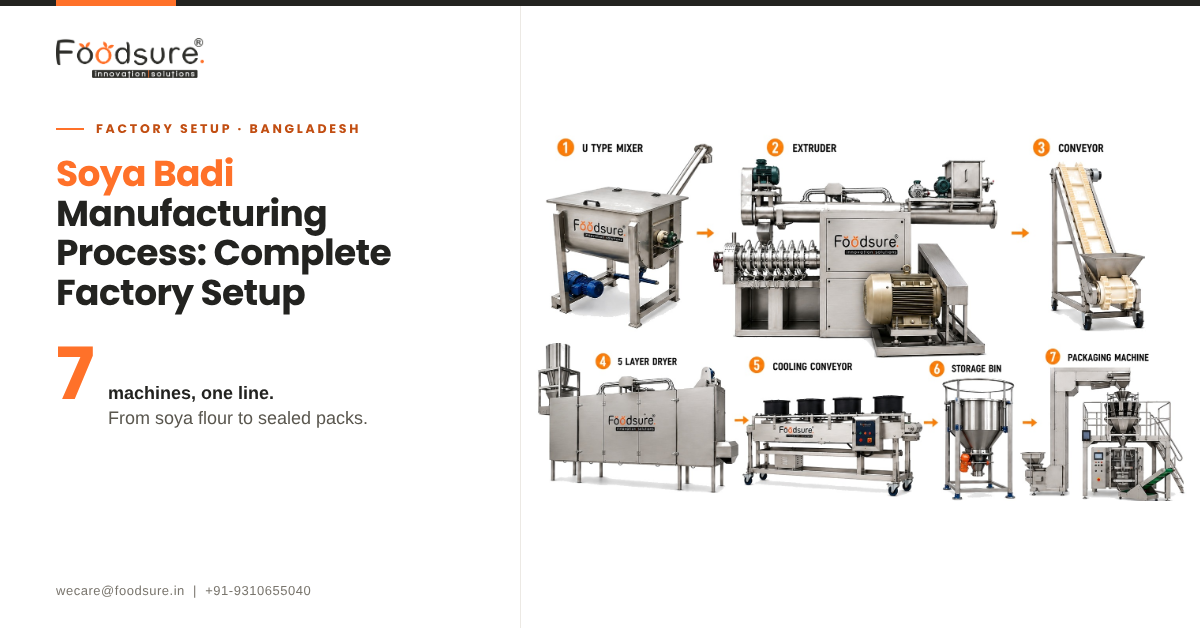
The soya badi manufacturing process involves preparing soybean-based ingredients, mixing them with controlled moisture, extruding the mixture, cutting it into the required shape, drying it, cooling it and packing the finished product.
The production flow generally follows this sequence:
Raw material inspection → Cleaning and sieving → Grinding, if required → Mixing → Moisture conditioning → Extrusion → Cutting → Drying → Cooling → Quality inspection → Packaging → Storage
The exact process depends on the formulation and the type of soy ingredient used. Some factories purchase ready-to-process defatted soy flour, while others may have additional raw material preparation equipment.
Research published in Foods in 2022 explains that soy flour, soy protein concentrate and soy protein isolate differ in composition and processing. These differences affect the final product’s nutritional and functional properties. Read the peer-reviewed review on soy protein quality and processing.
For this reason, a factory should select its raw materials and machinery as one connected system rather than making these decisions separately.
Complete Soya Badi Manufacturing Process Step by Step

1. Select the Right Raw Materials
The first step is selecting suitable soybean-based ingredients for the intended product.
Depending on the formulation, manufacturers may use defatted soy flour, soybean meal that meets the required food-grade specifications, soy protein concentrate or other appropriate ingredients.
The supplier should provide specifications that help the factory assess the material’s suitability for food production.
Important checks include:
- Moisture content
- Protein content
- Particle size
- Colour and odour
- Foreign matter
- Microbiological quality, where applicable
- Consistency between batches
- Storage and transport conditions
Raw material composition affects how the mixture behaves during extrusion. Two batches with different moisture levels or particle sizes may not process identically under the same machine settings.
For a factory in Bangladesh, Nepal, Sri Lanka or India, compare local sourcing with imported ingredients where relevant. Include transport, storage, supplier reliability, import duties and currency fluctuations in the calculation.
2. Clean and Sieve the Material
Cleaning removes unwanted particles before the material enters the production line.
Depending on the raw material and equipment layout, the factory may use sieves, screens and suitable separation equipment to remove foreign matter.
A magnetic separator can help capture ferrous particles when incorporated at an appropriate point in the material-handling system.
Cleaning is important for two reasons. Foreign material can damage machinery, and contamination can compromise the safety and quality of the finished food.
The cleaning system should match the incoming material. Purchased, pre-processed soy flour may need a different arrangement from raw agricultural material.
3. Grind the Material When Required
Some formulations require grinding or size reduction before mixing. A suitable grinder or pulverizer can help achieve a more uniform particle size.
The correct size depends on the ingredients and the extruder’s operating requirements.
Very coarse particles may hydrate unevenly, while an unsuitable fine powder can change how the mixture flows through the machine.
The objective is not to grind everything as finely as possible. It is to prepare material that the selected extrusion system can process consistently.
4. Mix the Ingredients
The prepared soybean material is transferred to a mixer, where it is blended with water and any other permitted ingredients required by the formulation.
Uniform mixing helps the material enter the extruder with consistent composition and moisture distribution.
A commercial mixer should be selected according to batch size, ingredient characteristics, cleaning requirements and production capacity.
The operator should follow a standard recipe and record ingredient quantities. Changing water addition or ingredient proportions without controlled trials can affect the texture, shape and drying behaviour of the final product.
5. Control Moisture Before Extrusion
Moisture conditioning prepares the mixture for extrusion.
Water content influences the way the material moves through the extruder and responds to heat, pressure and mechanical energy. The required moisture level varies with the raw material, formulation and product type.
Operators should follow the machine manufacturer’s recommended operating range and confirm the settings through production trials.
This stage deserves particular attention when a factory is producing multiple product sizes or working with ingredients from different suppliers.
6. Extrude the Mixture
Extrusion is the central stage of the soya badi manufacturing process.
The mixture passes through an extruder containing a screw assembly inside a barrel. As the material moves through the machine, heat, pressure and mechanical energy change its structure. When it passes through the die, it forms a textured product that can be cut into chunks or other shapes.
FAO’s technical guidance on soy processing describes how extrusion creates the porous structure associated with textured soy protein.
The main parts of an extrusion system can include:
- Feeding hopper and feeding system
- Extruder barrel and screw assembly
- Heating or temperature-control system
- Die
- Cutting mechanism
- Control panel
- Conveying equipment
The main operating variables include feed rate, moisture, screw speed, temperature and die configuration.
These variables influence the product’s shape, texture, expansion and consistency. Their correct settings must be established for the specific formulation and machine.
A higher theoretical production rate is not necessarily better if it causes more rejected pieces, inconsistent texture or additional drying problems.
7. Cut the Product to Size
After extrusion, the product passes through a cutting system that divides it into the required shapes and sizes.
A manufacturer targeting household consumers may need smaller chunks and retail-ready products. A supplier serving food-service customers may prefer different sizes or bulk packaging.
Before finalizing the machine, discuss the number of product formats required, how quickly the line can change between them and whether additional dies or cutters are needed.
These details matter when estimating both production time and equipment cost.
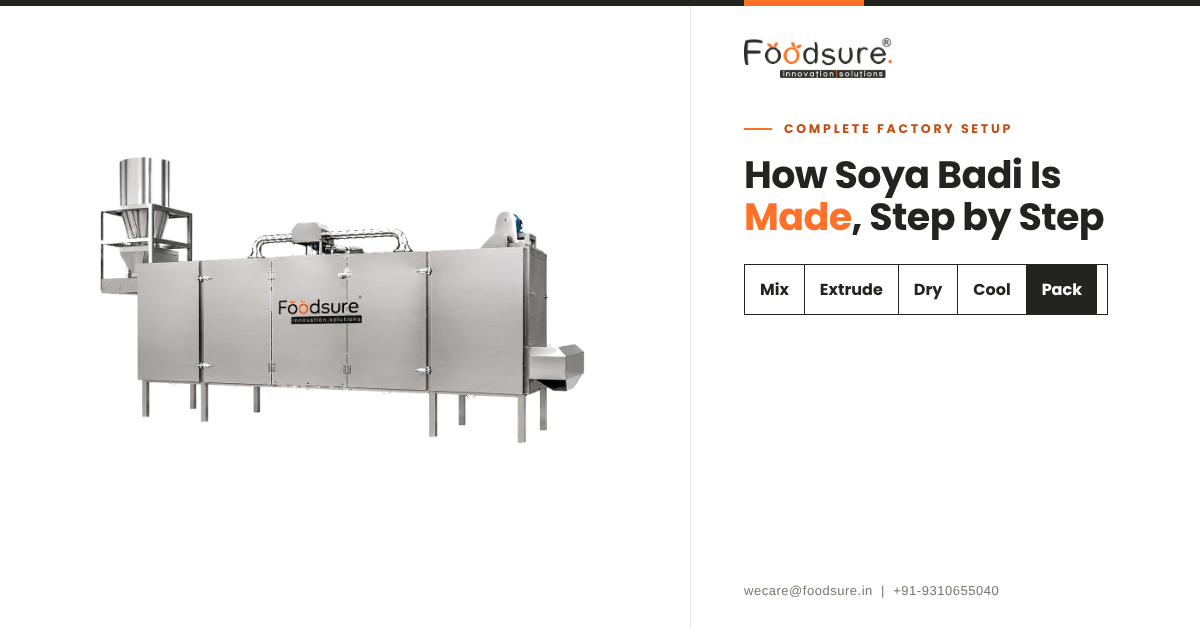
8. Dry the Soya Chunks
Freshly extruded soya pieces usually require controlled drying before packaging.
The dryer reduces moisture to the product’s specified level. This helps achieve the required storage characteristics and consistency.
Drying conditions depend on the formulation, product size, moisture entering the dryer and desired finished-product specification.
The main factors to monitor are:
- Drying temperature
- Airflow
- Residence time
- Product loading
- Final moisture content
- Uniformity between batches
Under-drying can create quality and storage problems. Excessive drying can affect texture and increase energy consumption.
The dryer must be sized to work with the actual output of the extruder. If the extruder produces material faster than the dryer can handle it, the dryer can become the main production bottleneck.
9. Cool the Product
After drying, the product should be cooled under controlled, hygienic conditions before packaging.
Packing hot product can create condensation if moisture accumulates inside the package. Cooling also helps prepare the product for inspection and handling.
The cooling arrangement should be suitable for the factory’s output and should protect the product from dust, pests and other sources of contamination.
10. Inspect the Finished Product
Before packing, the manufacturer should check whether the product meets its specifications.
Depending on the product and food safety plan, checks may include:
- Appearance, colour and shape
- Size consistency
- Moisture content
- Texture and cooking performance
- Foreign matter
- Metal detection, where appropriate
- Microbiological testing, where applicable
- Batch traceability
The business should establish clear acceptance criteria and document the results. A quality control system is more useful when it identifies the cause of a problem rather than simply rejecting the final batch.
Protein content and other nutritional values should be verified using appropriate product data or testing before they are declared on the label.
11. Weigh and Package the Product
Once the product passes inspection, it moves to the packaging section.
Common packaging options include:
- Small consumer pouches
- Medium retail packs
- Bulk bags for wholesalers
- Larger packs for restaurants and food-service buyers
- Private-label packaging for other brands
The right packing machine depends on pack size, product flow, required weighing accuracy, packaging material and target output.
Packaging should protect the product from moisture and contamination during transport and storage. The packaging material and sealing process should be validated for the intended product and storage conditions.
For Bangladesh, food businesses should review the applicable requirements issued by the Bangladesh Food Safety Authority (BFSA) and the Bangladesh Standards and Testing Institution (BSTI). The label must comply with the rules applicable to the product, including relevant ingredient, nutritional, batch and date information.
Avoid making claims such as high protein or specific nutritional benefits unless they are supported by suitable evidence and comply with the applicable rules.
12. Store and Dispatch the Finished Product
Finished soya badi should be stored in a clean, dry area protected from pests, direct sunlight, excessive heat and moisture.
A proper stock management system should record:
- Production and batch codes
- Manufacturing and applicable best-before dates
- Quantity produced
- Quantity dispatched
- Customer or distributor details
- Any quality issues or returns
Traceability helps a manufacturer investigate complaints and identify affected batches when a quality problem occurs.
The factory layout should also separate raw materials, finished products, packaging supplies and waste wherever needed to maintain hygienic operations.
Which Machines Are Required for a Soya Badi Manufacturing Plant?
A commercial soya badi plant may require the following equipment, depending on whether raw material preparation and packing are handled in-house.
| Machine or equipment | Main purpose |
| Cleaner and sieve | Removes unwanted particles |
| Grinder or pulverizer | Adjusts particle size when required |
| Mixer | Blends ingredients and water |
| Feeding and conveying system | Transfers material between stages |
| Soya badi extruder | Forms the textured soy product |
| Die and cutter | Produces the required shape and size |
| Industrial dryer | Reduces moisture after extrusion |
| Cooling conveyor | Cools the dried product |
| Inspection equipment | Checks product quality and foreign matter |
| Weighing and packing machine | Fills and seals consumer or bulk packs |
| Supporting utilities | Provides electrical power and other required services |
The final configuration depends on the product, capacity, automation level and available space.
For example, a factory buying ready-to-process soy flour may not need a complete soybean cleaning and grinding section. A business supplying retail brands may need more advanced weighing, sealing and coding equipment than one selling bulk products.
How Foodsure Machines Fits Into the Setup
For entrepreneurs evaluating a soya badi making machine in Bangladesh, the main question is whether the complete line can deliver the required product consistently at a commercially useful output.
Foodsure Machines offers soya badi manufacturing machinery with configurations covering extrusion, cutting, drying, cooling and packaging. The final equipment selection should be based on the buyer’s product specification, confirmed capacity, available utilities and factory layout.
Before purchasing, ask the supplier to clarify:
- Expected output for the exact product and raw material
- Whether quoted capacity refers to input or finished product
- Electrical load and connected utilities
- Space required for the complete production line
- Dryer capacity and expected finished moisture
- Included dies, cutters and accessories
- Installation, operator training and warranty
- Spare parts availability and after-sales support
Requesting these details in writing makes it easier to compare suppliers on more than the initial machinery price.
How to Choose the Right Production Capacity
The correct production capacity depends on expected sales, working hours, available capital, labour, factory space and future plans.
A startup supplying a limited number of distributors may not need the same equipment configuration as an established food company serving several regions.
Before deciding on capacity, estimate:
- Expected monthly sales in kilograms.
- Number of production days per month.
- Daily operating hours.
- Expected downtime for cleaning, maintenance and changeovers.
- Product losses and quality rejections.
- The output required from the extruder, dryer and packing section.
Example of Production Planning
Suppose a manufacturer wants to produce 10,000 kg of saleable soya badi per month and plans to operate for 25 days, with one eight-hour shift each day.
The required average saleable output is:
10,000 kg ÷ 25 days ÷ 8 hours = 50 kg per operating hour.
This is the required average saleable production rate, not a guarantee that a machine rated at 50 kg per hour will meet the target. Downtime, cleaning, changeovers, product losses and the difference between machine input and finished output must be considered.
A practical capacity plan should also account for the performance of the entire line. A fast extruder cannot deliver the required finished output if the dryer or packing machine cannot keep up.
What Affects the Cost of Setting Up a Soya Badi Factory?
There is no single factory setup cost that applies to every business. Machinery prices depend on capacity, automation, equipment configuration, utilities and the amount of work required at the factory site.
The total investment may include:
- Production machinery
- Electrical installation and utility connections
- Factory preparation and flooring
- Raw material and finished goods storage
- Packaging machinery and materials
- Quality testing and food safety arrangements
- Labour and operator training
- Licences and regulatory costs
- Initial raw material inventory
- Transport, installation and commissioning
- Working capital for day-to-day operations
Entrepreneurs should request a detailed quotation that separates the machine price from installation, transportation, utilities, taxes and other expenses.
It is also important to calculate operating costs. Soy ingredients, packaging materials, electricity, labour, maintenance, transport and distributor margins all influence the final cost per kilogram.
A factory may have enough capacity to produce a large quantity but still struggle financially if it cannot sell that quantity at a sustainable margin.
How to Estimate the Business’s Break-Even Point
A simple starting point is to calculate the contribution earned per kilogram.
Contribution per kg = Selling price per kg − Variable cost per kg
Variable costs can include raw materials, packaging, production energy and other costs that change with output.
The business can then estimate how many kilograms it needs to sell to cover its fixed operating expenses.
Break-even sales volume = Monthly fixed costs ÷ Contribution per kg
This is a planning estimate, not a profit guarantee. The calculation should use realistic selling prices, production losses, distribution expenses and actual operating costs.
Food Safety and Regulatory Requirements in Bangladesh
Food entrepreneurs should confirm the legal requirements that apply to their specific product, factory and distribution model before starting commercial production.
The Bangladesh Food Safety Authority publishes food safety laws, regulations and related resources. Its official laws and regulations page should be checked for the latest applicable requirements.
The Bangladesh Standards and Testing Institution also publishes a list of mandatory products. The list was updated on 2 April 2026, so manufacturers should check the current position rather than relying on older information.
Before launching a soya badi product, verify:
- Applicable food business registration or licensing requirements
- Whether the product falls under a mandatory BSTI standard or certification requirement
- Current packaged-food labelling rules
- Requirements for ingredients and permitted food additives
- Rules governing nutrition and advertising claims
- Factory, environmental and fire safety requirements, where applicable
- Any additional import or export requirements
Do not assume that every food product automatically requires the same certification. Requirements depend on the product category and the rules in force at the time of launch.
How to Maintain Hygiene in a Soya Badi Factory
A hygienic production environment protects product quality and helps reduce the risk of contamination.
The factory should have suitable procedures for:
- Cleaning food-contact equipment
- Preventing pests from entering production and storage areas
- Managing waste
- Controlling employee hygiene
- Storing raw materials safely
- Separating raw materials from finished products
- Maintaining production and cleaning records
- Checking equipment before production
- Investigating customer complaints
The equipment layout should allow operators to inspect, clean and maintain the machinery without unnecessary difficulty.
Hygiene is easier to maintain when it is considered during factory planning rather than added after installation.
Expanding Beyond Soya Badi Into High-Protein Snacks
Once the core soya badi business is stable, some manufacturers may consider adding other products to serve different customers or sales channels. The right choice depends on demand, ingredient availability, product development requirements and the additional investment needed.
High Protein Snack Machine for Commercial Production
Entrepreneurs exploring new product categories can evaluate a high protein snack machine for suitable snack applications. A high protein snack manufacturing machine may be relevant for businesses developing extruded snacks, puffs or other products, depending on the machine configuration and formulation.
When researching a high protein snack machine price, compare the complete production line rather than relying on the price of a single unit. Important considerations include product compatibility, output, power consumption, forming or extrusion requirements, cooling, packaging and installation support.
High-intent searches such as high protein snack making machine, commercial high protein snack machine, high protein snack manufacturing machine, high protein snack production line and high protein snack machine manufacturer are useful starting points for comparing equipment. However, the machine must be selected for the intended product rather than for the keyword alone.
Protein Bar Machine for Packaged Nutrition Products
A business targeting gyms, sports nutrition brands, convenience stores or private-label customers may also investigate a protein bar machine.
Protein bars use different formulations and forming methods from conventional soya chunks. Their production may involve ingredient mixing, forming or extrusion, cutting, cooling and packaging, depending on the product.
Before adding protein bars to a factory, evaluate formulation development, ingredient costs, texture, shelf-life testing, packaging and the target selling price.
Makhana Machine for Roasted Snack Products
A makhana processing machine can be relevant to businesses looking to enter the roasted fox nut category.
Makhana production involves different raw materials and processing stages from soya badi manufacturing. A separate processing plan may be required for roasting, seasoning, cooling and packing.
For manufacturers serving several snack categories, this can offer another product direction to investigate, but it should not be treated as an automatic extension of a soya badi production line.
Popcorn Machine for an Additional Snack Category
A popcorn machine and other food-processing equipment can also be explored when assessing other snack manufacturing opportunities. Popcorn production has its own raw material, heating, seasoning and packaging requirements, so the machinery and factory workflow need to be evaluated separately.
The main principle is simple: expand into new categories only after checking product demand, equipment requirements, operating costs and the expected return on investment.
Final Thoughts
Setting up a soya badi manufacturing plant requires a clear understanding of the product, production process, machinery, quality control and market requirements. The best starting point is to define the target customers and product specifications before deciding on capacity or purchasing equipment.
For manufacturers in Bangladesh and across South Asia, a well-planned factory should connect raw material quality, extrusion, drying, packaging, hygiene and distribution into one workable production system.
Foodsure Machines can be considered when comparing commercial soya badi machinery and related food-processing equipment. Before making a decision, request a configuration-specific quotation, confirm the actual finished output, and review installation, training, warranty and after-sales support.
A practical factory plan should be based on verified technical information, local regulatory requirements and realistic business calculations, not unsupported market growth figures or maximum machine capacity alone.
Frequently Asked Questions About Soya Badi Manufacturing
1. What is the soya badi manufacturing process?
The soya badi manufacturing process generally involves raw material inspection, cleaning, grinding where required, mixing, moisture conditioning, extrusion, cutting, drying, cooling, quality inspection and packaging.
2. What is the soya badi making process in Bangladesh?
The soya badi making process in Bangladesh follows the same main food-processing stages used in other markets. Factory owners must select suitable raw materials and machinery, then meet the food safety, labelling and other legal requirements applicable in Bangladesh.
3. Which machine is used to manufacture soya chunks?
A soya badi extruder is the main machine used to form textured soy chunks. A commercial line may also include a mixer, feeding system, cutter, dryer, cooling conveyor, inspection equipment and packing machine.
4. Is a soya chunk manufacturing business profitable in Bangladesh?
Profitability depends on raw material prices, selling price, production efficiency, packaging costs, distribution margins, working capital and actual sales. Prepare a cost and break-even calculation using local supplier quotations and realistic sales estimates before investing.
5. What is the price of a soya badi manufacturing machine?
The price depends on production capacity, automation, machine configuration and the equipment included in the quotation. Buyers should request a detailed quote covering the extruder, dryer, cutter, packaging equipment, installation and after-sales support where required.
6. What capacity soya badi machine should a startup choose?
Start with expected monthly sales and calculate the required hourly output. Consider operating hours, downtime, cleaning, rejected product and future demand before selecting the machine capacity.
7. How much space is required for a soya badi factory?
There is no universal factory size. Space depends on the complete production line, raw material storage, finished product storage, packaging, utilities, staff facilities and future expansion plans.
8. Is drying necessary after extrusion?
Yes, conventional dried soya chunks normally require controlled drying after extrusion. The dryer must be suitable for the extruder’s output and the finished product’s moisture specification.
9. Which raw materials are used in soya badi production?
Depending on the formulation, manufacturers may use defatted soy flour, suitable soybean meal, soy protein concentrate or other appropriate soy ingredients, along with water and permitted additional ingredients.
10. How can a manufacturer maintain consistent soya badi quality?
Use consistent raw materials, standardize the formulation, monitor moisture and extrusion settings, control drying, inspect finished products and maintain batch records. Periodic testing should verify the product specifications.
11. What licences or certifications are required in Bangladesh?
Requirements depend on the product, business structure and applicable regulations. Check the latest BFSA requirements and BSTI mandatory-product list, and confirm any relevant licensing or certification obligations before production.
12. Can one machine manufacture both soya badi and high-protein snacks?
Not necessarily. Some food-processing equipment may support multiple applications, but compatibility depends on the ingredients, formulation, extrusion system, dies, product shape and processing conditions. Confirm this with the machine manufacturer before purchasing.
13. What should I check before buying a high protein snack machine?
Check product compatibility, output, power consumption, automation, material of construction, forming or extrusion requirements, cleaning, packaging integration, installation, warranty and spare parts. For a high protein snack manufacturing machine, also confirm whether the proposed configuration can handle your intended formulation.
14. Can a soya badi manufacturer also produce protein bars?
Yes, a business can establish a separate protein bar production line as an additional product category. However, protein bars generally need different mixing, forming, cutting and packaging arrangements, depending on their formulation.
15. Can a soya badi factory supply other South Asian markets?
A manufacturer may explore eligible regional markets, but exporting requires separate research into demand, pricing, logistics, import requirements, labelling and product standards in each destination. Requirements in Bangladesh should not be assumed to apply identically in India, Nepal or Sri Lanka.




