Starting a soya badi manufacturing business in Bangladesh can be a practical opportunity for entrepreneurs interested in packaged foods, plant-based protein products, and food processing. Soya badi, also called soya chunks, soya nuggets, or textured vegetable protein (TVP), is used in curries, biryani, vegetable dishes, and other everyday meals.
However, starting a manufacturing business involves more than buying an extruder. You need to understand the market, source suitable raw materials, choose the right production capacity, maintain product quality, meet food safety requirements, and build a reliable distribution network.
These decisions matter across South Asia. Entrepreneurs in Bangladesh, India, Nepal, and Sri Lanka may face different raw material costs, electricity tariffs, import requirements, consumer preferences, and distribution challenges. A production plan that works in one country may not be suitable for another.
This guide explains how to start a soya badi manufacturing business in Bangladesh in 2026, covering market research, raw materials, machinery, production processes, investment planning, food safety, marketing, and business expansion. It also explains how manufacturers can explore related high-protein snack categories as their businesses grow.
Why Consider a Soya Badi Manufacturing Business?
Soya badi offers manufacturers a product that can be sold through grocery stores, supermarkets, wholesalers, restaurants, caterers, and institutional kitchens.
It is made from soy-based ingredients and can be prepared in different shapes and sizes. Once properly processed, dried, and packed, the product can be stored and distributed without the refrigeration required by many fresh protein products. Its actual shelf life depends on moisture, packaging, storage conditions, and product testing.
Common product formats include:
- Soya chunks and nuggets
- Mini soya chunks
- Large soya chunks
- Soya granules for minced-style dishes
- Textured vegetable protein ingredients for food manufacturers
- Specially formulated or flavoured soy-based products
These formats allow manufacturers to serve different customer groups using an appropriately configured production line.
What does the available soybean data tell us?
The USDA Foreign Agricultural Service’s Bangladesh Oilseeds and Products Annual provides useful information for entrepreneurs evaluating raw material supply.
For the 2025/26 marketing year, the report forecasts Bangladesh’s soybean production at 160,000 metric tonnes, up from its estimate for the previous marketing year. However, it also states that domestic production supplies only about 7% of Bangladesh’s annual soybean requirement. Much of the locally grown crop is used in animal feed rather than directly in human food production. Source: USDA Foreign Agricultural Service.
This distinction is important. Soybean production figures alone do not establish demand for packaged soya chunks. They do, however, highlight why manufacturers should investigate the availability, quality, price, and import dependence of their intended raw materials before investing.
For a soya badi business, the commercial opportunity must be assessed through local retail prices, competitor products, buyer interviews, distributor feedback, and realistic sales estimates.
Understand the Bangladesh Market Before Investing
The first step is to identify who will buy your product and how much they are likely to purchase.
A factory supplying a few local wholesalers needs a different production setup from a company targeting supermarket chains, national distributors, or export customers.
Start with these questions:
- Who are your primary customers?
- What pack sizes do competing brands sell?
- What are the wholesale and retail prices?
- Which districts will you serve first?
- How frequently will distributors place orders?
- What quality and packaging standards do buyers expect?
- How much product can you realistically sell each month?
- Where will you source soy-based ingredients?
- What payment terms will retailers and wholesalers require?
For example, a new brand could test demand for 100 g, 200 g, 500 g, and 1 kg packs. These are possible product formats, not a claim that they are the most popular sizes in Bangladesh. Interviews with retailers and buyers should determine the final range.
Bulk packs may be more appropriate for restaurants, caterers, foodservice distributors, and institutional kitchens.
Consider the wider South Asian market
Bangladesh should remain the primary market if that is where you intend to establish your factory. However, understanding neighbouring markets can help you plan future expansion.
| Market | Business considerations |
| Bangladesh | Check the availability and landed cost of soy-based ingredients, local competitors, retail prices, distribution margins, and applicable BFSA and BSTI requirements. |
| India | Assess regional demand, competition, state-wise distribution costs, and applicable FSSAI requirements. |
| Nepal | Examine transport costs, import procedures, local retail pricing, and distribution opportunities in the intended cities. |
| Sri Lanka | Review import dependence, foreign exchange exposure, freight costs, food labelling, and local distributor requirements. |
These are areas to investigate, not assumptions that demand or profitability will be the same across all four markets.
A manufacturer planning regional exports must also check the destination country’s product standards, labelling rules, customs duties, import permissions, and buyer specifications before committing to a production plan.
The correct sequence is:
Market research → Product selection → Sales forecast → Capacity planning → Machinery selection → Factory setup → Commercial launch
Choosing a machine before estimating demand can leave a business with more production capacity than it can use.
What Is Soya Badi Made From?
Soya badi is commonly produced using defatted soy flour or other suitable soy protein-rich ingredients. The exact formulation depends on the intended product, texture, nutritional profile, raw material specifications, and manufacturing technology.
Depending on the recipe, manufacturers may use additional permitted ingredients to achieve the desired characteristics.
Important formulation considerations include:
- Protein content
- Moisture before extrusion
- Particle size
- Product density and expansion
- Texture after rehydration
- Shape and size
- Cooking performance
- Finished-product moisture
- Target selling price
The main processing technology is extrusion. During extrusion, the prepared ingredients pass through a machine that applies controlled heat, pressure, moisture, and mechanical force. The material is shaped through a die and then cut, dried, cooled, and packed.
A successful product depends on the combination of formulation and processing conditions. Simply purchasing a high-capacity machine will not guarantee the required texture or quality.
Soya Badi Manufacturing Process Step by Step
A commercial soya badi production line generally follows this sequence:
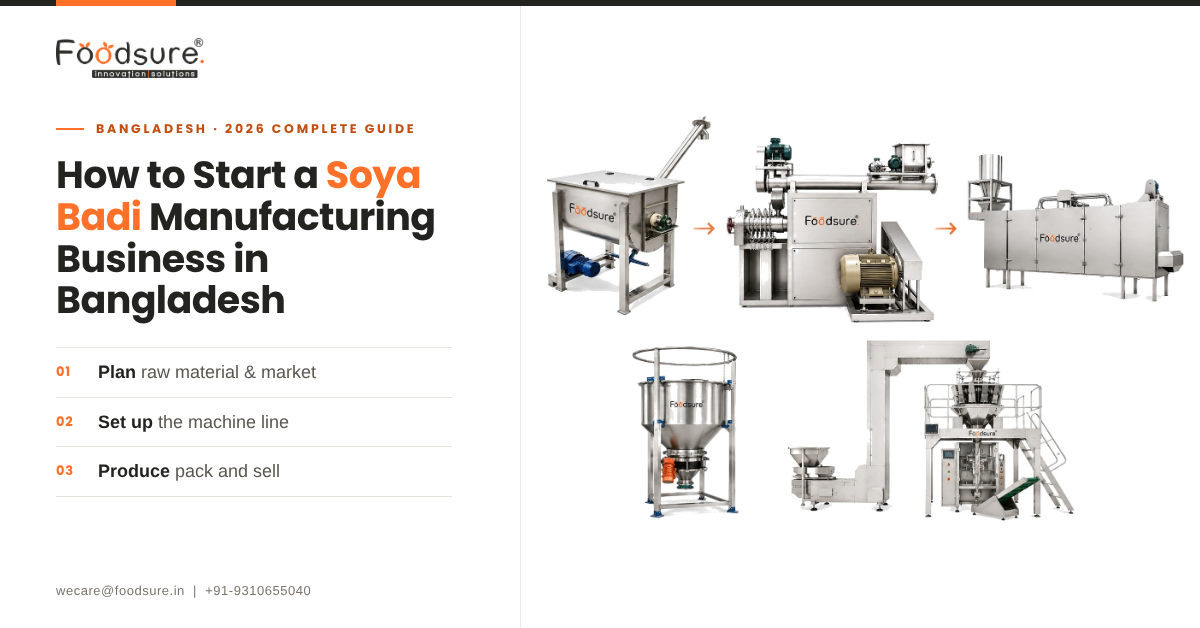
Raw Material Inspection → Weighing → Mixing → Conditioning → Extrusion → Cutting → Drying → Cooling → Quality Inspection → Packaging → Storage
The exact arrangement depends on the formulation, extruder design, output target, and level of automation.
Step 1. Raw material inspection
Inspect incoming soy flour and other ingredients against approved supplier specifications.
Checks may include moisture, appearance, odour, particle size, foreign matter, and relevant chemical or microbiological parameters.
Store ingredients in clean, dry conditions and protect them from pests, moisture, and contamination.
Step 2. Weighing and mixing
Measure ingredients according to the approved formulation.
A suitable mixer distributes the ingredients evenly, helping reduce batch-to-batch differences. Water is added according to the process requirements.
Inconsistent weighing or mixing can affect expansion, texture, colour, and production stability.
Step 3. Conditioning
Conditioning helps distribute moisture more evenly before extrusion.
The aim is to prepare the material so it can pass through the extruder consistently. Incorrect moisture levels can cause unstable feeding, uneven expansion, or undesirable product texture.
Step 4. Extrusion
Extrusion is the central stage of soya badi manufacturing.
The prepared mixture passes through the extruder barrel, where controlled temperature, pressure, moisture, and mechanical shear transform the ingredients into a textured structure.
The machine configuration should match the raw material and desired product.
Before selecting an extruder, confirm its suitability for your formulation, required throughput, product shape, energy supply, and downstream drying system.
Step 5. Cutting and forming
The extruded material is cut to the required dimensions.
Depending on the die and cutting arrangement, a production line may produce small chunks, large nuggets, granules, or other textured soy formats.
If you plan to sell several product types, ask the machinery supplier which formats can be produced with the proposed configuration and what changes are required between products.
Step 6. Drying
The newly extruded product contains more moisture than the finished product generally requires.
A controlled dryer reduces moisture to the level established for the product specification and validated shelf life.
Uneven or insufficient drying can create storage problems. Excessive drying can affect texture, product yield, and energy consumption.
The drying process should therefore be established through trials and product testing rather than copied directly from another factory.
Step 7. Cooling
Cool the dried product before packaging.
Packing warm product can lead to condensation under unsuitable conditions, affecting product quality and storage stability.
A cooling conveyor or appropriate cooling arrangement can help prepare the product for the next stage.
Step 8. Packaging
Packaging protects soya badi from moisture, contamination, physical damage, and other factors that can reduce product quality.
Possible formats include small retail pouches, family packs, bulk bags, and foodservice packs.
The correct packaging material depends on moisture sensitivity, distribution conditions, expected shelf life, and the intended retail or wholesale channel.
Packaging should also provide the information required by the applicable food labelling regulations.
How to Choose the Right Soya Badi Machine
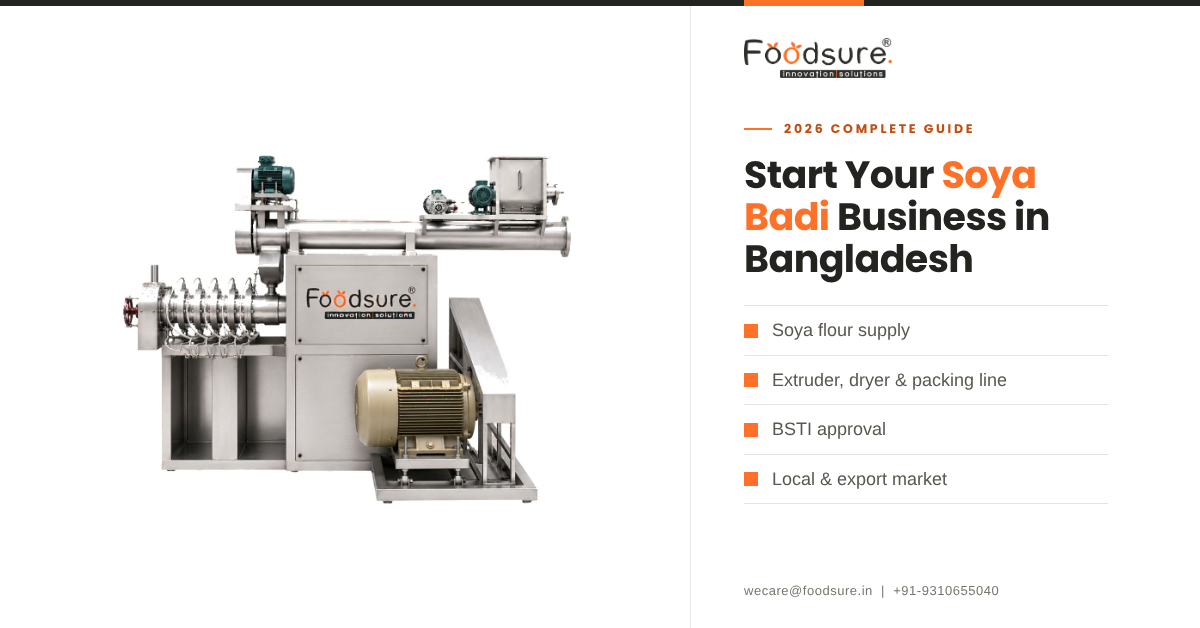
A soya badi machine in Bangladesh should be selected according to the product you intend to manufacture, your expected sales, and the production system you can operate reliably.
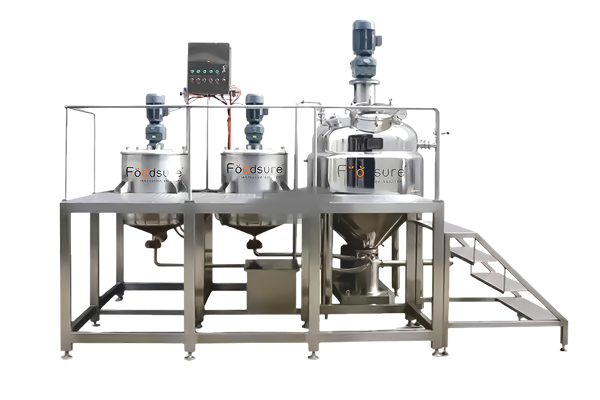
A complete line may include a mixer, material-feeding system, extruder, dies, cutter, dryer, cooling conveyor, weighing equipment, and packaging machine.
Not every factory needs the same configuration. A smaller operation may use more manual handling, while a high-volume factory may require greater automation and integrated material handling.
Before purchasing machinery, evaluate the following:
| Factor | What to check |
| Production capacity | Confirm the expected hourly output under the proposed operating conditions. |
| Raw material compatibility | Test the ingredients you plan to use. |
| Product options | Confirm the available shapes, sizes, and die configurations. |
| Power requirements | Check connected load, actual consumption, voltage, and three-phase supply requirements where applicable. |
| Drying capacity | Ensure the dryer can handle the extruder’s output. |
| Construction material | Check food-contact surfaces and the suitability of materials for the product and cleaning process. |
| Controls | Review temperature control, feeding control, safety systems, and operator requirements. |
| Cleaning and maintenance | Understand cleaning access, spare parts, and maintenance schedules. |
| Technical support | Confirm installation, commissioning, operator training, and after-sales support. |
Why machine trials matter
Before finalising a purchase, request a production trial using your intended formulation wherever possible.
Evaluate:
- Product appearance and shape
- Expansion and density
- Texture after rehydration
- Cutting consistency
- Moisture distribution
- Finished-product quality
- Output under the trial conditions
- Product losses
- Energy use
- Cleaning and changeover time
A trial helps establish whether the proposed line can make the product your customers expect. It also helps identify changes needed in the formulation, dies, drying system, or packaging equipment.
Explore Foodsure Machines’ production solutions
For entrepreneurs comparing commercial machinery, Foodsure Machines’ soya badi machine page describes its extrusion-based production equipment and supporting line components.
The supplier lists options for different production scales, but advertised capacity and specifications should be confirmed against the final quotation, machine configuration, product formulation, and site conditions. Ask for a technical proposal covering the complete production line rather than evaluating the extruder alone.
How Much Investment Is Required?
There is no single reliable investment figure for starting a soya badi manufacturing business in Bangladesh. The cost depends on the plant’s location, capacity, automation, equipment configuration, utilities, and working capital.
A realistic project budget should include:
| Investment area | What it covers |
| Land or factory rent | Production area, raw material storage, finished goods storage, and loading space |
| Machinery | Mixer, extruder, cutter, dryer, conveyors, and associated equipment |
| Packaging equipment | Weighing, filling, sealing, coding, and inspection systems |
| Utilities | Electricity, water, ventilation, drainage, and other site requirements |
| Installation | Transportation, installation, commissioning, and trial production |
| Quality control | Testing equipment, external laboratory services, and quality records |
| Initial inventory | Raw materials, packaging materials, and spare parts |
| Regulatory costs | Applicable registrations, permits, inspections, and certifications |
| Labour | Operators, supervisors, maintenance personnel, and quality staff |
| Working capital | Wages, utilities, inventory replenishment, transport, and credit provided to buyers |
| Sales and marketing | Packaging design, sampling, distributor development, and promotion |
Machinery is only one part of the project cost. Spending most of the available capital on the production line can leave a business short of cash for raw materials, wages, packaging, and distribution.
Prepare a financial model before placing the order. Include a contingency allowance for unexpected installation expenses, delays, and changes in raw material prices.
Calculate the cost per kilogram
A useful starting point is:
Cost per kg = Raw material cost + Processing cost + Packaging cost + Allocated overhead + Distribution cost
For a more accurate model, separate variable costs from fixed expenses.
Variable costs may include ingredients, packaging, production-linked electricity, and some labour expenses. Fixed expenses may include rent, administrative salaries, insurance, and other costs that continue even when production falls.
Then calculate:
Contribution per kg = Selling price per kg − Variable cost per kg
The contribution helps cover fixed expenses. It is not the same as net profit.
To estimate the monthly break-even quantity:
Break-even volume = Monthly fixed costs ÷ Contribution per kg
Use actual supplier quotations, local electricity tariffs, wage estimates, and buyer prices to calculate these figures. Do not rely on generic profit-margin or payback-period claims.
Food Safety and Regulatory Requirements in Bangladesh
Food safety should be part of the factory plan from the beginning, not something addressed after the first production run.
Bangladesh’s food regulatory framework includes the Bangladesh Food Safety Authority (BFSA) and the Bangladesh Standards and Testing Institution (BSTI), alongside other authorities responsible for business, factory, environmental, fire, tax, and import-related requirements.
The exact approvals depend on the business structure, product category, manufacturing location, and sales channels.
What should entrepreneurs verify?
- Business and factory requirements
Confirm the applicable trade licence, tax and business registrations, factory permissions, fire safety requirements, and environmental approvals with the relevant authorities.
- Food safety requirements
Review the applicable BFSA regulations for food businesses, food handling, hygiene, testing, packaging, and labelling.
- Product standards and certification
BSTI publishes a list of products subject to mandatory certification. Check the current list and verify whether your specific product falls within a mandatory certification category. Do not assume that every food product has the same certification requirements as per the BSTI mandatory product list.
- Nutritional and health claims
If your packaging states that the product is high in protein or makes another nutritional or health claim, verify the applicable requirements before printing the label. The BFSA laws and regulations page provides access to relevant regulatory material, including rules concerning food advertising and claims.
- Export requirements
If you plan to sell in India, Nepal, or Sri Lanka, check the destination country’s food import rules, product standards, labelling requirements, customs procedures, and any required certificates.
Regulations can change, so verify the requirements in force at the time of launch rather than relying only on older articles or supplier advice.
Quality Control and Shelf-Life Management
Consistent quality helps manufacturers retain customers and reduce avoidable product losses.
A soya badi plant should have written specifications for incoming ingredients, in-process material, finished product, packaging, and storage.
Important checks may include:
- Moisture content
- Protein content, where specified
- Appearance and colour
- Texture after rehydration
- Product dimensions and weight
- Foreign matter
- Relevant microbiological and chemical parameters
- Packaging integrity
- Net weight
- Shelf-life stability
Testing should be based on the product’s risk profile, approved specification, applicable standards, and intended market.
Maintain batch records
Every batch should be traceable to its raw materials, suppliers, processing conditions, inspection results, packaging lot, and dispatch details.
Document cleaning schedules, maintenance, pest control, complaints, corrective actions, and product testing.
These records make it easier to investigate quality problems, manage recalls where necessary, and maintain consistency as production grows.
Do not assign a long shelf life simply because the product is dry. Establish shelf life through appropriate testing under the intended packaging and storage conditions.
How to Sell Soya Badi in Bangladesh
A commercially successful factory needs a sales plan that works alongside production planning.
Potential sales channels include the following.
Retail distribution
Supply local grocery stores, supermarkets, independent retailers, and regional distributors.
Retail products need clear packaging, consistent quality, competitive pricing, and reliable replenishment.
Wholesale distribution
Wholesalers can help a new manufacturer reach multiple districts without building a large direct-sales team.
However, account for distributor margins, transport costs, credit periods, returns, and minimum order quantities.
Foodservice and institutional buyers
Restaurants, caterers, cafeterias, hostels, and other institutional kitchens may need larger packs and regular deliveries.
Approach these buyers with product samples, pricing, specifications, and clear delivery terms.
Private-label manufacturing
Some retailers and food brands may prefer to sell products under their own labels.
Private-label production can help a manufacturer build volume, but it requires agreed product specifications, packaging arrangements, production schedules, and quality responsibilities.
Online sales
Online marketplaces and direct-to-consumer channels can help a new brand test product positioning and collect customer feedback.
The economics must include packaging, fulfilment, delivery, platform charges, customer acquisition, and returns.
Start with a manageable sales territory and expand when repeat orders and production performance support the decision.
Expanding Beyond Soya Badi Into High-Protein Snacks
Once the core business is stable, manufacturers may consider related snack categories. This can be useful when existing customers, distribution partners, or production facilities offer a route into additional products.
However, different snack categories may require different machines, formulations, processing conditions, and quality controls. A soya badi extruder should not be assumed to manufacture every type of high-protein snack.
For example, businesses exploring extruded protein puffs, soy crisps, or other shaped snacks can review a high protein snack machine. This equipment serves a different production purpose from a conventional soya chunk line, so manufacturers should confirm product compatibility and processing requirements.
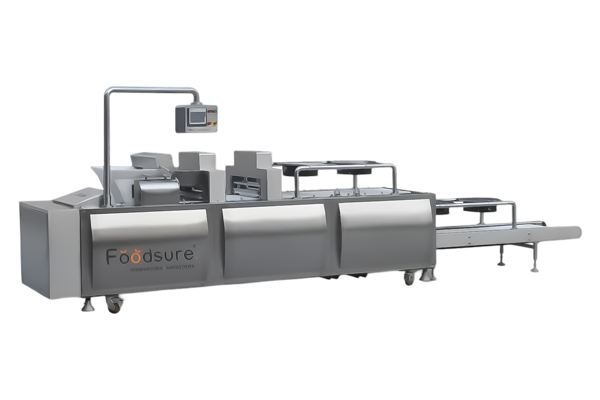
Brands developing nutrition bars, energy bars, or other formed snack bars can also explore a protein bar machine. Bar production generally requires equipment suited to mixing, forming, cutting, cooling, and packaging the intended formulation.
For manufacturers interested in other packaged snack categories, a makhana machine provides a route to explore roasted foxnut processing. Makhana is a different raw material from soy, and its cleaning, roasting, seasoning, and packaging needs must be assessed separately.
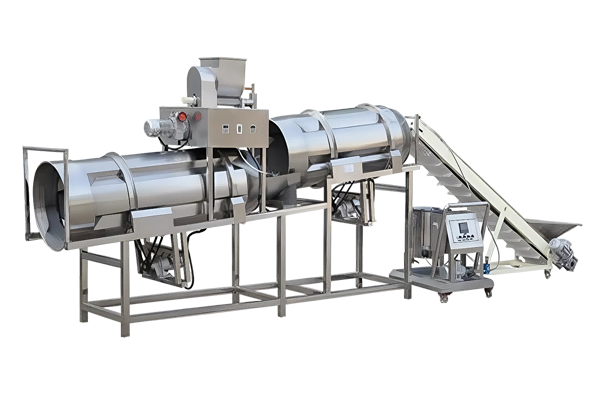
Businesses considering popcorn or other seasoned ready-to-eat snacks should similarly evaluate dedicated popping and seasoning equipment. Foodsure’s seasoning machine page describes equipment for applying flavours to products including popcorn and extruded snacks. Confirm the availability of a suitable popcorn production and popping system directly with the supplier.
These links are most useful when treated as separate business opportunities rather than as equipment that can automatically be added to a soya badi line.
11. Common Mistakes to Avoid
Buying more capacity than you need
A high-output machine does not guarantee higher profits. If sales remain low, the factory may run below capacity while rent, wages, and other fixed expenses continue.
Ignoring the drying stage
The extruder and dryer must be planned as a coordinated system. A dryer that cannot handle the output of the extruder can create a bottleneck and disrupt production.
Skipping production trials
A machine may perform differently with different raw materials and formulations. Test the intended product before finalising the configuration.
Underestimating working capital
Cash is needed for ingredients, packaging, wages, electricity, maintenance, transport, and distributor credit. Include these expenses in the financial plan.
Neglecting packaging and storage
Poor moisture protection, weak seals, unsuitable storage, or inadequate labelling can damage the product’s marketability and shelf life.
Making unsupported nutritional claims
Protein-related claims should match the product’s tested nutritional composition and the rules of the target market. Avoid claims that cannot be substantiated.
Relying on one customer or distributor
Depending on one buyer can create serious cash-flow problems if orders are delayed or cancelled. Develop a balanced sales pipeline and monitor repeat orders.
A Practical Launch Plan for 2026
A new manufacturer can organise the project into eight stages.
Stage 1: Market research
Interview retailers, wholesalers, foodservice buyers, and distributors. Record competing products, pack sizes, prices, and estimated monthly demand.
Stage 2: Product development
Choose the intended product format, formulation, nutritional specification, and packaging. Test texture, cooking behaviour, and shelf life.
Stage 3: Financial planning
Estimate the complete plant cost, operating expenses, cost per kilogram, working capital, expected sales, and break-even volume.
Stage 4: Machinery selection
Compare suppliers based on technical specifications, trials, energy requirements, production consistency, installation, operator training, spare parts, and after-sales support.
Stage 5: Factory preparation
Plan raw material storage, production flow, utilities, ventilation, drainage, finished-product storage, packaging, and safe movement of workers and materials.
Stage 6: Regulatory checks
Verify the required business registrations, factory approvals, food safety obligations, product standards, packaging and labelling rules, and any export requirements.
Stage 7: Installation and trial production
Install the equipment and establish stable processing conditions. Test finished products, document the results, and correct problems before full-scale production.
Stage 8: Commercial launch
Start with selected buyers and a manageable distribution area. Track sales, repeat orders, customer complaints, production yield, packaging performance, and contribution per kilogram.
Use the results to decide when to increase production or expand into additional markets.
Start With Market Demand and Build the Right Production Line
Starting a soya badi manufacturing business in Bangladesh requires a clear plan for raw materials, production technology, quality, compliance, packaging, and sales.
The strongest approach is to establish what your customers will buy, determine the product specifications, calculate the cost of production, and then select machinery that fits the business plan.
For entrepreneurs comparing suppliers, Foodsure Machines offers a soya badi production line with supporting equipment for extrusion, drying, cooling, and packaging. Request a technical proposal based on your intended formulation, required capacity, available utilities, and factory layout.
Before making an investment, ask for a detailed equipment configuration, production trial, installation plan, operator training, spare-parts information, and after-sales support terms.
The objective is not to build the largest factory possible. It is to build a plant that produces consistent quality, controls costs, serves customers reliably, and expands when sales justify the investment.
Frequently Asked Questions
Is soya badi manufacturing profitable in Bangladesh?
It can be commercially viable, but profitability depends on raw material prices, production yield, energy consumption, labour, packaging, selling prices, distribution costs, and capacity utilisation. Prepare a financial model based on actual local quotations and realistic sales estimates.
Which machine is used to manufacture soya badi?
An extrusion-based soya badi production line is commonly used. Depending on the product and output target, the line may include a mixer, feeder, extruder, die, cutter, dryer, cooling conveyor, and packaging system.
What is the raw material for soya badi?
Defatted soy flour and other suitable soy protein-rich ingredients are commonly used. The formulation depends on the intended product, texture, nutritional specification, and processing technology.
What is the difference between soya badi and TVP?
TVP stands for textured vegetable protein. Soya badi, soya chunks, and soya nuggets are common soy-based forms of TVP. The term TVP can also cover textured products made from other suitable plant protein ingredients.
How do I select the right soya badi machine capacity?
Start with your expected monthly sales, operating hours, product mix, and available working capital. Select equipment that can meet realistic demand and allow sensible expansion. Confirm the rated capacity under conditions relevant to your product.
Can one machine produce different soya badi shapes?
Some systems can produce different shapes using suitable dies and cutting arrangements. Confirm which formats the proposed configuration can handle and whether adjustments or additional equipment are required.
What is the total investment for a soya badi plant in Bangladesh?
The cost depends on the production capacity, automation, factory rent or construction, equipment configuration, installation, utilities, quality testing, and working capital. Obtain a complete project quotation instead of relying on the extruder price alone.
What approvals are needed to start a soya badi factory in Bangladesh?
Requirements depend on the business, location, and product. Entrepreneurs should verify applicable business and factory registrations, BFSA requirements, BSTI certification where applicable, and fire, environmental, tax, and other relevant approvals with the responsible authorities.
Can I export soya badi from Bangladesh to Nepal, India, or Sri Lanka?
Potentially, subject to the destination market’s import rules, product standards, labelling requirements, customs procedures, and any necessary certificates. Check these requirements before committing to export orders.
Can I expand from soya badi into other high-protein snacks?
Yes, as a business strategy, but each product category must be assessed separately. Protein puffs, protein bars, makhana, and popcorn have different raw materials and processing needs. Choose equipment based on the intended product rather than assuming one machine can handle every category.