
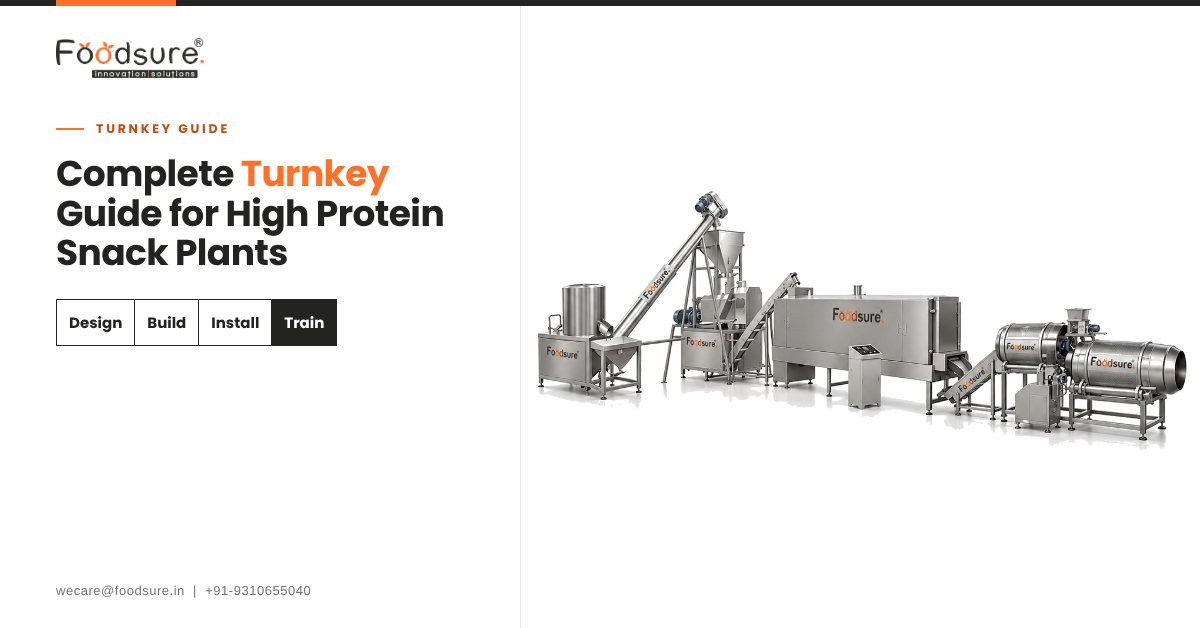
High protein snacks are no longer limited to products sold in specialist sports nutrition stores. Food manufacturers can now develop protein bars, extruded snacks, protein chips, roasted pulses, nut and seed bars, and other convenient products for different consumer groups.
For manufacturers in India, Nepal, Bangladesh and Sri Lanka, the opportunity is to develop products that balance protein content, taste, affordability and consistent quality. However, launching a successful product requires more than selecting a recipe. Manufacturers also need suitable processing equipment, reliable packaging, quality control and a production line that matches their expected sales.
This is where a high protein snack machine becomes important. Depending on the product, a commercial setup may require mixing, extrusion, forming, cutting, baking, roasting, cooling, seasoning and packaging equipment. Each machine must work with the formulation and the rest of the production line.
Foodsure Machines helps food businesses plan processing equipment around their product requirements and production goals. Whether you want to manufacture protein bars, high protein chips or pulse-based snacks, the first step is to identify the right process before investing in machinery.
This guide explains the equipment required, production capacity, plant setup costs, automation options and food safety considerations for manufacturers planning a commercial high protein snack manufacturing plant in South Asia.
Why Consider High Protein Snack Manufacturing?
Protein-rich foods are already part of everyday diets across South Asia. Pulses, lentils, chickpeas, peanuts, soybeans and other ingredients provide opportunities to develop familiar foods in convenient, packaged formats.
The OECD and Food and Agriculture Organization’s Agricultural Outlook 2026–2035 identifies pulses as an important source of plant-based protein and dietary fibre. It also explains how pulse-derived proteins, starches and fibres are being used in processed foods, including snacks and bakery products.
The report projects that global per-person food consumption of pulses will increase by 11% from its base period to reach 8.2 kg per year by 2035. This is a projection for pulses as a food category, not a growth forecast for the high protein snack market. However, it helps explain why pulse-based ingredients deserve consideration when developing new snack products.
For manufacturers, there are several possible product directions:
- Protein bars: Convenient products made using protein ingredients, cereals, nuts, seeds and suitable binders.
- High protein chips and puffs: Extruded or otherwise processed snacks developed using cereal, pulse and protein-rich ingredients.
- Roasted pulse snacks: Chickpeas, lentils, peas and other suitable ingredients processed into seasoned snacks.
- Nut and seed snacks: Products combining peanuts, seeds, cereals and other ingredients.
- Soya-based snacks: Products made using soy ingredients and suitable processing methods.
- Protein bites and clusters: Small-format snacks made using compatible combinations of protein ingredients, nuts, seeds and cereals.
Not every product needs to target the premium fitness market. Depending on the formulation, pack size and nutritional profile, manufacturers can develop products for general snacking, convenience retail, fitness-focused customers or specialist food brands.
The commercial question is not simply whether a product contains protein. It is whether the product can be manufactured consistently, packaged safely and sold at a price that works for the intended market.
What Is a High Protein Snack Manufacturing Plant?
A high protein snack manufacturing plant is a food-processing facility designed to produce protein-rich snacks at a commercial scale.
The equipment depends on the product being manufactured. A protein bar production line uses different machinery from an extruded snack line or a roasted pulse processing line.
A typical production flow may include:
Raw material handling → Weighing → Mixing → Processing or forming → Cooking or roasting → Cooling → Seasoning or coating → Packaging
Some products require only a few of these stages, while others need a more complex production line.
For example, a protein bar may require a mixer, forming system, cooling arrangement, cutter and flow-wrap packaging machine. Extruded protein snacks may need a suitable extruder, cutter, dryer, seasoning system and packaging equipment.
A turnkey project brings the relevant stages together. Instead of buying separate machines without checking their compatibility, the manufacturer plans the process, equipment capacity, utilities, layout and packaging requirements as one system.
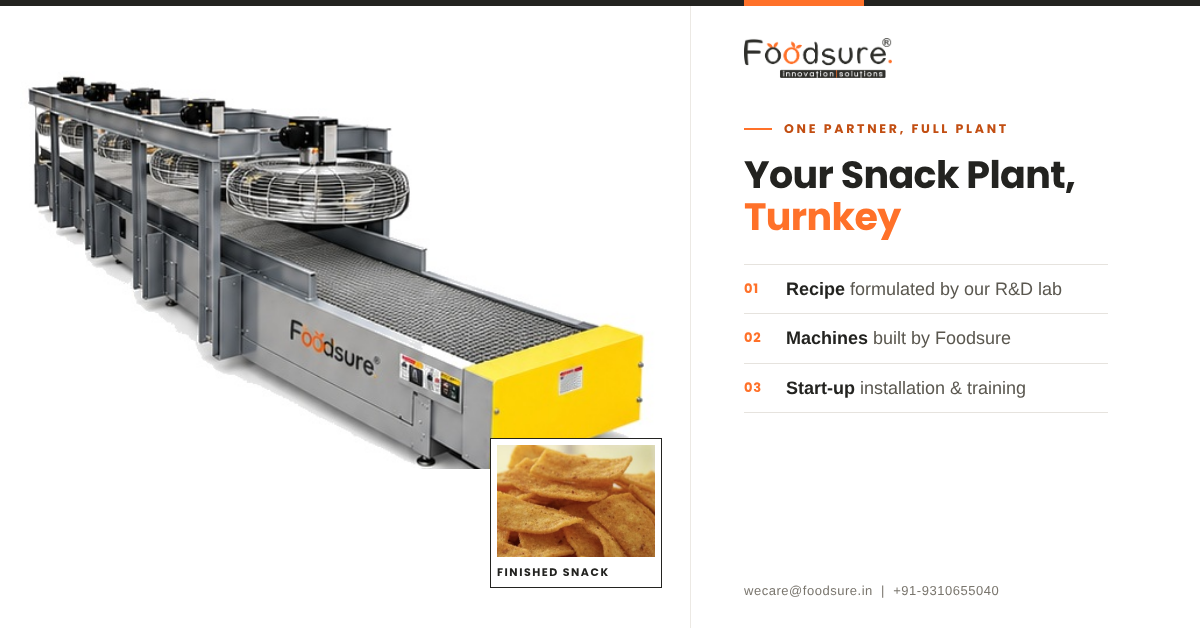
This approach is particularly useful for businesses that want to expand from trial production to regular commercial manufacturing.
Which High Protein Snacks Can You Manufacture?
Before choosing a high protein snack machine, decide which products you want to manufacture. The product determines the ingredients, processing method, equipment configuration and packaging format.
1. Protein Bars
Protein bars can be developed using whey, milk, soy, pea or other suitable protein ingredients. Depending on the recipe, manufacturers may also use oats, nuts, seeds, dates, cocoa, cereals and binders.
A commercial protein bar production line may include:
- Ingredient weighing and mixing equipment
- A slab-forming or bar-forming machine
- A cooling system, where required
- A cutting machine
- An optional chocolate enrober
- A suitable packaging machine
The final equipment selection depends on the bar’s texture, dimensions, ingredients and target output.
For businesses specifically planning this product category, a Protein Bar Machine is a relevant next step to explore. The machine configuration should be matched to the formulation and the required number of bars per hour.
2. High Protein Chips, Puffs and Extruded Snacks
Extrusion can be used to manufacture different snack shapes, including curls, puffs, sticks and crisps. The formulation may combine cereal ingredients, pulse flours, protein ingredients and other components.
A typical process may involve feeding, conditioning, extrusion, cutting, drying, cooling, seasoning and packaging.
Protein concentration affects how a mixture behaves during processing. A formulation with a high proportion of protein ingredients may expand differently from a conventional cereal-based formulation. It may also require adjustments to moisture, temperature and other processing conditions.
For this reason, manufacturers should evaluate the formulation and the high protein snack extruder machine together before finalising the production line.
3. Roasted Chickpeas, Lentils and Other Pulse Snacks
Roasted pulse snacks offer another product direction for South Asian food businesses. Chickpeas, lentils, peas and other suitable ingredients can be processed into seasoned, packaged snacks.
Depending on the raw material, the process may include cleaning, grading, soaking or conditioning, roasting, cooling, seasoning and packaging.
The product’s moisture content, texture and required shelf life influence the equipment configuration. Manufacturers should also evaluate the quality of the incoming raw material and validate the roasting conditions.
4. Nut, Seed and Protein Bites
Protein bites and clusters can combine protein ingredients with nuts, seeds, cereals, fruit ingredients and suitable binders.
These products may be formed into small pieces, coated or packaged in single-serve pouches. A manufacturer planning several product variations should consider whether the forming equipment can accommodate different sizes and textures without excessive changeover time.
5. Makhana and Popcorn Products
A manufacturer does not have to limit the business to protein-labelled products. Makhana and popcorn can provide additional snack categories, although their nutritional composition depends on the ingredients and processing method.
Businesses interested in expanding into traditional and contemporary snack formats can also explore a Makhana Machine for makhana processing and a Popcorn Machine for popcorn production.
These machines serve different processing needs from a high protein snack production line. They should be evaluated as separate equipment requirements unless a supplier has confirmed a compatible integrated configuration.
Similarly, manufacturers exploring soy-based products can review the Soya Badi Machine. Soya badi production involves its own mixing, extrusion and drying requirements and should not be assumed to use the same line as protein bars or expanded snacks.
How to Choose the Right High Protein Snack Machine
The right machine is the one that can produce your intended product consistently at the required output. A machine with a high advertised capacity may not be suitable if it cannot handle your ingredients or achieve the desired texture.
Before requesting a quotation, define the following requirements.
Product and Formulation
Identify the product, protein source, other ingredients, texture and final dimensions. Share the formulation with the equipment supplier where possible.
Different formulations behave differently during mixing, extrusion and forming. Product trials can help identify processing problems before the equipment is finalised.
Production Capacity
Calculate how much finished product you expect to sell per day or month. Then consider working hours, shifts, cleaning, changeovers, planned downtime and packaging speed.
Do not base your entire investment decision on the machine’s maximum rated output. Actual production depends on the formulation, process conditions and the performance of the complete line.
Automation Level
Decide which operations should be manual, semi-automatic or fully automatic.
A smaller business may prefer a setup with operator-assisted feeding and packaging. A larger manufacturer may require automatic ingredient feeding, continuous processing, integrated controls and automated packing.
Packaging Format
Decide whether the finished product will use flow-wrap packs, pillow packs, sachets, stand-up pouches or multipacks.
The packaging equipment must match the product dimensions, weight, required sealing performance and planned production rate.
Utilities and Factory Space
Check the available electrical supply, water requirements where applicable, ventilation, compressed air requirements and floor space.
The equipment supplier should provide the relevant technical specifications before the factory layout and utility connections are finalised.
Equipment Required for a Commercial Protein Snack Production Line
A high protein snack manufacturing plant can include several types of equipment. Not every project requires every machine.
| Equipment | Main purpose |
| Ingredient handling system | Stores and transfers raw materials |
| Weighing equipment | Measures ingredients for the formulation |
| Mixer or blender | Distributes ingredients evenly |
| Extruder | Processes suitable mixtures into snack shapes |
| Forming machine | Shapes protein bars, bites or other products |
| Cutter | Produces consistent product sizes |
| Oven, roaster or dryer | Applies the required heat treatment or moisture reduction |
| Cooling conveyor | Cools products before subsequent processing or packing |
| Seasoning or coating system | Applies flavourings or coatings |
| Packaging machine | Fills, wraps or seals the finished product |
| Inspection equipment | Supports checks for weight, foreign material or other defined quality requirements |
Mixing Equipment
Mixing is essential for products that combine protein powders, cereals, fats, binders, nuts, seeds and other ingredients.
A suitable mixer should distribute ingredients evenly without creating excessive variation in texture. The required mixing system depends on the batch size, ingredient characteristics and formulation.
Extrusion Equipment
For extruded snacks, the extruder’s design and operating conditions must match the recipe.
Important factors include feed moisture, temperature, screw configuration, screw speed, feed rate and die design. Manufacturers should confirm these parameters through trials rather than assuming that a machine designed for a conventional cereal snack will automatically produce a high protein snack successfully.
Forming and Cutting Equipment
Protein bars and bites need consistent dimensions and weight. The forming and cutting equipment should accommodate the product’s texture and allow the manufacturer to achieve the intended size with minimal deformation.
Product consistency also affects packaging efficiency and the amount of material used per pack.
Roasting, Baking and Drying
Thermal processing must suit the product. Roasting may be suitable for pulses, nuts and seeds, while baking or drying may be required for other snack formats.
The correct process depends on the formulation, moisture level, texture and food safety requirements. It should be validated for the finished product rather than selected only on the basis of machine capacity.
Packaging and Inspection
Packaging protects the product during storage and distribution. The right packaging material depends on the product’s sensitivity to moisture, oxygen, light and physical damage.
The plant may also require weighing checks, coding equipment, metal detection or other inspection systems based on the product risk assessment and applicable requirements.
How Much Does a High Protein Snack Machine Cost?
The high protein snack machine price depends on the equipment configuration. There is no single price that applies to every product or production capacity.
A machine intended for forming protein bars is not directly comparable with an extruder for protein puffs or a complete line that includes drying, seasoning and packaging.
The main factors affecting the cost of a high protein snack manufacturing machine include:
- Type of product and formulation
- Required production capacity
- Manual, semi-automatic or automatic operation
- Number of processing stages
- Food-contact material specifications
- Packaging equipment and pack format
- Electrical and other utility requirements
- Factory layout and installation needs
- Product trials and commissioning
- Operator training, warranty and after-sales support
For a complete plant, the budget should also cover factory preparation, quality-control requirements, raw materials for trials and working capital.
A supplier quotation should clearly identify what is included and excluded. Check whether it covers installation, commissioning, training, spare parts, packaging equipment and any additional utilities.
The best way to estimate the investment is to share your product details, required output, packaging format and available factory space with the supplier. This allows the equipment configuration to be planned around your actual production needs.
Semi-Automatic vs Fully Automatic Production
The appropriate automation level depends on demand, budget, labour availability and the level of control required.
Semi-Automatic Production
A semi-automatic setup may suit a new food brand or a manufacturer starting with a limited product range.
Operators may handle some ingredient feeding, product transfer or packaging activities. This can reduce the initial equipment requirement, but the business needs to plan for labour, training and consistent operating procedures.
Fully Automatic Production
A fully automatic line can connect multiple stages, from feeding and processing to cooling, seasoning, inspection and packaging.
Depending on the configuration, automation can reduce manual handling and help maintain consistent operating conditions. However, it also requires suitable maintenance, trained operators and a clear plan for cleaning and product changeovers.
Modular Production
A modular setup allows a business to start with the equipment needed for its initial products and expand later.
For example, a manufacturer may begin with a core processing line and add automatic feeding, extra forming capacity or faster packaging when sales justify the investment.
The important point is to ensure that the original line can support the planned additions. Expansion should be considered during the initial engineering stage.
Planning a High Protein Snack Plant for India, Nepal, Bangladesh and Sri Lanka
South Asia is not a single uniform market. Ingredient availability, consumer preferences, packaging needs, production costs and regulatory requirements differ by country and product category.
Manufacturers should use local market research to decide which products to launch rather than relying on a single regional growth estimate.
India
India’s established use of pulses, chickpeas, lentils, peanuts and other plant ingredients provides several possible starting points for protein-rich snack development.
Manufacturers can explore roasted pulse snacks, cereal-based bars, extruded snacks and products made with suitable soy or pea protein ingredients. The choice should depend on the target customer, price point, ingredient supply and desired nutritional profile.
For Indian manufacturers, the Food Safety and Standards Authority of India (FSSAI) publishes the Labelling and Display Regulations and the Advertising and Claims Regulations, along with their amendments.
Before making a protein, nutrition or health claim, manufacturers should check the applicable requirements and confirm that the finished product meets them. The product label must accurately reflect the formulation and nutritional information.
Nepal
Nepalese manufacturers can explore products using pulses, cereals, peanuts, seeds and other ingredients suited to their sourcing and pricing plans.
Potential products include roasted lentil snacks, pulse-based extruded snacks, nut and seed bars, and protein-rich cereal snacks. Manufacturers should first confirm that the selected ingredients and processing method can deliver the required taste, texture and shelf life.
Nepal’s Department of Food Technology and Quality Control (DFTQC) publishes food laws, regulations and standards through its official website. Its guidance also provides information about details required on packaged-food labels.
Businesses planning to sell in Nepal should verify the current applicable food safety, registration, labelling and product-specific requirements before commercial production.
Bangladesh
For Bangladesh, manufacturers should evaluate the selling price, pack size, distribution channel and ingredient cost before selecting a product format.
Small packs may be worth testing alongside larger packs, but the decision should be based on consumer research and production economics rather than an assumed preference across the entire market.
Pulse-based snacks, cereal bars, extruded snacks and other convenient formats can be assessed through product trials and local market testing.
The Bangladesh Food Safety Authority publishes applicable food laws and regulatory updates through its official laws portal. Manufacturers should review the current rules relevant to packaged-food labelling, advertising and claims, food additives and the specific product category.
Sri Lanka
Sri Lankan manufacturers can assess protein-rich snacks made with suitable pulses, peanuts, cereals, seeds and other ingredients available through their supply chains.
Regional flavour development may help distinguish a product, but the formulation should still meet its intended nutritional, quality and cost targets.
The Sri Lankan Ministry of Health’s food regulatory resources include the Food Labelling and Advertising Regulations. The current regulatory position should be checked before finalising labels, especially because newer regulations and commencement dates can affect compliance.
What All Four Markets Have in Common
Regardless of the country, manufacturers should make five decisions before purchasing machinery:
- Identify the target consumer and product category.
- Confirm the ingredients and final formulation.
- Establish the intended production capacity.
- Select the pack format and required shelf life.
- Verify the applicable food safety and labelling requirements.
A production line designed around these decisions is more likely to fit the actual business requirement than a machine selected only by price or advertised output.
Food Safety and Quality Control in High Protein Snack Manufacturing
Food safety must be part of the plant design from the beginning. It should not be treated as a final check after the machinery has been installed.
Raw Material Checks
Incoming ingredients should be checked against defined specifications. Depending on the ingredient, this may include identity, moisture, protein content, microbiological quality, foreign matter and allergen status.
Supplier approval and traceable purchasing records also help manufacturers investigate quality problems when they arise.
Process Monitoring
The plant should have clear operating procedures for mixing, extrusion, roasting, drying, cooling and other relevant stages.
The parameters that require monitoring depend on the product and process. They may include temperature, time, moisture, product weight and other factors that influence finished-product quality and safety.
Allergen Management
Protein snacks may contain milk, soy, peanuts, tree nuts, wheat or sesame.
Manufacturers should identify the allergens in each formulation and establish appropriate storage, handling, cleaning and labelling procedures. These controls are especially important when a single facility produces several different products.
Finished Product Testing
The testing plan should reflect the product and destination market. Depending on the formulation, manufacturers may need to evaluate protein content, moisture, microbiological parameters, water activity, texture, shelf life and packaging integrity.
A protein claim should be supported by suitable nutritional information and testing where required. Manufacturers should not rely solely on ingredient specifications to determine the final product’s declared protein content.
Common Mistakes When Setting Up a Protein Snack Production Line
Buying Machinery Before Finalising the Product
The formulation and process determine the equipment requirement. Buying machinery first can lead to unnecessary modifications or a line that cannot produce the intended product.
Selecting Capacity Based Only on Maximum Output
Rated capacity does not always equal actual saleable output. Allow for cleaning, changeovers, downtime, rejected products and the speed of downstream equipment.
Ignoring Packaging Requirements
A processing line can produce a good snack and still face commercial problems if the packaging cannot protect the product or keep up with production.
Overlooking Product Trials
Trials help establish whether the formulation works with the chosen equipment. They can reveal problems with expansion, binding, texture, moisture and processing conditions before full-scale production.
Underestimating Operating Costs
The total cost of production includes more than the machine purchase price. Ingredient costs, packaging, labour, electricity, maintenance, quality testing and wastage also affect profitability.
Treating Turnkey Supply as Machinery Delivery Only
A complete project may require process planning, equipment integration, installation, commissioning, operator training and production trials.
These requirements should be discussed with the supplier and clearly documented in the project scope.
How Foodsure Machines Can Help With Your Plant Setup
Selecting a high protein snack machine is only one part of setting up a commercial production facility. The equipment also needs to match the product formulation, factory layout, required output and packaging process.
Foodsure Machines works with food businesses planning processing and manufacturing setups. Depending on the project scope, the planning process can cover equipment selection, production flow, capacity requirements, utilities, installation, commissioning, operator training and after-sales support.
Before requesting a quotation, prepare the following details:
- Product type, such as protein bars, high protein chips or roasted pulse snacks
- Target production capacity in kilograms per hour
- Ingredients or a preliminary formulation
- Required pack size and packaging format
- Available factory space and electrical supply
- Preferred automation level
- Target market and expected launch timeline
These details help establish whether you need an individual machine, a connected production line or a larger turnkey project.
For businesses comparing the high protein snack machine price across suppliers, request a technical quotation that clearly states the machine configuration, rated output, utility requirements, included equipment, installation scope and support terms.
Contact Foodsure Machines to discuss your product, production capacity and machinery requirements before finalising your investment.
Conclusion
Setting up a high protein snack manufacturing plant requires a clear understanding of the product, ingredients, processing method, capacity and packaging requirements.
Manufacturers in India, Nepal, Bangladesh and Sri Lanka can explore several product categories, including protein bars, extruded snacks, high protein chips, roasted pulses and nut or seed-based snacks. However, each product requires a suitable process and a formulation that can deliver consistent quality at the intended selling price.
The right high protein snack manufacturing machine is not necessarily the one with the highest rated output or the lowest initial price. It is the one that suits the product, works with the other equipment, meets the required quality standards and fits the business’s production plan.
Start with the product and target market. Validate the formulation, calculate realistic production capacity and then select machinery around those requirements. With the right planning and technical support, a snack concept can be developed into a production setup that is ready for commercial manufacturing and future expansion.
Frequently Asked Questions
What is a high protein snack machine?
A high protein snack machine is food-processing equipment used to manufacture protein-rich snacks. Depending on the product, it may be a mixer, extruder, forming machine, cutter, roaster or part of an integrated production line.
What is the price of a high protein snack machine?
The price depends on the machine type, production capacity, automation, materials, included equipment and installation requirements. For an accurate quotation, share the product details, target output and packaging requirements with the supplier.
Which machine is required for high protein snack manufacturing?
The required equipment depends on the snack. Protein bars may need mixing, forming, cooling and cutting equipment. Extruded snacks may require an extruder, cutter, dryer, seasoning system and packaging machine.
Can one production line manufacture different high protein snacks?
A line may be designed for multiple compatible products, but not every snack can be produced on the same equipment. Confirm product compatibility, tooling, formulation requirements, cleaning and changeover needs before purchasing machinery.
What is the difference between a protein bar machine and a high protein snack machine?
A protein bar machine is designed for forming or processing bars. A high protein snack machine is a broader term that may refer to equipment for bars, extruded snacks, chips or other protein-rich products.
Is a high protein snack extruder machine suitable for protein chips?
An extruder can be suitable for certain protein chip and puff formats. The formulation, moisture, temperature, screw configuration and die design must be evaluated to achieve the desired texture and expansion.
How do I choose the right production capacity?
Estimate expected sales, working hours, shifts, cleaning time, changeovers and downtime. Then select a line that can meet the production target without creating unnecessary capacity or investment.
What ingredients can be used to make high protein snacks?
Depending on the product, manufacturers may use whey, milk, soy, pea, rice or pulse-derived protein ingredients, along with cereals, nuts, seeds and other components. The final choice depends on taste, texture, nutritional targets, ingredient cost and processing performance.
Is a turnkey protein snack manufacturing plant suitable for a new business?
A turnkey setup can help a new business plan compatible equipment and production stages. The scope should match the expected demand, available budget and intended product range rather than include unnecessary machinery.
What should I check before buying a commercial protein snack machine?
Check product compatibility, rated and expected output, food-contact materials, power requirements, cleaning, changeover time, installation, commissioning, warranty, spare parts, operator training and after-sales support.
Can I set up a high protein snack plant in Nepal, Bangladesh or Sri Lanka?
Yes, provided the equipment and product are planned for the local operating conditions and applicable food regulations. Confirm the ingredients, utilities, packaging, labelling and other compliance requirements before commercial production.
How can I estimate the cost of a complete protein snack production line?
Prepare a list of required processing stages, target capacity, packaging format, utilities and factory requirements. Ask suppliers to separate machinery costs from installation, commissioning, training and other project expenses so that quotations can be compared accurately.
Why are product trials important before buying a high protein snack machine?
Trials help establish whether the selected equipment can process the formulation and achieve the desired texture, shape and output. They can also reveal changes needed in moisture, temperature, mixing or other operating conditions.
Can I expand from protein bars into other snack categories?
Expansion is possible, but different snack categories may require separate processing equipment. Plan the original plant with future products in mind, while confirming technical compatibility before adding new machinery.
What information should I share to get a quotation from Foodsure Machines?
Share the intended product, ingredients or formulation, target output, packaging format, available factory space, utility details and preferred automation level. This information helps establish the equipment configuration and project scope required for your manufacturing plan.
<script>




