
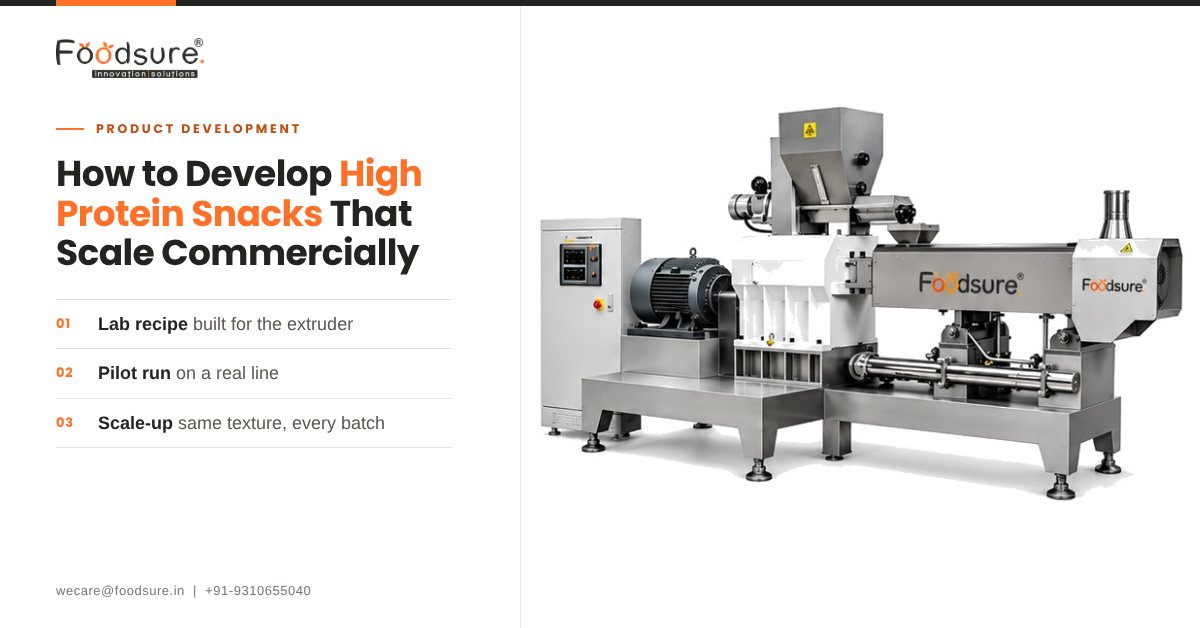
High-protein snacks offer food manufacturers an opportunity to develop products for fitness consumers, working professionals, students and everyday snack buyers. In India, Nepal, Bangladesh and Sri Lanka, businesses can explore products such as protein chips, protein bars, extruded snacks, roasted legumes and other foods made with protein-rich ingredients.
However, developing a successful high-protein snack requires more than adding protein powder to a recipe. Manufacturers must consider taste, texture, nutritional value, ingredient costs, shelf life, packaging and food safety. A recipe that works in a small kitchen may behave differently when produced in batches of hundreds of kilograms.
This is where product development and machinery selection become important. The right formulation, production process and equipment help manufacturers maintain consistent quality while preparing their products for commercial distribution.
In this guide, we explain how to develop high-protein snacks for commercial production, select suitable ingredients, choose the right high protein snack machine and plan manufacturing for South Asian markets.
Why Should Food Manufacturers Explore High-Protein Snacks in South Asia?
High-protein snacks can serve several consumer groups, but their commercial potential depends on local demand, purchasing power, competition and distribution. Manufacturers should evaluate these factors before investing in a production line.
Three considerations can help businesses assess the opportunity.
1. Consumer Needs and Convenience
Some consumers look for snacks that fit into their workday, travel routine or fitness schedule. Others prioritise taste, affordability and familiar ingredients.
This creates several product development options, including:
- Protein chips and savoury crisps
- Protein bars and nutrition bars
- Roasted chickpeas and soy-based snacks
- Extruded snacks made with pulses and cereals
- Makhana and other roasted snack products
The best product depends on the intended customer. A premium protein bar sold through fitness retailers may require a different formulation and price point from an affordable savoury snack sold through local grocery stores.
2. Regional Ingredients and Flavours
South Asian manufacturers can explore locally available ingredients such as soybeans, chickpeas, lentils, rice and millet, depending on sourcing, quality and formulation requirements.
For example, a business in Nepal could test millet-based savoury snacks, while a manufacturer in Bangladesh might explore chickpea or lentil formulations. In Sri Lanka and India, manufacturers could test different spice blends alongside familiar snack formats.
These are product development opportunities, not guarantees of consumer demand. Taste testing and market research should determine which products move forward.
3. Local Manufacturing and Distribution
Manufacturing locally may help businesses manage lead times, adjust flavours and coordinate distribution. However, producing locally is not always cheaper than importing finished products.
The actual cost depends on raw materials, machinery, electricity, labour, packaging, maintenance and production volume.
Before setting up a manufacturing unit, calculate the expected cost per pack and compare it with the intended selling price. This helps establish whether the product can compete in the target market.
What Does Commercially Scalable High-Protein Snack Production Mean?
Commercial scalability means producing larger quantities of a snack while maintaining consistent taste, texture, nutritional composition, food safety and cost.
A formulation that works in a 5 kg trial may not perform identically in a 100 kg batch. Mixing efficiency, moisture distribution, processing temperatures and cooling times can all affect the final product.
| Small-scale production | Commercial production |
| Small batches prepared manually | Standardised batches or controlled processing |
| Ingredient quantities adjusted by eye | Measured and documented formulations |
| Basic taste and texture checks | Planned quality checks and production records |
| Small quantities packed by hand | Packaging systems suited to production requirements |
| Limited storage testing | Shelf-life studies under intended conditions |
The objective is not simply to manufacture more snacks. It is to establish a repeatable production process that delivers acceptable quality at a commercially workable cost.
How to Identify the Right Market Before Developing a Product
Before choosing ingredients or purchasing a high protein snack making machine, identify who will buy the finished product and what they expect from it.
The target customer influences the recipe, protein content, pack size, price, flavour and manufacturing process.
Understand Your Target Customers
Fitness consumers may look for clearly stated protein content, convenient portions and nutritional information.
Working professionals and students may prioritise portability, taste, affordable pricing and easy-to-carry packaging.
Families may prefer familiar flavours, accessible prices and clear ingredient information.
Retailers and distributors generally need consistent quality, reliable supply, suitable packaging and commercially workable margins.
Export buyers may require product specifications, testing records, food safety documentation and compliance with the destination country’s regulations.
Defining the target customer early helps manufacturers avoid spending money on a product that is difficult to price or distribute.
Which Flavours Should Manufacturers Test?
Rather than launching too many flavours at once, start with a small selection that suits the intended market.
| Target market | Flavour ideas to test |
| India | Masala, chilli, tomato and roasted spices |
| Nepal | Garlic, pepper, chilli and herb blends |
| Bangladesh | Tangy spices, savoury masala and chilli |
| Sri Lanka | Black pepper, curry-inspired spices and coconut-based combinations |
These suggestions are starting points for product trials, not verified rankings of national flavour preferences. Test samples with the intended customers before finalising the formulation.
Which High-Protein Snack Should You Manufacture?
The product category determines the ingredients, processing method and machinery required. Four common options are protein chips, protein bars, extruded snacks and roasted snacks.
Protein Chips and Extruded Snacks
Protein chips and extruded snacks can be developed using suitable combinations of cereal flours, pulses and concentrated protein ingredients.
Depending on the formulation, production may involve ingredient mixing, hydration, extrusion or forming, drying, seasoning and packaging.
A high protein snack machine must match the intended product and processing method. Some products require an extrusion system, while others need separate forming, baking or roasting equipment.
Businesses planning commercial production should assess a commercial protein snack manufacturing machine based on:
- Product type and formulation
- Required output per hour
- Ingredient handling requirements
- Heating, drying and cooling needs
- Seasoning and packaging requirements
- Available factory space and utilities
The machine should be selected after the product formulation and production process have been evaluated.
Protein Bars
Protein bars are suitable for businesses exploring sports nutrition, convenience retail and online sales. Depending on the recipe, they may contain protein powders, nuts, seeds, cereals, sweeteners and binding ingredients.
The production process generally involves mixing, forming or sheeting, cutting, cooling where required, and packaging. Some formulations also require a coating stage.
A protein bar machine may combine several of these functions or form part of a larger production line. Before purchasing a protein bar making machine, check whether it supports your recipe, bar dimensions, target weight and intended output.
Businesses comparing a protein bar machine price should also consider installation, supporting equipment, packaging and ongoing operating costs rather than comparing the machine’s purchase price alone.
Soya-Based Snacks
Soya chunks and soya badi are established food formats that manufacturers can explore when developing protein-rich products for South Asian consumers.
Production commonly involves preparing a soy-based mixture, conditioning it where required, extrusion, cutting, drying and packaging. The exact process depends on the formulation and final product specifications.
A soya badi making machine is relevant for businesses planning to manufacture soya badi or soya chunks. Before selecting equipment, confirm the desired production capacity, product shape, moisture requirements and drying arrangement.
Manufacturers should also assess raw material quality and the final product’s nutritional composition before making protein-related claims.
Roasted Makhana and Other Roasted Snacks
Roasted chickpeas, soybeans, lentils and makhana provide other opportunities for savoury snack manufacturing.
Products can be developed with salt, spices or coatings depending on the intended market and formulation.
A makhana processing machine may be suitable for businesses that want to grade, roast, season and package fox nuts. The required equipment depends on whether the business purchases cleaned makhana or intends to carry out additional processing stages.
Popcorn is another snack category that businesses may consider when expanding their product range. A popcorn making machine serves a different application, so manufacturers should confirm the machine’s suitability for the intended product before purchasing it.
Popcorn should not automatically be marketed as a high-protein snack. Its nutritional composition depends on the ingredients, preparation method and final serving size.
How to Choose the Right Protein Ingredients
Protein ingredients behave differently during mixing, heating, extrusion and storage. Some absorb more water, while others affect texture, flavour, colour and product expansion.
The right choice depends on the target protein content, product format, manufacturing method and ingredient budget.
Soy Protein
Soy protein is used in several food applications, including protein-rich snacks and bars. Depending on the ingredient type and formulation, it can support extruded snacks and other savoury products.
Its suitability depends on ingredient quality, flavour, water absorption and processing conditions.
Manufacturers must also manage soy allergen declarations according to the applicable market’s labelling requirements.
Pea Protein
Pea protein can be used in plant-based snack formulations, either alone or in combination with other proteins and cereal ingredients.
Its effect on texture and flavour depends on the ingredient grade and inclusion level. Some formulations may become dry or dense when the proportion is too high, making pilot trials important.
Whey Protein
Whey protein is a dairy-derived ingredient commonly used in sports nutrition and protein bars.
It can support products aimed at consumers seeking dairy-based protein, but its behaviour during heating and processing must be considered. It may also affect moisture, texture and ingredient costs.
Because whey is milk-derived, appropriate allergen labelling is necessary.
Chickpea, Lentil and Cereal Ingredients
Chickpea flour, lentil ingredients, rice and millet can help manufacturers develop products around familiar regional ingredients.
However, using a pulse or cereal flour does not automatically make a snack high in protein. The nutritional composition of the complete recipe must be calculated and, where appropriate, verified through laboratory testing.
Manufacturers may combine these ingredients with soy, pea or other protein concentrates to achieve the intended nutritional target while maintaining acceptable taste, texture and cost.
Why Pilot Trials Matter Before Buying a Commercial Machine
Pilot trials help manufacturers determine whether a formulation can be produced reliably before investing in a larger manufacturing setup.
They can also reveal problems that would be expensive to correct after commercial production begins.
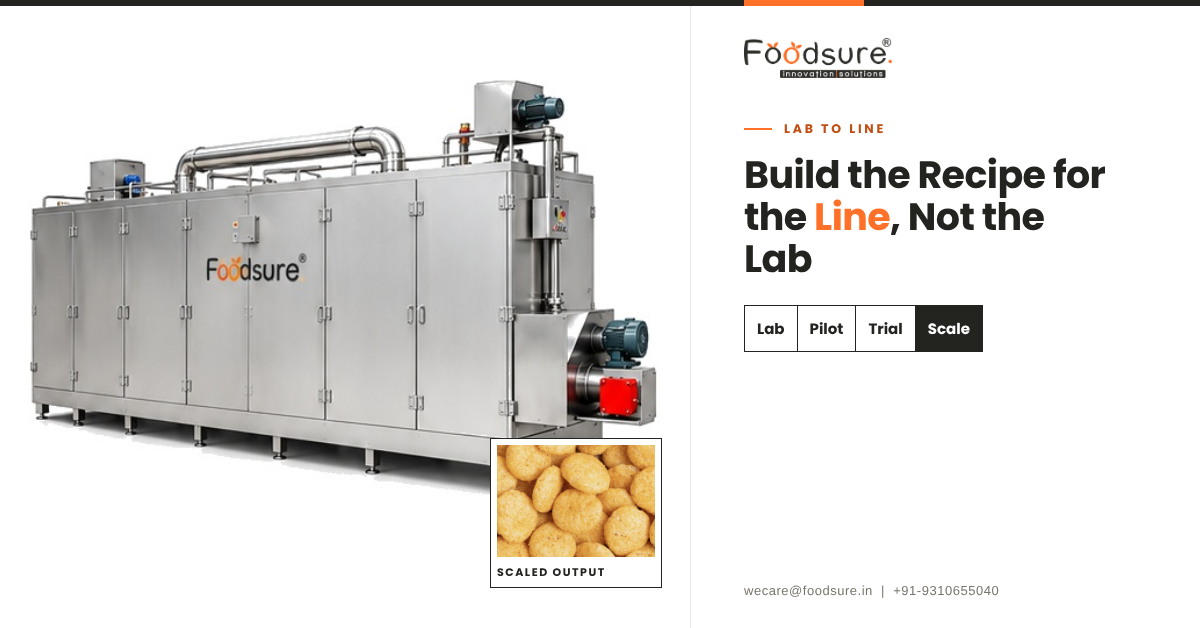
During a pilot trial, evaluate:
- Taste, aroma and texture
- Protein content and nutritional composition
- Ingredient mixing and moisture distribution
- Processing temperature and product expansion, where applicable
- Cutting accuracy and portion weight
- Drying and cooling requirements
- Packaging compatibility
- Product stability under intended storage conditions
For example, a protein bar may become too hard during storage, while an extruded snack may lose its crispness if moisture is not controlled properly.
These problems require different solutions depending on the formulation, production process and packaging. Increasing machine capacity alone will not resolve them.
Pilot results should guide the final recipe, processing parameters and equipment specifications.
How to Scale High-Protein Snack Production Commercially
A commercial manufacturing line may include raw material inspection, weighing, mixing, forming or extrusion, drying or cooling, seasoning, inspection and packaging.
The exact sequence depends on the snack being manufactured.
A Typical Production Workflow
- Raw material inspection: Check incoming ingredients against approved specifications.
- Weighing and mixing: Measure ingredients and prepare a uniform mixture.
- Forming, extrusion, baking or roasting: Use the process suited to the product.
- Drying or cooling: Control moisture and texture where required.
- Seasoning or coating: Apply the intended flavour and coating consistently.
- Inspection: Carry out the quality and safety checks required for the product.
- Packaging: Use suitable packaging to protect the finished snack during storage and distribution.
Each stage affects the final product. A problem with mixing, drying or packaging can lead to inconsistent quality, product losses or reduced shelf life.
Selecting a High Protein Snack Manufacturing Machine
The right high protein snack manufacturing machine depends on the product, recipe and required output. A single machine may not perform every operation needed for a complete production line.
Before requesting a quotation, establish the following:
Product type: Protein chips, bars, extruded snacks and roasted products require different processing systems.
Required capacity: Estimate the amount of finished product needed per hour or shift. Allow for cleaning, setup, downtime and rejected products.
Recipe compatibility: Confirm that the machine can handle the intended ingredients, moisture levels and processing conditions.
Utilities and space: Check electrical supply, ventilation, installation space and any requirements for drying or cooling.
Packaging requirements: Select packaging equipment and materials suitable for the product’s storage and distribution needs.
Cleaning and maintenance: Ask about cleaning procedures, spare parts, operator training and technical support.
Total project cost: Include machinery, installation, utilities, packaging, labour, testing and working capital.
Do not compare machines using hourly capacity alone. Advertised maximum output may differ from the actual saleable output achieved with a particular formulation.
Businesses searching for a high protein snack machine price should request a detailed specification sheet and, where possible, arrange a product trial using their intended formulation.
Foodsure Machines offers food processing equipment for different manufacturing applications. Businesses evaluating a production setup can discuss their product, recipe, target output and factory requirements before deciding on the appropriate equipment configuration.
How to Calculate Production Capacity and Manufacturing Cost
Capacity planning should begin with expected demand rather than the largest machine a business can afford.
For example, if a manufacturer plans to produce 200 kg of finished snacks during an eight-hour shift, the theoretical average output is 25 kg per hour.
The actual equipment requirement may be higher because production time also includes setup, cleaning, product changeovers and quality checks.
Required hourly output = Planned finished product quantity ÷ Available production hours
The estimate should then be adjusted for expected downtime and production losses.
Manufacturers should also calculate the cost per saleable kilogram or pack. Include:
- Raw materials and protein ingredients
- Packaging materials
- Electricity and other utilities
- Direct labour
- Cleaning and routine maintenance
- Product losses and rejected batches
- Distribution and other operating expenses
This calculation helps determine whether the intended selling price can support the business. Distribution margins, competition and repeat purchases must also be considered when evaluating commercial viability.
Food Safety, Labelling and Shelf Life in South Asian Markets
Food safety and accurate labelling are important from the first formulation trial, not just before the product reaches retailers.
Manufacturers should establish controls for ingredient quality, hygiene, allergen management, traceability, processing conditions and finished-product inspection.
Regulations differ by country, so products intended for multiple South Asian markets may require separate compliance checks.
India
Manufacturers should review the applicable Food Safety and Standards Authority of India (FSSAI) requirements for product standards, labelling, advertising and nutritional claims. The exact requirements depend on the product and the claims being made.
Bangladesh
Businesses should verify the applicable Bangladesh Food Safety Authority requirements and any relevant rules governing food labelling, safety and advertising claims.
Sri Lanka
Manufacturers should consult the Sri Lankan Ministry of Health’s Food Control Administration Unit for applicable food regulations, including labelling requirements.
Nepal
Businesses should check the applicable requirements with Nepal’s Department of Food Technology and Quality Control before finalising product specifications and packaging.
Across all four markets, a protein claim should be supported by the finished product’s nutritional composition and the relevant local rules. The quantity of protein powder added to a recipe alone does not establish that a finished snack qualifies for a particular claim.
Shelf life must also be validated. Formulation, moisture content, processing, packaging and storage conditions all affect product stability. Manufacturers should conduct appropriate shelf-life studies rather than assigning an expiry period based on assumptions.
Conclusion
Developing high-protein snacks that scale commercially requires more than a promising recipe. Manufacturers must understand their customers, select suitable ingredients, validate the production process and maintain quality from the first batch to the finished package.
For businesses in India, Nepal, Bangladesh and Sri Lanka, the practical starting point is to choose a product that fits the intended market and establish whether it can be manufactured consistently at a workable cost.
Once the formulation and production process are validated, selecting the right high protein snack machine becomes a more informed decision. Whether the product is an extruded snack, protein bar, soya badi or roasted makhana, the equipment should match the actual manufacturing requirement.
Foodsure Machines can be considered when evaluating equipment for a commercial food production setup. Discuss your product formulation, expected output, factory requirements and machinery specifications before investing in a production line.
Frequently Asked Questions
What is a high protein snack machine?
A high protein snack machine is equipment used to manufacture protein-rich snacks through processes such as mixing, extrusion, forming, roasting or baking. The required machine depends on whether the product is a protein chip, bar, extruded snack or roasted snack.
What is the price of a high protein snack machine?
The price depends on production capacity, automation, machine configuration and the processing stages included. Buyers should request a quotation based on their product, recipe and required output rather than relying on a generic price.
Which machine is best for commercial protein snack production?
There is no single machine suited to every product. Extruded snacks, protein bars, soya chunks and roasted makhana require different processing arrangements. Manufacturers should validate the recipe and confirm the equipment’s expected output before investing.
How do I start a high-protein snack manufacturing business in South Asia?
Start by researching the target customer, choosing a product category and developing a formulation. Test the product through pilot production, calculate manufacturing costs, assess machinery requirements and confirm the applicable food safety and labelling regulations before commercial launch.
Which ingredients can be used in high-protein snacks?
Common options include soy protein, pea protein, whey protein, chickpea flour and lentil ingredients. Rice, millet, oats and other cereals may also be used, depending on the recipe. The final protein content must be assessed for the complete product.
How can manufacturers increase the shelf life of protein snacks?
Shelf life depends on formulation, moisture content, processing conditions, packaging and storage. Manufacturers should conduct appropriate shelf-life studies under the conditions in which the product will be stored and distributed.
Can locally sourced ingredients be used in South Asian protein snacks?
Yes. Soybeans, chickpeas, lentils, millet and other regional ingredients can be explored for different formulations. Their suitability depends on sourcing, nutritional targets, processing behaviour, taste and cost.
What should I check before buying a commercial protein snack machine?
Confirm product compatibility, actual production capacity, utilities, installation requirements, cleaning procedures, spare parts, warranty, technical support and the total cost of the production setup.




