
Walk through the snack aisle of almost any supermarket in Colombo, Dhaka, or Kathmandu today, and one thing becomes clear. Consumers are no longer choosing snacks based only on taste. They’re reading nutrition labels, comparing protein content, and looking for healthier alternatives that fit their lifestyles.
This shift is creating one of the most promising opportunities in South Asia’s food manufacturing sector: extruded high protein snacks.
Whether it’s a startup launching a fitness-focused brand, an established food manufacturer expanding its portfolio, or an exporter targeting international buyers, protein-rich extruded snacks are becoming a fast-growing category. Rising disposable incomes, urban lifestyles, sports nutrition trends, and government support for food processing are all contributing to this momentum. Biospringer’s Asia Pacific high protein report values the region’s high protein market at USD 10.1 billion in 2025 and shows new product launches rising 47 percent between 2021 and 2025, from 3,377 to 4,955.
For manufacturers in Sri Lanka, Bangladesh, and Nepal, the timing couldn’t be better. Local demand is increasing, while regional production capacity is still developing, leaving room for businesses that can deliver consistent quality, competitive pricing, and innovative products. Getting the production line right from day one is the part many new entrants underestimate, and it is where an equipment partner like Foodsure Machines, a Noida-based maker of food processing machinery and turnkey plants, can save months of trial and error.
In this guide, we’ll explore the market potential, consumer trends, manufacturing opportunities, and why investing in commercial production could become a strategic move over the next decade.
What Are Extruded High Protein Snacks?
Extruded high protein snacks are ready-to-eat food products made by processing protein-rich ingredients through an extrusion system. The process combines heat, pressure, and mechanical force to create crispy, uniform snacks with enhanced texture, shelf stability, and nutritional value.
Unlike conventional fried snacks, extruded products can be formulated with ingredients such as:
- Soy protein isolate
- Pea protein
- Chickpea flour
- Lentil flour
- Rice flour
- Corn grits
- Oat flour
- Whey protein concentrate
- Pulse-based ingredients
- Natural seasonings
The result is a wide variety of nutritious snack products, including protein puffs, curls, rings, chips, sticks, and breakfast cereals that appeal to health-conscious consumers.
Why South Asia Is Becoming a High Protein Snack Manufacturing Hub
South Asia has traditionally been associated with carbohydrate-rich snacks. However, consumer preferences are changing rapidly.
Today’s buyers want products that are:
- Higher in protein
- Lower in unnecessary fats
- Convenient to carry
- Suitable for busy lifestyles
- Affordable without compromising nutrition
This isn’t limited to gym enthusiasts anymore. Parents, office workers, students, and older adults are increasingly looking for snacks that provide better nutrition than traditional fried alternatives.
At the same time, regional food manufacturers are responding with innovative formulations that combine local ingredients with modern food processing technologies.
Several factors are accelerating this transformation.
Rising Health Awareness
Consumers are becoming more informed about balanced diets, protein intake, and functional foods. Social media, fitness communities, healthcare professionals, and nutrition campaigns have all contributed to increased awareness. In Bangladesh, a 2025 study published through the National Library of Medicine, as reported by The Business Standard, found that 97% of people eat packaged food at least once a week, and that 63% of the packaged products examined were high in sodium. That gap between how often people buy packaged snacks and how healthy those snacks are is exactly what better-formulated products can fill.
As a result, snacks are no longer viewed as occasional treats. Many consumers now expect them to deliver nutritional value alongside taste.
Expanding Middle-Class Population
Sri Lanka, Bangladesh, and Nepal continue to experience steady urbanization and income growth. With higher purchasing power comes increased spending on packaged and premium food products. The Centre for Policy Dialogue, citing Bangladesh Investment Development Authority data, puts Bangladesh’s packaged food market at about USD 4.8 billion today and expects it to reach USD 5.8 billion by 2030, with nearly 40 percent of the population living in urban areas and younger, working households leaning toward convenient, branded products. Statista’s outlook for Nepal draws a similar line between rising incomes, urbanisation, and growing demand for convenient snacks.
Modern retail outlets, supermarkets, convenience stores, and online grocery platforms are making healthier snack options more accessible than ever before. Euromonitor’s Sri Lanka coverage notes that supermarkets are winning over budget-conscious urban shoppers, and that health and wellness is shaping demand.
Growth of Fitness and Active Lifestyles
Fitness centers, sports clubs, marathon events, and recreational activities are growing across South Asia. In Nepal, The Kathmandu Post reports that gyms, once seen as the territory of bodybuilders, are now drawing office workers and older people too, helped by fitness creators and doctors recommending exercise.
This has increased demand for:
- Protein-rich snacks
- Functional foods
- Post-workout products
- Convenient on-the-go nutrition
A survey of 214 gym users in Nepal’s Lamjung district found that about one in three took dietary supplements, and 70% of those supplement users took protein or amino acids. Extruded protein snacks naturally fit into these consumption occasions because they offer convenience without requiring refrigeration.
Government Support for Food Manufacturing
Several South Asian governments are encouraging investments in food processing through industrial development initiatives, export incentives, and agricultural modernization programs. Bangladesh Bank’s FY2026-27 export incentive schedule places agro-processed products among the sectors with the top 10 percent cash incentive rate, so check whether your product category qualifies. In Sri Lanka, President Dissanayake met industry leaders in June 2026 to set a target of USD 1 billion in food and beverage exports within two years, and said the government plans incentives to encourage value-added products.
This creates opportunities for manufacturers willing to invest in modern production facilities, quality assurance systems, and value-added food products.
Why Extrusion Technology Is Transforming Protein Snack Manufacturing
Extrusion has become one of the most widely used food processing technologies because it combines multiple manufacturing steps into a single continuous process. PotatoPro’s overview of extruded snacks describes it as a high temperature, short time method that brings mixing, cooking, and shaping together in one operation.
Instead of relying on several independent operations, manufacturers can mix, cook, shape, expand, and partially dry products within one integrated production line.
This offers significant commercial advantages.
Consistent Product Quality
Modern extrusion systems maintain precise control over:
- Temperature
- Pressure
- Moisture
- Screw speed
- Residence time
This consistency helps manufacturers produce snacks with uniform texture, appearance, expansion, and nutritional quality across large production volumes. It matters even more with high protein recipes. A Clextral sales manager quoted in Baking Business says that tight control of cooking and mechanical work inside the extruder is what protects protein integrity, which can break down under too much thermal or mechanical stress.
Better Production Efficiency
Commercial extrusion lines operate continuously, making them suitable for medium and large-scale manufacturing.
Benefits include:
- Higher productivity
- Reduced manual handling
- Lower production costs
- Improved process control
- Less material wastage
For manufacturers aiming to serve domestic and export markets, this efficiency can significantly improve profitability. A 2020 review by Choton, Gupta and Bandral credits extrusion with high productivity and better nutrient retention than conventional cooking.
Flexible Product Development
One of extrusion technology’s greatest strengths is its versatility.
Manufacturers can produce:
- Protein puffs
- High-protein chips
- Protein rings
- Corn curls
- Breakfast cereals
- Children’s fortified snacks
- Pulse-based snacks
- Multigrain products
Simply by adjusting ingredient formulations, moisture levels, die designs, and processing parameters, businesses can diversify their product portfolios without investing in entirely new production systems. The International Journal of Food Studies review points out that blending cereals and pulses before extrusion is a well-tested route to protein-enriched snacks.
Longer Shelf Life
Extrusion cooking reduces moisture content and helps create products with improved microbiological stability. PotatoPro’s overview puts the final moisture of extruded snacks at roughly 1.5 to 3 percent, and the Choton review describes extruded products as microbiologically safe with a longer shelf life.
Combined with appropriate seasoning, packaging, and storage practices, manufacturers can achieve longer shelf life while maintaining product quality, making extrusion an attractive choice for export-oriented businesses.
Why This Opportunity Matters Now
The South Asian snack industry is entering a new phase where nutrition is becoming just as important as taste. As demand for healthier, protein-rich products continues to grow, manufacturers that invest early in extrusion technology, quality ingredients, and scalable production are well positioned to serve both domestic consumers and export markets.
For businesses in Sri Lanka, Bangladesh, and Nepal, this isn’t simply about launching another snack. It’s about participating in a category that aligns with evolving consumer preferences, regional food innovation, and long-term market growth.
Country Wise Market Opportunity for Extruded High Protein Snacks
The opportunity for extruded high protein snacks isn’t developing at the same pace across South Asia. Each country has its own consumer behavior, retail landscape, purchasing power, and food manufacturing ecosystem.
For businesses planning to enter this segment, understanding these regional differences is just as important as choosing the right production technology.
Let’s take a closer look.
Sri Lanka Is Moving Toward Premium Healthy Snacking
Sri Lanka has one of the more mature packaged food markets in South Asia. While traditional snacks remain popular, consumers are increasingly willing to pay more for products that offer better nutrition and cleaner ingredient lists. Euromonitor’s coverage of Sri Lankan snacks highlights convenience demand and premiumisation as the main growth drivers, while noting that small local grocers still dominate even as supermarkets broaden their appeal.
This trend is especially noticeable in urban centers where working professionals, students, and young families are actively looking for convenient yet healthier snack options.
Several factors are supporting this shift:
- Growing awareness of lifestyle-related health concerns
- Expansion of modern supermarkets and premium grocery stores
- Increasing participation in fitness and recreational sports
- Rising demand for convenient ready-to-eat foods
- Greater availability of imported health food brands
For local manufacturers, this creates an opportunity to replace imported protein snacks with products made closer to home, reducing logistics costs and improving pricing flexibility.
High-Potential Product Categories in Sri Lanka
Manufacturers can explore products such as:
- Protein puffs
- Multigrain protein chips
- Lentil-based extruded snacks
- Children’s fortified snacks
- Sports nutrition snacks
- Baked protein crisps
- Breakfast cereals with added protein
Consumers are increasingly attracted to products that combine familiar local flavors with improved nutritional value.
Popular seasoning profiles may include:
- Black pepper
- Chili lime
- Barbecue
- Cheese
- Herb seasoning
- Masala blends
Why Local Manufacturing Makes Sense
Many premium protein snacks available in Sri Lanka are imported.
Import dependence often leads to:
- Higher retail prices
- Longer lead times
- Currency-related pricing fluctuations
- Supply chain uncertainty
Recent history shows how real these risks are. After the foreign exchange crisis, Sri Lanka issued Imports and Exports (Control) Regulations in April 2022 that required import licences for several food categories, including prepared cereals and starches, according to the USDA’s Foreign Agricultural Service. Euromonitor’s earlier snack coverage also recorded sharp raw material price increases and supply chain disruption through 2023.
Local manufacturing provides businesses with greater control over production schedules while allowing products to be tailored to regional taste preferences.
For companies aiming to serve supermarkets, pharmacies, gyms, schools, and e-commerce platforms, domestic production can become a strong competitive advantage.
Bangladesh Is Becoming One of South Asia’s Fastest Growing Snack Markets
Bangladesh has witnessed remarkable growth in its packaged food industry over the past decade. Urbanization, rising incomes, and a young population are reshaping consumer preferences. Euromonitor reports that value sales of snacks rose in 2025, led by strong demand from children and young consumers for small, affordable packs.
Health-conscious consumers are beginning to seek snacks that offer more than just flavor.
Protein has become an increasingly important purchase consideration, particularly among:
- University students
- Office professionals
- Fitness enthusiasts
- Young parents
- Middle-income households
At the same time, Bangladesh already has a well-developed food manufacturing base, making it easier for companies to scale production once demand increases. A USAID report covered by The Financial Express counted more than 400 food processing firms in the country, yet only about a dozen were export-oriented at the time, which suggests there is still room for new exporters.
Strong Distribution Channels Support Growth
One of Bangladesh’s biggest strengths is its expanding retail network.
Manufacturers can reach consumers through:
- National supermarket chains
- Traditional retail stores
- Convenience shops
- Wholesale distributors
- Online grocery platforms
- Food delivery applications
This multi-channel ecosystem allows both established brands and new businesses to build market presence relatively quickly.
Affordable Nutrition Is the Winning Formula
Unlike some mature markets where premium positioning dominates, Bangladesh presents an opportunity for manufacturers to balance affordability with nutrition. Euromonitor also warns that rising prices may hold back demand among lower-income consumers, which makes pricing discipline part of the product strategy.
Consumers are looking for products that offer:
- Higher protein content
- Better ingredient quality
- Competitive pricing
- Convenient packaging
- Familiar regional flavors
This creates opportunities for cost-effective formulations using locally available grains and pulses alongside protein concentrates.
Nepal’s Protein Snack Industry Is Still Emerging
Nepal represents an interesting opportunity because the market remains relatively underdeveloped compared to neighboring countries.
Healthy snacking is gaining attention, particularly among younger consumers living in cities such as Kathmandu, Pokhara, and Lalitpur. Statista’s analysis says Nepali consumers are looking more and more for healthier snacks with natural ingredients.
Demand is being influenced by:
- Higher health awareness
- Tourism and hospitality
- Expansion of organized retail
- Growth of fitness culture
- Increasing internet access
- Social media influence
On the online side, Statista’s Nepal e-commerce outlook ties growth in snack and confectionery sales to rising internet penetration and the influence of social media on buying decisions.
Since competition remains comparatively limited, early entrants may have the advantage of building brand recognition before the market becomes crowded.
Local Ingredients Can Create Product Differentiation
Nepal has access to several agricultural ingredients that can be incorporated into protein snack formulations.
Examples include:
- Millet
- Buckwheat
- Lentils
- Chickpeas
- Maize
- Rice
- Soybeans
Blending traditional grains with modern extrusion technology enables manufacturers to create products that appeal to both domestic consumers and export markets seeking authentic regional ingredients.
Sourcing deserves a careful plan, though. An ICIMOD policy brief notes that millet production and consumption in Nepal have been declining, and a Kantipur opinion piece reports that Nepal has imported more than Rs 2.5 billion worth of millet in just over four years. Statista also lists limited ingredient availability and high production costs among the factors holding back Nepal’s snack industry. Early supplier agreements with farmers and processors will matter.
Comparing Market Opportunities Across South Asia
| Factor | Sri Lanka | Bangladesh | Nepal |
| Health awareness | High | Growing rapidly | Emerging |
| Packaged food market | Mature | Expanding | Developing |
| Manufacturing ecosystem | Strong | Very strong | Growing |
| Export opportunity | High | High | Moderate to High |
| Competition | Moderate | Moderate | Relatively low |
| Premium snack demand | Strong | Increasing | Emerging |
| Investment potential | High | Very High | High |
These ratings are a qualitative view drawn from the Euromonitor, Centre for Policy Dialogue, and Statista sources cited above rather than hard market-size figures.
While each country offers different advantages, all three markets share one common trend: consumers are becoming more interested in healthier, protein-rich snack options.
Why Extrusion Technology Is the Preferred Manufacturing Method
Traditional snack manufacturing often involves multiple processing stages that increase production time and operational complexity.
Extrusion simplifies the process by combining mixing, cooking, shaping, and expansion into one continuous operation.
For commercial manufacturers, this offers several advantages.
Greater Production Efficiency
Continuous production reduces downtime and supports higher output volumes, making it suitable for businesses planning regional distribution or exports.
Consistent Product Quality
Modern extrusion systems maintain tight control over temperature, pressure, and moisture, resulting in snacks with uniform size, texture, and expansion.
Lower Raw Material Waste
Optimized process control helps improve ingredient utilization, reducing waste and improving production economics.
Faster Product Innovation
Changing dies, seasoning profiles, or ingredient formulations allows manufacturers to introduce new products without completely redesigning the production line.
This flexibility helps businesses respond quickly to changing consumer preferences.
How Extruded High Protein Snacks Are Manufactured
Commercial production of extruded high protein snacks involves ingredient preparation, mixing, extrusion cooking, drying, seasoning, cooling, packaging, and quality inspection. Each stage plays a critical role in achieving consistent texture, taste, and shelf life.
Step 1: Raw Material Selection
The quality of the final product begins with carefully selected ingredients. Manufacturers typically combine cereal flours with protein-rich ingredients to create a balanced formulation.
Common raw materials include:
- Corn grits
- Rice flour
- Wheat flour
- Oat flour
- Chickpea flour
- Lentil flour
- Soy protein isolate
- Pea protein concentrate
- Whey protein concentrate
- Natural starches
- Vegetable oils
- Seasonings
- Vitamins and mineral premixes
The ingredient ratio varies depending on the target protein content, texture, expansion, and flavor profile. Protein choice matters more than most beginners expect. A USDA study on whey protein found that plain whey above roughly 5 percent hurts expansion and crunch in puffed snacks, while whey texturized beforehand could be used at 25 percent and still produced a crispier, more expanded product.
Step 2: Ingredient Mixing
Dry ingredients are blended in industrial mixers to achieve a homogeneous mix before entering the extrusion system.
During this stage, manufacturers monitor:
- Moisture content
- Protein percentage
- Particle size
- Mixing consistency
Uniform mixing helps ensure even cooking and expansion during extrusion.
Step 3: Extrusion Cooking
This is the heart of the manufacturing process.
Inside the extruder, ingredients are subjected to:
- Controlled heat
- Mechanical shear
- Pressure
- Steam (where applicable)
As the mixture exits through a specially designed die, the sudden pressure drop causes the product to expand, creating the light, crispy texture consumers expect.
Key process parameters include:
- Barrel temperature
- Screw speed
- Feed rate
- Moisture level
- Die configuration
Even small adjustments can significantly influence the product’s appearance, density, and crunch. High protein levels make this sensitivity worse. A technology director at Bühler North America, quoted in Baking Business, warn that more protein tends to reduce expansion and can leave snacks dense, hard, or rubbery. Researchers working with pea protein-enriched corn puffs found that injecting nitrogen gas during extrusion improved crispness at protein levels up to 50 percent.
Step 4: Drying
Freshly extruded snacks still contain residual moisture that must be reduced to improve shelf life.
Industrial dryers help achieve:
- Better product stability
- Consistent crispness
- Reduced microbial risk
- Improved storage performance
Controlled drying also prevents texture defects such as sogginess or excessive brittleness.
Step 5: Seasoning and Flavor Coating
After drying, snacks move through a seasoning system where oils and flavor blends are evenly applied.
Manufacturers can create a wide variety of flavor profiles, including:
- Cheese
- Barbecue
- Tomato
- Sour cream
- Chili
- Black pepper
- Masala
- Garlic herbs
- Peri-peri
- Sweet chili
This stage is often where brands differentiate themselves in a competitive market.
The flavour blends you develop for protein snacks don’t have to stop there. If you plan to expand into other snacks, a popcorn machine can carry many of the same seasoning profiles, such as masala, peri peri, or cheese, into a lower-cost product.
Step 6: Cooling
Cooling stabilizes the product before packaging.
Without proper cooling, residual heat may lead to condensation inside the package, reducing shelf life and affecting texture.
Step 7: Packaging
Packaging protects the product from moisture, oxygen, and contamination.
Popular packaging formats include:
- Pillow pouches
- Stand-up pouches
- Family packs
- Single-serve packs
- Multi-pack retail cartons
Manufacturers often use nitrogen flushing to help preserve freshness and extend shelf life. A shelf-life study on fried crisps in PubMed Central found that flushing with nitrogen slowed oxidation after frying, which is the same protection extruded snacks need on a long supply chain.
Machinery Required for Commercial Production
An efficient production line combines several machines into one integrated system.
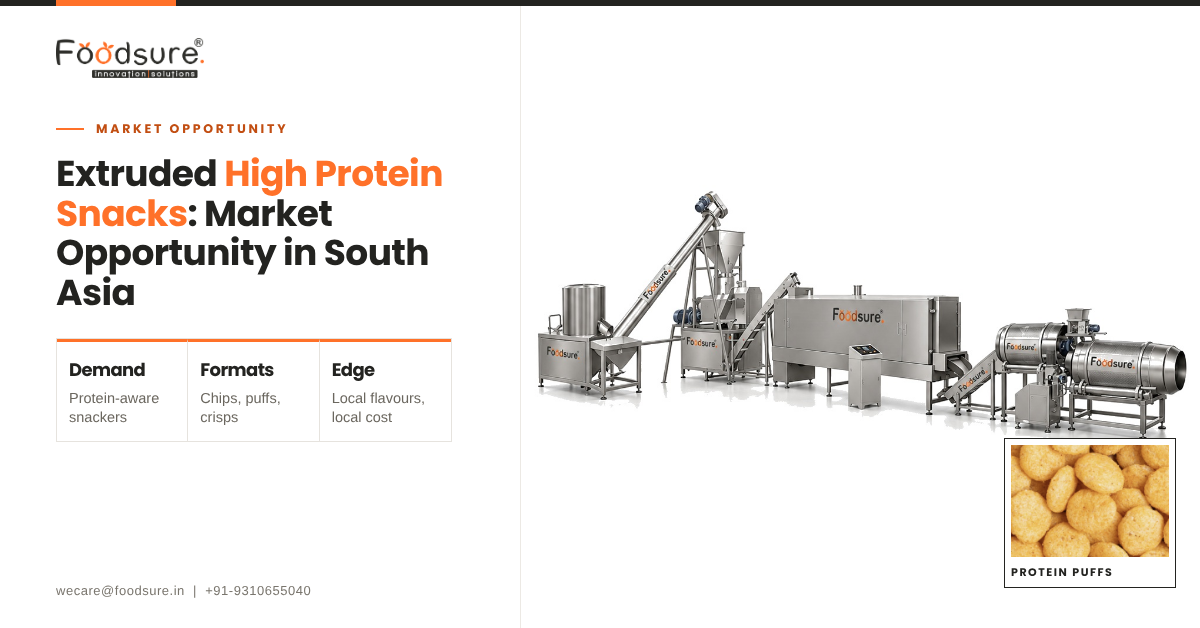
A typical extruded high protein snack manufacturing line includes:
| Machine | Function |
| Ribbon Mixer | Blends dry ingredients uniformly |
| Screw Feeder | Transfers ingredients to the extruder |
| Twin-Screw Extruder | Cooks, mixes, and shapes the product |
| Dryer | Reduces moisture for shelf stability |
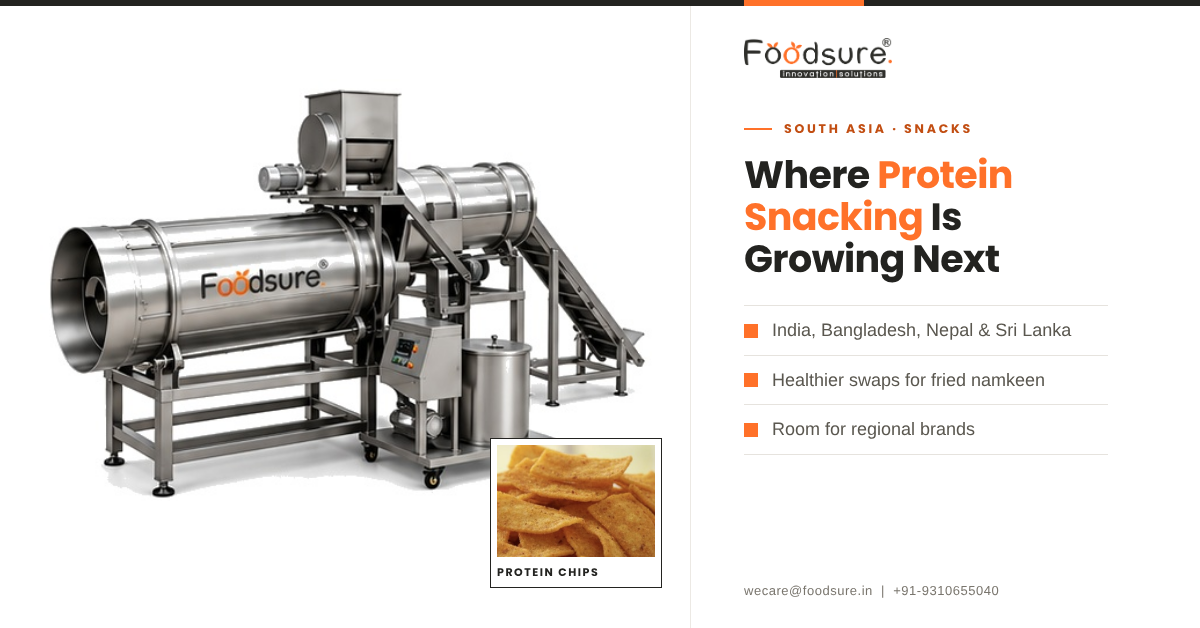
| Seasoning Drum | Applies oil and flavor coatings |
| Cooling Conveyor | Stabilizes product temperature |
| Automatic Packaging Machine | Packs finished snacks efficiently |
Automation minimizes manual handling, improves hygiene, and supports consistent production quality.
Foodsure Machines, which has been building food processing equipment in Noida since 2012, supplies this kind of integrated line as a turnkey plant. Its company profile lists consulting, production line planning, customised machine design, engineering, quality testing, installation, operator training, and after-sales technical support, so one team stays accountable from layout to first production run.
If your plan centres on extruded protein snacks, Foodsure Machines’ high protein snack machine is built to be configured around your formulation, target capacity, and factory layout, so the extruder, drying, seasoning, and packaging equipment work as one line instead of separate purchases.
Choosing the Right Production Capacity
Production capacity should match business goals rather than simply maximizing output.
Factors to evaluate include:
- Target market size
- Distribution network
- Available investment
- Workforce availability
- Factory space
- Future expansion plans
Many manufacturers begin with a medium-capacity line and expand as demand grows.
Scalable production systems also make it easier to introduce new product variants without major equipment changes. Foodsure Machines designs its lines around the customer’s product, capacity, automation level, and factory layout, which makes it easier to size the plant for where the business is heading, not just where it starts.
Food Safety Standards Manufacturers Should Follow
As healthy snacks become more popular, buyers increasingly expect products to meet internationally recognized food safety standards.
Manufacturers supplying supermarkets, institutional buyers, or export markets should implement strong quality management systems.
Common standards include:
- HACCP
- GMP
- ISO 22000
- FSSC 22000
- Local food safety regulations
- Product labeling compliance
- Allergen management
- Traceability systems
Meeting these standards not only improves food safety but also strengthens buyer confidence during supplier evaluations. HACCP comes from the Codex Alimentarius Commission, a joint FAO and WHO body, and TÜV SÜD explains that ISO 22000 folds those principles into a wider food safety management system. FSSC 22000 is built on ISO 22000 and recognised by the Global Food Safety Initiative.
Local labelling rules are changing quickly, so build them into your launch plan:
- Sri Lanka: The Food (Labelling and Advertising) Regulations 2026 took effect on 1 July 2026, and, as ChemLinked reports, health and nutrient-function claims now need prior written approval from the Chief Food Authority.
- Bangladesh: BFSA’s draft 2026 labelling regulations propose mandatory front-of-pack warnings for products high in sugar, sodium, and saturated fat, so seasoning blends are worth watching. Dhaka Tribune reports the draft was still with the Ministry of Food in mid-October 2026.
- Nepal: The Food Hygiene and Quality Act, 2081 (2024) replaced the older Food Act, and, according to this compliance summary, requires labels in Nepali or English and an import entry permit from the Department of Food Technology and Quality Control. Confirm current details with the DFTQC before launch.
Common Manufacturing Challenges and How to Overcome Them
Launching a protein snack production line comes with its own set of challenges. Fortunately, most can be addressed with proper planning and process control.
| Challenge | Practical Solution |
| Poor product expansion | Optimize formulation, moisture, and extrusion parameters |
| Inconsistent texture | Maintain stable temperature and screw speed |
| High raw material costs | Diversify suppliers and use locally sourced grains where feasible |
| Flavor inconsistency | Use automated seasoning systems with controlled dosing |
| Short shelf life | Improve drying, packaging, and storage conditions |
| Production downtime | Implement preventive maintenance and operator training |
| Difficulty meeting buyer requirements | Adopt recognized food safety standards and document quality processes |
Addressing these issues early helps reduce waste, improve productivity, and build a reputation for reliable, high-quality products. One equipment maker quoted in Baking Business adds that quick, reliable changeovers between recipes noticeably cut downtime, waste, and cost on extruded snack lines, which is worth asking about when you compare equipment suppliers, Foodsure Machines included.
How Food Manufacturers Can Stay Competitive
Success in this industry isn’t only about purchasing advanced machinery.
Long-term growth depends on combining technology with market understanding.
Leading manufacturers typically focus on:
- Continuous product innovation
- Consumer-driven flavor development
- Food safety certification
- Efficient production planning
- Sustainable sourcing practices
- Attractive packaging design
- Strong distributor relationships
- Ongoing research and development
Many brands that begin with extruded snacks later add a second product for the same gym, health-store, and modern retail customers. A protein bar machine is the most common next step, and it lets you reuse your protein ingredient suppliers and your brand positioning across both lines.
Businesses that consistently improve their products are more likely to retain customers in a competitive market.
Conclusion
The market for extruded high protein snacks is moving beyond niche health stores and becoming part of the mainstream food industry across South Asia. Consumers in Sri Lanka, Bangladesh, and Nepal are actively seeking snacks that combine convenience, taste, and nutrition, creating new opportunities for manufacturers willing to invest in modern production.
Commercial extrusion technology allows businesses to produce a wide range of protein-rich products efficiently while maintaining consistent quality. Combined with thoughtful product development, strong food safety systems, and an understanding of regional consumer preferences, manufacturers can build brands that compete successfully in both domestic and international markets.
As healthy snacking continues to evolve, businesses that prioritize innovation, operational efficiency, and quality will be well placed to capitalize on one of South Asia’s fastest-growing food categories.
Ready to Start Your Extruded High Protein Snack Business?
Whether you’re launching a new food brand or expanding an existing manufacturing facility, selecting the right production technology is a critical first step.
At Foodsure Machines, we design and manufacture commercial extruded high protein snack production lines tailored to different production capacities. From plant planning and equipment selection to installation and technical support, our team helps food manufacturers build efficient, scalable, and hygienic production facilities.
Looking to establish a protein snack manufacturing unit in Sri Lanka, Bangladesh, or Nepal? Get in touch with Foodsure Machines to discuss the right production solution for your business.
Frequently Asked Questions
What are extruded high protein snacks?
Extruded high protein snacks are ready-to-eat food products manufactured using extrusion cooking technology. Protein-rich ingredients such as soy, pea, lentils, chickpeas, or whey are combined with cereal flours and processed under controlled heat and pressure to create light, crispy snacks with enhanced nutritional value and extended shelf life.
Why is South Asia becoming an attractive market for protein snacks?
Growing health awareness, increasing disposable incomes, expanding retail infrastructure, urban lifestyles, and rising demand for convenient nutrition are driving the popularity of protein-rich snacks across Sri Lanka, Bangladesh, and Nepal. Bangladesh’s packaged food market alone is projected to grow from USD 4.8 billion to USD 5.8 billion by 2030, according to the Centre for Policy Dialogue.
Which ingredients are commonly used in extruded protein snacks?
Manufacturers commonly use:
- Soy protein isolate
- Pea protein
- Whey protein
- Corn grits
- Rice flour
- Chickpea flour
- Lentil flour
- Oats
- Millet
- Natural seasonings
- Vegetable oils
- Vitamin and mineral premixes
Ingredient selection depends on the desired nutritional profile and product texture.
What machinery is required to manufacture extruded high protein snacks?
A commercial production line generally includes:
- Ingredient mixer
- Screw feeder
- Twin-screw extruder
- Dryer
- Seasoning system
- Cooling conveyor
- Packaging machine
The exact configuration depends on production capacity and product type. Foodsure Machines designs complete lines around your product and capacity.
Which food safety standards should manufacturers follow?
Manufacturers should implement recognized quality systems such as:
- HACCP
- GMP
- ISO 22000
- FSSC 22000
Compliance with local food regulations and export requirements is equally important for building buyer confidence. ISO 22000 incorporates HACCP principles, as TÜV SÜD explains.
Can extruded high protein snacks be exported?
Yes. Manufacturers producing consistent, high-quality products with appropriate certifications and compliant packaging can target export markets, including the Middle East, Southeast Asia, Africa, and selected European markets. Sri Lanka, for instance, has set a goal of USD 1 billion in food and beverage exports by 2028, according to Hiru News.
Are plant-based protein snacks becoming more popular?
Yes. Plant-based proteins such as pea, soy, lentil, and chickpea are gaining popularity because they appeal to a broad consumer base while supporting trends toward healthier and more sustainable food choices.
How can manufacturers differentiate their products?
Businesses can stand out by focusing on:
- Innovative flavor profiles
- Regional ingredients
- Clean-label formulations
- High-quality packaging
- Consistent product quality
- Strong nutritional positioning
- Reliable food safety practices




