There are not too many things to be done to make a protein bar once its concept is ready.
Basically, all one needs is a portion of protein, some nuts or grains, a binding agent, optionally, chocolate coating, and wrapping.
However, it takes more efforts to make it into a reliable and commercially viable product that can be mass-produced, packaged, price-optimized, and sold throughout South Asia. The real preparation begins even before any equipment is bought.
A manufacturer needs to choose whom the protein bar is intended for, what amount of protein it must contain, how it should taste, what components are reliable sources of proteins, how the recipe will work in commercial production, what kind of packaging will be required, what regulations exist in the target country, and how productive the manufacturer will be able to utilize its facilities.
Moreover, it is impossible to consider South Asia as a whole market of protein bars. India boasts a well-developed category of the product, while Bangladesh, Nepal, Pakistan, and Sri Lanka are on various stages of category development.
This guide takes the complete journey from protein bar recipe development to commercial manufacturing and plant setup, with a focus on South Asian markets.
What is the protein bar manufacturing process?
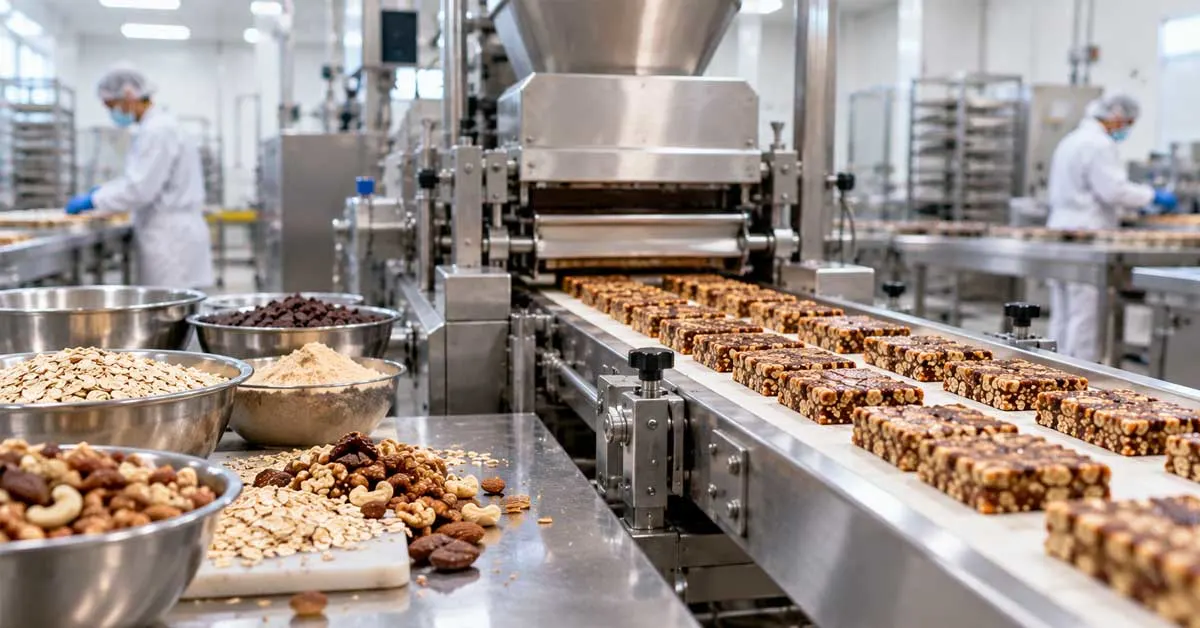
Protein bar manufacturing usually involves ingredient preparation, mixing, forming or sheeting, cutting, optional coating, cooling and packaging. The exact process changes with the recipe, bar size, protein source, texture and level of automation.
For a commercial plant, the basic flow looks like this:
Not every protein bar needs every stage. An uncoated date-and-protein bar, for example, may not need an enrober, while a chocolate-coated bar will need controlled coating and cooling.
The important point is that the recipe and machinery have to be developed together. A recipe that works in a small kitchen batch may not behave the same way when several kilograms of ingredients are mixed and formed continuously.
Why Protein Bars Are Getting Attention in South Asia
Protein is making waves outside the traditional gym and sports nutrition market in some South Asian markets such as India. As per a report published by Reuters in 2025, there was an expansion of products that had the protein theme in India across snacks, beverages, and other food categories in India because of the growing demand for protein.
The category of protein bars also represents a significant market in India. According to Grand View Research, the revenue of India’s protein bar market was about US 863.9 million in 2024 and is expected to grow to about US 1.27 billion by 2030 at a projected CAGR of 6.6% between 2025 and 2030. In 2024, its report identified the category of sports nutritional bars as the biggest type of segments in this market, while meal replacement bars are expected to represent the fastest growing type of segment in this market over the forecast period.
The numbers are not to be considered a definite market size. Various research firms define the market differently.. For a South Asia-wide article, it is therefore more useful to look at individual countries and explain what the available evidence says rather than add unrelated country estimates together.
India
India currently provides the strongest publicly available market data among the South Asian markets covered in this article. The category is also moving beyond a narrow sports-nutrition audience. Reuters reported growing interest in protein-rich foods across Indian urban markets, including protein snacks and bars.
For a manufacturer, that shift matters because it widens the possible product brief. A protein bar can be positioned around sports nutrition, everyday snacking, meal replacement, convenience or a specific nutritional need, depending on the formulation and the claims that can legally be made.
The manufacturing implication is equally important. A brand may begin with one or two SKUs but later need different textures, protein systems, flavours and pack formats. The production line should therefore be selected with the product roadmap in mind, not just the first order.
Bangladesh
Bangladesh has a smaller documented protein-bar market than India, but market research from 6Wresearch identifies health awareness, fitness activity and demand for convenient nutrition as factors supporting the category. The research also tracks supermarkets, convenience stores, specialty stores and online channels within the market.
For a local manufacturer, this creates an interesting product-development question: should the bar copy an imported international product, or should it be formulated around a price point, flavour profile and ingredient system that makes more sense for local consumers?
There is no reason to assume the answer will be the same for every brand. The right decision depends on the target consumer, protein source, raw-material costs and intended retail price.
Nepal
6Wresearch describes Nepal’s protein-bar category as being supported by growing health awareness, fitness and demand for convenient snacks. Its market coverage includes supermarkets, convenience stores, specialty stores and online stores.
Nepal can therefore be approached as a market where product size, price, distribution and portability can matter alongside protein content. A manufacturer targeting Kathmandu and a manufacturer planning broader distribution should not necessarily start with the same production and packaging strategy.
Pakistan
Pakistan’s protein-bar market is also being tracked separately by market-research firms. 6Wresearch identifies health and fitness awareness, demand for convenient snacks and new product introductions among the category’s drivers, while also identifying price sensitivity and limited consumer awareness as challenges.
Euromonitor’s 2025 sports-nutrition research provides a useful wider context. It describes sports nutrition in Pakistan as growing from a low base, with high prices keeping much of the category concentrated among wealthier urban consumers.
For a protein-bar manufacturer, that suggests that pricing and product education may be just as important as the formulation itself.
Sri Lanka
Sri Lanka offers another useful example of why country-level data matters. 6Wresearch reports that protein-bar imports increased by 153.33% between 2023 and 2024. That is an import trend, not proof that the entire protein-bar market grew by the same percentage, so it should be interpreted carefully.
For a local manufacturer, rising imports can still be a useful signal to investigate. It may point to an existing demand that is currently being served partly or substantially through imported products.
What These South Asian Trends Mean for a Manufacturer
The market data points to a broader change: protein products are no longer limited to powders and traditional gym supplements.
But that does not mean every consumer wants the same bar.
A manufacturer could develop a high-protein sports bar, a softer everyday snack bar, a plant-protein bar, a meal-replacement product or a bar built around ingredients such as nuts, seeds, dates or grains. Each option changes the formulation, production process, packaging and cost.
That is why market research should happen before machinery selection.
The first question should not be:
Which protein bar machine should I buy?
It should be:
What exactly am I planning to manufacture, for whom, at what price and at what volume?
Step 1: Define the Protein Bar Before Developing the Recipe
Before the formulation team starts weighing ingredients, define the product.
A useful product brief should answer:
- Who will buy the bar?
- What is the target bar weight?
- What protein source will be used?
- What protein level is required?
- What texture should the bar have?
- Will it be coated?
- What flavour will lead the launch?
- What price range is realistic?
- Which country or countries will it be sold in?
- What packaging format will be used?
- What shelf life is required?
- What claims are planned on the label?
This sounds basic, but it prevents a common problem: developing a recipe first and discovering later that it is too expensive, difficult to manufacture or unsuitable for the intended retail price.
Step 2: Develop the Protein Bar Recipe
A commercial protein bar is usually built around several functional groups of ingredients.
Protein source
Common options include whey protein, milk proteins, soy protein, pea protein and blended protein systems.
The choice affects much more than the nutrition panel. Different proteins can change taste, texture, water binding, processing behaviour and cost.
Whey may work well for a premium sports-nutrition product, while plant proteins may make sense for a vegan or plant-focused formulation. A blended system can also be considered when the goal is to balance nutrition, texture and cost.
There is no universal best protein source. The right choice depends on the product brief.
Binder system
The binder gives the bar its structure.
Depending on the recipe, a formulation may use ingredients such as dates, glucose syrup, honey, nut butter or other carbohydrate and syrup systems.
The binder affects chewiness, softness, sweetness, moisture and shelf stability. Changing it can change the way the whole bar behaves during forming and cutting.
Texture and bulk ingredients
Oats, puffed grains, nuts, seeds, cereals and other inclusions can provide texture and volume.
They also influence the manufacturing process. Large inclusions may require different handling from a smooth protein paste, and their size and distribution can affect cutting and weight consistency.
Fat system
Nut butters, oils and other fat sources can influence mouthfeel and energy density. The fat system also needs to be considered when evaluating oxidation and shelf stability.
Flavour
Chocolate remains an obvious option, but manufacturers can also develop fruit, nut, coffee, spice or regional flavour profiles.
The important part is not simply choosing an interesting flavour. It is making sure the flavour works with the protein system, binder, sweetener and storage conditions.
Step 3: Make the Recipe Commercially Manufacturable
A recipe that tastes good in a small batch is not automatically ready for a production line.
During scale-up, the formulation needs to show consistent behaviour during mixing, forming and cutting.
The development team should look at:
- mixing time
- ingredient order
- dough consistency
- temperature
- moisture
- protein dispersion
- bar density
- cutting behaviour
- coating behaviour
- packaging compatibility
This is one area where formulation and machinery decisions should stay connected.
Foodsure’s protein formulation service states that its work includes sensory optimisation, scale-up support and consistency between formulation and actual manufacturing conditions. Foodsure also documents Stroom as a protein-bar project that was formulated, piloted and scaled with a complete machinery setup.
That kind of formulation-to-production connection matters because commercial machinery does not fix an unstable recipe. It reproduces the process at scale.
Step 4: Run Pilot Trials Before Full Commercial Production
Pilot production is the bridge between the laboratory and the factory.
The goal is to check whether the formulation behaves properly when the quantities increase and the process becomes more controlled.
A pilot trial should help answer questions such as:
- Does the mixture form properly?
- Is the bar easy to cut?
- Does the weight remain consistent?
- Does the bar hold its shape?
- Does the coating set correctly?
- Does the packaging protect the product?
- Does the texture remain acceptable during storage?
Pilot trials are also the right stage to identify process problems before investing in a large production line.
This is one reason it is risky to choose machinery only from a recipe or a catalogue photograph. The machine needs to suit the actual formulation.
Step 5: Test Shelf Life and Stability
Shelf life should not be guessed from another company’s protein bar.
The formulation, water activity, packaging, fat system, ingredients, storage conditions and distribution environment all affect how long the product remains suitable for sale.
For South Asian markets, temperature and humidity also deserve attention because products may move through different storage and transport environments before reaching the consumer.
A shelf-life programme can examine changes in:
- texture
- moisture
- water activity
- rancidity or oxidation
- microbial stability
- flavour
- appearance
- packaging integrity
The final shelf-life claim should come from product-specific testing rather than a generic 9-month or 12-month assumption.
Step 6: Choose the Protein Bar Manufacturing Process
Once the recipe has been validated, the commercial production flow can be designed.
Ingredient Preparation
Some ingredients may need roasting, grinding, sieving, softening or other preparation before mixing. The exact preparation depends on the recipe.
This stage is easy to overlook, but inconsistent raw materials can create problems later in the line.
Mixing
The mixer combines the protein system, binder, dry ingredients, fats and other components into a uniform mass.
Mixing time and temperature matter because the target is not simply to combine ingredients. The final mass needs to have the right consistency for forming.
A mixer that works for one formulation may not be ideal for another, which is why formulation details should be discussed before final equipment selection.
Forming and Sheeting
The mixed mass is formed into a slab or another defined shape.
Commercial forming equipment provides more consistent thickness and dimensions than manual forming, which becomes increasingly difficult as production volumes rise.
For a manufacturer planning several SKUs, the forming system should also be considered alongside the desired bar dimensions and production speed.
Cutting
The formed slab is cut into individual bars.
This controls dimensions and helps maintain weight consistency. Weight control is important not only for production economics but also for accurate product declarations and packaging.
Enrobing or Coating
Not every protein bar requires coating.
If chocolate or compound coating is part of the product, an enrober can apply the coating more consistently than manual dipping at commercial scale.
The coating also changes the cooling requirement, packaging process and overall plant layout.
Cooling
Coated bars need controlled cooling so the coating sets and the bar reaches the required handling condition before packaging.
Cooling becomes particularly important when ambient conditions are warm or humid. The right cooling setup should therefore be selected according to the formulation, coating and production capacity rather than treated as an optional add-on.
Packaging
Protein bars are commonly packed individually before being placed into secondary cartons or multipacks.
The packaging material should be selected according to the product’s sensitivity to moisture, oxygen, light, temperature and handling.
A good recipe can still lose quality if the packaging does not provide enough protection during storage and transport.
Coding and Batch Traceability
Commercial production also needs batch identification and date coding.
This supports stock management, traceability and regulatory requirements in the target market.
Protein Bar Manufacturing Machinery Required
A commercial protein bar production line may include:
| Production Stage | Typical Equipment |
|---|---|
| Ingredient Preparation | Preparation equipment based on the recipe |
| Mixing | Planetary or suitable industrial mixer |
| Forming | Slab forming or sheeting system |
| Cutting | Bar cutting system |
| Coating | Enrober, where required |
| Cooling | Cooling tunnel |
| Packaging | Flow-wrap or suitable bar packaging machine |
| Coding | Batch and date coding equipment |
The final line does not have to contain every machine listed above. A simple uncoated bar and a chocolate-coated protein bar will require different configurations.
This is where a manufacturer should resist the temptation to buy the largest available line.
The right capacity depends on actual demand, working shifts, bar weight, number of SKUs, distribution plans, available factory space and expected expansion.
Foodsure Machines can configure protein-bar production systems around these requirements rather than treating every project as the same machine package. For a new manufacturer, that approach is useful because the machinery should fit the business plan, not force the business plan around the machinery.
How Much Production Capacity Do You Need?

There is no universal answer.
A startup supplying a few gyms and online customers does not have the same requirement as a manufacturer supplying multiple modern-retail chains.
Capacity planning should consider:
Expected monthly sales × bar weight × production days × operating shifts
It should also leave room for cleaning, changeovers, maintenance and downtime.
For example, a line producing multiple flavours may spend part of its working day changing products and cleaning between formulations. A theoretical machine output therefore should not be treated as the same thing as sellable monthly production.
This distinction becomes important when preparing a business plan or calculating the return on machinery investment.
Setting Up a Protein Bar Manufacturing Plant in South Asia
A protein bar plant should be designed around the product flow rather than simply filling a room with machines.
A typical layout can move from:
Raw material receiving → Storage → Ingredient preparation → Mixing → Forming → Cutting → Coating → Cooling → Packaging → Finished goods
The actual layout will depend on the product and machinery.
Raw Material Storage
Protein powders, grains, nuts, seeds, binders, flavours and packaging materials need suitable storage conditions.
Ingredients with specific temperature or humidity requirements should be handled accordingly.
Production Area
The production area should allow safe movement of ingredients and people while keeping the process organised.
The layout should also leave enough access around machines for cleaning, inspection and maintenance.
Packaging Area
Packaging should have enough space for primary packaging material, coding, inspection and secondary packing.
For export-oriented production, additional attention may be required for carton storage, palletisation and dispatch.
Quality Control
A commercial plant needs a defined quality-control system covering incoming ingredients, production checks and finished products.
Depending on the product and market, this may include nutritional, microbiological, physical and stability testing.
What Does a Protein Bar Manufacturing Plant Cost?
There is no reliable single price for setting up a protein bar manufacturing plant across South Asia.
The investment changes with:
- production capacity
- level of automation
- formulation
- number of SKUs
- coating requirements
- packaging format
- factory size
- utilities
- quality-control setup
- storage requirements
- installation
- testing
- working capital
The machine is only one part of the investment.
For a realistic project estimate, separate the costs into machinery, factory infrastructure, formulation and testing, packaging, utilities, labour, compliance, raw materials and working capital.
This also makes it easier to compare a semi-automatic setup with a fully automatic production line.
Protein Bar Manufacturing Regulations Across South Asia
Regulatory requirements are one area where a South Asia-wide manufacturing strategy cannot simply copy one country’s label and use it everywhere.
The same production line may be able to manufacture bars for several countries, but the formulation, claims, packaging and documentation may need to change.
India
India’s pre-packaged food labelling requirements are governed by FSSAI’s Food Safety and Standards (Labelling and Display) Regulations. FSSAI’s official regulatory page lists amendments through March 24, 2026, so manufacturers should check the latest version before finalising packaging.
Protein-related claims also need to be checked against the applicable FSSAI requirements rather than assumed from the amount of protein added to the recipe.
For an India-focused launch, compliance should therefore be reviewed during formulation and packaging development, not after the artwork has already been printed.
Bangladesh
Bangladesh’s regulatory system includes the Bangladesh Food Safety Authority and the Bangladesh Standards and Testing Institution, with the exact requirements depending on the product and applicable standards.
BSTI currently publishes a list of products subject to mandatory standards/certification, and its certification guidance includes requirements around product information, ingredients, batch identification, production and expiry dates, manufacturer details and other label information for applicable products.
Manufacturers should therefore check whether their specific protein-bar category falls under a mandatory BSTI standard before commercial launch.
Nepal
Nepal’s Department of Food Technology and Quality Control publishes the country’s Food Regulation and related food requirements.
The Food Regulation requires packed-food labels to include information such as the product description, ingredients and, where applicable, batch number, production date and expiry date. Labels may be presented in Nepali or English, with another language also permitted.
A Nepal-bound product should therefore be checked against the current DFTQC requirements before final packaging.
Sri Lanka
Sri Lanka’s official Food Control Administration Unit currently lists the Food (Labelling and Advertising) Regulations 2026 No. 2494/4 among its current regulations.
The 2026 regulations also contain provisions around food claims and advertising. This matters for protein bars because claims around protein, energy, weight control, health benefits or other nutritional properties can affect the compliance review.
The label should therefore be developed with the target market’s rules in mind instead of adapting an Indian or international pack at the last stage.
Pakistan
Pakistan has its own food regulatory and standards framework, and the exact compliance route can depend on the jurisdiction and product category.
Euromonitor’s 2025 sports-nutrition research and 6Wresearch’s protein-bar market coverage both indicate that price, consumer awareness and distribution remain important considerations in the category.
For a commercial launch, the manufacturer should confirm the applicable food authority, product standards, labelling requirements and import rules for the specific province or market being served.
Can One Protein Bar Manufacturing Line Serve Multiple South Asian Markets?
Yes, the same core production technology can potentially serve several markets.
The production sequence can remain broadly similar:
Mixing → Forming → Cutting → Coating → Cooling → Packaging
What may change is:
Recipe → Protein system → Claims → Label → Pack size → Language → Ingredients → Compliance documentation
This is one of the biggest advantages of planning the plant properly from the beginning.
A manufacturer that expects to export later can discuss those requirements before finalising the machinery and packaging system.
Packaging for Protein Bars in South Asia
Packaging is not simply the final step after manufacturing. It is part of product development.
The right packaging needs to protect the bar during storage, transportation and retail handling.
Depending on the formulation, the manufacturer may need to consider protection against:
- moisture
- oxygen
- light
- heat
- mechanical damage
A chocolate-coated bar can have different packaging requirements from a dry, uncoated nut-and-seed bar.
The packaging machine should therefore be selected after the product format and film requirements are understood.
From Manufacturing to Commercialisation
A production line alone does not create a successful protein-bar business.
Once the product is ready, the manufacturer still needs to decide:
- where the bars will be sold
- what pack sizes will be offered
- how much margin each channel requires
- how much stock distributors need
- how online orders will be fulfilled
- how the product will be sampled
- how repeat purchase will be encouraged
- how production will scale when demand increases
Potential channels include gyms, specialty nutrition stores, supermarkets, pharmacies where permitted and appropriate, e-commerce and direct-to-consumer sales.
The right mix will vary by country.
For a new brand, it is usually more useful to validate one clear product and distribution model than to manufacture several SKUs before there is evidence of demand.
Case Study: How Yoga Bar Moved From Small-Batch Production to a Large Consumer Brand
One of the more useful South Asian examples is Yoga Bar.
The company was founded by sisters Anindita and Suhasini Sampath after they returned to India and began exploring healthier snack options. According to a 2019 Times of India interview, they initially used a local bakery to make their snack bars and had people try them in yoga studios.
The bakery eventually could not support their demand, so the founders took a bank loan and established a larger production facility. They also began approaching retailers in Bengaluru.
A particularly important moment came in 2015, when IndiGo placed an order for 30,000 bars a month for its employees, according to the founders’ account.
The lesson here is not that every new protein-bar brand needs to immediately build a large factory. It is almost the opposite.
The journey shows how formulation, early production, customer validation and manufacturing capacity can develop together. The founders first tested the product, then encountered a production constraint, and eventually invested in a larger facility as demand developed.
Years later, Yoga Bar became part of a much larger corporate strategy. ITC announced in January 2023 that it would acquire Sproutlife Foods, the company behind Yoga Bar, in stages, describing Yoga Bar as a D2C brand with a portfolio including nutrition bars, muesli, oats and cereals.
For a new South Asian manufacturer, the useful takeaway is simple: product development and manufacturing capacity have to grow with the commercial model.
Foodsure Example: From Protein Bar Formulation to Machinery
The same recipe-to-commercial-production connection can be seen in Foodsure’s documented work with Stroom.
Foodsure states that Stroom’s protein bar was formulated, piloted and scaled with a complete machinery setup. The company presents the project as an example of moving from product development into commercial manufacturing.
That is important because a protein-bar project often has two separate problems that need to meet in the middle:
Can the recipe work?
and
Can the recipe be manufactured consistently?
Treating those as separate questions can create problems during scale-up. Working through formulation, pilot trials and machinery configuration together can reduce that gap.
For brands planning a South Asian manufacturing plant, this is also where an integrated formulation and machinery partner can be useful. Foodsure’s current formulation services cover protein-product development and scale-up support, while Foodsure Machines works on the equipment side of commercial production.
Common Mistakes When Setting Up a Protein Bar Plant
Buying the machine before finalising the recipe
The machine should be selected around the product, not the other way around.
Choosing capacity only because a larger machine looks more profitable
Unused capacity still costs money. Production planning should be based on realistic demand and future expansion.
Ignoring packaging during formulation
A product can perform well in a lab and behave differently after weeks of storage in its final package.
Assuming one country’s label will work everywhere
South Asian markets have different regulatory frameworks. Export plans should be considered before the packaging is finalised.
Launching too many SKUs
More flavours mean more raw materials, more changeovers, more packaging inventory and more production complexity.
Treating shelf life as a fixed number
Shelf life needs to be validated for the actual formulation and package.
Looking only at machine price
The real investment includes formulation, testing, factory infrastructure, utilities, installation, packaging, compliance and working capital.
A Practical Checklist Before Starting a Protein Bar Manufacturing Plant
Before placing a machinery order, make sure you have answers to these questions:
- Who is the target consumer?
- Which South Asian country will be the first market?
- What will the bar weigh?
- What protein source will be used?
- What protein claim is planned?
- What texture and flavour are required?
- Will the product be coated?
- Has the recipe been tested at pilot scale?
- Has shelf life been validated?
- What packaging format will be used?
- What production capacity is actually required?
- How many SKUs will launch?
- What factory space and utilities are available?
- Which food regulations apply?
- Will the product be sold domestically or exported?
- What machinery is required?
- What level of automation makes sense?
- What is the expected unit cost?
- Which distribution channels will be used?
- How will the plant scale if demand increases?
If these questions are clear, machinery selection becomes much easier.
Final Takeaway
A protein bar manufacturing business is not simply a matter of buying a machine and putting a recipe into it.
The commercial journey starts with understanding the market, defining the product and building a recipe that can actually be manufactured. From there, the manufacturer needs pilot trials, stability testing, suitable packaging, the right production capacity, a practical factory layout and country-specific regulatory checks.
South Asia adds another layer because the markets are not identical. A formulation that works commercially in India may need changes in price, ingredients, packaging or positioning before it is taken to Bangladesh, Nepal, Pakistan or Sri Lanka.
That is why the strongest manufacturing projects connect formulation, pilot production, machinery and commercial planning from the beginning.
For brands planning a protein bar manufacturing plant, Foodsure can support this journey through protein formulation, pilot development, scale-up and machinery setup, helping connect the product idea with the production system required to manufacture it commercially.
Planning a Protein Bar Manufacturing Plant in South Asia?
Talk to Foodsure about your recipe, production capacity, machinery requirements and plant setup.
Have a Question? Let’s Connect
Need expert guidance on food processing machines, production setup, or process optimization? Our team is ready to help you choose the right solution for your business.
Frequently Asked Questions
How are protein bars manufactured?
Protein bars are generally made by preparing the ingredients, mixing the protein and binder system, forming the mixture into a slab or shape, cutting it into bars, coating it when required, cooling it and then packaging the finished product.
What machinery is required to manufacture protein bars?
A commercial line can include a mixer, forming or sheeting machine, cutting system, enrober, cooling tunnel, packaging machine and coding equipment. The exact configuration depends on the formulation, bar format and production capacity.
How do I start a protein bar manufacturing plant in South Asia?
Start with market research and product definition, then develop and test the recipe, run pilot trials, establish shelf life, determine the required capacity, select machinery, design the plant layout and complete the applicable regulatory process before commercial production.
How much does a protein bar manufacturing plant cost?
There is no single cost for South Asia. Investment depends on capacity, automation, formulation, packaging, factory infrastructure, utilities, testing and working capital. A project estimate should be built from these individual components.
Can one protein bar production line serve different countries?
The same core production equipment can potentially serve multiple markets, but formulations, claims, labels, packaging and regulatory documentation may need to change from one country to another.
How long is the shelf life of a protein bar?
There is no universal shelf-life period. It depends on the formulation, moisture and water activity, fat system, packaging, storage conditions and distribution environment. Shelf life should be established through product-specific testing.
What is the difference between a protein bar and an energy bar?
The main difference is the product’s nutritional purpose and formulation. Protein bars are generally designed around a higher protein contribution, while energy bars may place more emphasis on carbohydrates and energy delivery. The exact nutritional composition depends on the product.
Can protein bars be made with plant protein?
Yes. Soy, pea and other plant proteins can be used in protein-bar formulations. The choice affects taste, texture, nutrition, cost and processing behaviour, so the protein system needs to be tested as part of the complete recipe.
Is India the only South Asian market worth considering?
No. India currently has the strongest publicly documented protein-bar market data among the countries discussed here, but Bangladesh, Nepal, Pakistan and Sri Lanka also have documented category activity and different commercial conditions. The right market depends on the product, price, distribution strategy and manufacturing plan.