

It is a certain type of rain that Gulf residents look forward to each year – that which begins with merely the change in the atmospheric pressure over the water and remains invisible to any person who stands upon the land below. It is through the right amount of humidity, the right temperatures, and the right collision of masses that this invisible phenomenon develops into a visible cloud, while even more is required in order to turn the cloud into something tangible enough to touch. Most often, the conditions do not come together and the cloud disappears without precipitation.
The recipe for a protein bar is somewhat similar to the above cloud. Every food innovator we have come across at Foodsure Machines has found themselves sitting down with a bowl of oats, whey, and date syrup, enjoying the product of their own creation to the fullest degree, and thinking, “This is it.” And for the most part, they are right about it tasting good. What they do not know yet is how this mixture will behave weighing 500 kilograms rather than just 5 or how it will pass through the Jebel Ali customs control. That gap between a recipe that tastes right and a bar that’s actually commercially producible is where most first-time manufacturers get stuck. It’s also exactly where this guide picks up.
This is the complete Protein Bar Manufacturing Process, from the first pilot batch to a finished bar ready for shelves in Dubai, Riyadh, Doha, or Manama.
What Actually Makes a Protein Bar “Complete”?
because in this industry, it means something that is actually both things at the same time.
In terms of nutrition, a complete protein bar is made using a protein that will provide all of the nine essential amino acids. Whey and casein can provide the complete protein profile naturally, and combined plant proteins (soy, pea, brown rice, hemp) are now designed to be similar. As for the structure of a complete bar, it should survive the process of production and stay intact literally and figuratively from the initial material to packed product.
But there’s a third meaning of completeness for a GCC market that is not taken into account at the beginning of the consideration process: regulatory completeness. It may taste delicious and stay in one piece during transportation but still be not market-ready because of lack of halal compliance, Arabic/English labeling, and adequate nutrient declaration according to GSO requirements. We will elaborate on the topic later on because this is the point that is ignored by competitor blogs, and it is the real reason of delays.
The Protein Bar Manufacturing Process, Step by Step
Here’s the honest version, not the marketing-brochure version of what happens between “recipe” and “retail-ready bar.”
| Stage | What Happens | Why It Matters |
|---|---|---|
| 1. Formulation & Sourcing | Protein, binders, and bulking agents are balanced for taste, nutrition, and machine compatibility | An ingredient that works by hand can jam a mixer or crack on a cutter |
| 2. Mixing | Dry ingredients (protein powder, oats, seeds) are blended separately from wet binders (honey, nut butter), then combined | Inconsistent mixing is the single biggest cause of texture complaints in commercial bars |
| 3. Forming / Sheeting | Dough is compressed into a continuous slab of controlled thickness, usually cold-rolled | Sets the density and weight consistency of every single bar |
| 4. Cooling | Slab passes through a cooling tunnel to set before cutting | Prevents deformation during slicing |
| 5. Cutting | A longitudinal slitter sets bar width; a guillotine cutter sets precise length and weight | Directly determines label accuracy and packaging fit |
| 6. Coating (optional) | Bars pass through an enrober for chocolate or yogurt coating, then a final cooling tunnel | Coating weight and finish are quality-control checkpoints |
| 7. Packaging | Individual wrapping preserves freshness and carries all regulatory declarations | In the GCC, packaging is a compliance checkpoint, not just a freshness one |
| 8. Quality Control | Runs weight, moisture, metal detection, and seal integrity continuously | Catches problems before they reach a container ship, not after |
Written as a flow, the whole line reads like this:
It looks simple on paper. It rarely feels simple the first time you watch it run.
How is protein bar dough mixed at industrial scale?
Industrial mixers blend dry ingredients, protein powders, oats, and seeds first, while wet binders like honey or melted nut butter are combined separately before merging. This order matters because it prevents clumping and ensures every bar in the batch has the same protein distribution, moisture level, and bite.
What’s the difference between extrusion and sheeting for protein bars?
A soft dough protein bar machine typically sheets and compresses the mixture into a continuous slab before cutting, while a protein bar extrusion machine pushes dough through a shaped die to form a continuous rope that’s then cut to length. Sheeting suits denser, chunkier formulations (nuts, dried fruit); extrusion tends to suit smoother, more uniform pastes. The right choice depends on your recipe’s texture, not on which sounds more “advanced.”
Why a Kitchen Recipe and a Factory Line Are Two Different Problems

This is the part that ten years on the machining floor teaches you, and it rarely shows up in a nutrition textbook: a recipe and a production-ready product are not the same achievement.
A formulation team can perfect a bar by hand with the right protein percentage, right sweetness, and right bite. But it only becomes a genuine commercial product once it survives mixing consistency at scale, forming pressure, cutting precision, and packaging speed, all running continuously for hours. We’ve seen founders arrive with a beautiful recipe and the wrong machine for it: a soft, high-moisture dough forced through equipment built for a firmer, drier mix, and watch weeks of R&D unravel on the line.
Getting the Protein Bar Manufacturing Process right means treating formulation and equipment selection as one decision, not two sequential ones. That’s the gap our protein bar machine line is built to close, matching the machine to the recipe before either one is finalized, not after.
Choosing the Right Machine for Your Market: UAE, Saudi Arabia, Qatar, Oman, Kuwait, Bahrain
Machine selection isn’t one-size-fits-all across the Gulf, even though the regulatory umbrella (GSO) is shared. A brand scaling out of Dubai with an eye on export volume needs different throughput than a Muscat-based producer serving a domestic market.
A few practical patterns worth knowing before you shop:
Protein bar machine price ranges vary enormously based on automation level, capacity, and whether you need a full protein bar factory setup or are adding a line to an existing facility, which is exactly the kind of detail worth working through directly rather than estimating from a spec sheet. If you’re at the stage of comparing protein bar equipment options or looking for a protein bar machinery manufacturer who understands both the mechanical and the GCC regulatory side, our Protein Bar Manufacturing Line Middle East page breaks down configurations by capacity tier.
Regulatory Reality: What GCC Market Entry Actually Requires
This is the section most manufacturing blogs either skip or oversimplify, and it’s where shipments actually get held at customs.
- Halal certification is non-negotiable, and it goes deeper than the ingredient list. GSO 2055-1:2015 is the governing standard, and a certificate valid in one country isn’t automatically accepted everywhere. The UAE only accepts halal certificates from Ministry of Industry and Advanced Technology (MoIAT)-approved bodies; Saudi Arabia requires certification through an SFDA-recognized Islamic authority. Even packaging film needs sign-off, since some plasticizers and slip agents are derived from animal fat.
- Labeling must be bilingual Arabic and English, showing product name, manufacturer, country of origin, ingredients, usage instructions, and shelf life, per Gulf Standard 9/1995. GSO’s 2022 nutrition labeling revision expanded the mandatory nutrient list to include energy, fat types, cholesterol, sodium, carbohydrates, fibre, and both total and added sugars. From 2026, front-of-pack warning symbols become mandatory for products high in sodium, sugar, or saturated fat.
- Shelf life at import is the detail exporters miss most often. Saudi Arabia’s SFDA requires at least 50% of a product’s declared shelf life to remain at the point of import fall short, the shipment gets rejected, returned, or destroyed at your cost. If you’re planning to manufacture in one country and export across the GCC, this number should shape your packaging and dispatch schedule from day one.
Ready to Scale Your Protein Bar Manufacturing Business in UAE?
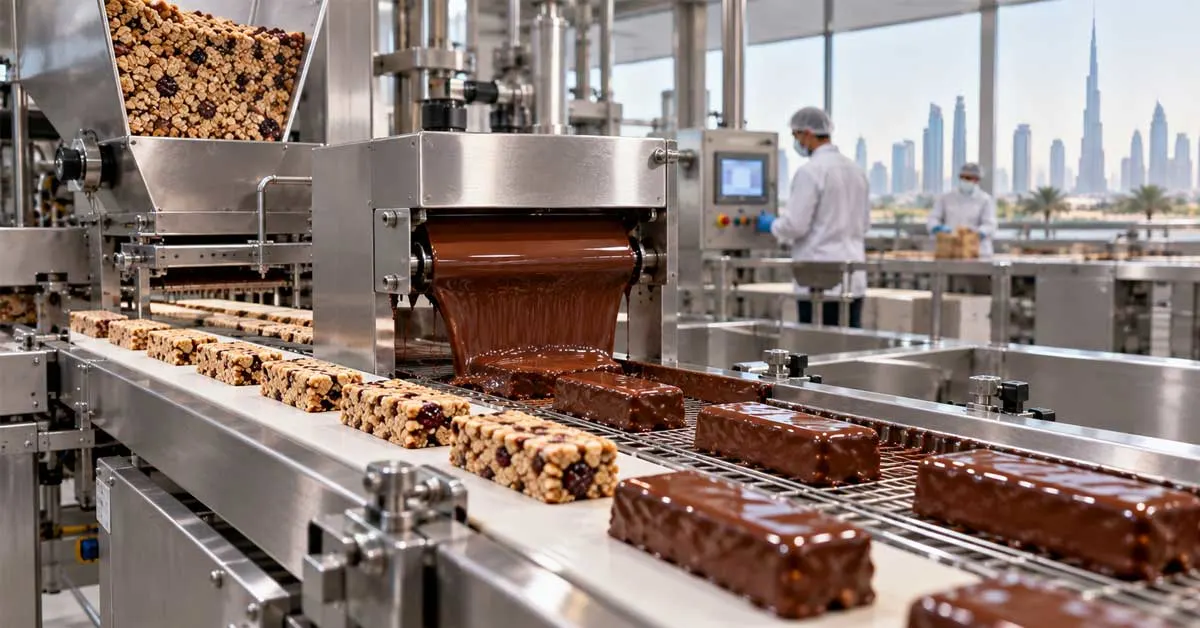
Getting from a working recipe to a compliant, shelf-ready bar involves more moving parts than most first-time producers expect, but none of them are unsolvable, and every one of them is a problem we’ve helped GCC manufacturers work through before.
If you’re evaluating equipment for a protein bar manufacturing plant or planning a turnkey protein bar plant anywhere from Dubai to Muscat, our team at Foodsure Machines is happy to walk you through y Protein bar machine price depends on automation level, capacity, and whether you need a semi-automatic line or a full turnkey protein bar plant. Costs range from smaller batch-capacity setups to large automated lines producing several thousand bars per hour; it’s best assessed against your target volume rather than a single fixed number. our specific formulation and capacity needs. Get in touch.
Have a Question? Let’s Connect
Need expert guidance on food processing machines, production setup, or process optimization? Our team is ready to help you choose the right solution for your business.
Frequently Asked Questions
What is the protein bar manufacturing process?
The protein bar manufacturing process moves from formulation and ingredient sourcing, through mixing, sheeting or extrusion, cooling, cutting, optional coating, packaging, and continuous quality control typically eight distinct stages between raw recipe and sealed, shelf-ready bar.
How much does a protein bar machine cost?
Protein bar machine price depends on automation level, capacity, and whether you need a semi-automatic line or a full turnkey protein bar plant. Costs range from smaller batch-capacity setups to large automated lines producing several thousand bars per hour; it’s best assessed against your target volume rather than a single fixed number.
Do protein bars sold in the UAE or Saudi Arabia need halal certification?
Yes. Halal certification is effectively mandatory for retail placement across the GCC, governed by GSO 2055-1:2015. Importantly, the UAE and Saudi Arabia each require certification from their own approved certifying bodies, so a certificate valid in one market isn’t automatically valid in another.
What’s the difference between a soft dough protein bar machine and an extrusion machine?
A soft dough machine sheets and compresses the mixture into a slab before cutting, suited to chunkier formulations with nuts or dried fruit. An extrusion machine forms a continuous shaped rope through a die, better suited to smoother, more uniform pastes. The right fit depends on your recipe’s texture.
How long does it take to set up a protein bar manufacturing plant in the UAE?
Once documentation is complete and the first inspection passes, manufacturing permits typically take four to eight weeks. This timeline sits alongside, not after, equipment installation and commissioning, so the two are usually planned in parallel.




