
When it comes to the process of sauce production in a commercial setting, tanks come in handy in the regulation of the flow of product between processing and packaging steps. Though it might seem similar, there is a big difference between a holding tank and a storage tank that needs to be noted.
The holding tank vs storage tank for sauces difference will give one an idea of which tank would be best to use when handling products, ensuring production flow, regulating temperature, and providing safe storage for your products.
This guide explains the difference between a holding tank for sauces and a storage tank for sauces, their applications, design considerations, and how to choose the right tank for a commercial sauce-processing line.
Holding Tank vs Storage Tank for Sauces: The Basic Difference
A holding tank for sauces temporarily buffers sauce between processing stages, while a storage tank for sauces holds processed or finished sauce for longer before filling or dispatch. Both may include agitation, insulation, or temperature control depending on the product.
What Is a Holding Tank for Sauces?
Holding tank for sauces are temporary storage containers where the processed sauce is stored during the process cycle. These serve as buffers for processing equipment like homogenizers and filling machines in case of speed differences among the machines.
A holding tank can therefore support:
- Flow of products
- Efficient coordination among processes
- Minimizing production disruptions
- Product buffering
- Controlled flow into filling equipment
The necessary volume will depend on the production rate, filling rate, and duration for which the product needs to be stored.
What Is a Storage Tank for Sauces?
A storage tank for sauces is used to store processed or finished sauces for an extended time before further processing or packaging. Such a tank becomes handy in situations where production and packaging are not synchronized or when large batches of sauces have to be stored.
The design should consider:
- Viscosity of product
- Duration of storage
- Batch size
- Temperature needs
- Need for agitation
- Cleaning and sanitization
Why Holding Tanks Are Important in Sauce Production
A holding tank works as a buffer within the production line. This becomes important when the processing and packaging sections do not operate at exactly the same rate.
For example, the cooking or homogenizing plant can make a continuous production of sauce while the filling machine does not process the containers at the same speed. In such cases, without the use of an intermediate holding facility, one part will have to come to a halt whenever the other is delayed.
An appropriately sized holding tank may act as an absorber for these discrepancies. The use of the holding tank is particularly significant in automated sauce factories.
Why Storage Tanks Are Important
Storage tanks offer more flexibility when there is a need to keep the sauce available before filling or additional processing.
Rather than moving all batches straight to the packaging department, manufacturers can store the finished product for some time and plan their filling in accordance with the production process.
It will be possible to:
- Control larger production batches
- Coordinate processing and packaging schedules
- Keep the product available
- Plan production processes better
- Avoid unnecessary interruptions in processing
However, storage cannot be seen merely as storage of the product in the tank. The tank has to be designed in accordance with the product specifics.
Holding Tank vs Storage Tank: Agitation Requirements
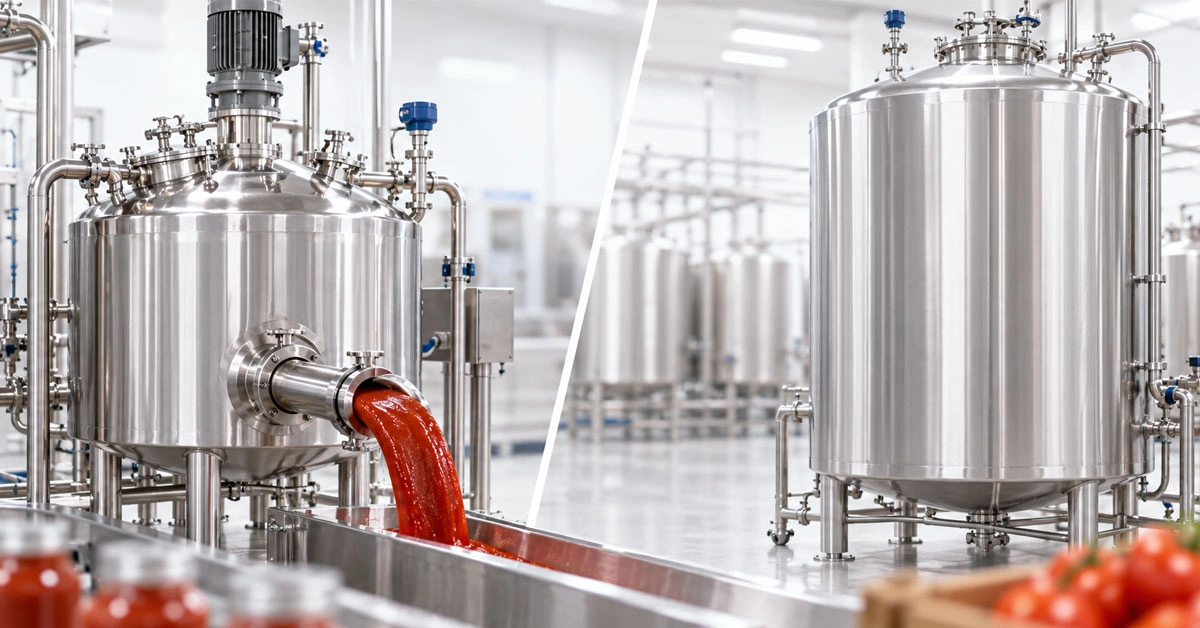
Agitation is used to ensure uniformity in the viscosity of sauces or those that contain suspended components. But the choice of agitation depends on the type of sauce and tank.
An agitator should be chosen based on:
- Viscosity of the sauce
- Content of solids
- Size of particles
- Tank volume
- Intensity of mixing required
- Duration of storage needed
For a viscous sauce, the choice of an improper agitator will not give adequate agitation. Whereas too much agitation would be unnecessary for those products that don’t require continuous mixing.
Temperature Control in Sauce Tanks
Some sauces will need controlled temperatures during the holding process or storage period.
A tank will thus have to be designed using heating, cooling, insulation, or a temperature control system where the process will require such systems.
Temperature needs will vary depending on the product, the process stage, composition, and the conditions under which the sauce is to be held.
For instance, the sauce may be required to have a certain temperature range before filling because of viscosity issues during filling.
The design of the tank will thus have to revolve around the actual product and process.
Hygienic Design of Sauce Tanks
Holding and storage tanks must be designed hygienically, cleanable, and with ease of cleaning in mind. Some sauces that are thick in consistency may form deposits on the tank surfaces, the agitator, valves, and pipelines.
A good tank should be able to offer:
- Smooth product contact surfaces
- Hygienic fittings
- Good drainage
- Access for inspection
- Good cleaning facilities
- No product retention points
Tanks, agitators, piping, pumps, and valves should be considered as part of the hygienic handling system.
Tank Capacity and Production Planning
Capacity should be planned taking into consideration the actual flow of the production.
In case of a holding tank, capacity usually depends on the volume of the sauce to be stored between processing steps. The manufacturer should take into account output from upstream machinery and the capacity of the next processing step.
In the case of a storage tank, capacity would depend more on batch sizes, packaging schedule, production frequency, and storage period required.
An oversized tank would lead to higher expenses and space utilization, whereas an undersized tank would lead to bottlenecks.
Therefore, planning for proper capacity will help in balancing the entire process of producing sauces.
Holding Tank vs Storage Tank for Different Sauces
Sauces of varying types may have completely varied handling needs.
For instance, thin sauces may need less complex holding systems than thick sauces that may need more agitation and the right type of pumps.
Moreover, sauces that are made up of herbs, spices, vegetables, and other particles may need agitation to ensure that the sauce is homogeneous.
The selection of tanks should therefore depend on the properties of the sauce and not the category it belongs to.
Product Transfer Between Processing Stages
The tank itself is only one part of the product-handling system. Pumps, pipelines, valves, and connections also influence how efficiently sauce moves through the plant.
An appropriate transfer system must be chosen based on the viscosity, temperature, solids content, and desired flow rate of the sauce.For instance, a different pumping system could be required for thicker sauces compared to thin liquid sauces.
Appropriate transfer lines can aid in avoiding any unnecessary product retention.
Role of Tanks in a Complete Sauce Processing Line
Holding and storage tanks play an essential role in linking various processes in a sauce manufacturing facility.
These processes will usually involve the preparation of raw materials, cooking, mixing, homogenization, holding, filling, capping, labeling, and packing.
Tanks allow for greater flexibility among these processes, and also help avoid situations where one process is directly dependent upon another.
In case a tomato sauce machine is being used by a manufacturer, the capacities and location of the tanks should be taken into account along with cooking, mixing, homogenizing, pumping, and filling systems.
Holding Tank vs Storage Tank: Which One Does Your Sauce Line Need?
This decision is dependent on the purpose of the tank. Holding tanks act as buffers from stage to stage in the production process, while storage tanks store sauces for a longer period of time before being filled. This could mean that some facilities will need both.
In conclusion, this configuration should be dependent on the following criteria:
- Product specifications
- Holding time
- Storage time
- Production capacity
- Batch size
- Filling rate
- Agitation requirement
- Temperature requirement
- Facility layout
How Tank Design Can Affect Sauce Quality
The tank design will have an impact on the consistency of the sauce after processing.
Agitation may help in preventing settling in case of thick sauces. In addition, proper heating/cooling may be necessary for thermally sensitive applications.
In addition, the tank geometry, the agitation design, the outlet location, and the transfer design will determine the efficiency of the product flow through the system.
Therefore, the design of a good tank will aid in achieving both production quality and efficiency.
Avoiding Bottlenecks Between Processing and Filling
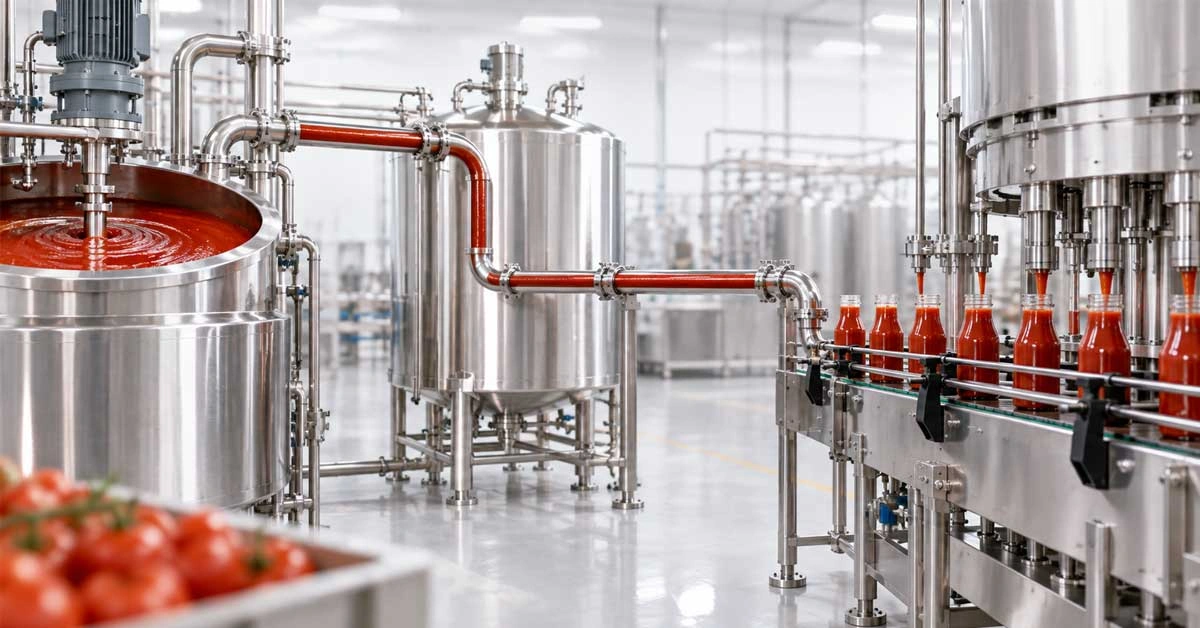
The advantage of having a properly sized tank is that it serves as a buffer between processing and packaging operations.
In case the cooking or homogenisation process generates the sauce faster than the packaging machinery handles it, a holding tank is able to compensate for the difference.
Nevertheless, neither the tank should be too small nor overly large.
Too small tanks result in interruptions, while overly large tanks lead to extra costs and consume production space.
Therefore, the tank size should take into account not only existing needs but also future potential.
Connection With Cooking Equipment
Also, Tank selection has to be done in conjunction with the cooking system.
The nature of cooking kettles, batch volume, discharge method, the viscosity of the product, and the cooking process are all some factors that could affect the tank selection downstream.
There is also a Cooking Kettle Selection Guide for Sauces that manufacturers can use when planning the cooking process to see how they should coordinate the cooking equipment with other processing equipment.
This way, cooking, mixing, homogenization, tank holding, and filling will become an integrated process.
Foodsure Machines for Sauce Processing
Foodsure Machines is involved in providing processing machinery and solutions for manufacturers of sauces and condiments.Depending on the nature of the product and manufacturing requirements, the processing line may consist of cooking kettles, mixers, homogenizers, holding tanks, storage tanks, pumps, filling machines, and packaging equipment.
Foodsure is in a position to assist manufacturing companies in the planning and selection of processing machinery as well as plant layout and installation.
In case companies are making an evaluation between a holding tank vs storage tank for sauces, the equipment selection is possible based on certain parameters.
Conclusion
Knowing the difference between a holding tank vs storage tank for sauces is essential in order to design a more effective processing line. Holding tanks will provide temporary buffering, while storage tanks will ensure better capacities for sauce to be stored after processing.It is important to choose the correct tank based on such factors as product viscosity, batch size, time period during which sauce will be held, agitation, temperatures, production rates, and filling needsIf used along with other equipment like cookers, mixers, homogenizers, pumps, and fillers, the right choice of tanks will allow you to manufacture sauces effectively and efficiently.
Have a Question? Let’s Connect
Need expert guidance on food processing machines, production setup, or process optimization? Our team is ready to help you choose the right solution for your business.
Frequently Asked Questions
What is the difference between a holding tank and a storage tank?
A holding tank is basically utilized for short term buffering between the processing steps, whereas a storage tank is normally used to store the processed or ready-to-package sauce.
Is it necessary to use a holding tank during the manufacture of sauce?
Not necessarily. It really depends upon the process flow, the speed of equipment, capacity of filling, and the buffering requirement.
Do we need to provide an agitator in a sauce storage tank?
It depends upon the product. Thick sauces and those containing particles may require agitation.
Can the same tank be used for holding and storage?
Yes, depending upon application requirements, but the tank needs to be suitable for that purpose based upon duration, product properties, and other aspects like agitation, temperature control, and cleaning, etc.
Factors affecting selection of the sauce tanks?
Viscosity of the product, batch size, duration of holding, storage requirements, production capability, agitation, temperature control, transfer and plant layout etc.




