
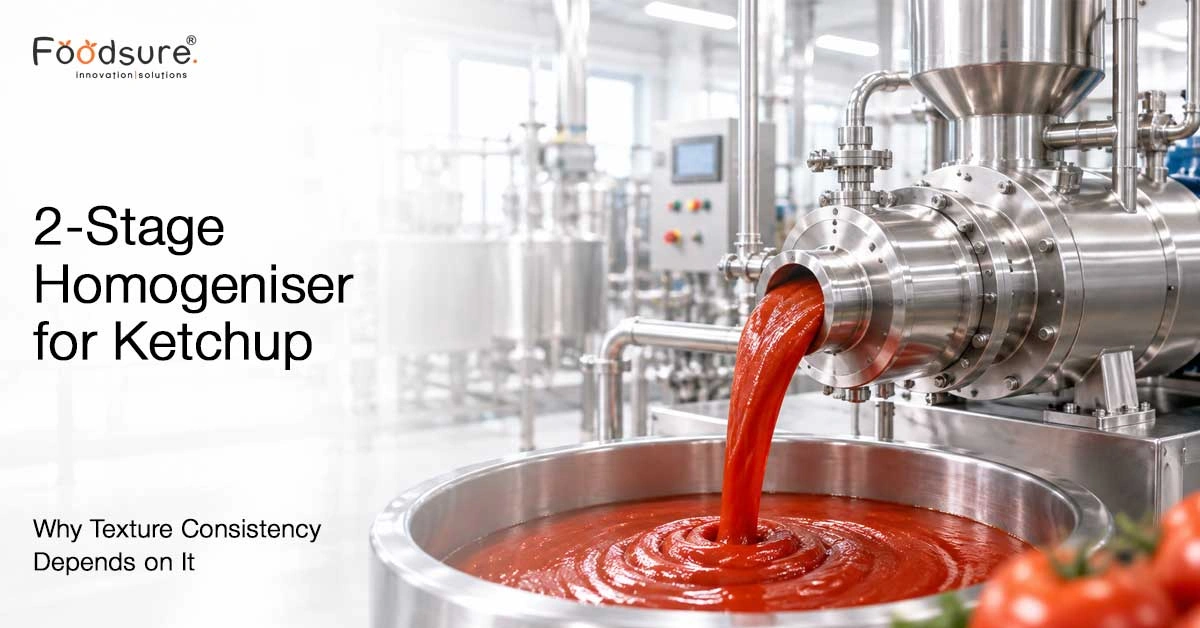
The quality of ketchup is determined to a great extent by the texture of the product. The use of a 2-Stage Homogeniser for Ketchup is one way of improving the texture of the product through the application of the pressure homogenisation technique.
The choice of homogeniser can make all the difference for commercial producers of ketchup.
This guide explains how a 2-Stage Homogeniser for Ketchup works, why it is important for texture consistency, and what manufacturers should consider when selecting a homogeniser for their ketchup processing line.
Why Is Homogenisation Important for Ketchup?
In Ketchup, there are tomato solids and other components that should be uniformly mixed in the final product. If there is no proper homogenization process, then it will affect the texture of the final product. A good homogeniser for tomato ketchup would help improve the quality of the product.
It can support:
- Smoother texture
- Better product uniformity
- Consistent mouthfeel
- Improved batch consistency
- Reduced particle size
- Better stability
What Is a 2-Stage Homogeniser?
A 2-stage homogeniser is a homogenizer where the homogenization process takes place in two stages as opposed to one homogenizing stage.
During the first stage, the material is exposed to a high-pressure homogenizing valve, which exposes larger particles to intense mechanical energy, thereby decreasing the size of the particles.
The second stage comes after that in order to give more effect to the process.
It therefore implies that a two-stage homogenizer machine is very useful in products where uniformity of texture and particle reduction is very important.
How Does a 2-Stage Homogeniser Work?
In a 2-stage homogeniser machine, the product is subjected to 2 homogenisation processes under controlled conditions.
While the first process is responsible for reducing larger particles and increasing the uniformity of the ketchup initially,
the second stage is responsible for further homogenisation that leads to better dispersion and uniformity. Such a two-stage homogenisation process could prove effective where the line of ketchup has to have fine texture and consistency.
The pressure and other conditions depend on certain parameters.
2-Stage Homogeniser for Ketchup vs Single-Stage Homogenisation
Both systems can be used for homogenisation, but they provide different levels of processing control.
How a Ketchup Homogeniser Machine Improves Texture
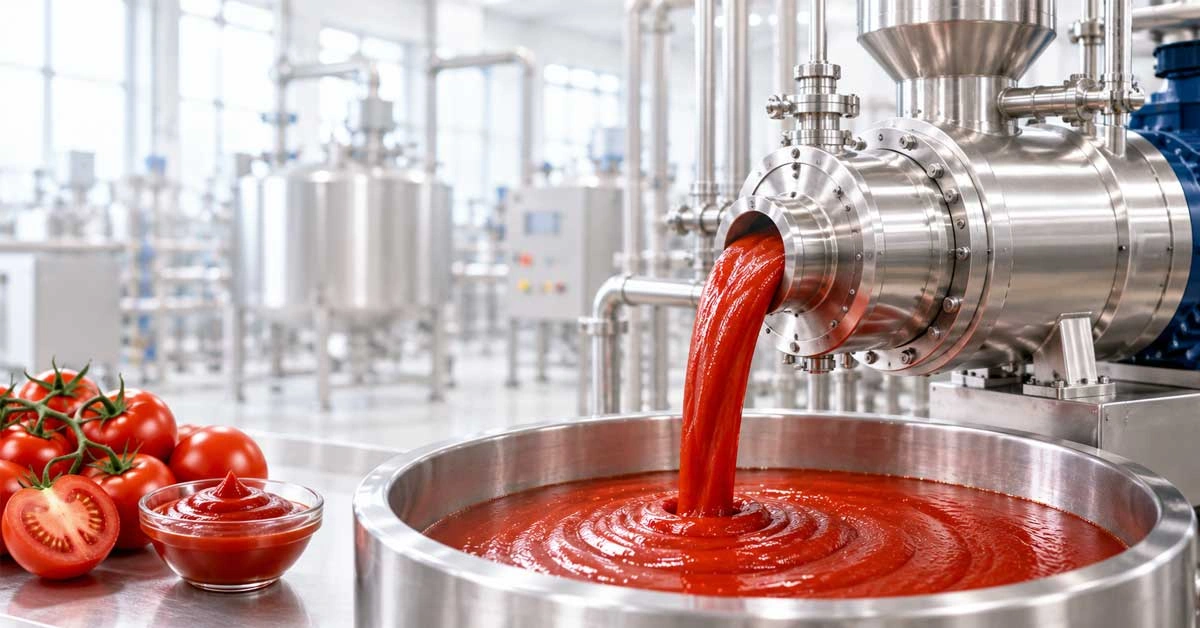
Homogenisation involves subjecting ketchup to high mechanical forces during its passage through the homogenisation valve. This makes it easier for the larger particles to be broken down.
The use of a ketchup homogeniser machine makes it possible for one to achieve an even texture and appearance as well as a more even mouthfeel.
Homogenisation is especially important in the production of commercial ketchup, where the end product requires a smooth and even texture before packaging.
Role of Homogenisation in the Ketchup Processing Line
Homogenisation is one of the key steps of ketchup manufacturing, which is performed after cooking and mixing stages. The step aims at improving the homogeneity and texture of the processed ketchup prior to its movement further to the stage of storing and filling.
Selection of the homogenizer for ketchup and sauces depends on the viscosity of the product, the desired texture, production volume, and overall production line. Integration with other equipment will ensure the continuity of the production process.
Factors to Consider Before Selecting a Homogeniser
Choosing a homogeniser should be based on the complete production requirement.
Product Viscosity
Ketchup can become relatively viscous, particularly after concentration. The homogeniser should therefore be capable of handling the expected product viscosity.
Production Capacity
The homogeniser capacity should match the required production output. Selecting equipment that is too small can create a processing bottleneck.
Desired Texture
Manufacturers should define the required final texture before selecting the homogenisation system. A smoother product may require more intensive processing.
Operating Pressure
The required operating pressure depends on product characteristics and desired results. Equipment should be selected according to the manufacturer’s technical recommendations and product trials.
Automation
Commercial plants may require automated pressure, temperature, and process controls for better monitoring and repeatability.
Cleaning and Maintenance
Food-contact components should be designed for practical cleaning and maintenance. This is particularly important for products such as ketchup that can leave residues inside processing equipment.
Benefits of Using a 2-Stage Homogeniser in Ketchup Production
If the appropriate 2-stage homogeniser machine is used in a commercial ketchup line, then there are various advantages that will result from its use.
- Smaller particles: Helps to decrease large particles in the product.
- Consistency: Makes it easy to ensure that there is an even distribution of the ingredients.
- Uniformity: Helps to ensure that there is consistency in each batch.
- Processing control: Allows better control of the particle reduction process due to the two stages.
- Better appearance: Particle uniformity results in better appearance.
The specific benefits will depend on the product and its conditions.
How Does Homogenisation Affect Sauce Production Efficiency?
An appropriately designed homogenizer will contribute to a smoother manufacturing flow. Matching the homogenization process to the capacity of other machines in both directions will reduce production delays.
Nevertheless, it is not recommended for the homogenizer to be a bottleneck. Its capacity needs to be evaluated together with the cooking kettle, the mixing process, the storage tanks, the filling machine, and the packaging equipment.
In the case of producers designing their whole manufacturing facility, the overall process should be evaluated as opposed to choosing an individual homogenizer.
Sauce and Ketchup Processing Line Cost
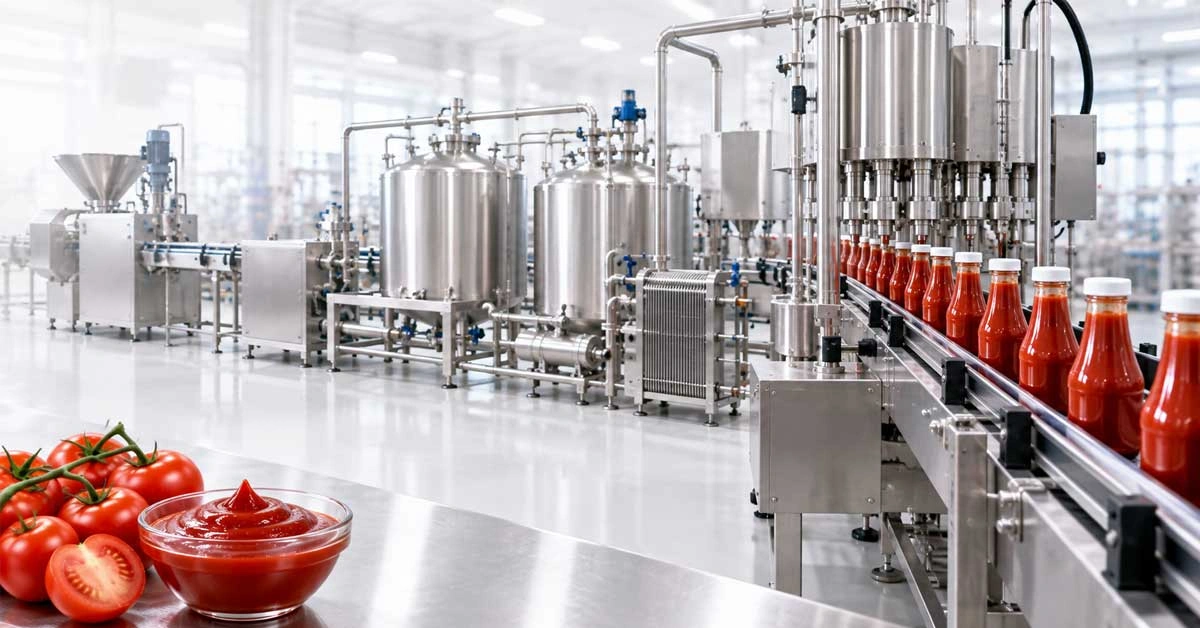
Sauce and Ketchup Processing Line cost depends on the whole process equipment arrangement.
The following can affect the cost of investment:
- Capacity of production
- Capacity of homogeniser
- Specifications of homogeniser
- Number of processing stages
- Equipment for cooking and mixing
- Storage space
- Packaging equipment
- Automation process
- Facility layout
- Installation requirements
The use of a 2-stage homogeniser would lead to higher equipment cost than the single-stage homogeniser installation, but finally the decision should depend on the quality requirement of the product.
Foodsure Machines for Ketchup and Sauce Processing
Foodsure Machines offers processing solutions for ketchup, sauces, condiments, and other food products.
It is possible to customize the processing line depending on the nature of the product, production volume, degree of automation, and desired consistency.
Depending on the application, the configuration may comprise cooking kettles, a mixing system, a homogenizer, a holding tank, a filler, and packaging equipment.Foodsure Machines may assist producers in planning the process, choosing the right equipment, plant design, installation, commissioning, and operator training.If a company is considering the use of a 2-stage homogeniser for Ketchup, it is important to choose the equipment within the framework of the entire production line.
Conclusion
A 2-Stage Homogeniser for Ketchup may prove to be an essential part of a ketchup production line when smoothness of the texture, even distribution of particles, and consistency in product features are essential.
It is obvious that a 2-stage operation gives more control than simple homogenization, but at any time, equipment selection must be done based on product viscosity, composition, capacity, and required texture.For producers who are ready to organize the whole process of ketchup manufacturing, homogenization must be taken into account along with cooking, mixing, storing, filling, and packaging operations. A properly chosen homogenizer may prove helpful in achieving good quality of the product.
Have a Question? Let’s Connect
Need expert guidance on food processing machines, production setup, or process optimization? Our team is ready to help you choose the right solution for your business.
FAQs
What is a 2-stage homogeniser meant for?
The 2-stage homogeniser is a device that is used to improve the consistency of the product, reduce the particle size, and make the texture more uniform by subjecting the product to two homogenisation processes consecutively.
Is a homogeniser required for tomato ketchup?
This depends on the desired characteristics of the product. The homogeniser is very handy, especially when the manufacturers desire a smooth and uniform ketchup texture.
What is a ketchup homogeniser machine?
A ketchup homogeniser machine uses the principle of high pressure to improve particle distribution and uniformity of the product.
Is it better to use a 2-stage homogeniser machine than a single-stage one?
The two-stage homogeniser gives the manufacturer more control over the particle reduction process and consistency of the product; however, it all depends on the requirements of the manufacturing process.
What is the role of homogenisation in sauce production?
Homogenisation helps create a more uniform product structure and can improve texture, particle distribution, and consistency in suitable sauce applications.




