
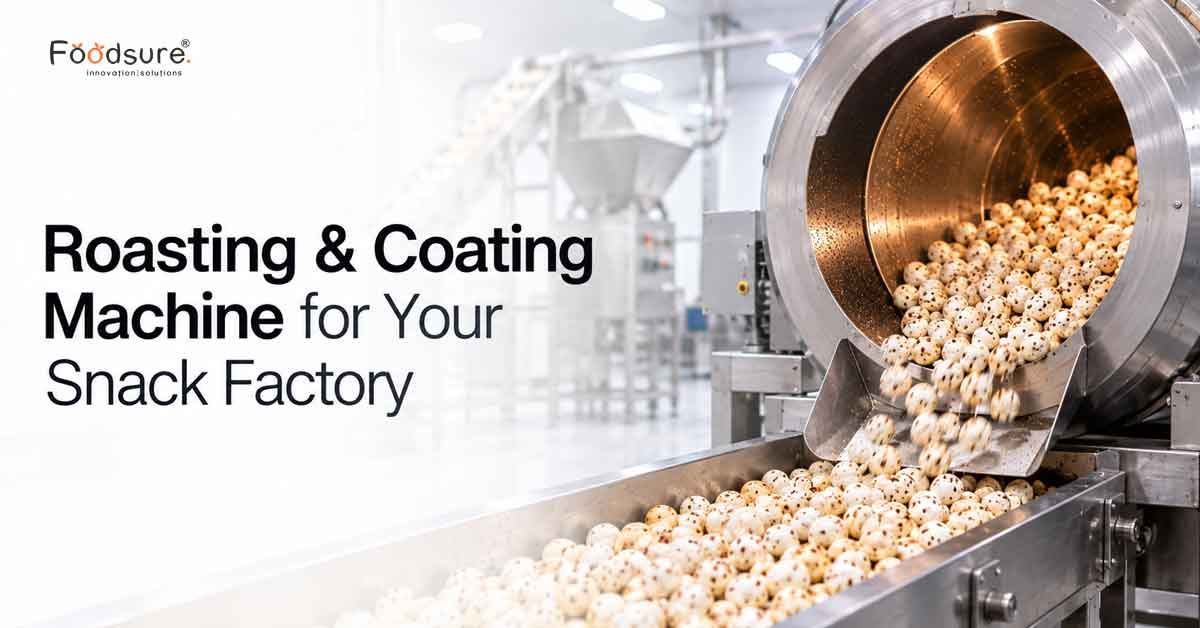
Purchasing roasting and coating machines is one of those decisions that can be wrong in silent ways. Your machine is working, making snacks, and everything seems okay until you realize that there is inconsistency in the batches, poor throughput, or the coating line cannot catch up with the roasting line.A snack roasting and coating machine is a kind of machine that roasts or heat-treats your snack and coats it with flavoring, oil, or seasonings evenly. It is better to have the combination right than to purchase a roasting machine or coating machine on its own since roasting will affect coating.
In this article, we are going to discuss how these machines operate, what makes one machine better than another, and how to select machines that suit your factory needs.
What Is a Snack Roasting and Coating Machine, and How Does It Work?
The snack roasting and coating machine comprises two operations: the dry or hot air roasting process, which cooks and dries the snack, and then a rotating drum or a coating system that adds the flavorings, oil, or seasoning to each individual piece.
Some machines are available in one single integrated unit, whereas some are available in separate snack roasting and coating machines which need to be placed one after the other in order to function properly.
Roasting Stage: What It Actually Does
This step employs the process of cooking the product through dry heat, hot air, or infrared rays, depending upon the kind of roasting equipment used. Roasting is essential for producing certain products such as makhana, nuts, and roasted grains because it gives them their unique texture and moisture levels along with improved shelf life.
Some of the common processes used for roasting are:
- Drum roasters – rotating cylinders that cook the product through heat
- Conveyor/tunnel roasters – a belt-based system that moves the product through the hot chamber
- Fluidized bed roasters – moving the product through hot air
Coating Stage: What It Actually Does
The coating process involves the application of seasonings, oil, sugar syrup, or flavor powders on roasted products while they are still warm enough to receive the coating. An even distribution of the coating is what makes the difference between a professional-grade product and a poorly made one.
Coating machinery generally includes:
- Tumbling drums — coat the product by tumbling it while spraying or dusting it with seasoning
- Liquid coating machines — apply liquid oil or flavor coatings with precision nozzles
- Dusting machines — apply dry seasoning mixes rather than liquid coatings
Snack Roasting Machine vs Snack Coating Machine: Key Differences
Types of Roasting and Coating Equipment: Which One Fits Your Product?
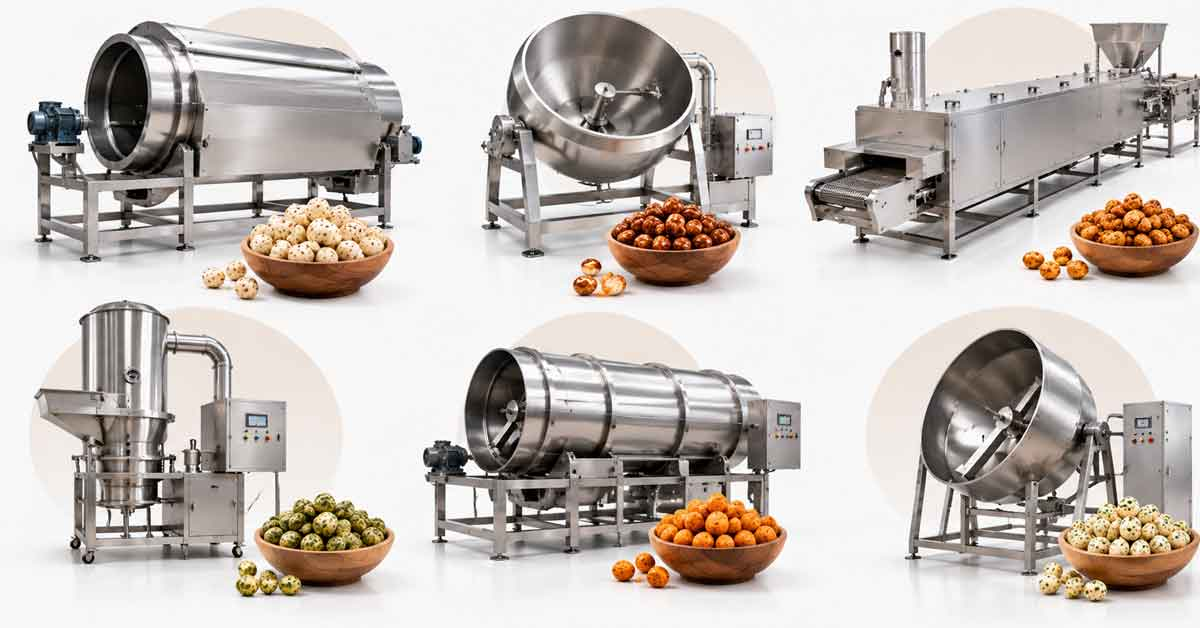
Not all types of roasting and coating machines will suit every kind of snack food product. Here is an example method for considering which one to go for, depending upon your product.
For Makhana and Puffed Snacks
A combination of a drum roaster and a rotating drum coater is a good choice, since the movement helps mimic the traditional hand roasting process and ensures consistency. If you are operating a makhana processing plant, then adding a coating drum downstream becomes easier than changing the entire roasting equipment.
For Nuts and Seeds
Fluidized bed and tunnel roasters ensure uniform heat distribution among dense items such as nuts, and then spray coating or drum coating depending on whether it requires oil or dry seasonings.
For Namkeen and Extruded Snacks
High throughput tunnel roasting along with spray coating may prove necessary for their production.
7 Factors to Consider Before Buying
The key factors include production capacity, level of automation, building material, heating type, coating accuracy, energy efficiency, and after-sales services – listed here in the order of common buyer priority.
- Production capacity – choose a machine according to your real needs (kg per hour), not your dreams – idle big machines represent a waste of money.
- Level of automation – manual and semi-automatic devices are cheaper at first, while automatic ones with programmable controllers require less workforce and ensure better quality of batches.
- Building material – food-grade stainless steel is better and more expensive due to hygiene reasons and longer lifespan, especially in case of exports or branded products.
- Heating type – different types of heating (electric, gas or infrared) have different operating costs and accuracy of temperature control; although gas seems to be cheaper but requires proper safety installation.
- Coating accuracy and its adjustment possibility – choose machines that allow controlling coating density and seasoning proportion since requirements for coating can differ within the product line.
- Energy efficiency – insulated chambers and heat recovery systems can significantly reduce operating costs during the machine lifetime.
- After-sales services and spare parts supply – a little more expensive, but a well-supported machine pays off in case of lower downtime costs compared to a cheaper device with bad support.
Common Mistakes Buyers Make
- Mismatching roasting capacity and coating capacity is another error, which results in either bottlenecks when there is a fast roaster and slow coater or the other way around.
- Neglecting accessibility for servicing and cleaning purposes – a small footprint does not always translate into efficiency and easy maintenance.
- Relying solely on the price of the equipment, which leads to underestimating other costs that will be incurred – installation cost, training costs, maintenance costs.
- Failing to test the machine with your product – a good example is a machine designed to process nuts. While it may work well with them, there is no guarantee that it will perform equally well with lightweight puffed makhana.
- Neglecting future expansion capacity needs – buying only what is needed at the moment may lead to an expensive re-investment within a year or two.
Best Practices for Getting the Most Out of Your Equipment
- Test the product you intend to use, not the samples supplied by the supplier.
- At least two operators per shift should be trained for temperature setting and coating calibration.
- Plan cleaning sessions regularly because the build-up of residues in coating drums impacts hygiene as well as coating uniformity.
- Monitor weekly output uniformity in the initial few months of operation.
- Have some spare parts (belts, nozzles, seals) handy instead of relying on delivery schedules from the supplier.
When to Buy Combined Equipment vs Separate Machines
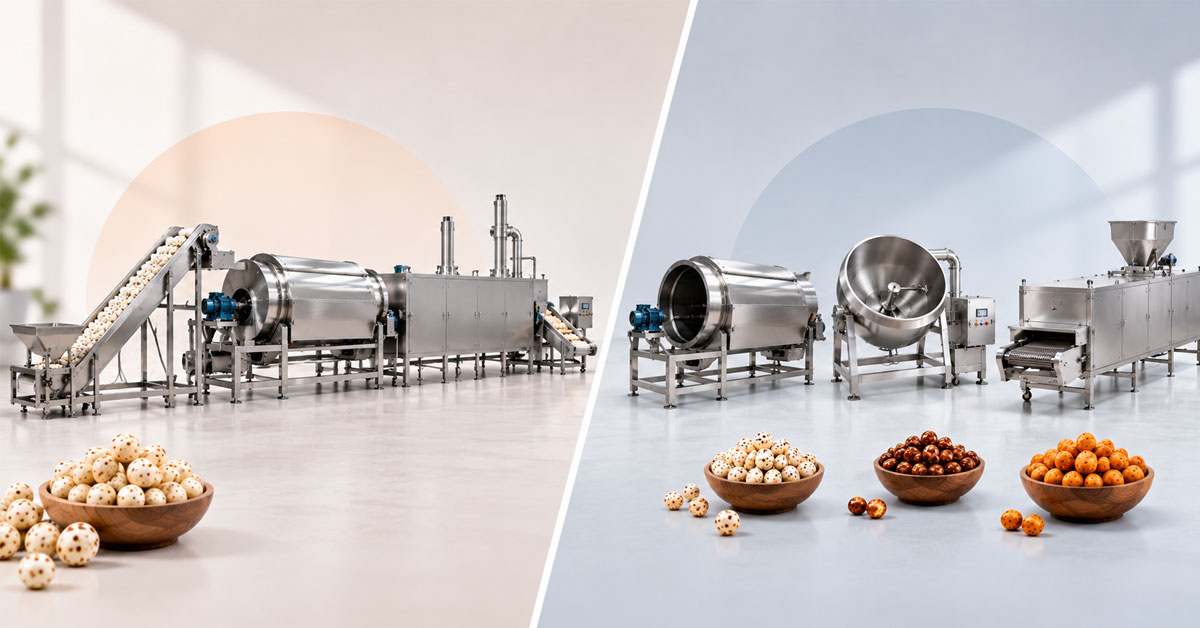
A combined machine for both processes works well if:
- Floor space is limited
- Your product range is relatively similar (only one or two major products)
- You require a simple installation and single-point maintenance
On the other hand, if you have:
- Different product ranges requiring individual coating
- Future scaling of each process in mind separately
- Only a roasting machine and not a coating one
How This Fits Into a Larger Processing Line
Roasting and coating operations are not normally used independently in a practical industrial setting. For instance, in manufacturing products such as makhana, the order of operation follows cleaning, popping, grading, then roasting and coating, and finally packaging. The process of grading at an earlier stage will make the roasting and coating processes more consistent, because kernels that are of equal size get roasted and coated uniformly as compared to a mixture.
For those who are designing a processing plant from scratch, our article on the differences between automated grading of makhana and manual grading helps to understand how an automated grading machine increases consistency in this case at a later stage. For those who are in the process of planning their processing operations, our article on assessing a makhana processing machine can help.
Why Choose Foodsure?
When investing in a makhana processing line, the right machine is not necessarily the most expensive one. It is the one that matches your required capacity, production process, and plans for expansion.
Foodsure provides makhana processing equipment for businesses at different stages of production, with capacity options from 50 kg/hr to 200 kg/hr. Instead of relying on a one-size-fits-all setup, the equipment can be selected according to the processing stage, output requirement, and level of automation.
With SS304 food-grade construction, automated and semi-automatic options, and equipment designed for commercial makhana processing, Foodsure helps processors build a setup that can deliver consistent output while remaining practical to operate.
The focus is not simply on supplying a machine. It is on helping businesses choose equipment that makes sense for their current production and leaves room for future expansion.
Why processors consider Foodsure:
- 50–200 kg/hr capacity options for different production requirements
- Semi-automatic and fully automatic configurations depending on labour and throughput needs
- SS304 food-grade construction for food-contact components
- Makhana-specific processing equipment rather than generic machinery
- Scalable solutions for businesses planning to increase production
- Installation and operational support to help teams put the equipment into use
- Equipment selection based on actual production requirements, rather than simply selling the highest-capacity machine
If you are comparing makhana processing line prices, getting a capacity-based quotation is a better starting point than comparing machine prices alone. Foodsure can help you assess the equipment required for your production capacity and processing setup. Also, read our article on makhana grading machines versus manual sorting explains what benefits you may get from grading makhana mechanically, while our guide to establishing a makhana processing unit covers all stages of installation.
Key Takeaways
- The snack roasting and coating machine is a combination of two different stages, namely roasting and coating, which require equally capable capacity to avoid inefficiency.
- Product category will dictate the choice of machinery, in that drum roasters are preferable for puffed products like makhana, but tunnel roasters are preferred for nuts and namkeen.
- Production capacity, level of automation, and construction materials are the three elements that will influence the cost and efficiency of the equipment.
- Performing tests using your own products prior to purchasing will help you identify any problems that may arise, as opposed to running trials using other material.
- The best results will be achieved when the previous stage of grading produces sorted products.
Conclusion
Selection of the right roasting and coating machines depends on the proper fit of the machinery with your products and production quantities rather than looking for the most automated system. The right medium-sized system that operates consistently is better than a big, but idle system. Do test runs with your products and verify the production capacity of the machine with your daily production. Don’t ignore the after-sales service when comparing different vendors; it is usually the difference between a good and bad year.
Have a Question? Let’s Connect
Need expert guidance on food processing machines, production setup, or process optimization? Our team is ready to help you choose the right solution for your business.
FAQs
How different is the snack roasting machine from the coating machine?
The roasting machine cooks the snack, while the coating machine adds flavoring to the snack after cooking it.
Is it possible to combine the functions of roasting and coating in one machine?
Yes, there are machines designed to do roasting and coating in one machine, but there are others that are not.
What is the suitable capacity of a roasting and coating machine for a small snack factory?
Small snack factories have small production volumes and hence their machines range between 20-100 kg/hour.
Does the kind of snack that will be produced influence the roasting and coating equipment I should buy?
Yes, puffed snacks require machines with drums, whereas nut products require tunnels/ fluidized beds.
How will I know if the capacity of the roasting and coating machine is not suitable?
If either one takes time to process what the other already processed, there is mis-match in capacity.
Is it compulsory to use stainless steel in roasting and coating machines?
Food grade stainless steel is not compulsory everywhere but it is highly advised.
What is the maintenance required in roasting and coating machines?
Cleaning of coating drums/nozzles and checking heating elements and belts regularly.




