
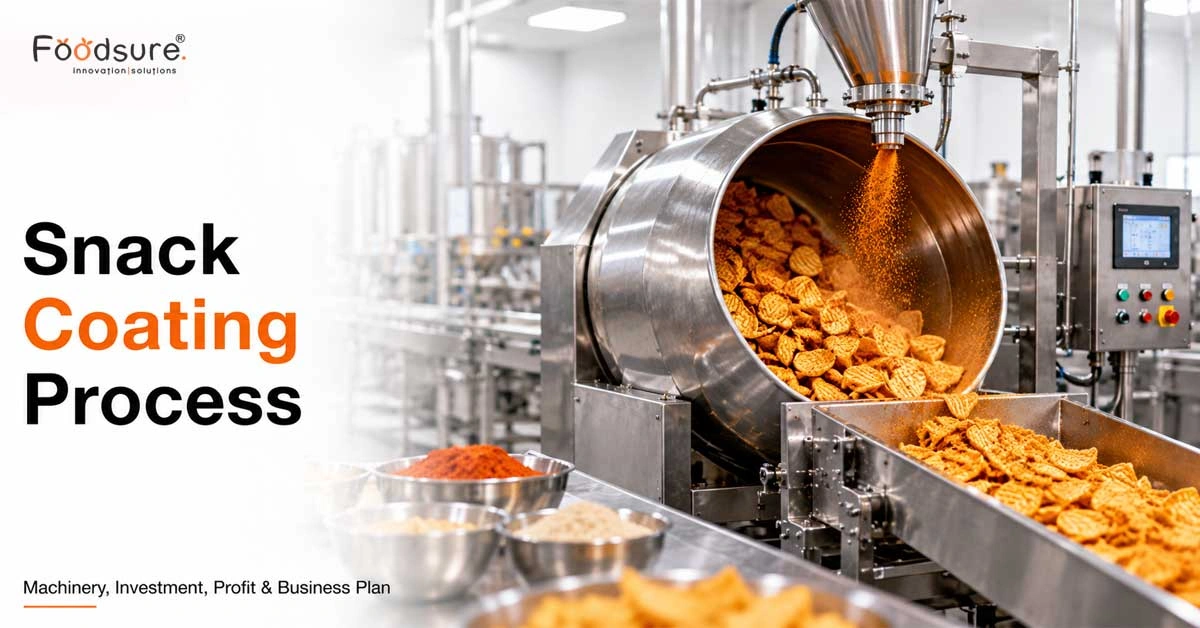
Snack coating process refers to the stage at which the plain roasted kernel or chip turns into something that the consumer is willing to have again. It is the stage where the flavor is added – and it is the same place where most otherwise fine products become inconsistent due to uneven seasonings, greasy clusters, or under-seasoned kernels in the same batch.
Simply put, the process of coating of a snack product involves the addition of oils, dry masalas, or liquid masalas to roasted or fried base product. If this process is done incorrectly, then no matter how well done the previous processes were, your final product will be ruined.
In this informative article, we will take you through all the steps of the snack seasoning process, the process of making masala slurry, the benefits of having an automatic snack coating process over manual process, and what is special about makhana coating process compared to coating of other snacks such as chips and puffs.
What Is the Snack Coating Process?
Snack coating is defined as the step in snack manufacturing process where oil, dry seasoning or liquid masala is uniformly coated on top of roasted or fried base food for consistent flavor, color and texture of all individual pieces.
Coating normally takes place immediately after roasting or frying when base food cools down and before the final cooling and packaging step. Snack coating is not only related to flavors but also to the visual appearance of the finished product, its seasoning stability and crispness.
Where Coating Fits in the Production Line
- Roasting or frying – this involves cooking and drying the basic snack (makhana, chips, puff snacks, nuts)
- Cooling – cooling of the snack to be at the right temperature prior to seasoning
- Coating/seasoning – this is the core discussion of the paper; seasoning in the form of oil, powder, or slurry is applied
- Final cooling – the seasoned product is once again cooled down
- Packaging – the snack is packaged
Why the Coating Stage Matters So Much
The flavour profile of the snack is largely determined at this point. Two batches roasted exactly the same way can end up tasting very different depending on the quality of coating done.
- Consistency of flavour – each bite must have more or less equal quantities of the seasonings, not just the ones on top of the batch
- Appeal of appearance – poor coating results in some snacks being unseasoned while others have clusters of excess masala
- Stability on shelf – too much oil in the coating speeds up the process of rancidity, while too little seasoning doesn’t stick to the snack
- Cost management – inconsistent coating uses excess seasonings as operators try to remedy obvious problems
- Customer loyalty – the change in the intensity of flavouring becomes noticeable to repeat customers
Roasting creates texture. Coating creates flavour. A production line can only function as well as its worst stage, and coating is the weak point for many operations.
The Manual Snack Seasoning Process
Before automated coating systems became common, and still in many small units today, seasoning was applied by hand sprinkling dry masala over a batch and manually tossing or shaking it to distribute the coating.
How Manual Coating Works
- Product in its roasted or fried form is spread on trays or bowls
- Oil is poured on top of the batch so that the seasoning sticks easily
- Dry masala is sprinkled on the batch manually, usually just by estimation rather than by measurement
- The batch is tossed or shaken by hand for proper seasoning
- The batch is allowed some time to rest before being packaged
Limitations of Manual Coating
- Uneven coverage – hand-tossing fails to cover all pieces uniformly
- Imbalance between oil and seasoning quantities – the quantities are not uniform across batches without standard dosage
- Slow process – manual tossing reduces the quantity a single employee can season within an hour
- Inconsistent hygiene – increased chances of contamination through repetitive contact without consistent procedures
- Challenging to scale – consistency in small volumes for local production becomes inconsistent at larger volumes
This explains why most businesses resort to a mechanized drum seasoning method when coating makhana, chips, or any other snack as soon as it is economical.
Masala Slurry Preparation: The Foundation of Even Coating
The production of masala slurry involves the combination of edible oil with the dry powder form of spices (in addition to some liquid flavor carriers), resulting in the formation of the liquid form of the spices which is applied to the snacks for coating and flavoring.
It starts from blending of the oil with dry seasoning in a pre-mix tank, after which it is transferred to a holding tank for the purpose of supplying it continuously to the coating drum. The important thing to understand is that dry powder does not stick to the dry roasted surface; oil is necessary in order to bind it together and allow it to stick.
Common Steps for Preparation of Masala Slurry
- Weighing and measuring — oil and dry seasonings are measured for the required proportion for the batch or production line
- Pre-mix blending — oil and seasonings are mixed in the pre-mixing tank until homogenous
- Transfer to the holding tank — the blend is supplied to a holding tank that supplies the coating system continuously
- Application — the slurry is supplied to the coating drum through the application nozzles or spray lance
- Preparing a second batch in parallel — a new batch may be prepared to make sure that the coating system does not run out of the masala slurry during production
Getting the proper oil-seasoning proportion at this stage is one of the main moments in quality control of the process.
How an Automatic Snack Coating Process Works
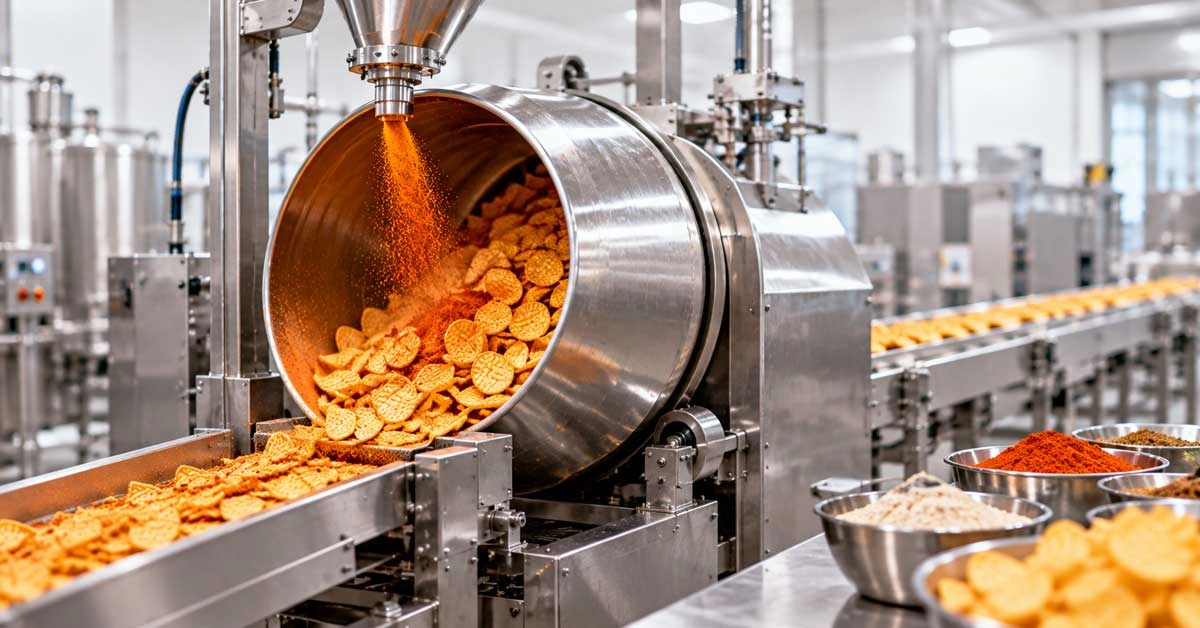
An automatic snack coating process uses a rotating drum or continuous conveyor system to tumble roasted or fried product while spraying or dusting it with a pre-measured seasoning slurry or dry powder, ensuring every piece receives a consistent coating.
Most systems fall into a few main types, each suited to different products and seasoning styles.
Types of Snack Coating Machines
- Coating equipment for the food industry, such as drum coaters, uses a stainless steel drum that keeps revolving and applying oil/dry seasoning on the product continuously; best for makhana, nuts, extruded snacks, etc.
- Spray coating equipment uses a liquid slurry/oil spray that is sprayed through nozzles directly onto the product, which can be coupled with drum revolving
- Powder coating equipment involves application of dry seasoning on the product with a vibrating/tumbling system and is suitable for salt, sugar, or spice mixes.
- Continuous drum flavoring equipment consists of an inclining motor driven drum where product goes in one side and comes out the other side seasoned.
Key Components of an Automatic Coating Line
- Feed conveyor or feed inlets – feeds in the cooled and roasted products in to the coating drum
- Coating drum fitted with flights/ridges inside – ensures proper tumbling action of the products and prevents slipping of the product through the drum
- Seasoning slurry/powder metering/dosing system – introduces seasoning in precise and accurate quantities to each batch/minutes of product flow
- Drive Motor – drives the drum with the help of a variable speed control suitable for product size and fragility
- Outlet strainer/recovery system – recovers excess of seasoning for re-use
Manual vs. Automatic Snack Coating Process
The Makhana Coating Process Specifically
The principles of makhana coating are fundamentally the same as any coating process used in snack food production, but there are some nuances worth considering when coating makhana.
The makhana seeds themselves are delicate and easily damaged in comparison with heavier snacks such as chips and nuts. This means that:
- Lower tumbling speed is required to prevent breakage of makhana seeds during coating process
- Smaller amount of oil is sufficient due to porosity of seeds and its ability to soak up both oil and seasonings
- Low-pressure spraying is preferable to over-spraying which leads to seeds becoming wet
- Coating should be done immediately after roasting, when kernels cool down a little bit, as seasonings tend to steam
As makhana is highly appreciated for its lightness, over-oiling during coating process is one of the easiest ways to ruin this advantage.
Common Mistakes in the Snack Seasoning Process
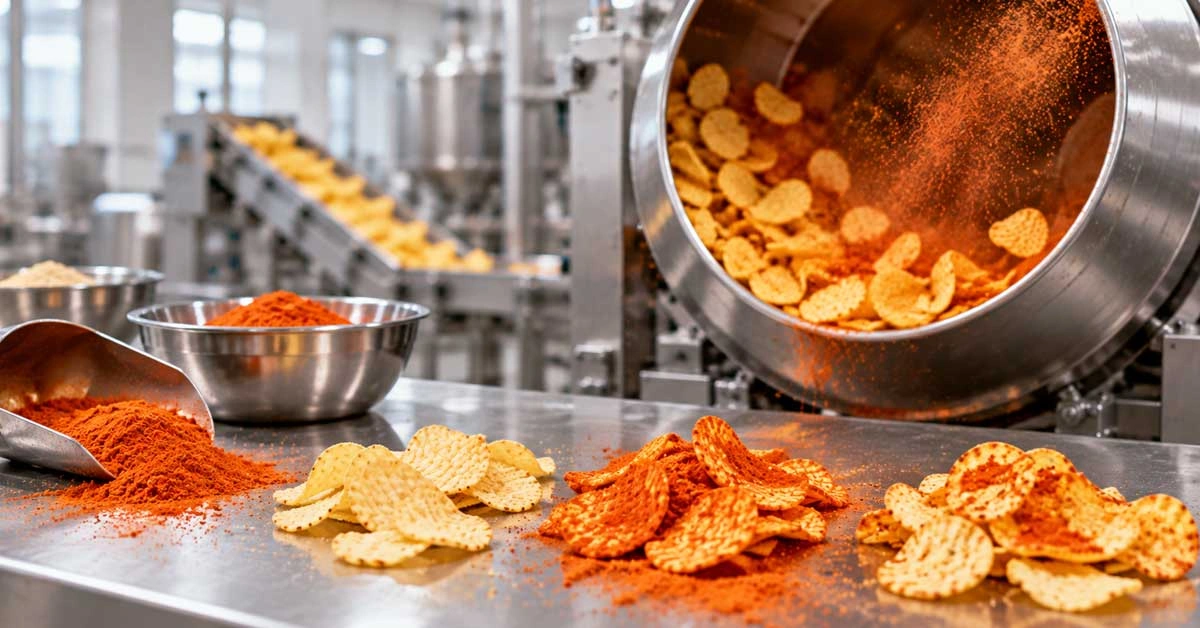
Even with good equipment, coating problems are common. The recurring issues worth watching for:
- Application of the hot product immediately from the roaster—seasoning may form clusters or the oil may burn instead of being applied evenly
- Inconsistent ratios of the slurry mix between batches—the slight difference in the proportion of oil and spices will result in flavour variation
- Overfilling of the coating machine—the excessive load of the product will hinder its even mixing, resulting in unevenly coated parts
- Not adjusting the drum speed to the fragile snack—the fast drum speed for the makhana will cause breakage
- Omitting the cooling process after coating—packaging of hot coated product will result in moisture retention
Best Practices for a Reliable Snack Coating Process
- Standardize masala slurry mixing using measured proportions instead of eye-balling the process
- Balance the speed of the drums and the tumbling according to the product being covered
- Let the product cool down a little before applying the coating and then packaging
- Implement a recycling process that captures excess seasoning for reuse
- Regularly test tastes and consistency of the entire batch and not just the initial outputs
When to Choose Manual vs. Automated Coating
Manual seasoning still makes sense when:
- Production is low, and the product is sold locally
- Positioning of the product is more towards handmade products
- There is no capital for buying a coating machine
An automatic snack coating process makes sense when:
- This will be for buyers who expect consistency in taste
- The amount of production is too much to be done by manual tossing
- Costs of seasoning and wastage have become a factor
- A makhana machine is already being used to grade and roast; there is a need to match this at the seasoning level
Key Takeaways
- Snack coating refers to the application of oil, dry seasoning or a masala slurry over roasted or fried snacks in order to achieve uniformity of taste, appearance and shelf stability.
- The preparation of masala slurry involves mixing oil with dry spices in a premix tank prior to its application; it’s very important to get the right proportions in order to achieve uniformity of taste.
- Manual seasoning relies on the technique of hand tossing and guesswork, and therefore becomes very inconsistent once the production volume increases.
- Automatic snack coating is achieved using drum or spray system that doses the seasoning uniformly on every piece in higher production volumes.
- Makhana coating requires lower oil proportion due to its delicate nature and porosity.
Conclusion
It is during the coating of the snacks that either all the processes that came before grading, roasting, and cooling have paid off or failed. It should be easy for the eater to enjoy well seasoned snacks but this is done through consistent slurry ratios, proper equipment and the particular product being coated.It does not matter whether the seasoning is done manually or through the entire automatic snack coating process; all these have one thing in common, even coating and the correct proportion of oil and seasonings.
Have a Question? Let’s Connect
Need expert guidance on food processing machines, production setup, or process optimization? Our team is ready to help you choose the right solution for your business.
FAQs
1. How is the snack coating process defined?
It is the process during which oil, dry seasoning or masala slurry are evenly coated onto roasted or fried snacks, giving them a consistent taste.
2. What is the principle of the masala slurry preparation?
The masala slurry preparation involves mixing the oil with dry spice powder in the pre-mix tank, holding and then applying it continuously via the nozzle onto the tumbling product.
3. What is the difference between the snack seasoning process and frying or roasting process?
While the roasting and frying process cooks the base product, seasoning only adds flavoring and coating to the cooled product after cooking.
4. How can the automatic snack coating process help to achieve the consistency of the process?
It provides metered dosing and continuous tumbling during the seasoning of the product to coat it evenly.
5. What is the difference between the makhana coating process and chips/nuts coating process?
The makhana requires lower drum speeds and a lower oil ratio due to high porosity and fragility of the kernels.
6. Can the excessive amount of oil spoil the snack coating process?
Yes, because the excess of oil results in clumping, inconsistency of the flavor and reduces the shelf-life of the snack because it makes the pack moist.
7. Is the manual seasoning process feasible for the snack business?
Yes, it is appropriate for the small snack business with limited volumes per day and local distribution.




