
There is an increase in mayonnaise consumption in India because of the rise in quick-service restaurants, cloud kitchen operators, packaged food producers, and retail outlets. At the same time, there is increasing preference for vegan and egg-free mayonnaise, and thus, this offers opportunities to the food producers.Establishing a profitable mayonnaise manufacturing unit India is not just about investing in machines. Companies need to take care of product development, plant infrastructure, production capacity, regulatory issues, and machines. A well-planned guide to setting up a mayonnaise business can help mitigate investment risks and improve production efficiency.This blog contains all details required for setting up a mayonnaise manufacturing unit in India, covering licensing, machinery selection, mayonnaise plant cost, process of production, and investment planning.
Why Invest in a Mayonnaise Manufacturing Unit in India?
Mayonnaise demand has risen in India due to consumer tendencies in favor of ready-to-eat products. Due to the rising demand for burgers, sandwiches, wraps, pizza, salads, and fast foods, mayonnaise demand has risen among consumers.
The reasons that can be attributed to the growth of this industry include the following:
- Rapid growth of quick service restaurants and cloud kitchens
- Increasing demand for vegan and eggless mayonnaise
- Increased opportunities for manufacturing private labels
- Increasing consumption through supermarkets and online platforms
- Increasing opportunities for export of processed foods
- Government support for the food processing business as part of initiatives such as PMFME
These factors make the establishment of a mayonnaise manufacturing plant in India a lucrative business.
Planning Your Mayonnaise Business Setup
Before setting up machinery, companies need to come up with an elaborate mayonnaise business setup guide that provides for production objectives, customers, investment amounts, manufacturing facility, and future expansions.
A complete business plan needs to cover:
- Product line
- Manufacturing capacity
- Market target
- Investment amount
- Location of factory
- Distribution plan
- Future expansions plan
Effective planning ensures that manufacturers make optimal use of their resources.
Licensing and Regulatory Requirements
Before starting commercial production, manufacturers must obtain the necessary approvals and registrations required for operating a food manufacturing business in India.
| License / Registration | Purpose |
|---|---|
| FSSAI License | Mandatory approval for manufacturing and selling food products in India. |
| GST Registration | Required for commercial business operations, taxation, and invoicing. |
| Trade License | Local municipal approval to legally operate a manufacturing business. |
| Factory Registration | Applicable based on workforce size, machinery, and production capacity. |
| Packaging Compliance | Ensures product packaging and labeling comply with applicable food regulations. |
Manufacturers setting up a mayonnaise manufacturing unit India must also consider government support schemes like PMFME that could offer financial help to qualifying food processing enterprises.
Choosing the Right Production Capacity
Production capacity influences the type of equipment to be used, the scale of the factory, personnel needs, and the mayonnaise plant cost. Companies should choose equipment according to current and future needs.
| Scale | Typical Output | Best Suited For |
|---|---|---|
| Pilot / Micro | 50–80 kg/hour | Home-based brands, SHGs, and cloud kitchen suppliers testing market demand. |
| Small Commercial | 80–100 kg/hour | Local retail supply, regional QSR chains, and private-label startups. |
| Medium Commercial | 100–200 kg/hour | Multi-city distribution, modern trade listings, and growing food brands. |
| Industrial | 200+ kg/hour (up to 1 ton/hour) | Export businesses, national brands, and large institutional contracts. |
Selecting the Right Manufacturing Equipment
Machine selection is an important aspect concerning production efficiency, consistency of products produced, and cost of operations in the long term. Rather than basing their decision on the price of machinery, firms need to assess production capacity, degree of automation, hygienic conditions, energy consumption, and scalability.
Companies interested in producing mayonnaise commercially may consider the entire Mayonnaise Making Machine package.
Mayonnaise Machine Price (2026)
The cost of machinery varies according to production capacity and automation requirements. The table below provides an estimated investment range for commercial mayonnaise production equipment.
| Machine Type | Capacity | Approx. Price (INR) | Suitable For |
|---|---|---|---|
| Semi-Automatic | 50–80 kg/hour | ₹8 Lakh | Pilot batches and small businesses. |
| Fully Automatic | 80–100 kg/hour | ₹15 Lakh | Small and medium-sized manufacturers. |
| Industrial Production Line | 150+ kg/hour | ₹18–50+ Lakh | Large commercial plants and export-oriented production units. |
The actual mayonnaise machine price India may vary depending on machine configuration, material grade, automation level, and additional equipment.
Estimated Project Investment
A complete mayonnaise manufacturing unit India requires investment in machinery, factory setup, utilities, packaging systems, and working capital.
| Scale | Machine Cost | Setup Cost | 3-Month Working Capital | Approx. Total Investment |
|---|---|---|---|---|
| Pilot / Micro | ₹4–7 Lakh | ₹2–4 Lakh | ₹2–3 Lakh | ₹8–14 Lakh |
| Small Commercial | ₹8–15 Lakh | ₹5–8 Lakh | ₹4–6 Lakh | ₹17–29 Lakh |
| Medium Commercial | ₹15–25 Lakh | ₹8–12 Lakh | ₹6–10 Lakh | ₹29–47 Lakh |
| Industrial | ₹25–30+ Lakh | ₹15–25 Lakh | ₹10–20 Lakh | ₹50–75+ Lakh |
Step-by-Step Mayonnaise Manufacturing Process
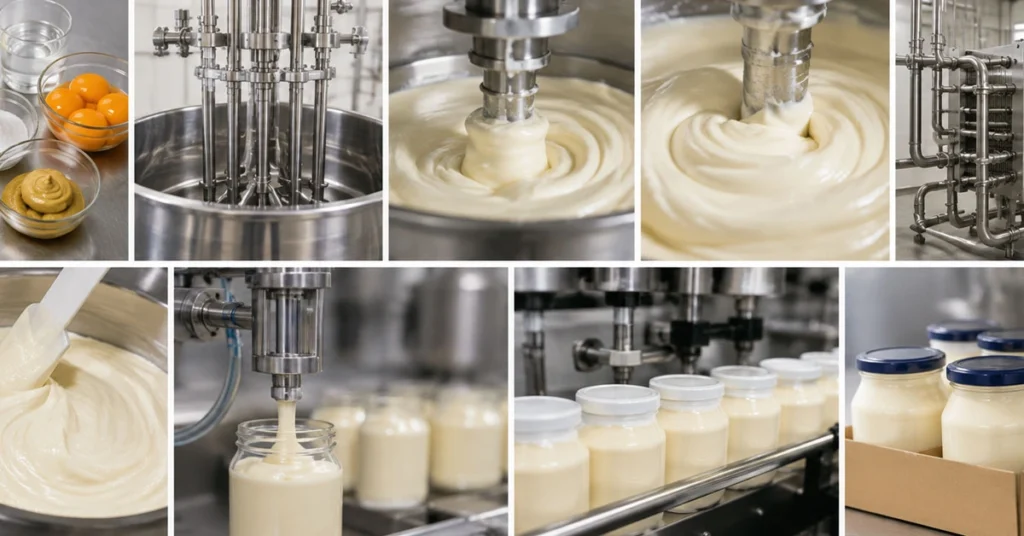
Mayonnaise manufacturing is carried out following an organized procedure for guaranteeing high-quality and safe products that are stable.
Step One: Preparation of Raw Materials
Raw materials such as vegetable oil, emulsifier base (with egg or without), vinegar, seasoning, stabilizer, and others are analyzed and prepared according to the formula.
Step 2: Emulsification
The oil is slowly mixed with the water phase to form an emulsion with the appropriate texture.
Step 3: Homogenization
The emulsion is homogenized to increase smoothness and ensure the stability of the final product.
Step 4: Quality Check
The quality of the product is checked for pH value, viscosity, and microorganism safety.
Step 5: Packaging
The produced mayonnaise is packed into different packages according to customer demands.
Mayonnaise Manufacturing Process Flow
A well-controlled manufacturing process helps maintain consistent product quality while improving production efficiency.
How Profitable Is a Mayonnaise Manufacturing Unit?
The profitability of a mayonnaise factory in India will depend on production volume, production costs, and demand. This example is provided for planning purposes only.
Assuming that a factory produces 100 kg per hour for 6 hours in 25 days in a month:
- Monthly output: 15,000 kg
- Approximate production cost: ₹75-95/kg
- Average wholesale sale price: ₹110-140/kg
- Approximate gross profit margin: ₹20-45/kg
If the factories maintain regular production and sales, companies are able to recoup the cost of equipment within 12-24 months.
How to Choose the Right Machine Manufacturer
Choosing the appropriate machinery supplier can be as crucial as selecting the appropriate machines. In deciding on the right manufacturer, some considerations are:
- Construction using food-grade SS304/SS316
- Quality of machines and degree of automation
- Installation and training of operators
- Availability of spare parts
- Warranty and after-sales service
- Experience in food processing equipment
A good choice of machinery supplier ensures efficient production with reduced maintenance costs.
How Foodsure Supports Manufacturers
Foodsure Machines offers full assistance to organizations that want to set up a manufacturing unit of mayonnaise in India. We offer all assistance related to product development, plant design, machinery procurement, process improvement, installation, and production of mayonnaise. If you are looking for mayonnaise manufacturing production process solutions, we offer these services as well.Feel free to visit our About Us or Contact Us section for further enquiries.
Conclusion
Creating a mayonnaise manufacturing unit in India needs good planning, appropriate production machinery, adherence to regulations, and an efficient production process. Proper guidance on the business setup of mayonnaise will help organizations in determining the cost of a mayonnaise plant as well as choosing the appropriate machinery. Due to increasing demand for mayonnaise, there is huge scope for manufacturers in the field of business.
Frequently Asked Questions
1. What is the cost of establishing a mayonnaise manufacturing unit in India?
The cost of investment varies between ₹8-14 Lakh for setting up a pilot/micro unit and ₹50 Lakh+ for establishing an industrial-scale unit.
2. Do I require an FSSAI license for the manufacture of mayonnaise in India?
Yes. It is essential to have a State FSSAI license for a small unit, whereas the Central FSSAI license is required based on production quantities and interstate/exports.
3. Is the production of eggless mayonnaise more profitable than that of egg mayonnaise?
Eggless mayonnaise may be more expensive due to a larger addressable market (i.e., vegetarians) and different formulation requirements.
4. What would be the lowest machine capacity for a business to manufacture mayonnaise commercially?
Commercial machines usually begin from 20-50 kg per hour for semi-automatic machines, and go to more than 100 kg per hour as the requirement increases.
5. Is there any subsidy available to establish a unit for making mayonnaise?
Units that manufacture mayonnaise may be entitled to a credit-linked subsidy under the PMFME program depending upon the fulfillment of criteria.
6. What would be the time period to establish a mayonnaise production line?
From license to commissioning, it usually takes 2-4 months to set up a mayonnaise manufacturing unit.
7. What are the raw materials required for the production of mayonnaise?
Vegetable oil, egg yolk or egg-free emulsifier base, vinegar or citric acid, salt, sugar, mustard, and stabilizer, based on your formulation.
8. How can I ensure mayonnaise does not split when stored?
It all comes down to the proper control of emulsification, proper oil-to-water ratio and proper homogenization during the production process, as explained above in detail.
9. Can manufacturing of mayonnaise be a profitable venture for a small company in India?
Yes, considering reasonable gross margins that go up to ₹20-45 per kg commercially. Profitability will depend greatly on finding regular distribution channels.
10. What is the difference between semi-automatic and fully automatic mayonnaise machines?
Semi-automatic machines involve manual operation in terms of loading and unloading and are suitable for smaller quantities, while fully automatic machines perform the complete process using a PLC control system.




