
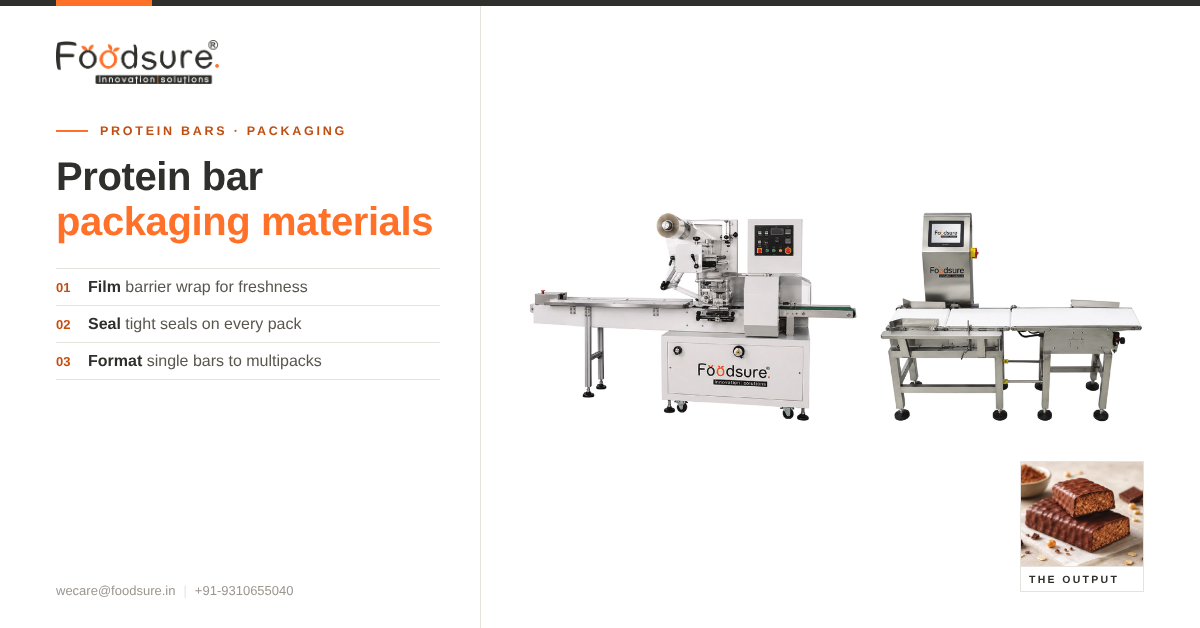
Protein bars are formulated to suit convenience, nutrition, and eating on the go. But the quality of the bars is not determined by the raw materials and the processing alone. Packaging is also very crucial in ensuring that the bars are protected from various elements.
Selection of appropriate protein bar packaging materials is thus an important consideration in the commercial production of such bars. Such packaging material will need to fit well with the texture, oil content, moisture, shelf-life, and distribution needs of the product. It will also need to be compatible with the chosen packaging equipment.
If you are starting out with a new brand of protein bars or upgrading your manufacturing facility, understanding packaging films, laminates, pouches, and wrapping machines will help you choose the right package.
Why Is Protein Bar Packaging Important?
The components that may be present in protein bars are protein powder, nuts, seeds, cereals, dried fruits, chocolate and various binding agents. The response of these components to water, air, heat and storage conditions may vary.
Suitable protein bar packaging helps protect the product and maintain its intended quality throughout its supply chain.
Some important functions of protein bar packaging include:
- Moisture resistance: Helps prevent the movement of moisture, which may alter texture and stability.
- Oxygen resistance: Proper barrier material can decrease oxygen exposure and help reduce oxidation of fats.
- Hygiene: Sealed packaging keeps the bars from contamination from outside sources.
- Physical protection: Packaging reduces damage, sticking, and handling problems.
- Presentation: Packaged products carry information about the product along with branding and a professional look.
- Storage: Individually wrapped protein bars are more convenient for storage, transportation, and consumption.
The packaging material should be selected according to the actual product characteristics rather than using the same specification for every protein bar.
What Are the Different Types of Protein Bar Packaging Materials?
Different types of materials provide different levels of protection, flexibility, appearance, and sealability. The best choice depends on the desired shelf-life period, product formulation, packaging format, and manufacturing process used.
1. Flexible Plastic Films for Wrapping Protein Bars
Flexible plastic films are frequently used for wrapping protein bars since they can be made into small packages that can then be sealed with the help of appropriate packaging machinery.
According to the structure of flexible plastic films, they can be used for protecting food from moisture, oxygen, and other external influences.
Their application will depend on their thickness, barrier features, and their ability to work with the packaging machine.
2. Metallised films
Metallised films consist of an outer layer of metal, usually aluminium, which is placed onto appropriate plastic films.
These films can have better barrier properties to protect food from light, oxygen and moisture than uncoated plastic films. They are often used for extra protection of products.
3. Aluminium Foil Laminates
Aluminium foil laminates are a combination of foil and other layers used for packaging purposes to form the flexible packaging structure.
It will be effective in protecting the product from any penetration by light, moisture, and oxygen when it is effectively converted and sealed. The whole laminated structure needs to be assessed in relation to its flexibility and sealing efficiency.
4. Multi-Layer Laminated Films
Multi-layer laminates are combinations of various materials to give different packaging properties. Each layer can have unique properties such as providing strength, acting as a barrier, and heat sealing.
This will be tailored to suit the protein bar composition and storage needs.
5. Paper-Based Packaging
Paper-based materials can be used for secondary packaging, outer cartons or selected packaging formats. However, paper alone may not provide the barrier properties needed for many protein bars.
When paper is used as part of a flexible packaging structure, it may need additional barrier and sealing layers depending on the product requirements.
How to Choose the Best Packaging Material for Protein Bar Shelf Life
Selecting the best packaging material for protein bar shelf life requires understanding how the product behaves during storage. A material that works well for a dry, crunchy bar may not be suitable for a soft, chewy, or chocolate-coated protein bar.
Manufacturers should evaluate the following factors:
Moisture Barrier
Moisture can impact the texture, structure, and stability of protein bars. Products could either get sticky with excessive moisture exposure, or they may fail to maintain their texture altogether.
The chosen film should offer a proper moisture barrier, considering the characteristics of the product and how it will be stored.
Oxygen Barrier
Products including nuts, seeds, and other fat-containing ingredients could be highly sensitive to oxidation caused by oxygen exposure. This can negatively impact the quality and the taste of the products.
Appropriate packaging, with adequate oxygen barrier properties, could help reduce this effect.
Light Resistance
Light can affect some ingredients used in the products during storage. Metallized and foil-based laminates can offer light resistance, depending on the composition of the film.
Seal Strength and Integrity
A very high barrier film will not adequately protect the product from damage if the seal is weak.
Compatibility of the Product
Chocolates, adhesives, oils, and other components may affect the behavior of the protein bar during packaging. The material to use must be compatible with the surface of the product without causing any difficulties in handling or sealing the packaging.
Storage and Distribution Conditions
Temperature, humidity, time, and other distribution conditions may affect the choice of material. The packaging needs to be tested in conditions reflecting the real-life supply chain.
What Is Protein Bar Packaging Film?
Protein bar packaging film is a flexible material used to wrap individual bars or form suitable packages around them. It is selected according to barrier requirements, sealing characteristics, appearance, and machine compatibility.
A suitable film structure may include:
- An outer layer for printing and mechanical strength.
- A barrier layer to control moisture, oxygen or light exposure.
- An inner heat-seal layer to create a secure package.
However, not all films used in packaging include all the aforementioned layers.
Before choosing any film, it is important to consider its thickness, width, roll specifications, coefficient of friction when necessary, sealing temperature, as well as barrier characteristics.
Flow Wrap Protein Bar Packaging: How Does It Work?
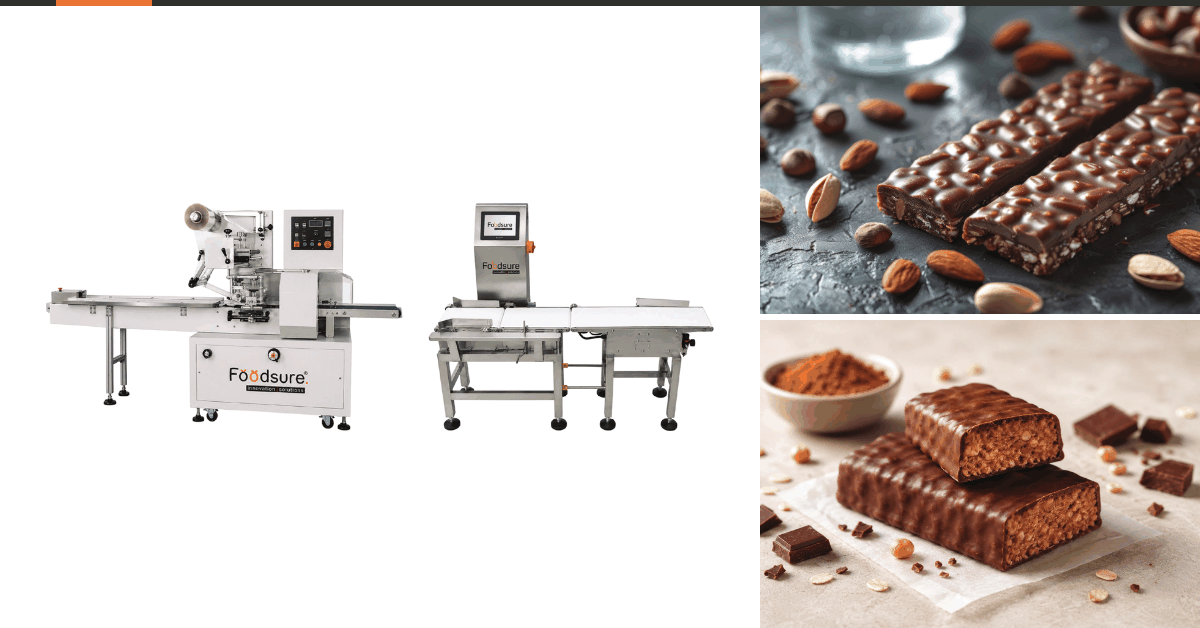
Flow wrap protein bar packaging is a common format for individually wrapping bars. In this process, the product moves through a packaging machine while flexible film is formed around it and sealed to create individual packs.
A typical flow-wrapping process involves:
- Product Feeding: Protein bars are sent to the packaging conveyor after completion.
- Film Unwinding: Film for packaging is provided by a roll.
- Film Forming: Film is wrapped around the bars.
- Longitudinal Sealing: Edges of the film are joined together.
- End Sealing and Cutting: Individual packages are sealed at their ends and cut out.
- Finished Package Discharge: Wrapped products go into inspection and secondary packaging
A flow wrap machine for protein bar production can be configured according to bar dimensions, required output, film specifications and packaging design.
The machine should also handle the product carefully to minimise deformation, breakage, or coating damage during feeding and wrapping.
Protein Bar Packaging Formats: Flow Wrap vs Pouch Packing
Different packaging formats are suitable for different products and market requirements.
| Packaging Format | Typical Application | Key Consideration |
| Flow wrap | Individually wrapped protein bars | Suitable film and reliable sealing are important |
| Pillow pouch | Individual or selected multi-piece packs | Depends on machine configuration and pouch design |
| Stand-up pouch | Multiple bars or selected snack formats | Requires suitable pouch-filling and sealing equipment |
| Carton packaging | Secondary retail or multipack packaging | Provides additional presentation and handling support |
| Paper-based outer packaging | Secondary packaging applications | May require an inner protective wrapper |
Protein bar pouch packing may be suitable for selected product formats, especially when multiple bars or other pack configurations are required. Flow wrapping is commonly considered for individually wrapped bars.
The choice should depend on product dimensions, packaging objectives, distribution requirements, and the machinery available.
How to Select a Protein Bar Packaging Machine
Package material and machines need to be considered in tandem. The package material may have the right barrier properties but might cause trouble due to incompatibility with the seal and speed of the machine.
Before selecting a protein bar wrapping machine, manufacturers should consider:
Production Capacity
Ascertain the number of completed packages per minute or hour required. It must be capable of processing the capacity of the production line feeding into it.
Dimensions of Bar
It must be capable of processing the length, width, and height of the bar needed. Dimensions of the product also determine the film width and packaging type.
Film Compatibility
Ensure that it is compatible with the packaging film chosen in terms of its thickness, roll dimensions, and sealing qualities.
Cutting and Sealing System
A cutting and sealing system is essential in ensuring consistent and sealed individual package sizes.
Product Handling
The protein bars may be soft, sticky, brittle, or have some form of coating. The system used should be compatible with the nature of the product.
Level of Automation
Semi or fully automated systems could be considered by the manufacturers based on the production levels, availability of labour, and plans.
Maintenance and Cleaning
The system must offer convenient access for cleaning, maintenance, and inspection. This is especially so in cases of sticky products or chocolate-coated bars.
Fully Automatic Protein Bar Packaging Machine for Commercial Production
A fully automatic protein bar packaging machine can integrate product feeding, film handling, wrapping, sealing, and cutting into a coordinated process.
This type of system can be useful for manufacturers handling regular commercial production volumes and looking to reduce repetitive manual packaging activities.
Depending on the configuration, automated equipment can support:
- Uniform product feeding
- Controlled movement of film
- Uniform wrapping
- Sealing and cutting done automatically
- Less manual handling
- Connecting with upstream conveyors
- Finished packs are more organized
Businesses researching the fully automatic protein bar packaging machine price should compare complete machine specifications rather than focusing only on the initial investment. Such factors as capacity, automation, film compatibility, cutting arrangements, installation issues, and after-sales support can all contribute to the total equipment requirements.
Protein Bar Packaging Line for Startups
A protein bar packaging line for startups should be planned according to the expected production volume and the product range.
The new brand may start with limited bar sizes and limited package formats. In such instances, it would make sense to have a semi-automatic or a compact automated system rather than go for a fully integrated line.
Startups should consider:
- Estimated daily volume to be packed
- Bar size specifications
- Packaging material specifications
- Number of types of products
- Labor force available
- Space in factory
- Future production capability
- Compatibility with the existing manufacturing process
The packaging system should also be planned alongside the mixing, forming, cooling, and cutting stages to avoid bottlenecks.
Common Packaging Problems and How to Avoid Them
Packaging issues can affect product appearance, storage stability, and production efficiency. Manufacturers should monitor the following problems:
Weak or Unreliable Seals
Wrong sealing parameters, incorrect film or contamination of the sealing area can have an effect on the integrity of the packaging. Film specifications and machine settings should be reviewed.
Film Wrinkles
The wrong tension, alignment, or feeding of the film may cause the appearance of wrinkles. Correcting machine parameters and choosing appropriate films can assist with better wrapping of the packages.
Product Deformation
Soft or sticky protein bars can get deformed during feeding and wrapping. The product should be reliable enough for the packaging process; the machine should not damage it.
Cutting Issues
Inappropriate settings and unsuitable film characteristics may cause poor cutting. The performance of cutting should be reviewed while testing the machine.
Moisture and Oxygen Exposure
Poor seals and unsuitable packaging material may reduce the protective effect of the packaging. The whole packaging structure should be evaluated.
Why Choose Foodsure for Protein Bar Packaging Solutions?
Foodsure is your solution provider for machines related to processing and packaging of food products when you plan on producing and packing protein bars on a commercial basis.
The choice of the appropriate packing machines depends on various factors, including the size of the product, texture, packing film used, production volume, and the degree of automation required.
Businesses planning to buy protein bar packaging machine equipment should evaluate machine compatibility, cutting and sealing performance, installation requirements, and technical support before finalising their selection.
For manufacturers comparing a protein bar packaging machine manufacturer India or looking for a suitable protein bar packaging machine supplier, it is important to discuss the complete production requirement rather than selecting equipment based only on advertised speed.
Conclusion
The selection of appropriate packaging materials for protein bars is crucial for ensuring quality, packaging uniformity, and commercial packaging. Different materials like flexible films, metallised packaging, and foil lamination have different characteristics. The decision regarding the selection of the most suitable packaging material should be based on the nature of the products themselves.
The process of machinery purchase must go side by side with packaging material selection. The right combination of a protein bar wrapping machine, film material, and sealing and cutting system can contribute to the development of an effective packaging process.
Frequently Asked Questions
1. What are the materials that can be used to pack protein bars?
The materials that can be commonly used include flexible plastic films, metallised films, laminated aluminium foil, and multi-layer packaging. The appropriate material will depend on the components of the bars, their moisture sensitivity, shelf life, and the packaging type.
2. What is the best material to pack protein bars for shelf life?
There is no one best material to pack all kinds of protein bars. This will depend on their moisture and oxygen sensitivity, the amount of fat in them, and how well the bar is packed.
3. What is a flow wrapping machine?
This is a packing machine that wraps individual protein bars with flexible film, seals, and cuts them into individual packets.
4. Are protein bars able to be packaged in pouches?
Yes, protein bar pouch packing is applicable for certain formats of products, as well as for some multipack applications. Selection of film material and filling machinery depends on particular product and packaging needs.
5. What should I consider when purchasing a protein bar packaging machine?
Production capacity, size of protein bars, film type, sealing and cutting, etc.




