
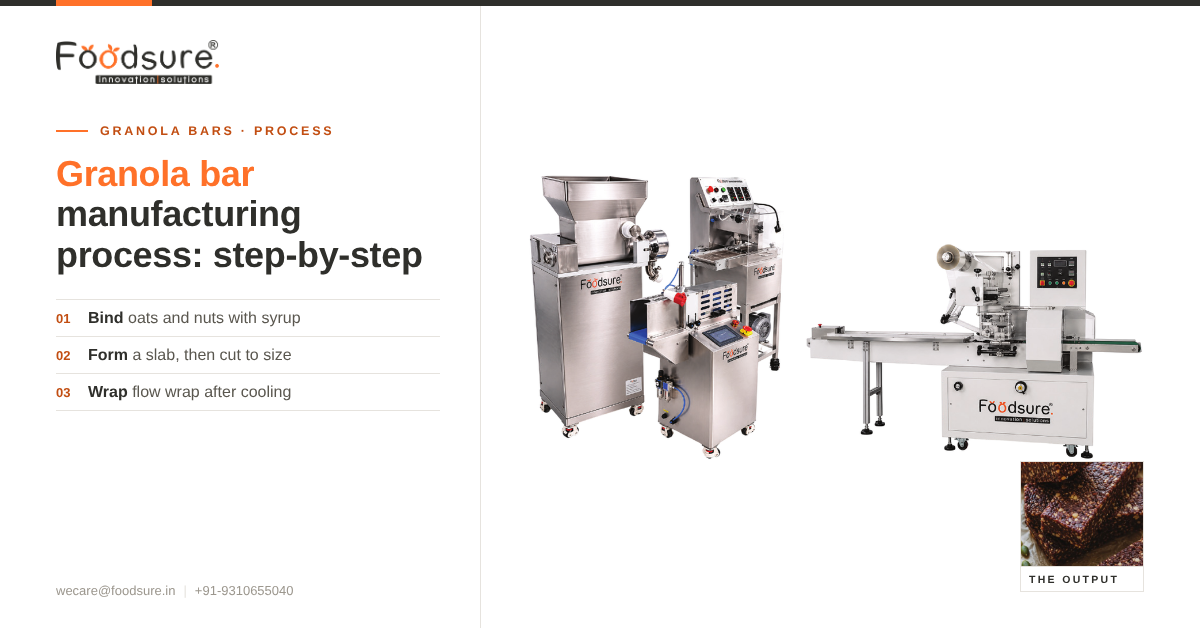
Granola bars are snacks that can be made by mixing materials such as oats, nuts, seeds, dried fruits, cereals, and binders. The increase in demand for ready-to-consume snacks means that food manufacturers are increasingly interested in making granola bars commercially.
The granola bar manufacturing process should be understood by any company wishing to start production or improve its existing snack manufacturing. Commercial production requires several steps, which include preparation of the ingredients, mixing, molding, cooling, cutting, and packaging. Each of the steps mentioned above must be carried out in a proper way.
Having the correct equipment and layout will aid in streamlining the production process and reducing manual handling. This guide will give you a breakdown of the granola bar production process, machines used, and important things to consider when setting up your manufacturing line.
What Is the Granola Bar Manufacturing Process?
The granola bar manufacturing process is a series of food-processing operations used to convert ingredients such as oats, nuts, seeds, dried fruits, and binders into finished bars.
Unlike some dense nutrition bars, granola bars often contain visible cereal pieces and larger inclusions. Therefore, the production process needs to combine ingredients evenly while maintaining their structure.
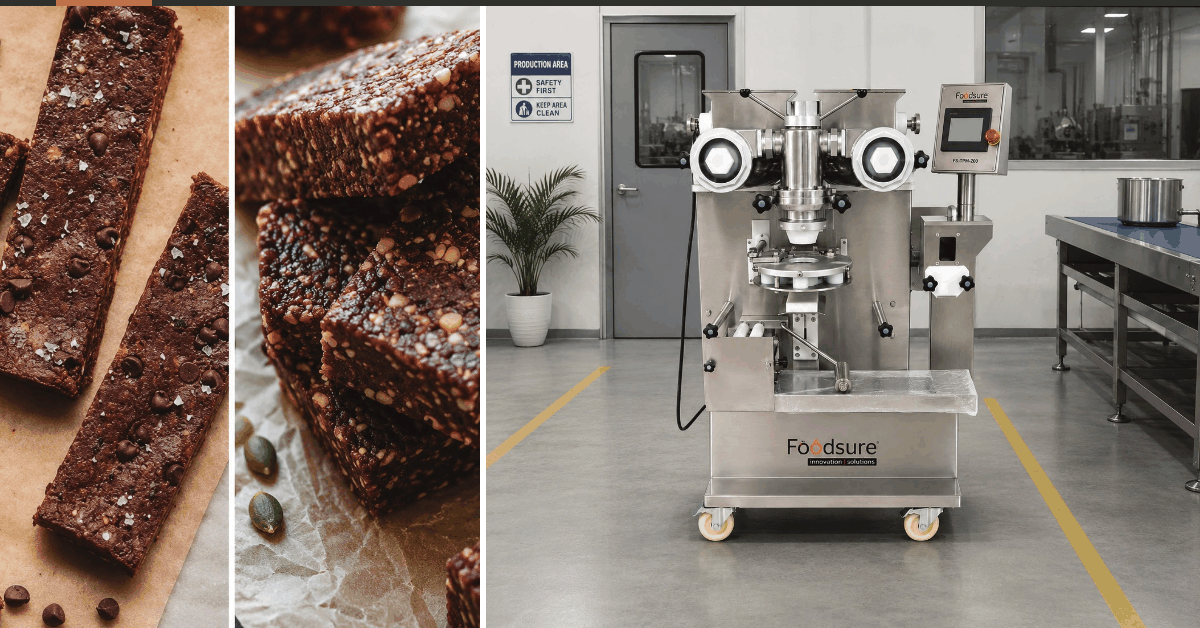
A typical commercial process includes:
- Inspection and preparation of the raw materials
- Cleaning and roasting (when needed)
- Mixing the binder formulation
- Mixing of ingredients
- Forming into slabs or sheeted forms
- Setting
- Cutting into single units
- Possible coating stage
- Packaging and storage
The granola bar making process varies depending on the recipe used, nature of ingredients used, texture requirement, bar size, and production capacity. Producers ought to choose the equipment based on the product and not think that one production setup can handle all types of granola bars.
Step-by-Step Granola Bar Manufacturing Process in Factory
The step by step granola bar manufacturing process in factory involves multiple stages that need to work together to achieve consistent product quality and efficient production.
1. Raw Material Inspection and Preparation
The process begins with the inspection of raw materials. Common ingredients include:
- Rolled oats
- Almonds, peanuts, cashews, and other nuts
- Sunflower, pumpkin seeds, and other seeds
- Raisins, dates, and other dried fruits
- Puffed cereals and grains
- Sweetening and binding agents
- Flavoring ingredients if needed
Manufacturers need to inspect raw materials for quality, hygiene, physical damage, and appropriateness for processing.
Storage of raw materials needs to be appropriate enough to keep them safe from moisture and other forms of deterioration.
The material also might be required to be cleaned, sorted, weighed, or reduced to proper sizes prior to being used in the production process.
2. Roasting of Oats, Nuts and Seeds
Roasting is needed whenever there is a requirement for a certain flavor, smell, color, or texture in the recipe.
Oats, nuts, and seeds may undergo roasting independently or in the appropriate combination, depending on their processing needs. Roasting provides control in order to get the same results without overheating or burning.
A roaster can be installed in the production line when there is such a necessity for the ingredients. But not every granola bar recipe requires roasting.
Ingredients can be cooled after roasting in order not to affect the process of mixing the binder.
3. Preparation of Binding Mixture
The binding mixture helps in holding dry ingredients together and gives structure to the granola bar.
The binder could be made up of some of the ingredients like syrups, honey, nut butter, or any other suitable ingredient. The preparation of the binder is carried out in an isolated manner, with processing conditions being well-controlled.
The binder has to have properties that allow it to distribute within the dry ingredients without rendering the whole mixture too wet and cumbersome to process.
Different preparation techniques will depend on ingredients and other factors of processing conditions.
4. Ingredient Mixing
Once ingredients and the binding mixture are prepared, the ingredients are brought to the mixing system.
Ingredients like oats, nuts, seeds, dried fruits, cereal, binders, among others, are mixed in order to produce a homogeneous mass. During this process, mixing is supposed to distribute the binder in the mix without breaking down the structures of the large inclusions.
This stage requires much attention because overmixing may lead to deterioration of certain ingredients. In contrast, less mixing will mean inadequate mixing and hence an unbalanced bar.
5. Slab Forming and Sheeting
The granola mixture is then conveyed from the mixing stage to the forming stage.
The slab forming machine helps form the continuous sheet with an exact thickness of the mixture using rollers or other forming equipment.
This stage determines important product characteristics such as:
- Bar thickness
- Slab width
- Product density
- Surface uniformity
- Consistency between batches
Gentle compression is essential when making granola bars that have whole nuts, seeds, oats, and other inclusions. Compression needs to be adequate to ensure the formation of the desired shape without damaging the ingredients.
6. Cooling and Setting
Following formation, the granola slab may go through a cooling process, which will aid in stabilising the product.
Cooling needs vary depending on the type of binder used, the moisture content, the thickness of the product, and the texture required. The slab must be able to withstand cutting with minimal breakages.
A cooling tunnel system would ensure that the consistency of the manufacturing process is maintained prior to transfer of the product to the cutting stage.
7. Cutting into Individual Bars
Once the slab reaches the right consistency, it is moved onto the cutting system.
The cutting process involves dividing the continuous sheet into individual bars based on the necessary dimensions. In some cases, depending on the type of production line, slitter cutters first divide the slab into strips and then a guillotine cutter cuts individual bar lengths.
8. Chocolate or Compound Coating
There may be granola bars that have a chocolate or compound coating. In such instances, the cut bars can go through an enrobing process wherein the coating can be added to the top, bottom, or whole surface.
This will depend on the product and the type of coating being used.
Coated bars may need to undergo cooling in order for the coating to solidify prior to packing. This process is optional and needs to be done only if necessary according to the product range.
9. Packaging and Storage
The last stage in making the granola bars involves packing the finished product.
Individual bars may be wrapped in suitable packaging materials. The packaging process must ensure that the product is protected from contamination by the environment during storage and transportation.
Commercial granola bar producers may have flow wrapping machines which can pack individual bars. These products can then be packed in boxes depending on the distribution.
Packing material and sealing process should consider the shelf life requirements of the product.
Machines Used in Granola Bar Production
The equipment selected for a commercial production unit depends on the product type, required output, and level of automation. Understanding the machines used in granola bar production helps manufacturers plan a suitable manufacturing line.
| Machine | Main Function |
| Ingredient cleaning and preparation equipment | Prepares raw materials for processing |
| Roasting machine | Roasts oats, nuts, seeds, or cereals when required |
| Binder preparation system | Prepares the binding mixture |
| Industrial mixer | Combines dry ingredients and binders |
| Slab forming machine | Spreads and compresses the mixture into a sheet |
| Cooling tunnel | Helps stabilise the formed slab |
| Slitter and guillotine cutter | Divides the slab into individual bars |
| Chocolate enrober | Applies optional coating |
| Final cooling conveyor or tunnel | Sets the coating where required |
| Flow wrapping machine | Wraps individual granola bars |
| Conveyors | Transfer products between processing stages |
Not every production unit requires all these machines. Equipment selection should be based on the recipe, production capacity, and intended level of automation.
How Does a Granola Bar Production Line Work?
A commercial granola bar production line involves linking several processing steps into one manufacturing process.
Materials for the production are first checked and prepared. Materials that need roasting are prepared and cooled before being introduced into the mixing department. The binder is separately prepared and added to the dry materials using an appropriate mixer.
The mix is then conveyed to the slabbing machine where it is spread and pressed into a sheet. Cooling and setting of the slab are followed by its moving into the cutting department, where it is cut into separate bars.
In case of coating, the bars are run in an enrober and subjected to additional cooling. At last, the finished bars are conveyed to the packaging machine.
An integrated production line will help avoid unnecessary conveyances and increase coordination of the processes. However, the capacity of the equipment must be coordinated with the production needs.
Granola Bar Production Process for Startups
The granola bar production process for startups may begin with a smaller or semi-automatic setup rather than a fully integrated industrial line.
A new business should start by defining its product lineup and production volume. A newly founded company producing one variety of granola bars does not necessarily require all the machinery that a large-scale factory uses.
A practical initial setup may include:
- Ingredient preparation and weighing equipment
- Mixing machine
- Slab making machines
- Cooling system
- Cutting machines
- Semi-automatic or fully automatic packaging machines, as per production requirements
It is imperative that startups consider the capability of their manufacturing process to expand in the future. The use of modular design will facilitate adding more roasting, coating, conveying, or packaging machines when necessary.
The main goal should be to choose machines that will cater to existing needs without any future complications.
How Are Granola Bars Made Commercially?
If you are researching how are granola bars made commercially, the main difference between small-batch and industrial production is the level of process integration and automation.
Commercial manufacturers have specialized equipment that takes care of the preparation of the ingredients, mixing, formation, cooling, cutting, and packaging. The production parameters will be set based on the recipe as well as the machine setup.
The manufacturing process also needs to take into account the differences between the ingredients. Oats, nuts, seeds, dried fruits, and the binder will respond differently when it comes to mixing and formation. Hence, the machine setup and the processing conditions will differ from product to product.
The manufacturing of multiple products by any manufacturer will require changeover and cleaning operations.
Factors to Consider When Setting Up a Granola Bar Manufacturing Plant
A commercial granola bar plant setup requires planning beyond the purchase of individual machines. Manufacturers should evaluate the complete production workflow before finalising their equipment.
Production Capacity
Establish the production capacity per hour, shift, and day. The machine capacity needs to be chosen based on the actual demand and the expected realistic growth.
Product Type and Texture
Granola bars can be crunchy, chewy, soft, and nut-based and may need specific conditions of processing. The chosen machinery needs to be suitable for the structure of ingredients and final texture.
Requirements for Mixing and Forming
The mixing process and slab forming process should be compatible. The mixture needs to have proper consistency for forming, while the formers should maintain the structure of the ingredients.
Cooling Requirements
The cooling capacity should match the forming and cutting capacity. Poor cooling may cause problems during the cutting and packaging process.
Packaging Capacity Requirements
It is important to match packaging capacity with the processing line capacity. The packaging machine may create a bottleneck in spite of having high-capacity upstream equipment.
Hygiene and Cleaning
Food contact surfaces of the equipment should be designed for food processing applications. It should also facilitate proper cleaning and maintenance of the equipment.
Layout of Plant
Layout of the plant should accommodate the machinery, material handling, personnel movement, cleaning, and maintenance needs.
Automation and Scalability
It is recommended that the manufacturers select the right level of automation based on their needs. The plant design should facilitate the addition of equipment in the future.
What Affects Granola Bar Machine Price?
The granola bar machine price depends on the machine configuration and the requirements of the production unit. Businesses should compare complete equipment specifications rather than evaluating machinery only by its initial purchase cost.
Important factors include:
- Production capacity
- Operation manual, semi-automatic or fully automatic
- Mixing and forming technique
- Cooling and cutting arrangement
- Optional coating unit
- Packaging system
- Materials of construction
- Automation and controls
- Installation and technical assistance required
The entire production line will comprise many machines, whereas a smaller one will consist of just those machines needed to perform the basic processes. It is advisable for manufacturers to analyze their entire production needs before requesting quotations.
Granola Bar Manufacturing Machine: How to Choose the Right Equipment
Selecting the right granola bar manufacturing machine requires understanding the product and the complete manufacturing process.
Before purchasing equipment, manufacturers should evaluate:
- Required production capacity
- Types of ingredients and inclusion size
- Required bar weight and size
- Mixing conditions
- Slab forming/Extrusion suitability
- Cooling time and conditions
- Cutting precision
- Coating condition if applicable
- Packaging type
- Cleaning and maintenance conditions
- Factory floor space available
- Future expansion possibilities
Testing or evaluation should be done using materials that are closest to the actual commercial production materials wherever possible. This will assist the manufacturer in knowing how the mix behaves when mixing, forming, cooling, and cutting.
Granola Bar Contract Manufacturing vs Setting Up Your Own Plant
Businesses entering the granola bar market may consider granola bar contract manufacturing instead of immediately establishing their own production facility.
Contract manufacturing enables a firm to collaborate with the existing producer of goods in order to manufacture those goods as per the specifications determined between both parties. This would be beneficial for a firm that wishes to test market demand without dealing with its own production machinery.
However, establishing an independent plant would mean that there is more control over the production process in terms of planning, machinery, product development, and manufacturing processes. Nevertheless, this will involve spending on machinery, infrastructure, labor, quality control, and maintenance.
It all depends on the objective of the firm.
Why Choose Foodsure for Granola Bar Manufacturing Equipment?
Foodsure offers solutions to food processing machines that may be necessary for companies looking to set up or grow their capacity for commercial snack manufacturing. An appropriate granola bar production line will have to be designed based on the product, capacity, properties of the ingredients, and degree of automation.
Foodsure can assist in assessing the machines needed for blending, shaping, cooling, cutting, coating, and packaging.
Whether you are planning a new granola bar plant setup or upgrading an existing facility, selecting machinery according to actual production requirements can help create a more organised and scalable manufacturing operation.
Conclusion
The process of manufacturing granola bars is comprised of several stages, which include preparation of raw materials, mixing, molding, cooling, cutting, and packing of the product. These processes ensure that the final quality of the product meets the required standards.
For commercial producers of granola bars, choosing the proper granola bar production process will depend on the type of ingredients used, the required texture of the product, the production capacity of the company, and its automation level. Appropriate choice of equipment for the granola bar production line helps streamline workflow and minimize unnecessary manual labor.
When looking to start your own granola bar production business or set up a granola bar manufacturing plant, understanding the process and choosing machines based on your needs will be key to successful operations.
Frequently Asked Questions
1. What is the process of making granola bars?
The process of making granola bars typically consists of raw materials inspection, preparation of ingredients, roasting when needed, preparation of binders, mixing, slab forming, cooling, cutting, coating if needed, and packaging.
2. What are the major production steps for granola bars?
Major production steps for granola bars involve preparation of ingredients, mixing of them with binders, slab forming, cooling, cutting to bars, and packaging. Other steps could be added according to the product.
3. What machines are involved in granola bar production?
Machines that can be used during granola bar production can consist of preparation of ingredients, roasters, mixers, slab formers, cooling chambers, cutters, coating equipment, conveyor systems, and packaging machines.
4. How can granola bars be manufactured industrially?
In order to know how granola bars can be made commercially, the manufacturing process needs to be analyzed thoroughly. Commercial equipment would be used for preparation, mixing, forming, cooling, cutting, and packaging.
5. What should startups take into consideration while setting up granola bar manufacturing line?
Startups should analyze what kind of product they plan to manufacture, what the capacity would be, the available area, the machinery requirements, the level of automation, packaging issues, etc.




