
The demand for convenience and high-protein snack foods in countries like India, UAE, Europe and USA has been responsible for the popularity of protein bars in sports nutrition, healthy snacking, functional food and meal replacement category. And the segment is one of the fastest growing. There has been an influx of startup companies looking into producing protein bars themselves.
Well-designed protein bar plant setup allows businesses to organize and streamline the major stages of the process including mixing, extruding, cooling, cutting and packing. The choice of proper equipment depends on multiple factors.
This article tells you how to establish a protein bar manufacturing plant in India. Find out the equipment needed, selection criteria and more.
Why Follow a Protein Bar Factory Setup Guide?
Consistency of shape, texture, size and composition is important for the protein bar. Consumers would not be satisfied if each bar would differ from one batch to another. Formulation, proper texture balance and shelf-life have to be consistent as well.
Manual production becomes hard as the need for production increases. Consistency of output, weight and quality become difficult when the quantity increases.
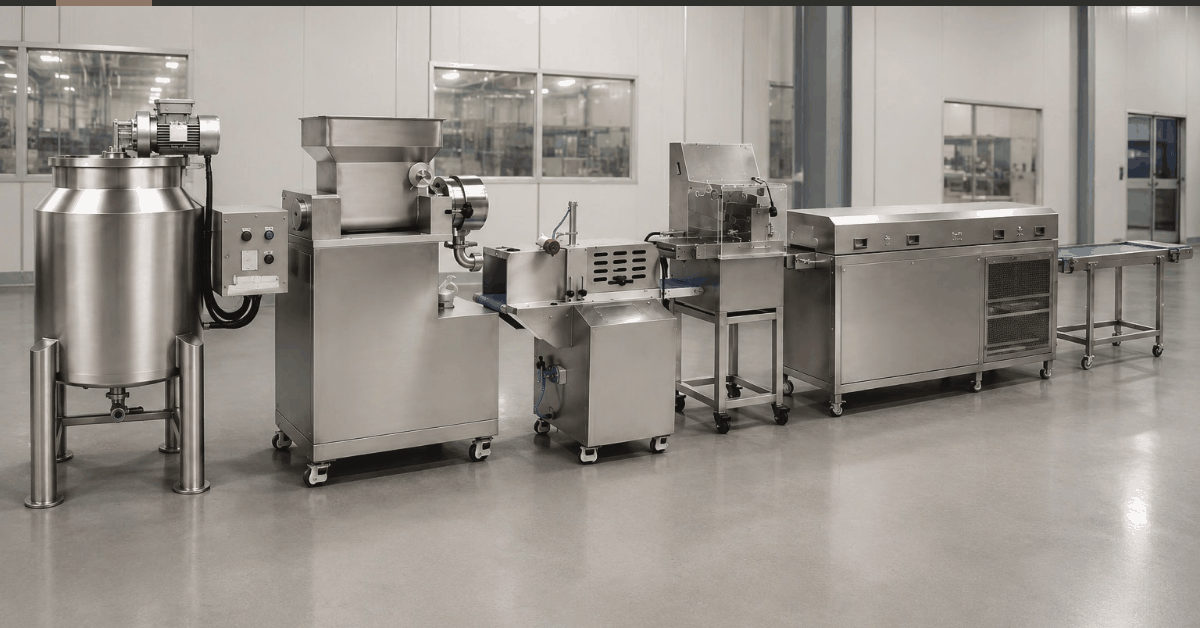
This is an issue which troubles many new businesses. Proper purchase of protein bar plants helps in solving these problems.
Some advantages of the equipment are:
- Productivity: Automation leads to higher output as the plant does more work with less human involvement.
- Consistent product size: Machine cuts down bars of the required size and weight.
- Good process control: Set parameters ensure that consistency of quality remains in every batch.
- Efficiency: Less material wastage due to automated process flow; also less human involvement with product.
- Flexibility of production: Properly designed line ensures production of protein bars, energy bars, vegan bars and filled functional bars.
- Integrated processes: Mixing, extruding, cooling, cutting and packaging are done in sequence which ensures smooth flow of products.
- It is necessary to buy equipment depending upon your formulation, required production quantity, available space and automation
What Is a Protein Bar Plant Setup?
The set up for a protein bar plant includes equipment, space, utilities, and controls that transform the raw materials into packaged bars. This may consist of the mixing, extrusion, cooling, cutting, enrobing, and packaging processes.
A protein bar plant solution can be designed to fit one stage of production or the entire line process.
A typical manufacturing workflow is:
Mixing → Extrusion → Cooling → Cutting → Packaging
Not every product needs the same processing sequence. Chocolate-coated bars add enrobing and a cooling tunnel, and filled bars call for twin extrusion, so select machinery according to the intended product.
Essential Equipment for a Protein Bar Production Line
A commercial setup may include several machines working together, depending on formulation, capacity and product specifications. Here’s a protein bar factory layout and machinery list, starting with the layout order.
Raw material receiving → Storage → Weighing → Mixing → Extrusion → Cooling → Enrobing (optional) → Packaging → Finished goods storage → Dispatch
1.Mixing equipment
Mixing involves mixing the raw materials into dough before extrusion. The type of equipment to be chosen will depend on your formulation and batch size.
2.Extruder
A single extrusion system would do for the conventional protein and nutrition bars. A twin extrusion system would do for the bars that have filling such as creams and fruit paste among others.
A twin extrusion system at 200 kg/hr capacity is preferred by start-ups due to its flexibility.
3.Forming and Cutting Systems
Forming comes after extrusion and determines the size of the bars as well as their weight. Forming is important in the protein bar manufacturing line due to the ability to ensure consistency in bar weights.
4.Cooling and Coating equipment
A cooling tunnel would ensure the stabilization of chocolate coating. Enrobing of chocolate is done through a chocolate enrobing machine which is optional.
5.Packaging Machinery
For automated bar packaging and sealing, a flow wrap machine is used. The packaging style will be dependent on the type of product being packaged, ranging from standard flow wrap to metallized films and high-barrier laminates, and also retail boxes for multipacks.
Ensure that packaging is matched with production to avoid stockpile of bars.
Automatic vs Semi-Automatic Protein Bar Production
The choice depends on production requirements, workforce availability and investment priorities.
| Factor | Semi-Automatic Setup | Automatic Setup |
|---|---|---|
| Operation | Operators handle several steps by hand | Machines run most steps on set parameters |
| Production volume | Suits lower to moderate volumes | Suits regular, higher volumes |
| Labour | Needs more people on the line | Needs fewer operators and more technical supervision |
| Flexibility | Easy to adjust for small or varied batches | Programmed settings suit steady, repeated products |
| Integration | Stages often run as separate machines | Stages connect into one continuous line |
| Expansion | Add machines as demand grows | Plan capacity changes around the full line |
A small business may begin semi-automatic. A manufacturer with regular commercial orders may consider a fully integrated line. Decide on realistic demand, not automation level alone.
How to Choose the Right Protein Bar Plant Setup
Match your machines, space and utilities to your product plan before you commit.
Production Capacity
Startups operate at 100-200 kg/hr, growth brands 200-500 kg/hr and commercial facilities above 500 kg/hr. The machines can vary in capacity, so it is possible to start off smaller and expand later on.
Formulation of the Product
Just having the right machine will not assure the success of the product; the right formulation of protein, texture, shelf-life, cost efficiency, and sensory testing are needed.
Whey protein isolate should be used for premium bars and whey protein concentrate for economical bars. Milk protein concentrate creates a soft texture and pea and rice proteins for vegan bars.
Bar Size and Weight
Ensure that the line can produce bars of the required size and weight with consistency. Weight control also impacts compliance checking.
Level of Automation
Choose the level of automation depending on your labor force, order volume and investment priorities as indicated in the table above.
Available Space & Utilities
The amount of space required for protein bar unit along with electricity needs to be around 10,000 sq ft in total, comprising of 3,000-4,000 sq ft for manufacturing process, 1,500 sq ft for raw material storage, 1,000 sq ft for packing materials, 2,000 sq ft for finished products, 500 sq ft for QA/QC and 1,000 sq ft for office and utilities.
Other than this, utilities need to include the connection load of about 65 kW on three-phase supply, 75-85 kVA stabilizer and UPS for extruder machine and packing machine along with 10 HP compressor (oil-free food grade preferable) and about 100 L/day of RO water having TDS below 30 ppm and hardness below 50 ppm.
Climate control is another aspect which should be considered where manufacturing process requires temperature from 18-22°C, enrobing zone from 18-20°C, packing from 20-22°C and storing below 25°C while the relative humidity should be less than 50%.
Technical Support
Select reliable protein bar machine manufactures having installation guidance and technical support along with room for future expansion.
Protein Bar Factory Setup Guide: What Affects the Investment?
The price depends on the machine configuration and your business’s production requirements. A startup protein bar factory typically needs an investment of ₹50 lakh to ₹3 crore, depending on capacity and automation.
Assess the complete equipment scope and operating requirements, not just the purchase price.
Important factors include:
- Capacity and automation
- Mixing, forming, extrusion and cutting setup
- Cooling, coating and packing equipment
- Installation and commissioning
- Electricity and infrastructure
- Cleaning, maintenance and spares
- Training and technical assistance
When you request a machine quote, share your intended product, target output, bar dimensions and required automation.
Your overall plant setup cost also covers the facility, utilities, storage, packaging and other infrastructure beyond machinery.
How to Start a Protein Bar Manufacturing Unit in India
It involves both commercial planning and manufacturing preparation.
Step 1: Choose Your Product
Choose what you will manufacture without purchasing the machine. The first production portfolio will include 4 to 6 SKUs like chocolate, peanut butter, date energy, high fiber, vegan and wellness bars. This will allow you to evaluate market demand with operational efficiency.
Step 2: Research the Market Demand
Consider the demand for high-protein snacks and meal replacement foods. Additionally, also research the contract manufacturing industry, as many sports nutrition companies, direct-to-consumer brands and importers prefer engaging a manufacturing company rather than setting up their own.
Step 3: Design the Manufacturing Plant
Make sure the manufacturing process is designed to avoid contamination and maintain efficiency. Additionally, you should not forget about air conditioning. The time it will take to establish a protein bar manufacturing plant depends on the facility’s preparedness, equipment installation, and many other factors.
Step 4: Compliance
Take care of the FSSAI licensing and food safety practices. You will also need to register for GST and get a factory license.
Step 5: Choose Machinery and Evaluate Process
Pick machinery that suits your list of products. Conduct pilot production to evaluate the process in terms of moisture content, protein analysis, weight, microbiological testing, and sensory tests. Shelf life needs to be tested.
Step 6: Prepare Packaging and Distribution Plans
The packaging is an important determinant of shelf life. Therefore, choose packaging that protects from moisture and oxygen, is attractive in appearance, and ready for distribution. Storage of finished goods should be at less than 25°C.
Small-Scale and Turnkey Protein Bar Plant for Startups in India
A small scale system is appropriate for those business owners willing to start small in production and grow as the need arises. The turnkey plant for protein bars for startups will come in handy too because everything will be provided by one manufacturer.
The automatic machine for the startup company must be chosen based on the output, variety of products and automation degree.
Before making your investment you have to think about:
- Estimated production amount for the first time
- Product variety
- Size and weight required
- Space and labor available
- Formula compatibility
- Possibility to add equipment in the future.
Why Choose Foodsure Machines for Protein Bar Machinery?
Foodsure Machines is in the business of food processing machines, and the types of machines that the company provides include protein bar, energy bar, makhana, tomato ketchup, and mayonnaise machines. Foodsure Machines claims 13+ years of experience in assisting companies with food machines.
The Foodsure Machines team can assist with production analysis, machine layout, automation, and integration of the different processes. For new protein bar manufacturers, the company also assists in recipe formulation, product development, and packaging.
Conclusion
Setting up a factory for producing protein bars requires more than purchasing a machine. Check the product specifications, capacity, level of automation, and infrastructure and technical support. This protein bar factory setup guide is best when combined with the proper product mix, facility layout, temperature control, quality control, and packaging.
Choose a reliable protein bar machine manufacturer who will help you with installation and future expansion. After that, choose between a small-scale setup and an integrated production line depending on the demand.
With a properly organised production process and appropriate equipment, commercial production becomes a lot easier whether it is done under your brand or private label protein bars.
Frequently Asked Questions
1.How do I select the right machinery using the protein bar factory setup guide?
Identify your product portfolio, select the type of extrusion, capacity, and automation. Startups usually opt for a 200 kg/hr twin extrusion machine.
2.What determines the cost of a protein bar plant setup?
The facility size, automation, utilities, capacity, and packaging infrastructure. The startup cost is ₹50 lakh to ₹3 crore generally.
3.Are there any automatic machines available in turnkey protein bar plant setups for startups?
Yes. The startup capacity is 100–200 kg/hr allowing you to start small and increase gradually.
4.What should I ask a supplier regarding my project and how much time will it take to set up a protein bar factory?
Enquire about the scope of equipment, layout design, installation and training, among others. Ask for a written schedule as it varies according to facility and machinery.
5.Is it possible to get the entire manufacturing unit of protein bars, and what are the requirements of space and power?
Yes. This covers from mixing to packaging. Allocate around 10,000 sq ft of total area and a load of about 65 kW (three phase).




