
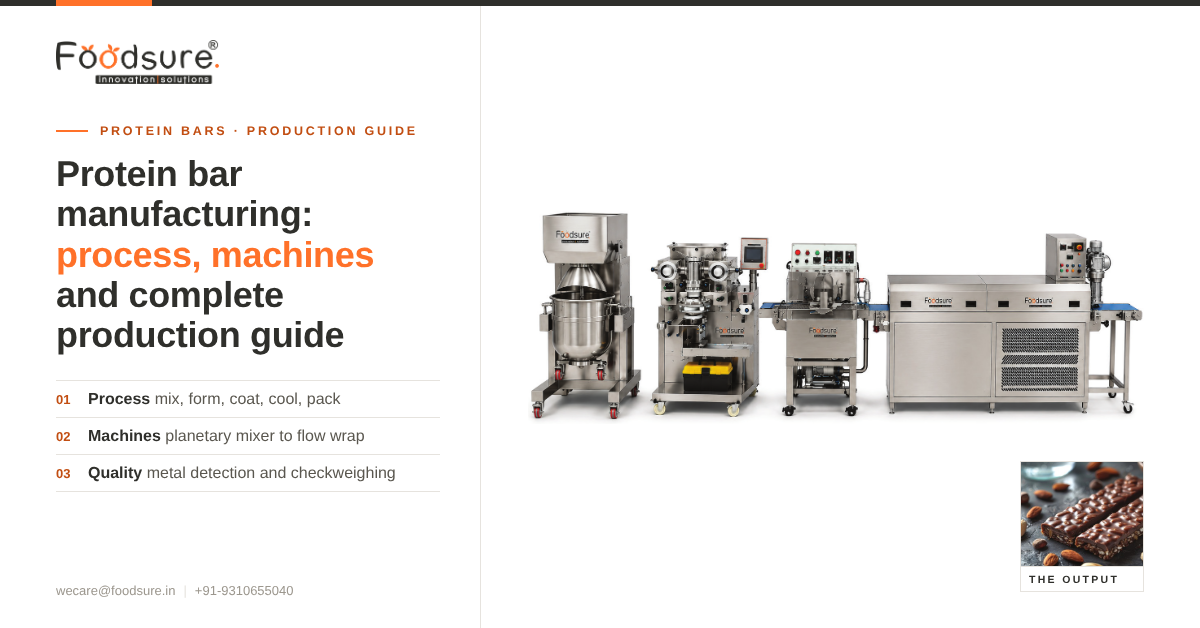
The use of protein bars is increasing because of their convenience along with their composition that contains different kinds of ingredients such as proteins, carbs, nuts, seeds, etc. The increase in the use of protein bars provides a chance for companies that want to produce protein bars commercially.
There are many steps in the protein bar manufacturing process, which include preparing the ingredients, mixing, forming, cooling, cutting, coating, and packaging.
For businesses planning to enter this market, understanding the protein bar manufacturing process, selecting suitable machinery, and designing an efficient production workflow are important steps towards establishing a reliable manufacturing operation.
What Is Protein Bar Manufacturing?
Protein bar manufacturing is an industrial process wherein selected raw materials undergo processing and packaging to produce protein bars. Raw materials differ depending on the specific protein bar and can be comprised of raw materials like protein powder, nuts, seeds, grains, dried fruits, sugar, and other food substances.
The manufacturing system may vary depending on the size of the business, from semi-automatic systems to integrated industrial ones.
A commercial setup may include:
- Systems for ingredients weighing and mixing
- Mixing systems
- Extrusion or slab forming systems
- Cooling tunnels or conveyors
- Cutting systems
- Chocolate or compound coating system (optional)
- Conveyors and transfer systems
- Automatic packaging systems
The appropriate configuration depends on the intended product, production volume, bar dimensions, and level of automation.
Protein Bar Manufacturing Process: Step-by-Step Guide
The protein bar manufacturing process follows a sequence of operations designed to achieve consistent texture, shape, weight, and product quality. Although individual requirements vary, most commercial production lines follow a similar workflow.
1. Ingredient Selection and Processing
The initial stage includes selection and processing of the ingredients depending on the recipe of the product. The ingredients include protein powders, ingredients for cereals, nuts, seeds, dried fruit, sweeteners, and binding agents.
Each ingredient has to satisfy the quality and food safety requirements. Also, the particle size, moisture content, flowability, and compatibility with the selected processing technology have to be taken into consideration.
Weighing is very important, since the proportion of each ingredient influences the final bar texture, flavor, nutritive value, and processability.
2. Roasting
Sometimes, the recipe for protein bars requires the inclusion of some nuts, seeds or grains which must be roasted before mixing.
The proper roasting equipment may provide controlled processing and desirable properties of the ingredient. But roasting is needed only in certain recipes and has to be included when it is required by the product.
3. Mixing the Ingredients
The process of mixing is done by combining the ingredients that have been prepared into a homogeneous mass for shaping purposes.
This is dependent on the type of formula being made. Depending on whether the mixture is dense, sticky, or has whole nuts and seeds or cereal grains, different types of mixing machines can be used.
It is important to distribute the ingredients properly while getting the right consistency for the forming machine.
4. Forming the Protein Bar Mass
Forming is one of the most important stages of the protein bar making process. The prepared mass is shaped into a continuous profile or slab before being divided into individual bars.
Two common forming methods are extrusion and slab forming.
- Extrusion: Suitable for many dense, cohesive, and sticky mixtures. The product is pushed through a forming die to create a continuous profile.
- Slab forming: Suitable for many mixtures containing nuts, seeds, cereals, or granola inclusions. The mixture is spread or compressed into a sheet of controlled thickness.
The appropriate method depends on the recipe, inclusion size, product texture, and required bar dimensions.
5. Cooling and Stabilisation
After formation, the product may need to be cooled to stabilise its structure prior to cutting or coating. This process uses a conveyor or a tunnel for cooling based on the properties of the product being manufactured. Cooling needs vary with ingredient formulation, bar thickness, binding system used, and the final texture sought.
Proper cooling will enable the bars to retain their form when handled subsequently.
6. Separation into Individual Bars
Once the product is formed and reaches a suitable state, it is cut into individual bars. The commercial processes may use guillotine cutters, slitter cutters, and others. Automated cutting helps maintain proper dimensions while avoiding repetitive work for people involved.
The cutting system should be designed for proper interaction with the product texture to prevent damage to the bars, sticking, and waste of the product.
7. Optional Chocolate or Compound Coating
Some protein bars are packaged with chocolate or compound coating.
If the process includes the coating, the bars will be coated using the enrobing system and then cooled again. This stage is optional depending on the product range.
8. Packaging and Labelling
Packaging is the final stage of the protein bar production process. Individual bars are wrapped using suitable packaging equipment, commonly a flow-wrapping system for many retail products.
The packaging material must safeguard the item from outside contact and be appropriate for the storage and transportation needs of the product.
There should also be an effort on the part of the manufacturer to make sure that the label contains all the required information regarding the product.
Protein Bar Process Flow Diagram
The protein bar process flow diagram provides a simplified view of the sequence followed during commercial production.
Ingredient Preparation and Weighing
↓
Roasting, If Required
↓
Mixing
↓
Extrusion or Slab Forming
↓
Cooling and Stabilisation
↓
Cutting
↓
Optional Chocolate or Compound Coating
↓
Final Cooling, If Required
↓
Packaging and Labelling
The exact protein bar process flow depends on the recipe and equipment configuration. For example, a dense date-based bar may require extrusion, whereas a granola-style protein bar containing larger inclusions may be better suited to slab forming.
Manufacturers should also consider how ingredient feeding, cooling, cutting, and packaging capacities work together to avoid production bottlenecks.
Machines Used in Protein Bar Production
Selecting the right machinery is essential for achieving consistent output and efficient operations. The machines used in protein bar production depend on the product type, manufacturing capacity, and automation requirements.
Ingredients Preparation Equipment
There is a need for weighing equipment, feeders, and appropriate preparation equipment to facilitate accurate quantity measurement and supply of the ingredients to the mixing process.
For industrial purposes, there is a need for controlled preparation of ingredients to minimize weighing mistakes and improve batch repeatability.
Roasting Machine
A roaster will be necessary if the product requires ingredients that require roasting; this machine must have appropriate temperature and processing capacity for the intended raw materials.
This type of equipment will not be needed in all production lines since this will depend on the product to be produced.
Industrial Mixer
The mixer mixes the ingredients, including the proteins, binding agents, sweeteners, cereals, nuts, seeds, and other ingredients to form a mass.
Mixer selection must take into account the density, viscosity, ingredient structure, batch size, and mixing requirements.
Protein Bar Extruder or Slab Former
A protein bar manufacturing machine may include an extrusion system or a slab-forming system, depending on the product.
Extrusion is often suitable for cohesive mixtures, while slab forming can be useful for products containing larger particulate ingredients. The machine should produce a stable shape that can be cooled and cut consistently.
Cooling Tunnel
The cooling tunnel will stabilize the formed bars before cutting, coating, and packaging. The capacity of the cooling tunnel should align with the production rate and the cooling requirements of the product.
Cutting Machine
The cutting machine will slice the continuous formed product into individual bars. Automation of the process can help in achieving dimensional consistency and minimizing human intervention.
Chocolate Enrober
This equipment is optional and only needed if the product needs to be coated with an outer coating of chocolate or compound coating.
Protein Bar Packaging Machine
The packaging machine will package the product and prepare it for delivery. This will depend on the dimensions of the bars, packaging material, production rate, and handling requirements.
Protein Bar Production Steps for Startups
The protein bar production process for startups should be planned around the initial product range, realistic demand, available space, and investment capacity.
It is not compulsory for new companies to start operations with an entirely integrated manufacturing line. The best choice would be a semi-automatic machine, which could be more realistic in the initial stages of operation.
Startups should consider the following steps:
- Define the product: Determine whether you are going to produce protein bars, nut bars, date bars, cereal bars, or coated bars.
- Determine production needs: Estimate how much production is needed per day and month.
- Select proper equipment: Equipment should be selected based on the consistency of the mixture and its forming technique.
- Plan the layout: Enough space should be allocated for storage, processing, cleaning, packaging, and storing finished products.
- Plan quality control: Set the standards for testing ingredients, processing, cleaning, and the final product.
- Select the proper packaging: Packaging should suit the product’s requirements for storage and target market.
- Plan for future expansion: Think about the possibility of adding more equipment in the future.
Before purchasing machinery, startups should evaluate the complete workflow instead of choosing individual machines without considering how they will operate together.
Protein Bar Production Line: Semi-Automatic vs Fully Automatic
The choice between a semi-automatic setup and a fully integrated protein bar production line depends on production volume, labour availability, product range, and operational requirements.
| Factor | Semi-Automatic Setup | Fully Automatic Production Line |
| Operation | Greater operator involvement | More integrated machine operation |
| Production volume | Suitable for selected smaller-scale requirements | Suitable for higher-volume requirements when correctly configured |
| Labour | More manual handling may be required | Can reduce repetitive manual handling |
| Integration | Individual stages may operate separately | Multiple stages can be connected |
| Flexibility | May suit smaller product runs | Depends on machine configuration and changeover design |
| Installation | Depends on the selected equipment | Requires planning for the complete line |
| Expansion | Additional equipment may be added | Capacity and integration must be planned carefully |
A fully automatic line can improve production flow, but it is not automatically the best choice for every business. The right setup is the one that matches current requirements while allowing realistic future expansion.
How Are Protein Bars Made Commercially?
Businesses asking how are protein bars made commercially should understand that successful production involves more than mixing ingredients and shaping bars.
Commercial manufacturing requires a coordinated process that maintains product consistency, hygiene, packaging quality, and reliable output.
Important considerations include:
Proper Ingredient Handling
Precision weighting and proper feeding ensure consistency from batch to batch. The ingredients need to be stored and handled based on their nature and food safety considerations.
Appropriate Forming Equipment
The forming equipment needs to be suited for the texture of the products. The equipment that can form cohesive products may not be right for all products made with large pieces of ingredients.
Effective Cooling
Cooling should be designed for the product’s formulation, size, and texture. Lack of sufficient stabilization could influence cutting, coating, and packing operations.
Proper Packaging
Packaging should take care of the products coming out of the processing plant without generating queues or piling up the products.
Quality and Food Safety
The manufacturers need to design proper procedures for checking the quality, process, allergens, hygiene, and shelf life of the products.
Factors to Consider Before Buying a Protein Bar Manufacturing Machine
Before purchasing a protein bar manufacturing machine, businesses should assess the following factors.
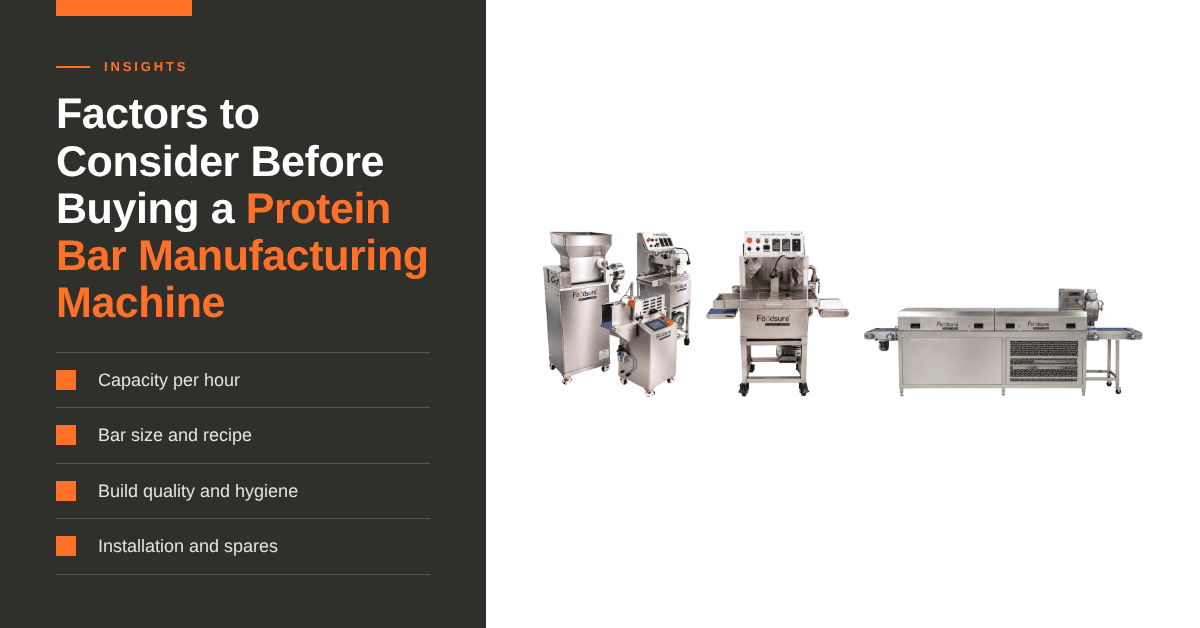
Production Capacity
Establish the necessary hourly or daily output rates. Mixing, forming, cooling, cutting, and packaging machinery capacity needs to match the production objectives.
Product Type and Consistency
Identify the bar to be produced and whether the product will form a sticky, dense, or particulate mixture. Extruder or slab forming will be selected based on the bar product type.
Bar Size and Weight
Define the bar size, length, width, and height; also the weight requirement. Forming and cutting machinery should suit the required bar specifications.
Automation Levels Required
Whether manual, semi-automatic, or automatic processing is required based on your expected production volumes and personnel available.
Cleaning and Hygiene
Provision of suitable contact material, easy cleaning access, and inspection capability of the equipment. The cleaning procedure needs to take into account the possibility of contamination by allergens and product changeovers.
Equipment Installation and Maintenance
Consider factory space available, utility requirements, installation needs, parts availability, and technical support before final selection of the equipment.
Packaging Suitability
Ensure that the packaging equipment matches the product specifications in size and packaging format. Packaging equipment capacity must be in sync with production levels.
Protein Bar Plant Setup: What Does It Include?
A protein bar plant setup may include individual processing machines or a complete integrated manufacturing line.
The exact configuration depends on the product range, capacity, facility layout, and automation requirements.
A commercial plant may require:
- Areas for receiving and storing raw materials
- Weighing and preparation equipment for ingredients
- Roasting equipment, when needed
- Mixing systems for industry
- Extrusion or slab-forming machines
- Cooling and cutting equipment
- Coating equipment, if necessary
- Conveyors and transferring systems
- Equipment for packaging and labeling
- Quality control and inspection facilities
Businesses should plan the facility layout to support logical material movement, hygienic operations, equipment access, and safe working conditions.
Before installing a protein bar production line, manufacturers should also review applicable food-business licensing and compliance requirements, including relevant FSSAI requirements in India.
Protein Bar Machine Price: What Influences the Investment?
The protein bar machine price depends on the equipment configuration and the production requirements of the business. A single forming machine has different requirements from an integrated line containing mixing, cooling, cutting, coating, and packaging equipment.
Factors that influence the overall investment include:
- Production capacity
- Manufacturing process
- Degree of automation
- Number of machines installed
- Product sizes and changeovers
- Materials of construction and hygiene
- Installation and commissioning
- Services requirements
- Packaging configurations
- Service and after-sales support
When comparing suppliers, businesses should review the complete scope of supply and the machine specifications rather than evaluating equipment on initial cost alone.
Protein Bar Contract Manufacturing vs Setting Up Your Own Plant
Protein bar contract manufacturing involves the collaboration between a business and an external manufacturer in the manufacture of the bars based on the predetermined specifications. This arrangement is quite useful in cases where the business wishes to create a product line without having its own manufacturing plant from the outset.
Creating an independent plant gives more control over the equipment and operations, but also calls for some investments in machinery, facilities, staffing, and maintenance.
| Factor | Contract Manufacturing | Own Manufacturing Plant |
| Initial infrastructure | External facility is used | Facility and machinery must be arranged |
| Production control | Depends on the contract and supplier agreement | Greater direct operational control |
| Equipment management | Managed by the contract manufacturer | Managed by the business |
| Product development | Depends on the partner’s capabilities | Can be developed within the business’s own setup |
| Scalability | Depends on partner capacity and agreement | Depends on installed capacity and expansion plans |
| Quality oversight | Requires supplier evaluation and quality agreements | Requires internal quality systems and controls |
The right approach depends on business objectives, expected demand, available resources, and the desired level of manufacturing control.
Why Choose Foodsure for Protein Bar Manufacturing Machinery?
Foodsure is a company that offers solutions in terms of machinery for food processing for companies wishing to set up or scale up protein bar manufacturing operations.
The choice of appropriate machinery depends on several important parameters, including the nature of the product, capacity, form of manufacturing, cooling needs, and packaging form. This will indicate whether the company needs an individual machine, a semi-automatic system, or an entire production line.
Prior to choosing a protein bar manufacturing machine, businesses need to consider their product specifications, production plant layout, automation needs, cleaning process, and scaling plans.
Appropriate planning of production plant layout will enable manufacturers to coordinate various stages of production and minimize any unnecessary bottlenecks.
Conclusion
The manufacture of protein bars involves a coordinated process of preparing the ingredients, mixing, shaping, cooling, cutting, and packaging. It would be helpful for businesses to understand the production process of protein bars, the equipment to use, and the entire production process to ensure a successful manufacturing process.
Depending on the business needs, the manufacture of protein bars, the design of a protein bar plant, or the consideration of protein bar contract manufacturing will require a different approach.
By considering the capacity, formation method, hygiene, cooling, packaging, and expansion needs of the production process before setting up, businesses will develop a practical production process.
Frequently Asked Questions
1. What is the protein bar manufacturing process?
The protein bar manufacturing process consists of ingredient preparation, weighing, mixing, slabbing, cooling, cutting, coating (optional), and packaging. The actual sequence is dependent on the formulation used and the equipment layout.
2. What machines are used in protein bar production?
The machines used in protein bar production may include ingredient preparation equipment, industrial mixers, roasters where required, extruders or slab formers, cooling tunnels, cutting machines, optional enrobers, conveyors, and packaging machines.
3. What is the protein bar production process for startups?
The protein bar production process for startups should begin with a clearly defined product, realistic capacity requirements, suitable machinery, a practical facility layout, and appropriate quality and packaging controls. The setup can be expanded as production demand grows.
4. How do I choose a protein bar production line?
Choose a protein bar production line according to the product’s texture, ingredient structure, required capacity, bar dimensions, forming method, cooling requirements, packaging format, and automation level.
5. What factors affect protein bar machine price?
The protein bar machine price depends on capacity, forming technology, automation, machine configuration, supporting equipment, installation, and packaging requirements. Comparing the complete scope of supply is essential.




