
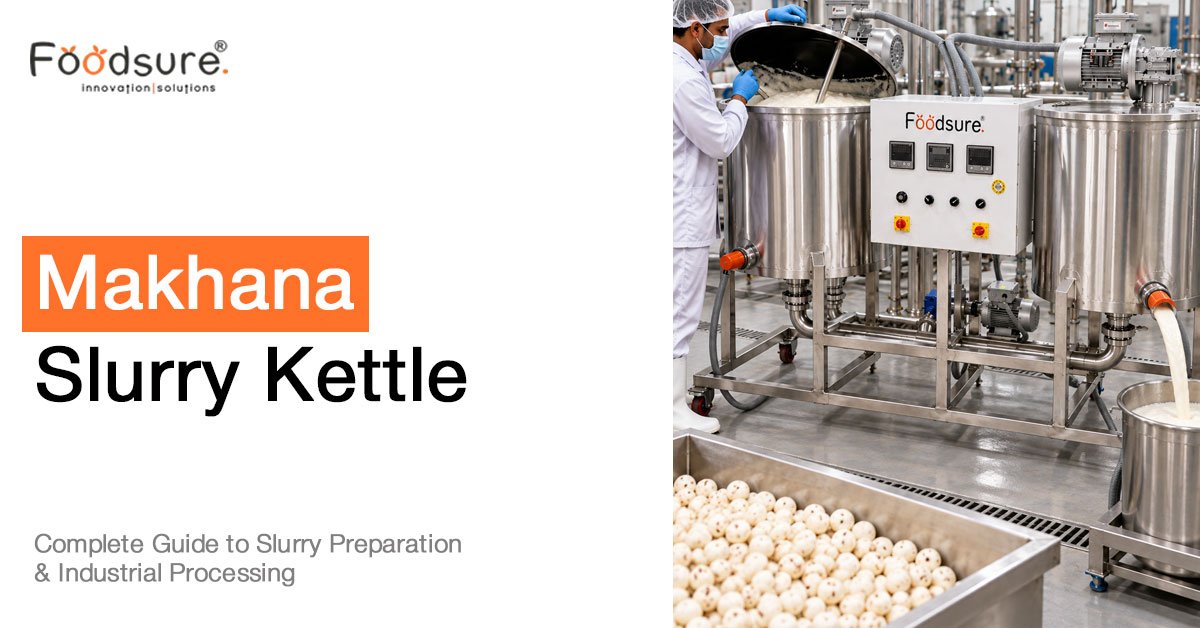
Makhana processing is no longer limited to roasting and seasoning. Contemporary food-processing companies are exploring other added-value makhana products that involve processing liquids, semi-liquids, or slurry.
The makhana slurry kettle serves the purpose of aiding the controlled preparation, heating, mixing, and holding of the slurry or the sauce-like material utilized during various processing stages for makhana. The kettle may be effective in maintaining consistency depending on the type of product or formulation.
The appropriate selection of a kettle for industrial manufacturers is influenced by a number of factors such as type of product, volume, heat input, mixing, materials used, and degree of automation.
What Is a Makhana Slurry Kettle?
A makhana slurry kettle is a food-processing vessel used for preparing and handling slurry-based mixtures associated with makhana production or value-added processing.
The typical structure of the kettle consists of two elements: the vessel and system of heating and mixing. The design depends on the features of the slurry and on the capacity of production.
The basic processing sequence may involve:
Ingredient Loading → Mixing → Heating, if Required → Controlled Agitation → Slurry Preparation → Transfer to Next Stage
It all depends on the end product that will be produced and whether the slurry will be used for coating, binding, seasoning, extruding, or any other process.
For companies that wish to produce makhana commercially, the kettle can be one of the components of the entire processing system and not just a single machine.
Why Is Slurry Preparation Important in Makhana Processing?
The preparation of a uniform slurry may be significant where the use of a liquid or semi-liquid slurry is involved in a further processing stage. Viscosity, temperature, composition, or mixing variations may impact the slurry’s performance in a further processing stage.
Equipment may help to achieve more precision than preparing large batches manually in open vessels.
A controlled system can help manufacturers achieve:
- Better mixing results
- Better temperature regulation
- Manual handling reduced
- Reproducible batches
- Easier transfer to following machinery
- Increased efficiency of manufacture
The exact requirements will depend on the type of slurry and the final makhana product being manufactured.
How Does Makhana Slurry Preparation Work?
The makhana slurry preparation process can vary according to the product and ingredients used. However, a commercial process generally follows several stages.
1. Ingredient Loading
The necessary components are placed in the kettle based on the need for production. The raw materials must be weighed and prepared prior to placing them in the process container.
The order of placement can depend on the nature of each individual component and the necessary process conditions.
2. Mixing
The agitator helps to ensure that all the components in the kettle are evenly mixed. Agitation becomes even more crucial when the various components have different densities or when powder needs to be mixed with the liquid medium.
3. Heating
Certain slurry preparations might need to undergo heating under controlled conditions. Here, the heating mechanism increases the temperature of the product based on the processing requirements.
The heating process needs to be properly controlled since high temperatures might alter the nature of the product.
4. Consistency Development
As the process of mixing and heating continues, the mixture becomes more homogeneous. The time taken for the process will depend on the recipe, batch size, ingredients used, and equipment used.
5. Transfer
Once the optimal processing condition is attained, the slurry can now be moved to the next step. This depends on the production process used, which could include coating, forming, extrusion, or any other processing system.
Key Features of a Slurry Kettle for Makhana Processing
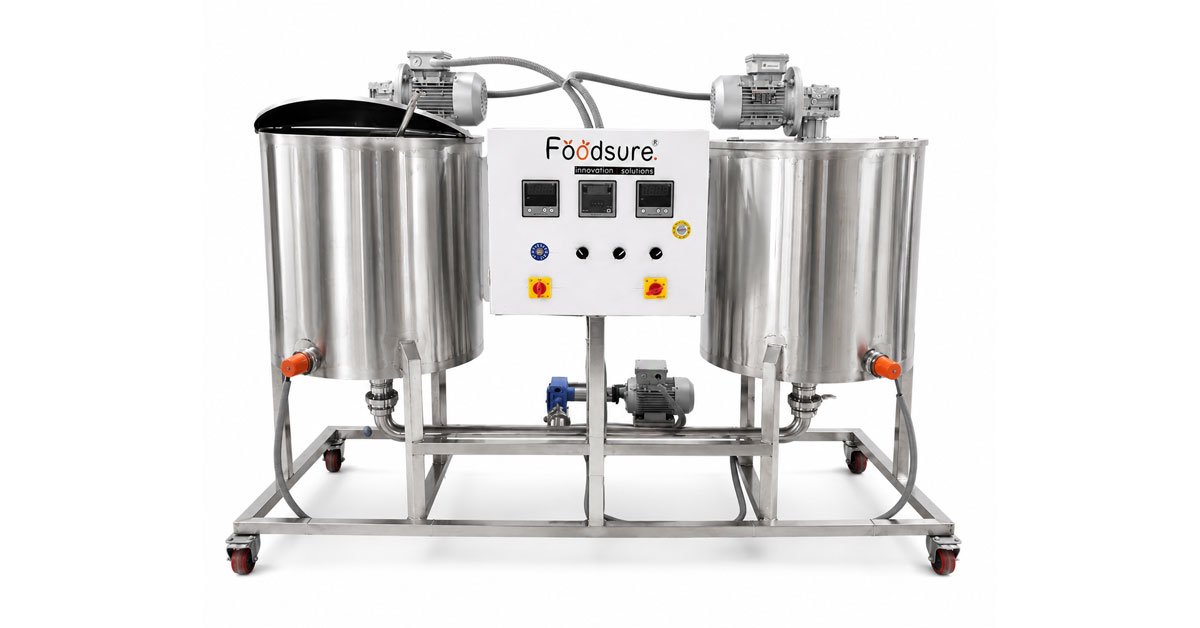
A slurry kettle for makhana processing should be selected according to the physical properties of the mixture and the requirements of the production line.
Heating System
An effective heater is necessary for temperature control in the processing operations. The selection of the type of heating system will depend on the product involved.
Agitation System
The agitator should be appropriate for the viscosity and characteristics of the slurry. Different products may require different mixing arrangements to achieve uniform results.
Temperature Control
Temperature monitoring and control can help maintain repeatable processing conditions. This is especially important for slurry preparations that require heating.
Food-Grade Construction
Suitable food-grade material must be used for the contact surfaces. For industrial equipment that processes food products, stainless steel construction is usually preferred since it facilitates hygiene and durability.
Easy Cleaning
Kettle design should be such that cleaning of the vessel and the product-contact parts is feasible. This is essential where different batches or products are treated in the same equipment.
Controlled Discharge
An appropriate discharge arrangement makes it easier to transfer the prepared slurry to the next stage without unnecessary manual handling.
What Is an Industrial Slurry Kettle?
An industrial slurry kettle is a larger-capacity processing vessel designed for commercial production environments where controlled mixing and, where required, heating are performed at a larger scale.
Industrial systems can be configured according to:
- Required batch size
- Slurry viscosity
- Need for heating
- Mixing behavior
- Contact materials
- Discharge system
- Degree of automation
- Available production area
Capacity needs to be selected based on actual batch needs and not the biggest available kettle.
Over-sizing the kettle could result in high investments and utility requirements while under-sizing would result in bottlenecks in production.
Makhana Slurry Kettle vs Conventional Mixing Vessel
| Factor | Conventional Mixing Vessel | Makhana Slurry Kettle |
| Mixing | Basic or manual | Designed for controlled agitation |
| Heating | May be limited | Can include integrated heating |
| Temperature monitoring | Often less controlled | Better process monitoring |
| Batch consistency | Depends on operation | More repeatable |
| Commercial production | Limited depending on design | Better suited to structured production |
| Cleaning | Depends on vessel design | Can be designed for food-processing hygiene |
It should depend on the type of product and the scale of production. A simple container might do for small quantities, but a special pot would be better for commercial production.
How to Choose the Right Makhana Slurry Kettle
Before purchasing equipment, manufacturers should evaluate several technical and operational factors.
Batch Capacity
Establish how much slurry is required per batch and how often the kettle needs to run. In this manner, you have a realistic approach for selecting vessel size.
Slurry Characteristics
Think of viscosity, solid content, particle size, thermal sensitivity, and mixing behavior. These attributes determine the kind of mixer needed.
Heating Requirement
Not all slurries need to be heated. If heating becomes necessary, the system must have temperature controls that do not create localized heating.
Material of Construction
Food-contact surfaces should be suitable for the product and processing environment. Stainless steel is commonly preferred for hygienic food-processing applications.
Automation
Companies have the flexibility to adopt manual, semi-automated, or fully automated controls based on their production scale. Automation could involve temperature control, mixing, timing, and other process parameters.
Cleaning and Maintenance
The kettle should allow operators to clean product-contact areas efficiently. Components requiring regular inspection or maintenance should also be accessible.
Role of the Slurry Kettle in a Commercial Makhana Processing Line
A slurry kettle may be integrated into a broader processing setup depending on the type of makhana product being manufactured.
A possible processing flow can be:
Raw Makhana Preparation
↓
Cleaning & Grading
↓
Roasting / Pre-Processing
↓
Slurry Preparation
↓
Coating / Binding / Forming
↓
Cooling
↓
Packaging
The actual configuration should be developed according to the final product and processing requirements.
In case of products requiring formation or extrusion, the prepared mixture may later proceed to the makhana extrusion machine, depending on the nature of the product.
Similarly, businesses setting up a complete production line may integrate the kettle with other equipment to reduce manual transfer and improve process flow.
Benefits of Using an Industrial Slurry Kettle
Using a dedicated kettle can provide several advantages for commercial food manufacturers.
Consistent Mixing
Controlled agitation can help distribute ingredients more uniformly throughout the batch.
Better Process Control
The parameters of temperature and mixing can be better regulated compared to the manual process.
Reduced Manual Handling
Mechanised mixing and controlled discharge can reduce the need for continuous manual intervention.
Improved Batch Repeatability
Standardised processing conditions make it easier to reproduce similar results across multiple batches.
Easier Production Scaling
A suitably sized kettle can support increased production volumes while maintaining a structured processing workflow.
Better Hygiene Management
Food-grade construction and an equipment design focused on cleaning can support hygienic production practices.
Maintenance and Hygiene Considerations
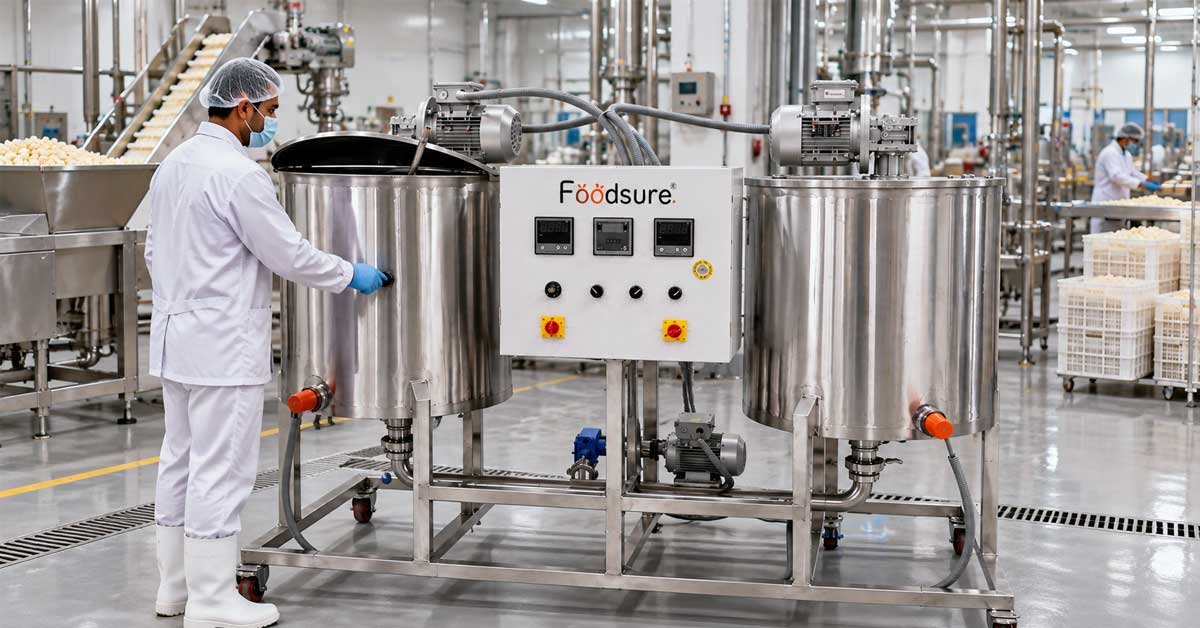
Proper maintenance and cleaning are crucial for slurry processing equipment. Residues of products can build up around the vessel, agitator, outlet, or any other surface in contact with the product if not cleaned properly.
Operators should follow the equipment manufacturer’s cleaning and maintenance recommendations.
Routine maintenance may include:
- Inspection of agitator parts
- Heating system check
- Inspection of valves and outlets
- Temperature probe check
- Cleaning of contact surfaces
- Inspection of electrical & control system parts
- Seal and connection check
- Lubrication of appropriate parts
Cleaning procedures should also be appropriate for the type of slurry being processed.
How Much Does a Makhana Slurry Kettle Cost?
The cost of a slurry kettle depends greatly on many factors, including the size of the vessel, the material used to construct the vessel, heating method, agitator type, automation, and other features.
Thus, it is not advisable for firms to evaluate machines based on the cost alone, but on the overall cost of ownership as well.
When evaluating makhana processing machine price, manufacturers should compare the complete machine configuration and production capability rather than using a single price figure as the deciding factor.
Who Should Invest in a Makhana Slurry Kettle?
A slurry kettle can be useful for businesses that require controlled preparation of slurry-based mixtures as part of their makhana processing operation.
It may be considered by:
- Commercial makers of makhana
- Makers of value-added snacks
- Food processing companies
- Companies producing coated or molded makhana products
- Companies setting up integrated processing lines
- Brands expanding into automated production
Companies producing low levels of goods might not need an industrial kettle at all. The determination will depend on the needs of production and the kind of product.
Conclusion
The makhana slurry kettle can be used to control mixing, heating, and batching operations when makhana processing on a commercial scale requires slurry mixtures. The use of the makhana slurry kettle can differ based on the purpose of the slurry (coating, binding, formation, extrusion, etc.).
The selection of equipment involves factors such as batch size, slurry properties, heating needs, agitator type, food-grade materials, automation, cleaning, and maintenance.
For manufacturers planning makhana slurry preparation at a commercial scale, a properly configured slurry kettle for makhana processing can improve process consistency and reduce manual handling. An appropriately designed industrial slurry kettle can also be integrated with other processing equipment to create a more organised production workflow.
Frequently Asked Questions
What is a makhana slurry kettle used for?
A makhana slurry kettle is used to blend and, as needed, heat slurry-type components within prescribed processing parameters, specifically for makhana formulations.
What factors should I consider when selecting a slurry kettle for makhana processing?
Think about batch sizes, slurry viscosity, agitator type, heat requirement, temperature regulation, food-grade manufacturing, automation, cleaning, and discharge systems.
Can a slurry kettle be used with other makhana-processing machines?
Yes. The kettle may be incorporated into equipment employed for coating, forming, extrusion, cooling, and other processes, depending on the product.
Is an industrial slurry kettle necessary for every makhana business?
No. This depends on the product itself, quantity of slurry, scale of production, and processing technique. Smaller companies may go for simple equipment, whereas large companies can get an industrial system.
Does the slurry kettle need regular maintenance?
Yes. It is essential that there is regular cleaning, maintenance, and inspection of the vessel, agitator, heating system, sensors, valves, and other components to ensure proper functioning.




